Bitcoin (BTC) has fallen to an all-time low compared to gold (XAU) in January. According to some analysts, this is creating a more attractive buying opportunity than the period just before the 2015–2017 growth cycle.
The shift from gold to Bitcoin may begin in February
Bitwise Europe data shows that on Saturday, the Bitcoin-to-gold value ratio dropped to its lowest level in history after adjusting for global money supply.
This indicator is used to identify when Bitcoin becomes “too strong” or “too weak” compared to gold. Currently, the indicator is approaching an extreme zone (the -2 mark on the chart), which in the past has often appeared around significant Bitcoin lows.
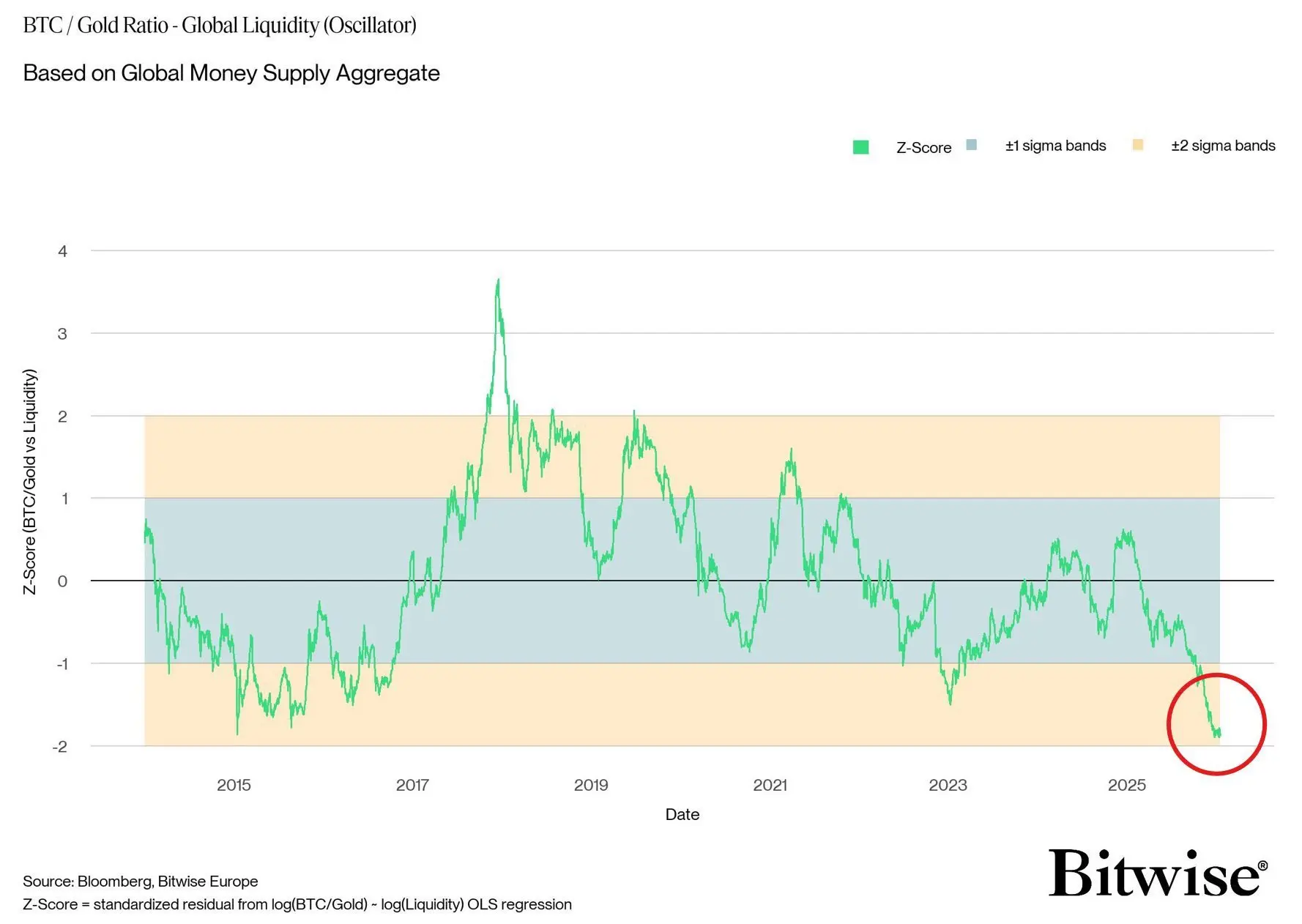 BTC/XAU Ratio | Source: Bitwise The last time this indicator reached a similar zone was in 2015, when BTC was significantly undervalued compared to gold. Subsequently, Bitcoin increased by about 11,800%, from around $165 to $20,000 in just two years. Analyst Michaël van de Poppe wrote on X.
“Currently, buying Bitcoin is a better opportunity than in 2017.”
This view aligns with many experts’ opinions that this year could see a partial shift of capital from gold to Bitcoin. André Dragosch, head of research at Bitwise Europe, and Pav Hundal, chief analyst at Swyftx, both mention this scenario; Hundal believes the rotation process could start in February or March.
Capital rotation “may not happen quickly”
An optimistic argument is made in the context of gold prices doubling in a year, while Bitcoin declined about 18% during the same period.
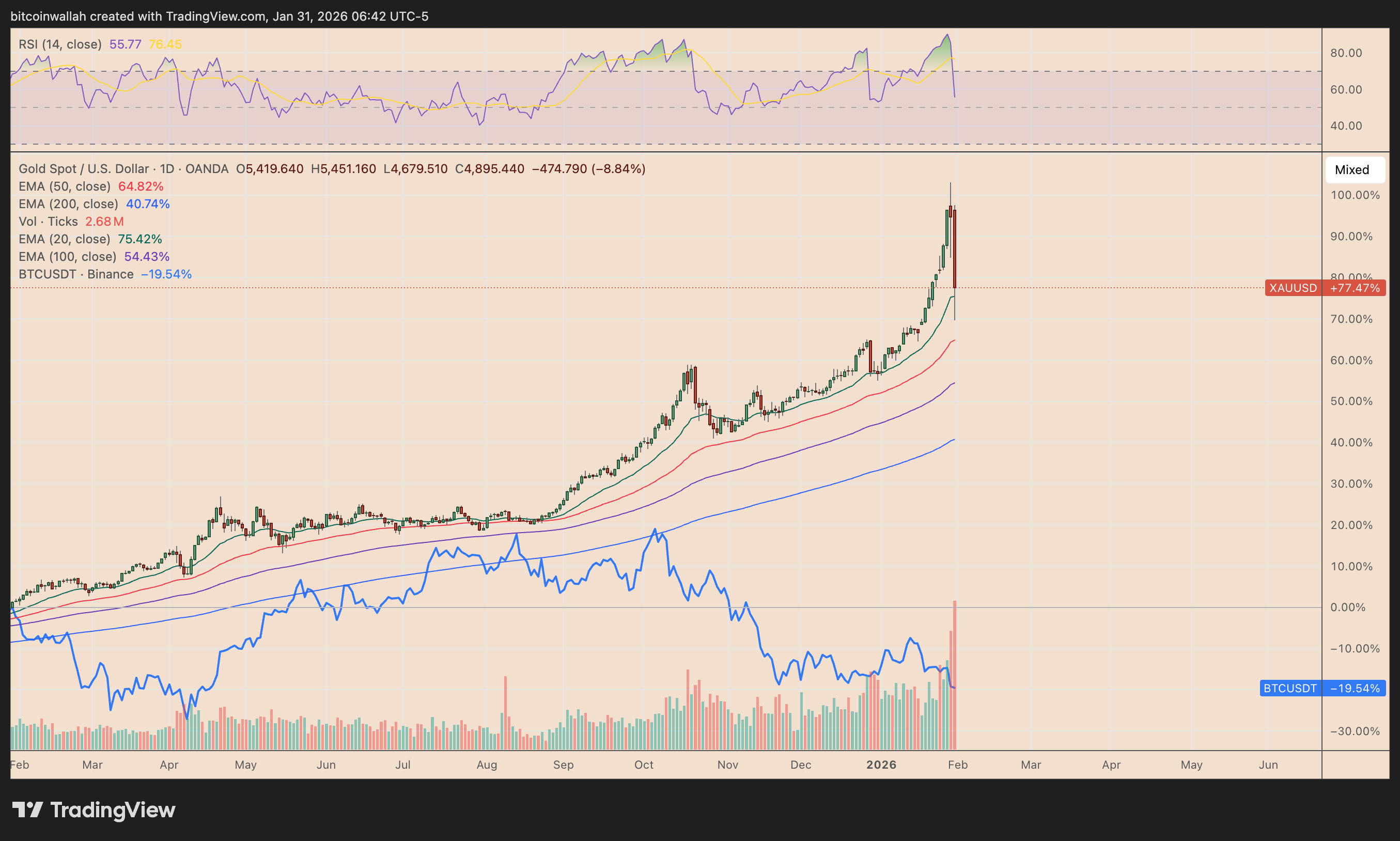 XAU/USD and BTC/USD Comparison | Source: TradingView However, not everyone believes that capital will soon leave precious metals for Bitcoin. Analyst Benjamin Cowen suggests that Bitcoin’s weakening trend could last longer than expected, and he also states that Bitcoin “is likely to continue to decline relatively compared to the stock market.” According to him, the expectation of a “large rotation wave” out of gold and silver may not be suitable in the short term.
Conversely, Citi predicts silver could continue to rise over the next few months due to demand from China and a weakening US dollar. RBC Capital Markets also forecasts gold could reach $7,000 by the end of 2026.
Cowen emphasizes that even if the precious metal maintains strength, capital flow into Bitcoin “may not” happen quickly.
Long-term Bitcoin holders have absorbed the January sell-off
Despite the sharp correction in January, on-chain data shows that long-term investors are gradually re-accumulating.
Specifically, the amount of BTC held by long-term holders (LTH)—entities holding Bitcoin for over 155 days—began to recover during the sell-off phase.
Additionally, the LTH Spent Binary index (reflecting whether LTHs are selling or holding) continues to decline, indicating that selling pressure from long-term investors is weakening.
According to analyst Anil, in previous cycles, the recovery of LTH supply along with a decrease in LTH Spent Binary has often been an early signal that the market is forming a sustainable bottom.
The most recent example is after the April 2025 bottom: LTH-held supply increased again beforehand, and about a month later, Bitcoin surged strongly, recovering about 60% from the bottom.
These signals collectively suggest that patient investors are taking advantage of the January dip to increase their positions—a form of “rebalancing” that often helps Bitcoin strengthen its base and set the stage for future growth.
Disclaimer: The information on this page may come from third parties and does not represent the views or opinions of Gate. The content displayed on this page is for reference only and does not constitute any financial, investment, or legal advice. Gate does not guarantee the accuracy or completeness of the information and shall not be liable for any losses arising from the use of this information. Virtual asset investments carry high risks and are subject to significant price volatility. You may lose all of your invested principal. Please fully understand the relevant risks and make prudent decisions based on your own financial situation and risk tolerance. For details, please refer to
Disclaimer.
Related Articles
US publicly traded company Hyperscale Data's Bitcoin holdings increase to over 610 coins, with a total market value of approximately $40 million
Hyperscale Data announced on March 7th that its Bitcoin holdings increased to 610.9188 coins, with a total market value of approximately $40 million. Subsidiary Sentinum holds 564.7252 Bitcoin, while another subsidiary ACG purchased 46.1935. The company's goal is to increase the value of its Bitcoin assets to $100 million.
GateNews5m ago
Construction Begins on Quantum Facility Capable of Breaking Bitcoin
The quantum computing race is edging closer to a commercially viable milestone, with PsiQuantum revealing progress toward a facility that could house a million qubits. The company, which has tied its plans to a collaboration with Nvidia, says the ambitious Chicago site will rely on advanced error-to
CryptoBreaking13m ago
XRP Holds $1.40 as Bitcoin Rally and ETF Inflows Lift Crypto Market
Key Insights
XRP maintained support above $1.40 as the broader market rebounded, while strong inflows into Bitcoin ETFs helped restore trading confidence.
Bitcoin surged beyond $74,000 alongside gains in major altcoins, lifting total crypto market value close to $2.45 trillion in one
CryptoFrontNews42m ago
Bitcoin mining company Cathedra Bitcoin and Sphere 3D reach a merger agreement, with combined operational capacity reaching 53 MW
Cathedra Bitcoin and Sphere 3D have reached a full stock transaction merger agreement. The new company after the merger will retain the Sphere 3D name and operate data centers in multiple states, with plans to expand operational capabilities and develop AI and high-performance computing services.
GateNews43m ago
New Yorkers can pay their mortgage with Bitcoin
New York City residents can now pay their mortgages using Bitcoin through the Strike platform, which has obtained the necessary licenses. This system streamlines transactions, lowers fees, and reduces the risks associated with price volatility, representing a major step forward in the integration of cryptocurrency into the real estate industry.
TapChiBitcoin1h ago
Price Predictions 3/6: BTC,ETH,BNB,XRP,SOL,DOGE,ADA,BCH,HYPE,XMR
Bitcoin (CRYPTO: BTC) faced a renewed test after a brief relief rally, sliding back below the $68,500 mark as sellers reasserted control. The move comes after the asset briefly flirted with the $74,000 threshold, a level that previously functioned as a ceiling during the latest ascent. Traders now e
CryptoBreaking1h ago


