Original Title: The Crypto Market was Much Healthier 5 Years Ago
Original Author: Jeff Dorman (Arca CIO)
Original Compilation: DeepSea TechFlow
Introduction:
Is the crypto market becoming increasingly dull? Arca Chief Investment Officer Jeff Dorman points out that despite infrastructure and regulatory environments being stronger than ever, the current investment climate is “the worst in history.”
He sharply criticizes industry leaders’ failed attempts to force cryptocurrencies into “macro trading tools,” leading to extreme asset correlation. Dorman calls for a return to the essence of “tokens as securities wrappers,” focusing on cash-flow-generating quasi-equity assets like DePIN, DeFi, and others.
In a time when gold is soaring while Bitcoin remains relatively weak, this in-depth reflection offers an important perspective for re-examining Web3 investment logic.
Full Text:
Bitcoin is Facing an Unfortunate Situation
Most investment debates exist because people operate on different time horizons, which often results in “talking past each other,” even though technically both sides are correct. Take the debate between gold and Bitcoin: Bitcoin enthusiasts tend to say Bitcoin is the best investment because its performance over the past 10 years far exceeds that of gold.
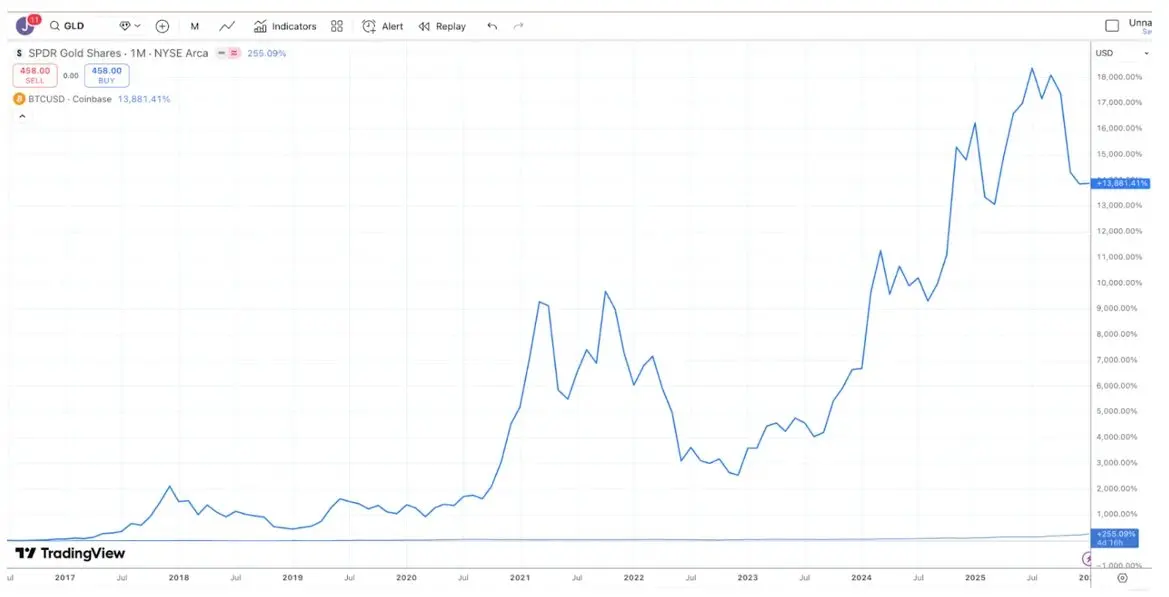
Caption: Source TradingView, comparison of returns over the past 10 years for Bitcoin (BTC) and gold (GLD)
Gold investors, on the other hand, tend to believe gold is the best investment and have recently been mockingly comparing Bitcoin’s downturn, as gold’s performance over the past year has clearly outperformed Bitcoin (similar cases with silver and copper).
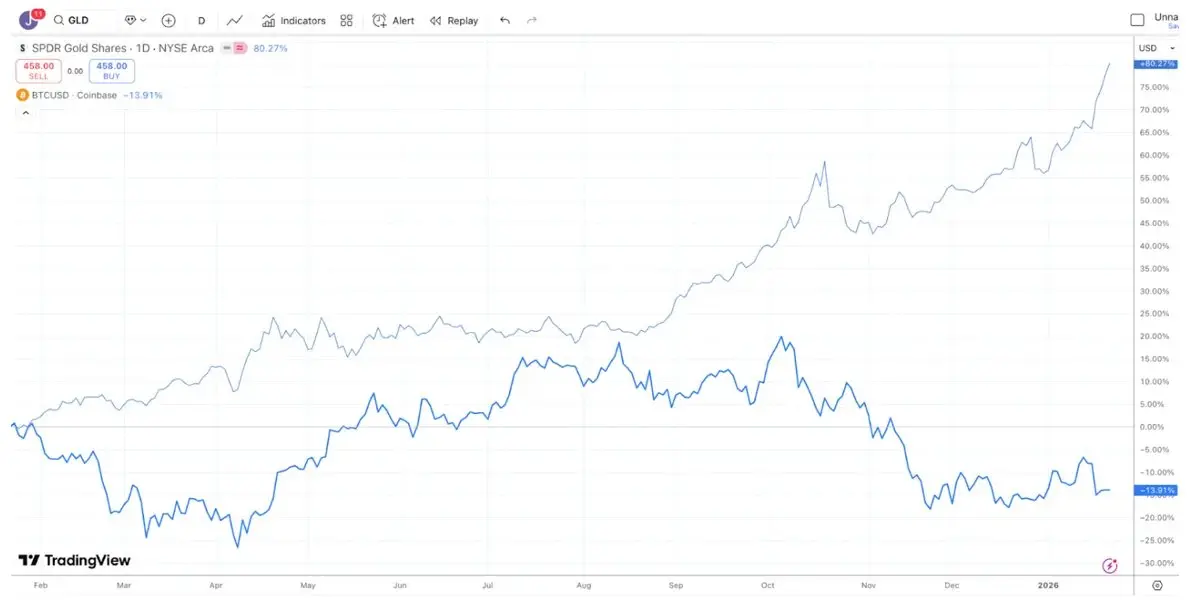
Caption: Source TradingView, comparison of returns over the past 1 year for Bitcoin (BTC) and gold (GLD)
Meanwhile, over the past 5 years, gold and Bitcoin’s returns are nearly identical. Gold often remains stagnant for long periods, then skyrockets when central banks and trend followers buy in; Bitcoin tends to have sharp rises followed by major crashes, but ultimately still trends upward.
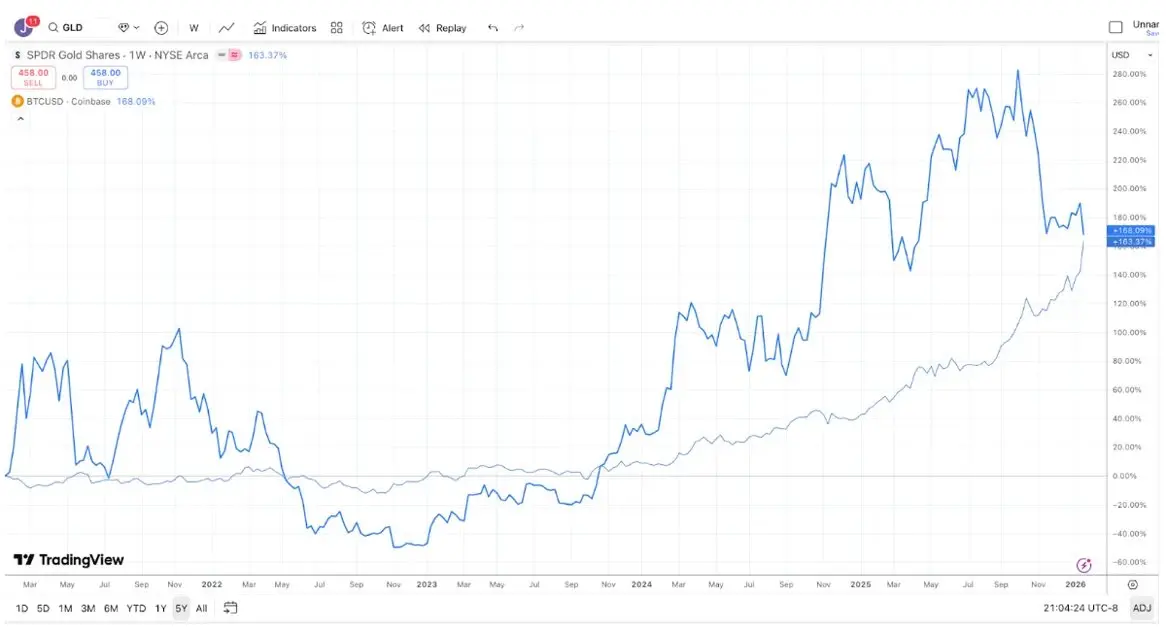
Caption: Source TradingView, comparison of returns over the past 5 years for Bitcoin (BTC) and gold (GLD)
Therefore, depending on your investment horizon, you can almost win or lose any debate about Bitcoin versus gold.
That said, it’s undeniable that recently gold (and silver) have outperformed Bitcoin. To some extent, this is a bit comical (or sad). The biggest companies in the crypto industry have spent the past 10 years catering to macro investors rather than fundamental investors, only to have these macro investors say: “Forget it, we’ll just buy gold, silver, and copper.” We have long been calling for a shift in industry mindset. Currently, there are over $600 trillion in entrusted assets, and the buyers of these assets are much more sticky investors. Many digital assets look more like bonds and stocks, issued by income-generating companies that buy back tokens, yet market leaders for some reason ignore this token sub-sector.
Perhaps Bitcoin’s recent poor performance relative to precious metals is enough to make large brokers, exchanges, asset managers, and other crypto leaders realize that their attempt to turn cryptocurrencies into all-encompassing macro trading tools has failed. Instead, they might focus on and educate the investors managing the $600 trillion who prefer to buy income-producing assets. For the industry, it’s not too late to start focusing on quasi-equity tokens that carry cash flows from tech businesses like DePIN, CeFi, DeFi, and token issuance platforms.
But on the other hand, if you just change the “finish line,” Bitcoin remains king. So, it’s more likely that nothing will change at all.
Asset Differentiation
The “good days” of crypto investing seem to be a thing of the past. Returning to 2020 and 2021, it seemed every month brought new narratives, sectors, use cases, and new tokens, with positive returns across all corners of the market. Although the growth engine of blockchain has never been stronger (thanks to legislative progress in Washington, the growth of stablecoins, DeFi, and RWA tokenization of real-world assets), the investment environment has never been worse.
A sign of market health is dispersion and lower cross-market correlation. You’d want healthcare and defense stocks to behave differently from tech and AI stocks; you’d also want emerging market equities to move independently of developed markets. Dispersion is generally seen as a good thing.
2020 and 2021 are largely remembered as a “broad rally,” but that’s not entirely accurate. It was rare to see the entire market move in unison. More often, one sector would rise while another fell. When gaming sectors surged, DeFi might decline; when DeFi surged, “dinosaur-level” Layer-1 (Dino-L1) tokens might fall; when Layer-1 sectors soared, Web3 sectors might decline. A diversified crypto portfolio actually smooths out returns and often reduces overall portfolio beta and correlation. Liquidity ebbs and flows with interest and demand, but performance is polymorphic. This is very encouraging. The influx of capital into crypto hedge funds in 2020 and 2021 made sense because the investable universe was expanding and returns were diverse.
Fast forward to today, all “crypto-wrapped” assets’ returns look identical. Since the flash crash on October 10, the declines across sectors are nearly indistinguishable. Whatever you hold, or how that token captures economic value, or the project’s development trajectory… returns are generally the same. This is very frustrating.
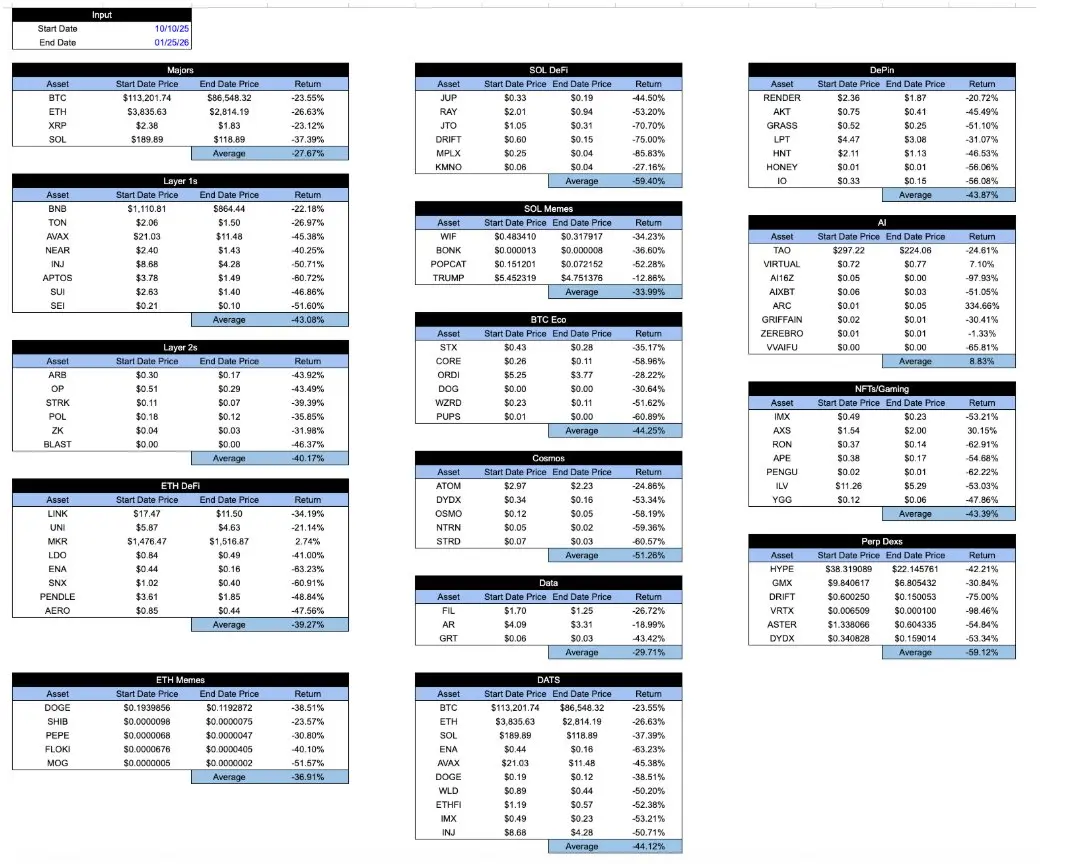
Caption: Internal calculations at Arca and representative crypto asset sample data from CoinGecko API
During market booms, this chart looks a bit more encouraging. “Good” tokens tend to outperform “bad” tokens. But a healthy system should be the opposite: you want good tokens to perform better even in bad times, not just during bull markets. Here is the same chart from the April 7 low to the September 15 high.
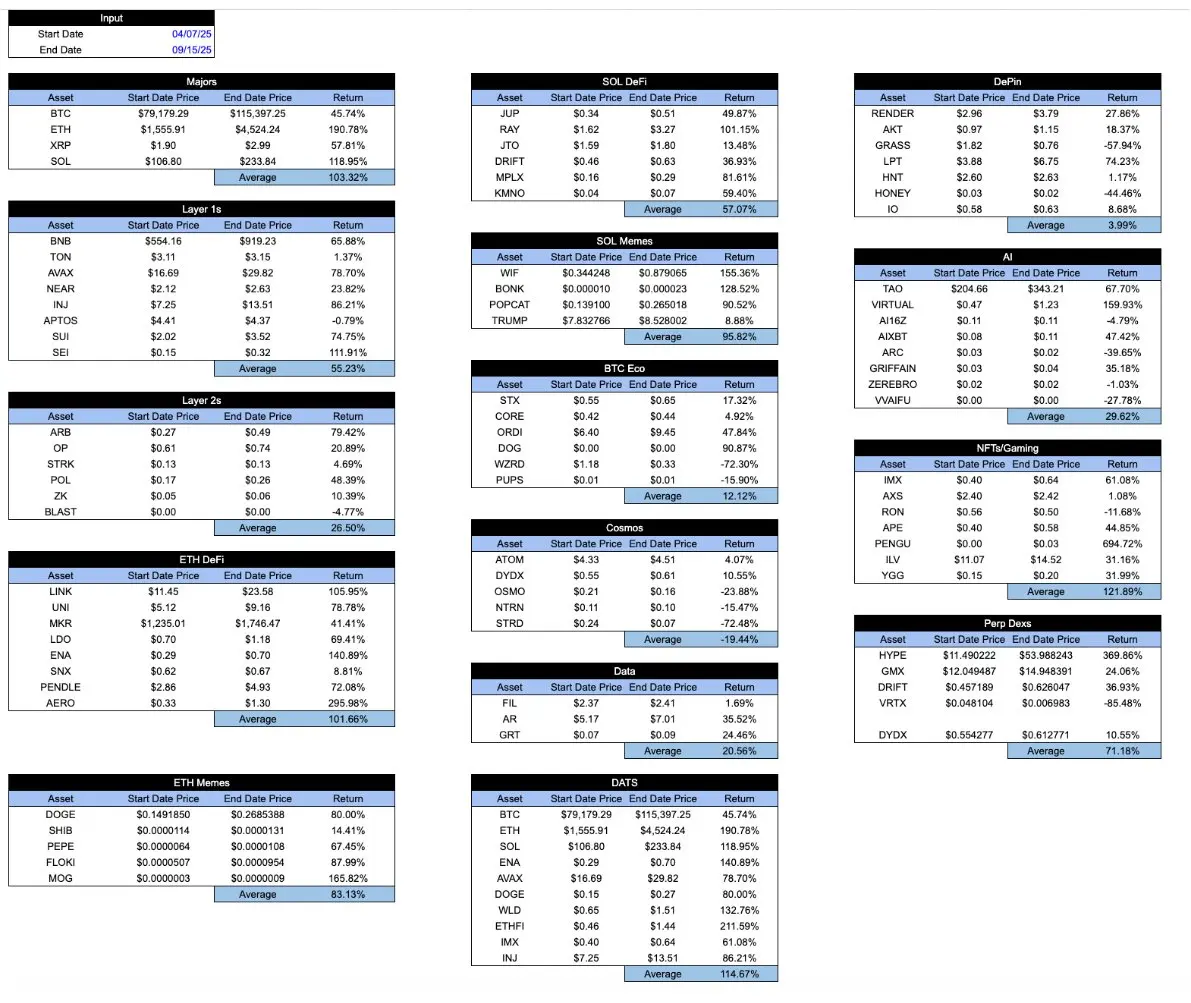
Caption: Internal calculations at Arca and representative crypto asset sample data from CoinGecko API
Interestingly, when the crypto industry was in its infancy, market participants worked hard to differentiate various types of crypto assets. For example, I published an article in 2018 classifying crypto assets into four categories:
- Cryptocurrencies/money
- Decentralized protocols/platforms
- Asset-backed tokens
- Pass-through securities
At that time, this classification was quite unique and attracted many investors. Importantly, crypto assets are evolving—from just Bitcoin, to smart contract protocols, asset-backed stablecoins, and then to quasi-equity pass-through securities. Studying different growth sectors was once a primary source of alpha, as investors sought to understand valuation techniques for different asset types. Back then, most crypto investors didn’t even know when unemployment benefit data was released or when the FOMC meetings occurred, and rarely looked for signals from macro data.
After the 2022 crash, these different asset types still exist. Essentially, nothing has changed. But the marketing of the industry has shifted dramatically. The “gatekeepers” now insist that Bitcoin and stablecoins are the only important assets; the media claims they don’t want to write about anything other than TRUMP tokens and other memecoins. Over the past few years, not only has Bitcoin outperformed most other crypto assets, but many investors have even forgotten the existence of these other asset types (and sectors). The business models of underlying companies and protocols haven’t become more relevant, but due to investor flight and market makers dominating price movements, the assets themselves have become more correlated.
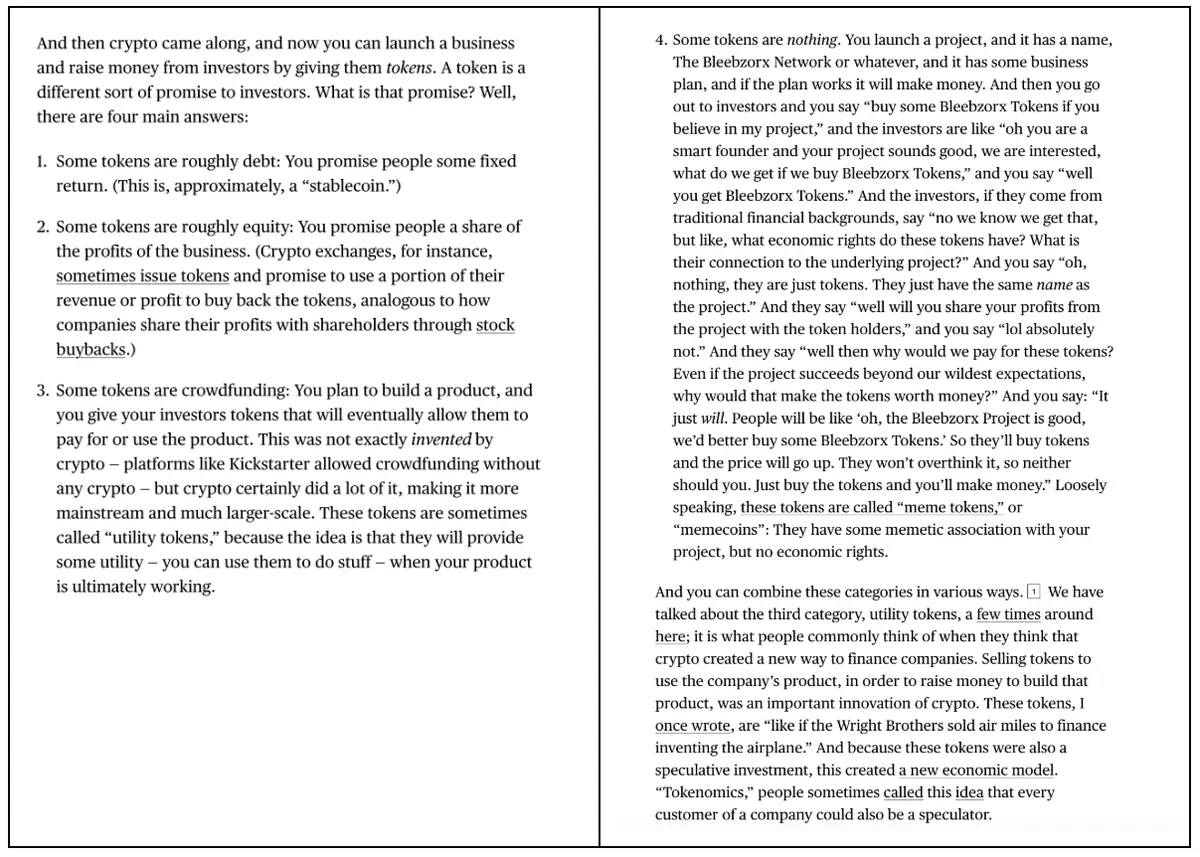
That’s why Matt Levine’s recent article on tokens was so surprising and popular. In just four short paragraphs, Levine accurately described the differences and nuances among various tokens. It gave me hope that such analysis is still feasible.
Leading crypto exchanges, asset managers, market makers, OTC platforms, and pricing services still refer to everything other than Bitcoin as “altcoins,” and seem to only produce macro research reports, bundling all “cryptocurrencies” into one large asset class. For example, Coinbase appears to have only a small research team led by a main analyst (David Duong), whose focus is mainly on macro research. I have no criticism of Mr. Duong—his analysis is excellent. But who would go to Coinbase just to read macro analysis?
Imagine if top ETF providers and exchanges only casually wrote articles about ETFs, saying things like “ETF down today!” or “ETF reacts negatively to inflation data.” They would be laughed out of business. Not all ETFs are the same; just because they use the same “wrapper,” the people selling and promoting ETFs understand this. What’s inside the ETF is most important, and investors seem capable of distinguishing different ETFs wisely, mainly because industry leaders help their clients understand these differences.
Similarly, tokens are just a form of “wrapper.” As Matt Levine eloquently describes, what’s inside the token matters. The type of token, the sector, its attributes (inflation or amortization) are all important.
Perhaps Levine isn’t the only one who understands this. But he does a better job than those who profit directly from it at explaining the industry.
Click to learn about ChainCatcher job openings
Recommended reads:
Has MSTR entered the buy zone after the premium reset?
Delphi Digital: What is the future direction of cryptocurrencies?
Pantera Capital Partner: The current state and future of the internet capital market
How RedotPay, valued at $2 billion in three years, is playing the game?
a16z in-depth article: How to properly understand the threat of quantum computing to blockchain


