


Japan's IHI is developing "Seawater Gold Refining Technology" — is this a real technological breakthrough or just a myth?
Gold prices repeatedly hit new highs, and Japan’s IHI Heavy Industries is developing a “seawater alchemy” project, aiming to challenge the fundamental logic of gold scarcity.
(Background: Tether is a major gold buyer! In Q4 2025, it will increase its gold holdings by 27 tons, ranking among the top 30 global gold holders)
(Additional context: Why are gold prices hitting new highs while Bitcoin remains stagnant? Delphi Digital: It’s all due to the surge in Japanese bond yields putting pressure on the global market)
Table of Contents
- Valuation reconstruction from the ground to the seabed?
- From ocean to hot spring: a smart business compromise
- Do investors need to care?
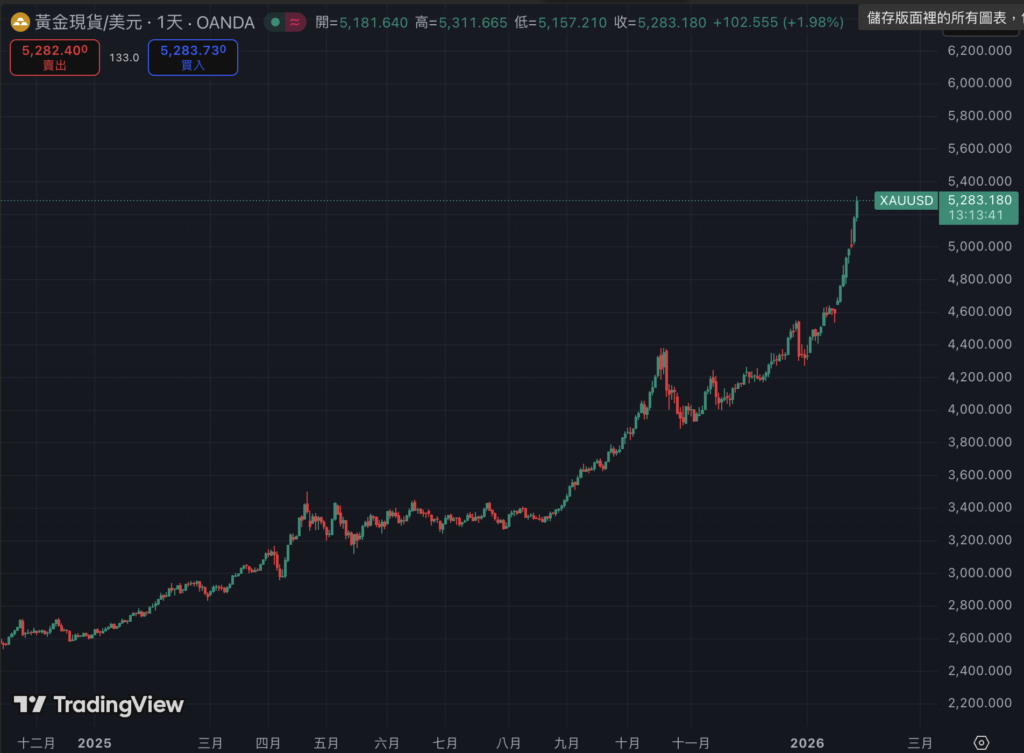
The risk aversion driven by geopolitical tensions, declining confidence in the US dollar, and strong investor demand have made gold quite bullish recently. Earlier today (28), gold even broke through $5,300 to hit a new all-time high. Against this backdrop, Fukushima Yasuyuki, a researcher at IHI Heavy Industries in Japan, proposed an innovative idea: challenging the extraction of gold from seawater!
Valuation reconstruction from the ground to the seabed?
We know that mining gold is difficult, and the reserves in the Earth’s crust are scarce. Scientific consensus estimates that the extractable reserves are only about 50,000 tons, and humanity has mined roughly 230,000 tons over thousands of years. This physical scarcity is one of the reasons why gold prices can continue to soar.
But IHI is challenging this logic. Fukushima Yasuyuki’s team has developed a technique called “Bio-sorption.” Simply put, it uses the chemical properties of specific algae to capture gold chloride ions from seawater and then reduce them to metallic gold. This method is much cleaner than traditional chemical displacement, which involves toxic cyanide.
However, there’s a huge “but”: the physical reality is harsh. Data shows that the concentration of gold in seawater is extremely low—about 0.03 parts per trillion (ppt). What does this mean?
Imagine trying to filter out a single grain of salt from an entire Olympic-sized swimming pool. Even if gold prices surge to $5,300, you’d need to process tens of millions of tons of seawater to obtain just a few grams of gold. The energy and equipment costs could bankrupt you.
From ocean to hot spring: a smart business compromise
The good news is that IHI isn’t crazy. They understand this, so they don’t plan to start draining the Pacific Ocean tomorrow. Their strategy focuses on “concentration,” targeting hot spring water and deep underground mine wastewater within Japan.
The gold concentration in these sources is several orders of magnitude higher than in seawater, and these are environments that already require treatment. Turning “mining” into “waste resource utilization” is where this technology becomes truly commercially attractive.
It’s a bit like the shale oil revolution—once the technology works at low costs, the marginal costs in the future will slide down like a slide.
Do investors need to care?
Should you worry about gold prices crashing?
In fact, seawater alchemy isn’t a new idea. About 100 years ago, Nobel laureate and German chemist Fritz Haber attempted it to help post-war Germany raise funds for reparations, but ultimately abandoned it due to high costs. Currently, no existing technology can make “seawater alchemy” economically competitive with traditional mining in terms of return on investment.
But this experiment reminds us: in this era of exponential technological breakthroughs, no asset’s moat is absolutely insurmountable—even gold or Bitcoin.

Related Articles
Dialogue with Tether USAT CEO: Experiencing the acceleration of U.S. crypto policies, user experience is the biggest difference in the clear legislation.
Tether-Backed USA₮ Shows Full Reserves in First Report By Anchorage Digital Bank N.A.
The US authorities seize over $61 million USD in USDT related to "pig slaughter" scams
Best Crypto Presale 2026: DOJ Seizes $61 Million in Tether Scam as Pepeto Presale Outpaces Mutuum Finance and Bitcoin Hyper
Tether Freezes $4.2 Billion in USDt Over Three Years as Global Crypto Crackdown Intensifies