


Kite Mainnet supports x402 protocol! Six pillars build AI agent pay-per-use
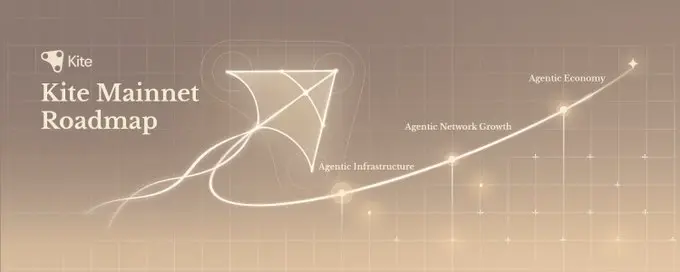
As AI agents evolve from “answering questions” to “executing trades,” traditional payment methods become the biggest bottleneck. The Kite mainnet builds an autonomous economic infrastructure through six pillars, with the core innovation being support for the x402 protocol from the largest compliant crypto exchange in the US, integrating payments into HTTP requests for pay-per-use. The mainnet will be launched in phases, from identity governance to payment settlement and ecosystem expansion.
x402 Protocol Ends Human Decision-Making Bottleneck
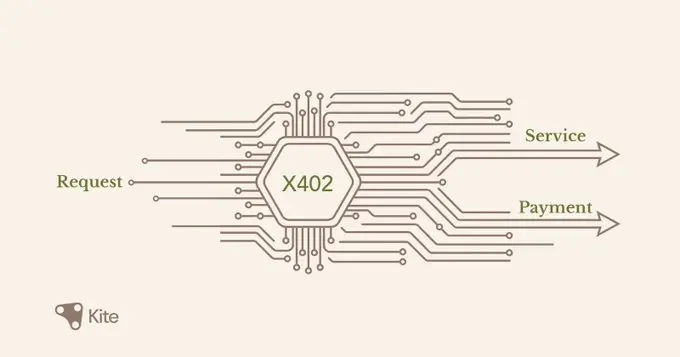
Traditional credit card processes rely on “human-machine collaborative decision-making,” requiring human input of card numbers, verification codes, and confirmation clicks for each payment. In contrast, AI agents need machine-readable, usage-based billing interfaces capable of authorization and settlement within milliseconds. The x402 protocol, launched by the largest compliant crypto exchange in the US, is designed for this purpose. It natively integrates payment functions into HTTP requests, fundamentally changing the billing model of API economies.
The operation logic of x402 is simple and efficient: when an AI agent calls an API that requires payment, the server does not reject the request or redirect to a payment page but instead returns a payment request. The agent’s wallet automatically completes the payment, generating a Payment Proof, which is then used to retry the same API call. After verifying the payment, the server immediately returns the data. The entire process requires no human intervention, and each step is recorded on-chain for auditability.
Kite has publicly announced its native compatibility with the x402 protocol, providing standardized payment intent and settlement support as an execution and settlement layer for agents. This compatibility allows any service supporting x402 (such as data APIs, AI inference, cloud computing resources) to seamlessly integrate into the Kite ecosystem, and AI agents on Kite can invoke all external services supporting x402. This open standard adoption is a key advantage that differentiates Kite from closed ecosystems.
For developers, integrating x402 means they can implement “pay-per-use” with just a few lines of code, without building complex subscription systems, account management, or payment gateways. For AI agents, this enables them to pay for services as naturally as humans use credit cards—yet at thousands of times faster speed and hundreds of times lower cost. This paradigm shift clears the biggest hurdle for the explosive growth of the “agent economy.”
Three-Layer Technology Stack: From Identity to Settlement to Ecosystem
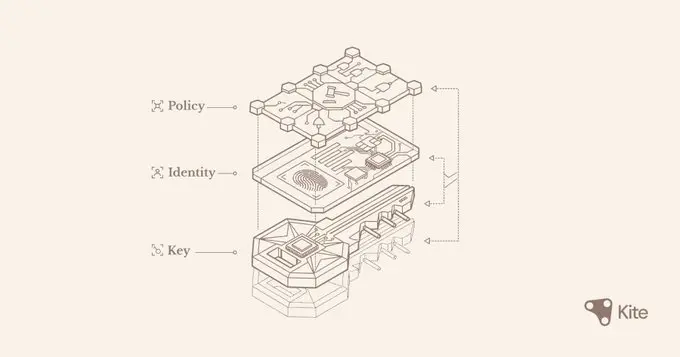
Kite’s six pillars can be summarized into a clear three-layer technology stack. The foundational layer is the trust and governance layer, solving “who is acting” and “where are the action boundaries.” KitePass provides verifiable agent identities, giving each agent a unique on-chain identifier that persists across services and environments. An identity-based policy framework then translates governance rules into executable code, defining permissions, budgets, and risk constraints.
Three Main Capabilities of the KitePass Identity System
Cross-Environment Persistence: Agent identities remain consistent across different dApps, services, and chains, building a cumulative reputation and credit history.
Programmable Permission Management: Permissions are defined via smart contracts, specifying what actions an agent can perform, e.g., “can only call specific contracts,” “daily spending limit of $1,000.”
Audit Trail Integrity: All agent actions are recorded on-chain, allowing regulators or auditors to trace the full authorization chain of any transaction.
The middle layer is the payment and settlement layer, handling high-frequency micro-payments billing and reconciliation. Kite’s stablecoin settlement capability is already operational, enabling near-zero gas fee settlements. The Facilitator component allows resource providers to define pricing rules, while payers can complete payments and obtain auditable proofs. An end-to-end closed loop establishes asset migration and ingress/egress channels, enabling real users to enter and exit the system through low-friction pathways.
The top layer is the ecosystem growth layer, ensuring sustainable expansion. SmartDev infrastructure offers zero-cost RPC services, complete node files, and block explorers, lowering integration barriers for developers. The agent network operates via staking contracts, validator dashboards, and VaaS (Validator as a Service) to achieve decentralization. AgenticFi channels include DEX and LSD protocols, providing liquidity and composability for $KITE tokens. The ecosystem growth engine drives continuous expansion through hackathons, incubation programs, and incentive frameworks.
These three layers form a coherent stack: enabling trusted agent identities, transparently resolving each interaction, and building repeatable infrastructure to drive ecosystem adoption. Kite is not just a “blockchain + AI” narrative wrapper but a dedicated protocol stack designed for the specific needs of the agent economy.
Mainnet Launch Timeline and Phase Goals
The mainnet will be rolled out in phases, with the six pillars gradually advancing over the next one to two years. The first phase focuses on building the native intelligent agent infrastructure, delivering results including the launch of KitePass identity system, deployment of x402 settlement coordinator, launch of zero-cost RPC gateway, and completion of core development documentation. The goal is to demonstrate technical feasibility and attract early developers and partners for proof of concept.
The second phase shifts toward developing the intelligent agent ecosystem and network, including onboarding external validators, auditing and launching staking contracts, launching DEX liquidity, enabling cross-chain bridges, and deploying the first native agent dApps. This phase aims to establish network effects, where the value of the ecosystem will grow exponentially as more agents, services, and users join.
The third phase focuses on cultivating a vibrant autonomous economy, including full activation of incentive frameworks, maturity of LSD protocols, ongoing hackathons and incubation programs, and deep integration with mainstream AI frameworks like LangChain and AutoGPT. The goal is to achieve a self-sustaining economic cycle, where agents earn income by providing services and use that income to purchase other services, forming a closed-loop economy.
Each phase will deliver tangible results and measurable progress, enabling the mainnet to expand steadily. The Kite team emphasizes that a phased approach balances innovation speed with system stability, avoiding early launch risks or delays that could lead to missed market opportunities.