


$SKR Airdrop Cut Short: Can Solana Mobile Escape the Fate of "Airdrop as the Peak"? Ecosystem Future Projection
Solana Mobile native token SKR opens airdrop today, but the price performance is not very impressive. This article analyzes the token economics of the Seeker phone, potential airdrop projects, future applications, and explores whether the Web3 mobile ecosystem can remain active after the rewards end.
(Background: SKR airdrop opened with a sharp drop! Pre-market price down 46%, community optimism completely dashed)
(Additional background: Attention Solana phone users! The native token SKR will be issued in January 2026: 30% total supply airdropped)
Table of Contents
- Pre-market price halved, confidence shaken
- Season 1 ecosystem data impressive, but price not convinced
- Future speculation of Solana mobile ecosystem
- Will ecosystem activity disappear after rewards end?
- Neutral view: possibly heading towards “niche but stable”
- Future utility guesses for SKR token
- dApp listing approval fees
- Phone feature unlocking / advanced services
- Payment medium within ecosystem
- Hardware upgrade discounts
- Guardian mechanism: giving tokens real utility
- Analysis of SKR token economic model
- Potential projects worth watching that haven’t airdropped yet
- Developer ecosystem remains key
- Summary
The native token SKR for Solana Mobile was officially open for airdrop claim today (21) at 10:00 AM (UTC+8). This was a long-anticipated moment for Seeker phone users, but the market’s price performance after opening disappointed many. It also prompted a re-evaluation: is the Web3 mobile ecosystem still worth attention?
Pre-market price halved, confidence shaken
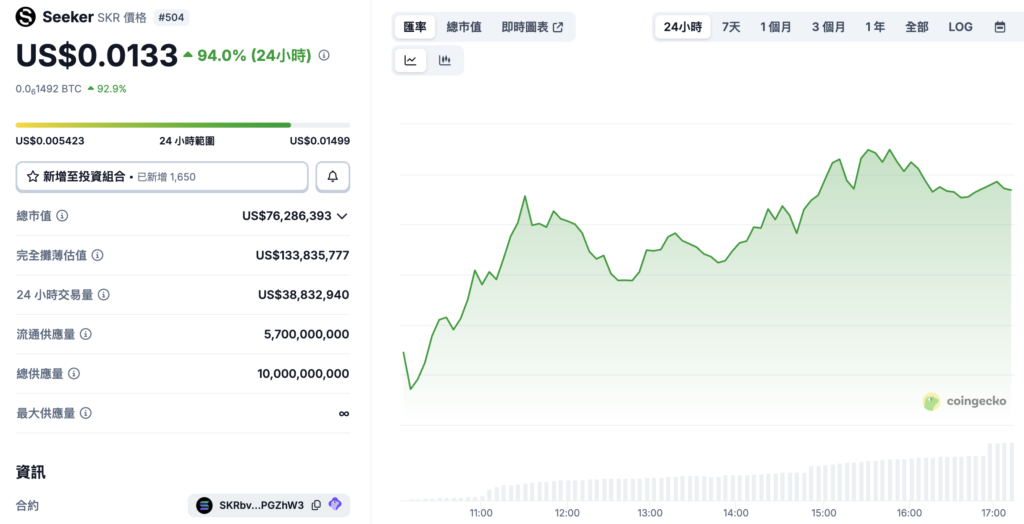
Initially, pre-market trading data showed SKR was around $0.02. However, after the official listing today (21), the price once dipped to $0.0088.
This price performance starkly contrasts with the community’s previous expectations. Before the airdrop opened, the market was generally optimistic about SKR, with most opinions expecting the token to be in the $0.02 to $0.04 range.
Season 1 ecosystem data impressive, but price not convinced
In fact, from a data perspective, Solana Mobile’s Season 1 performance was quite good:
| Metric | Data |
|---|---|
| Number of participating users | Over 100,000 |
| Total transaction count | 9 million |
| Number of participating dApps | Over 265 |
| Total transaction volume | $2.6 billion |
These figures show that the Seeker ecosystem does have a certain level of activity. However, impressive ecosystem data has not supported SKR’s pre-market price. The market needs to see sustained high activity after the rewards, which is the true test of competitiveness.
Future speculation of Solana mobile ecosystem
So far, the official claims that the second-generation Seeker phone has shipped over 150,000 units, with 265 dApps and $2.6 billion in transaction volume, proving real user engagement. But whether the Web3 phone can break free from the “use for airdrop” dilemma remains an unknown to watch.
Will ecosystem activity disappear after rewards end?
This is the existential question all “token incentive-driven” projects face. Looking at Season 1 data, 9 million transactions are not bad, but we must honestly ask: How many of these activities are driven by “genuine demand,” and how many are just “farming for airdrops”?
Optimistic scenario: positive flywheel formation
If Solana Mobile can successfully establish a positive flywheel, the scenario might be:
Airdrops attract users → Users use dApps → Developers see traffic → More quality applications emerge → User retention increases → Ecosystem sustains itself
During Season 1, 265 dApps participated, indicating genuine developer interest. If 10-20 of these apps truly solve user pain points (e.g., more secure wallets, easier DeFi operations, unique mobile games), then even after the airdrop ends, users will have reasons to continue using.
Pessimistic scenario: death spiral after rewards
But past experience shows that most “incentive-driven” ecosystems tend to follow this fate:
Airdrop ends → Farming users leave → Transaction volume plummets → Developers lose confidence and exit → Ecosystem shrinks
Looking back, the first-generation Saga phone initially struggled with sales, then exploded due to the BONK airdrop, but after the profit opportunity disappeared, the hype quickly faded. The official even stated they would no longer support that model.
Further reading: Solana Mobile stops supporting Web3 phone Saga! Fully shifting to second-gen Seeker, what should old users do?
Going further back: the once-popular Move-to-Earn app STEPN saw over 95% active user decline after token rewards were significantly reduced. At its peak, Axie Infinity had over 2 million daily active users, but activity shrank sharply after rewards decreased.
Can Seeker break this curse? That will be a key point to observe in the future.
Neutral view: possibly heading towards “niche but stable”
The possible outcome might be somewhere in between: Seeker may not become a mass-market product but could form a small, loyal Web3 native user base. These users are deep participants in the Solana ecosystem, using Seeker for hardware-level private key protection via Seed Vault and enjoying a smoother experience with native integrated dApp Store.
If Solana Mobile can serve this core group well, a device base of 150,000 units might sustain a healthy niche ecosystem.
Future utility guesses for SKR token
On the other hand, the official currently emphasizes SKR’s roles in “guardian staking” and “governance voting,” but from token economics and industry trends, there may be further extensions in the future:
dApp listing approval fees
Guardians responsible for reviewing dApp listings—this mechanism could evolve into:
- Developers pay SKR as listing application fee
- Fees are distributed to guardians after approval
- Creating a decentralized “app store cut” model
Phone feature unlocking / advanced services
Referring to traditional subscription models, SKR might be used for:
- Unlocking advanced security features (e.g., multi-signature, social recovery)
- Priority access to new feature testing
- Exclusive customer support channels
Payment medium within ecosystem
If Seeker’s ecosystem continues to develop, SKR could become:
- Payment method for purchasing phone accessories and peripherals
- Discounted payment option for in-app purchases (pay with SKR for discounts)
Hardware upgrade discounts
The most direct use might be:
- Using SKR to get discounts on next-generation Seeker phones
- Trade-in discounts for upgrading old devices
- Accessories purchase discounts
Key observation: In the coming months, whether the official announces more actual uses for SKR will directly impact its long-term value. If it remains only “governance” and “staking rewards,” SKR is likely to become a purely speculative asset.
Guardian mechanism: giving tokens real utility
Currently, holders can stake SKR with “guardians” to participate in platform governance and earn inflation rewards. The official explains that guardians are based on the TEEPIN architecture, responsible for verifying device authenticity and reviewing dApp listings, ensuring the decentralization and security of the mobile ecosystem.
Tokens are also allocated to a developer incentive fund, supporting teams developing applications on Seeker phones, introducing more use cases into the ecosystem.
SKR token economic model analysis
According to official announcements, SKR distribution is as follows:
- Airdrop: 30%
- Growth and partnerships: 25%
- Solana Mobile team: 15%
- Solana Labs: 10%
- Community treasury: 10%
- Liquidity and listing: 10%
In terms of inflation, SKR adopts a linear inflation model, with a 10% inflation rate in the first year (about 1 billion tokens), decreasing by 25% annually until stabilizing at 2%.
Not yet airdropped but worth watching potential projects
Besides SKR, there are several projects in the Seeker ecosystem that may conduct airdrops in the future. Here is a list of currently confirmed or highly suspected projects:
Highly suspected to airdrop
| Project | Likelihood | Suggested action |
|---|---|---|
| Backpack | 🔥 High | Well-known Solana wallet, rumored multiple integrations with Seeker. |
| Jupiter | 🔥 High | Largest Solana DEX aggregator, has previous airdrop records. |
| GeoNet | 🔶 Medium-High | Running Seeker-specific quests; completing quests may earn future tokens. |
| Soul Mail (Mailman App) | 🔶 Medium | Web3 email app, may integrate Seeker user identity for airdrops. |
These projects are not officially confirmed for airdrops yet. Please follow official announcements and avoid risky operations solely for potential airdrops.
Developer ecosystem remains key
Long-term success depends on the developer ecosystem. If talented teams are attracted to create “best-in-class experiences only on Seeker,” the ecosystem could sustain itself. Current areas to watch include:
- Mobile games: leveraging Seed Vault for true “Play-to-Own”
- DePIN applications: Seeker could become a node in decentralized physical infrastructure
- Social apps: combining mobile convenience with Web3 identity systems
Summary
Solana Mobile aims to build a mobile ecosystem involving users, developers, and validators through token economics. Whether this vision can be realized remains to be seen over time. But regardless, this effort is worth continuous attention, as finding a large-scale Web3 adoption entry point has always been one of the industry’s most critical challenges.
For users already owning Seeker phones, besides claiming SKR, they can also keep an eye on potential airdrops like Backpack, Jupiter, etc., which might create more value for their device.
Investors should carefully assess risks before participating and operate prudently.
Related Articles
Solana launches autonomous AI agent trust layer Agent Registry, providing native identity and reputation systems for agents
VanEck CEO: Bitcoin is bottoming out, and the 2026 corporate chain battle will determine the institutional financial landscape
Morgan Stanley Ventures into Cryptocurrency Opportunities: Applies for Banking License to Offer "Staking and Custody" Services
Data: The US SOL spot ETF had a total net inflow of $17,409,000 on the day.