


The price of Copper hits a historic high, potentially changing the liquidity story of crypto.
Copper prices have set a new weekly record high, amid most crypto traders focusing on the strong rally of silver and gold. However, it is copper — not traditional safe-haven assets — that may have a deeper impact on the interest rate trajectory, the core foundation of liquidity stories in the financial markets.
As of Wednesday, 14/01, the spot copper price surpassed $6.06 per pound, the highest in history. Market movements in futures contracts indicate this is not a short-term spike within a single trading session.
According to COMEX updates on 15/01/2026, trading volume is estimated at 74,332 contracts, down from 83,265 contracts in the previous session. Conversely, open interest increased to 269,825, up 3,588 contracts from before. The rise in open interest amid declining volume often reflects traders maintaining their positions rather than short-term momentum trading.
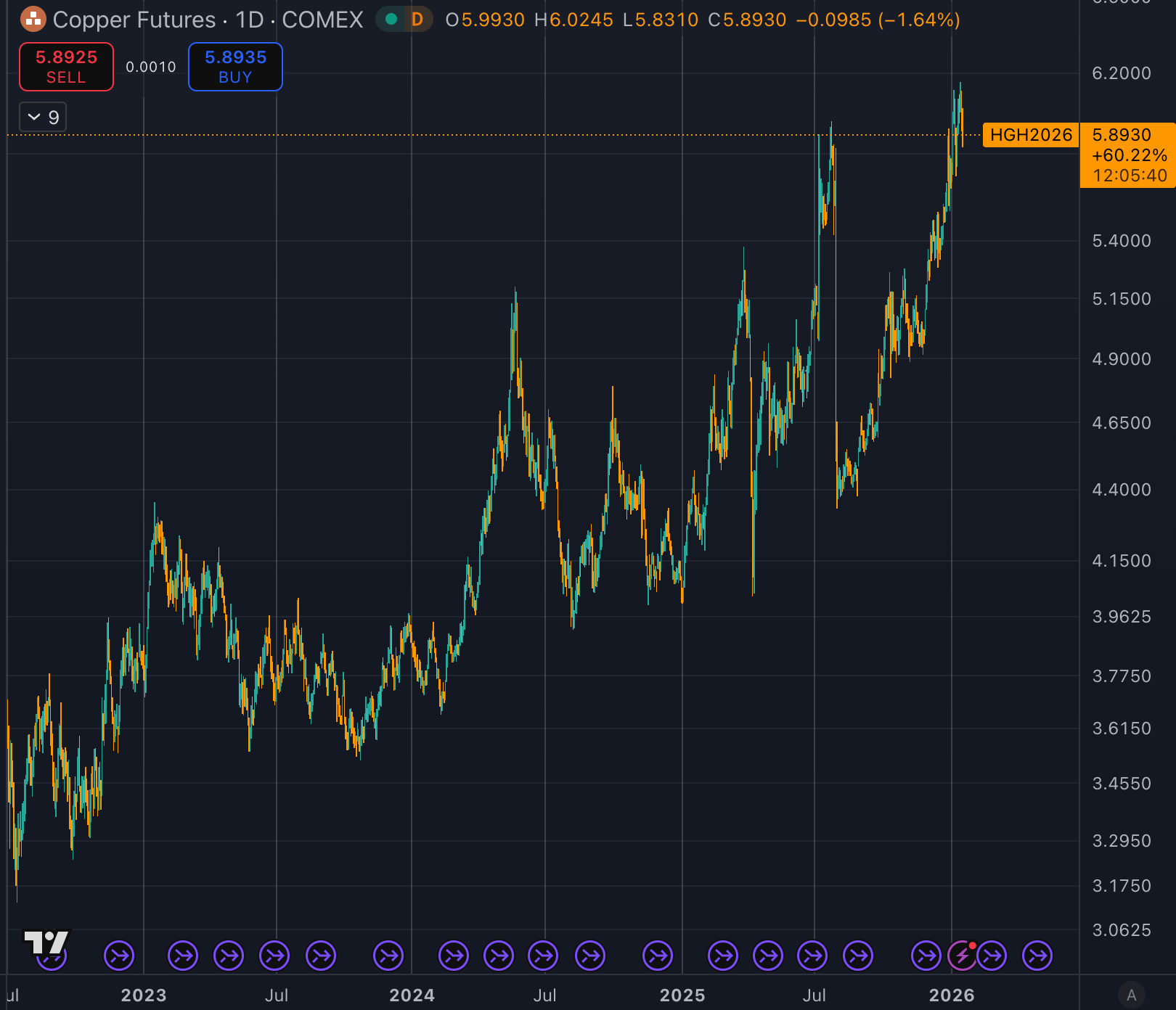 *Copper futures price (Source: TradingView)*Although the crypto market does not directly price copper, the approaching historic peak of this industrial metal could help reinforce the “everything is rising” sentiment across all asset markets. However, unlike gold or silver — which are associated with defensive psychology — copper reflects the real demand of the economy. This is what makes copper price movements particularly significant.
If persistent copper price pressure becomes entrenched, it could quickly influence inflation expectations, thereby affecting the interest rate outlook and liquidity conditions — key factors for the crypto market.
Copper, inflation, and the unanswered question about interest rates
The rally in copper is sharpening the debate around the degree of “stickiness” of inflation, real interest rate prospects, and when the US Federal Reserve (Fed) might ease policy. These variables also shape Bitcoin (BTC)’s outlook.
Even within the Fed, there is no consensus. Minneapolis Fed President Neel Kashkari believes inflation could hover around 2.5% by the end of 2026, but also admits he is unsure whether this level will be achieved by then. This ambiguity makes market expectations for interest rates in 2026 less stable — a particularly important factor for Bitcoin and high-liquidity assets, which often trade as long-term risk assets when real yields fluctuate.
Previously, the market considered rate cuts in 2026 almost certain. However, J.P. Morgan’s Chief Economist Michael Feroli has stated he does not expect the Fed to implement any cuts this year.
Copper prices rise amid AI investment stories and monetary policy pressures
The copper rally is also linked to AI infrastructure investment stories and demand from data centers. According to The Wall Street Journal, Amazon has signed a two-year agreement with Rio Tinto related to the Nuton/Johnson Camp copper project. This deal comes amid record copper prices, supply concerns, and increasing demand from the tech sector.
For the crypto market, the immediate impact is not about copper’s hedging role but how an inflation story driven by commodities could alter financial condition expectations. If the strength of copper prices signals persistent demand amid tightening supply, the “longer-lasting high interest rates” scenario could be priced in sooner. This often puts pressure on leverage and weakens capital flows into rate-sensitive assets, including crypto.
Even if spot capital flows or individual protocol catalysts — such as Ethereum (ETH) — complicate this relationship, the pressure from real yields remains a systemic obstacle.
Conversely, if disinflation trends return by the end of 2026, the uncertainty Kashkari mentioned could pave the way for expectations of policy easing to re-emerge. In that case, pressure from real interest rates would ease — a factor that has repeatedly restrained the crypto market.
COMEX signals and a test for the 2026 interest rate story
Data from COMEX also reflect shifts in inter-market positioning and risk appetite. The increase in open interest amid declining volume suggests traders are tending to hold their positions rather than just engaging in short-term momentum trades. However, open interest alone is insufficient to determine whether new money is coming from buyers or sellers.
Currently, the record high copper price zone serves as a direct test for the 2026 interest rate story: will pressure from the “real economy” and persistent inflation dominate, or will a softer inflation scenario gradually take shape?
To find confirmation, traders must revisit the familiar market indicator: the movement of copper prices relative to the January peak and the Fed’s willingness to accept inflation possibly above target into the end of the year.
Shach Sanh
Related Articles
ETF Launch Fails to Stem Tide As XRP Sinks to $1.81, Lowest Since April
Here’s Where Gold Price Could Head Next After the $300 Drop
Analyst Says Not Buying Kaspa (KAS) Here Is a “Disservice” – Here’s Why
Bitcoin Holds $66,000 as Market Braces for March Rebound
Dogecoin Price Compresses Near $0.10 as Open Interest Drops
NEAR Surges 14.5% — Will a Break Above $1.25 Ignite a Run Toward $3–$4?