


8.38 billion coins flood into the market! Mainnet migration boosts supply, with $0.20 becoming the survival line

The coin fluctuates narrowly between $0.19 and $0.20, with the mainnet migration boosting supply and expected to reach 8.38 billion coins by early 2026. The $0.2155 level has been tested three times as resistance; a stable break above is needed to challenge the $0.26-$0.28 range. RSI at 45 indicates a balanced state rather than recovery, with ongoing absorption of new supply by buying interest. Payment integration libraries enhance value but are price-regulated by supply adjustments.
The Truth About Supply Impact from Mainnet Migration
Pi Network’s mainnet migration marks a shift from a closed ecosystem to a fully transferable token economy. The phased KYC migration gradually transfers less liquid balances from the original system to the mainnet, in controlled cycles to maintain network stability. This increases token usability but also causes continuous growth in supply, rather than a one-time issuance. By early 2026, circulating Pi coins are projected to reach approximately 8.38 billion, with each migration cycle being gradually absorbed by the market.
The increase in circulating supply directly affects Pi’s price trend. Newly transferable tokens add to the supply at demand-sensitive price levels, limiting further price increases. As a result, price rebounds are more likely to be fleeting rather than establishing a long-term trend. From a mathematical perspective, if current daily trading volume remains around $10 million and daily new supply reaches $900,000 (based on unlock data), about 9% of daily trading volume is absorbing new supply. This persistent selling pressure makes sustained price growth difficult.
Additionally, recent streamlined payment integration libraries lower developer barriers, enabling Pi-based payment features to be embedded into applications within minutes (rather than hours). Thus, mainnet development enhances structural value, while price is moderated by absorption efficiency. The divergence between fundamental improvements and sluggish prices indicates supply pressure temporarily exceeds demand growth.
Mainnet Migration Supply Release Schedule
Q1 2026: Circulating supply expected to reach 8.38 billion coins, an increase of approximately 20-30% from current levels
Daily Unlock: About $900,000 worth of Pi continuously released, creating structural selling pressure
Absorption Difficulty: Daily trading volume around $10 million, with 9% used to absorb new supply
Price Suppression Effect: Each rebound faces selling from newly unlocked tokens, forming a ceiling
This phased release design aims to prevent a collapse caused by large one-time sell-offs, but its side effect is ongoing supply pressure. Compared to rapid market digestion after a one-time unlock, this slow, steady increase in supply keeps prices in a prolonged absorption phase, making clear upward trends difficult to establish.
The Technical Significance of the $0.2155 Rejection Three Times
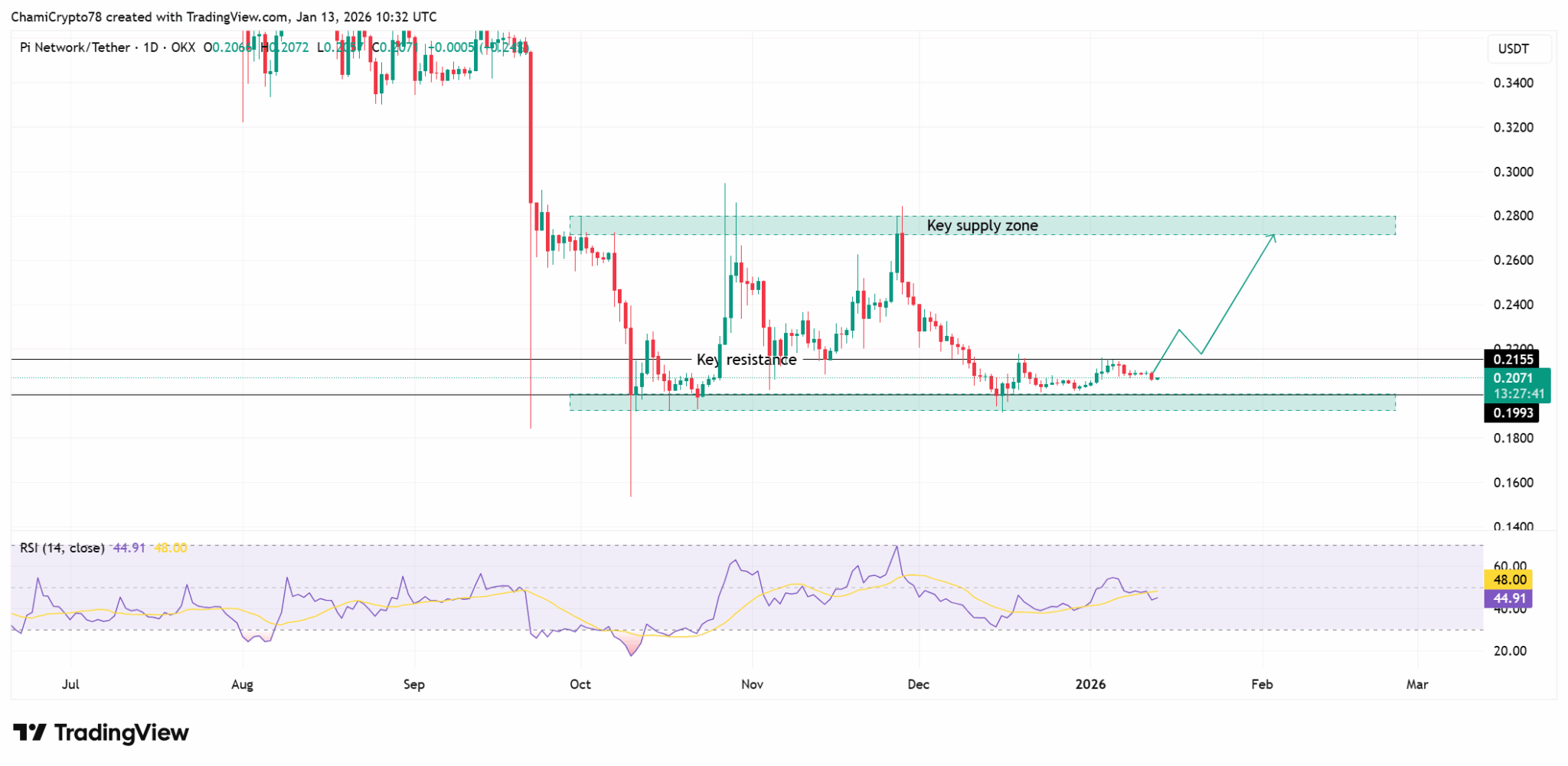
(Source: Trading View)
Pi’s price has been consolidating above the demand zone of $0.19 to $0.20 since the market crash at the end of 2025, continuously absorbing selling pressure. This support level determines how exhausted sellers are; a break below could trigger deeper correction. However, stabilization does not mean recovery. For Pi’s price to shift from balance to expansion, it must break above and hold the resistance at $0.2155, which currently caps the consolidation zone.
The $0.2155 level was previously a support but has turned into resistance after two rejections. Each failed attempt to break through this level reveals selling pressure. Long-term prices above $0.2155 indicate buyers are digesting the supply from migration rather than defending. If this scenario holds, the price could structurally break upward through the $0.26-$0.28 supply zone, where distribution was previously more concentrated.
From a technical analysis perspective, “support turning into resistance” is a classic bearish signal. When a price level shifts from support to resistance, stronger buying momentum is typically required to break through again. The $0.2155 level has already blocked bulls three times, reinforcing its resistance strength through repeated testing without breakthrough. To effectively surpass it, catalysts such as official mainnet launch announcements or major application deployments may be necessary.
This is a momentum-based conditional view. RSI near 45 indicates a neutral pressure state, not dominated by accumulation. RSI close to 45 reflects a balanced condition, reinforcing a market trend toward stability rather than immediate expansion. If RSI breaks above this threshold and price surpasses $0.2155, an upward trend becomes structurally plausible. Conversely, failure to recover above this level may deepen long-term range-bound oscillations, delaying Pi’s long-term price recovery.
Lack of Demand Is a Critical Weakness
After a prolonged distribution phase, Pi continues to fluctuate within a narrow range, reflecting market equilibrium rather than recovery. This price movement suggests the network’s price is digesting the impact of mainnet migration. Although the network is still developing, current price levels are not strongly influenced by demand.
This highlights a core issue: supply is increasing, but demand is not growing in tandem. Improvements in development tools have lowered application development barriers, but how many high-quality apps have launched and attracted users to transact with Pi remains uncertain. Without real use cases, Pi will remain a speculative asset, with prices under continued supply pressure.
From a risk management perspective, the current Pi price structure sets conditions for supply recovery but lacks clear upward catalysts. Conservative investors should wait until $0.2155 is effectively broken and trading volume increases before entering. Aggressive investors may consider light positions in the $0.19-$0.20 range but must set strict stop-losses below $0.18.
Related Articles
Ollama adds the "ollama launch pi" command to quickly start a minimalist programming agent.
Pi Network mainnet supply exceeds 9 billion coins! 50 million Pi coins are mapped daily to accelerate migration
Pi Network Maps 50M Coins Daily as Mainnet Tops 9B
Pi Coin Eyes March 2026 Upside on V23 Upgrade and Ecosystem Expansion
Pi Network Urges Mainnet Node Operators to Upgrade Before Key Deadline