


Pi Network January 2026 Analysis: Will PI Finally Break Out of Its Stagnation?
Pi Network native token PI continues to trade in a narrow, low-volatility range around $0.206–$0.208, showing minimal directional movement despite broader crypto market recovery signals.
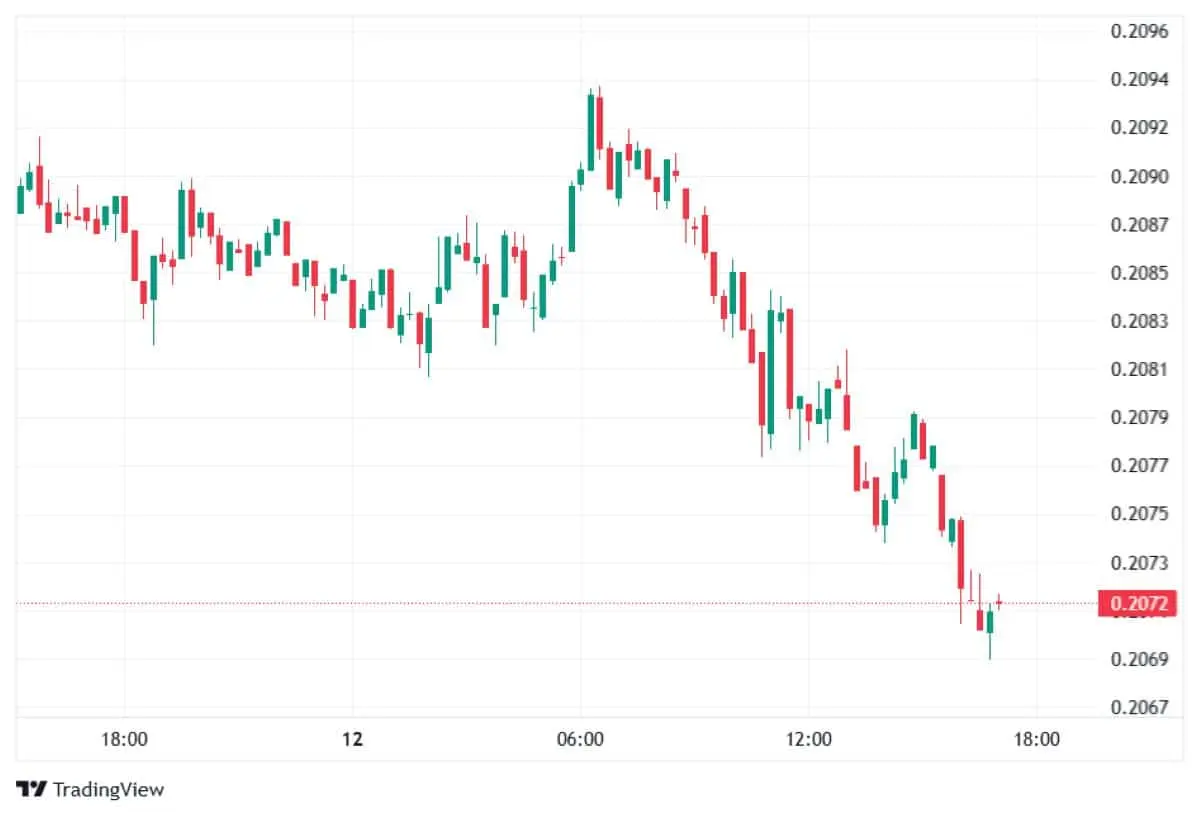
(Sources: TradingView)
After months of unusual stability—holding above $0.20 through November corrections but failing to capture upside momentum—PI remains one of the most stagnant altcoins in the space.
The recent release of Pi Network first major 2026 update (a streamlined developer library enabling Pi payments integration in under 10 minutes) aimed to boost ecosystem utility, but it generated no noticeable price impact. With ongoing token unlocks (95 million PI scheduled for January, worth ~$19.8 million at current levels) adding supply pressure and liquidity remaining thin, breakout prospects stay subdued.
Current Price Action & Technical Setup
PI hovers near $0.206–$0.207 (down ~1–1.5% in the last 24 hours), trapped in the $0.20–$0.22 band that has defined trading for weeks. Daily/weekly charts show near-flat momentum:
- RSI neutral (~49–50), indicating indecision rather than overbought/oversold extremes.
- Low volatility (1–2% daily swings), with volume modest (~$7–11 million 24h).
- Support at $0.20 has held reliably on dips; resistance at $0.22 rejects upside attempts repeatedly.
This “stuck in neutral” behavior contrasts sharply with PI’s earlier high-volatility phase post-listing, highlighting a lack of fresh catalysts amid ecosystem maturation.
Breakout Probabilities for the Week Ahead
Drawing from technical patterns, on-chain trends, and market context, here’s a realistic probability breakdown for Pi Network January momentum:
- Continued Sideways Consolidation (50–55% Probability): Most likely outcome. $0.20 attracts dip buyers, while $0.22 caps rallies. Without a strong trigger (e.g., major ecosystem adoption news, broader altcoin rotation, or reduced unlock pressure), PI stays range-bound—frustrating short-term traders but allowing long-term holders to accumulate patiently.
- Downside Breakout (20–25% Probability): Mild bearish tilt due to January unlocks (~95M PI) and persistent low liquidity. A break below $0.20 could test $0.18–$0.172 (early October lows), driven more by general market weakness or forced sales than PI-specific negatives. Bearish sentiment (Fear & Greed at ~27) adds caution.
- Upside Breakout (15–20% Probability): Lower conviction here. A push toward $0.25 (November resistance) would require renewed retail interest, positive developer adoption from the new payment library, or macro tailwinds. Recent updates haven’t sparked momentum, making a clean breakout unlikely without external catalysts.
Analyst consensus (from sources like CoinCodex, Binance forecasts, and CoinGecko data) points to short-term stability around $0.20–$0.21, with 2026 averages projected modestly higher (~$0.21–$0.24) if ecosystem tools gain traction.
Why PI’s Stagnation Persists in January 2026
Several factors explain the unusual resilience on downside protection combined with zero upside participation:
- No Clear Near-Term Catalyst: The 10-minute payment SDK is promising for dApp growth, but adoption remains early-stage. Protocol v23 upgrades (Rust smart contracts, Stellar integration) are phased through Q1, with testnet progress but no immediate hype.
- Token Unlock Pressure: January’s 95M PI release adds ~$20M supply influx, offsetting demand in a low-volume environment.
- Limited Speculative Flow: Unlike high-beta memes or AI tokens, PI lacks retail FOMO; focus remains on long-term utility and migration (15.8M users migrated to mainnet, 17.5M KYC’d).
- Liquidity Challenges: Trading volume has collapsed from peaks, exposing thin order books and vulnerability to small moves.
This creates a “boring but stable” dynamic—ideal for patient believers awaiting real-world utility milestones like DEX launch or supernode transitions later in 2026.
Bottom Line for Pi Network January Outlook
Pi Network January looks set for more consolidation in the $0.20–$0.22 zone, with downside risks slightly outweighing upside potential absent a fresh spark. The recent developer toolkit is a step toward utility, but price action suggests the market is waiting for tangible adoption or reduced supply pressure.
For traders, volatility remains low—better suited to range plays than directional bets. Long-term holders may view this as accumulation time ahead of 2026 roadmap milestones (e.g., DEX, protocol upgrades). Monitor key levels closely: a sustained break above $0.22 flips bias bullish; below $0.20 opens deeper downside.
Track PI and broader crypto developments securely with Bitget Wallet—perfect for monitoring tokenized assets, staking opportunities, and multi-chain exposure in a maturing ecosystem like Pi Network. Stay tuned for any ecosystem announcements that could finally catalyze movement.
Related Articles
Ollama adds the "ollama launch pi" command to quickly start a minimalist programming agent.
Pi Network mainnet supply exceeds 9 billion coins! 50 million Pi coins are mapped daily to accelerate migration
Pi Network Maps 50M Coins Daily as Mainnet Tops 9B
Pi Coin Eyes March 2026 Upside on V23 Upgrade and Ecosystem Expansion
Pi Network Urges Mainnet Node Operators to Upgrade Before Key Deadline