


The US crypto regulation "watershed" moment is approaching! The CLARITY Act is making a breakthrough this week, and Coinbase might withdraw support?
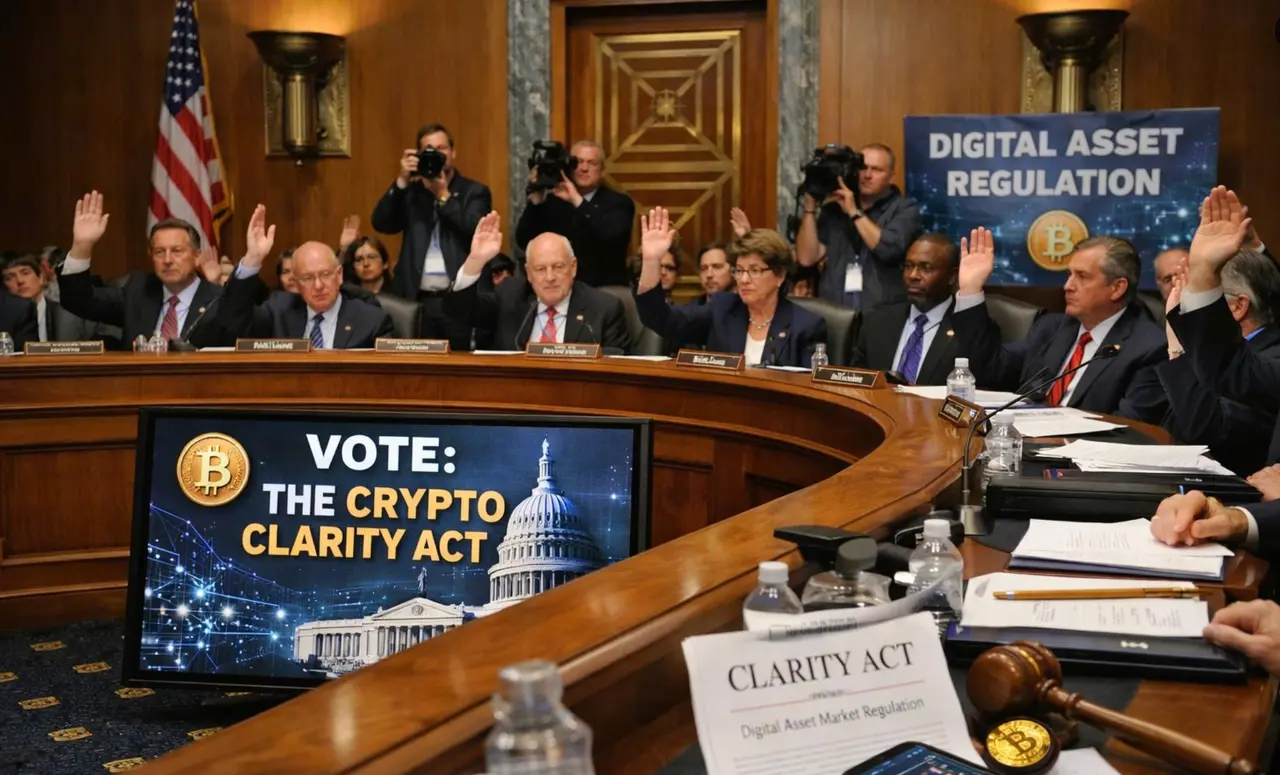
The upcoming week will be a historic one for US crypto regulation. The Senate Banking Committee is scheduled to hold a key hearing on January 15th for the Digital Asset Market Clarity Act, which aims to end a decade of regulatory ambiguity and clearly delineate the jurisdiction between the SEC and CFTC over digital assets.
(Source: X)
However, just before the bill’s critical review, a sudden development occurred. Bloomberg reports that if the final version of the bill restricts stablecoin reward programs, Coinbase, the largest crypto exchange in the US, may withdraw its support. This battle over “stablecoin yields” not only concerns Coinbase and other companies’ billion-dollar revenue models but could also determine whether the US can truly become the “world’s crypto capital” under President Trump’s vision.
Key Milestone in Crypto Legislation: Why is January 15th So Important?
For the US crypto industry, which has been navigating regulatory fog for over a decade, January 15, 2026, holds milestone significance. On this day, the Senate Banking Committee will hold an administrative hearing to review the Digital Asset Market Clarity Act, which was passed by the House in July 2025 with 294 votes in favor and 134 against. This process is far from a simple discussion; it is a decisive turning point in the legislative process. During the hearing, senators will review the bill line-by-line, debate, and propose amendments, ultimately deciding which version will be submitted to the full Senate for a vote. According to legislative experts, this is a “crucial step for the bill to go from concept to a workable text.”
SEC Chair Gary Gensler has called this week an “important week for crypto,” publicly supporting efforts to end regulatory gray areas and realize Trump’s vision of making the US the “world’s crypto capital.” The core goal of the bill directly addresses industry’s most fundamental pain points: clearly defining when digital assets should fall under SEC jurisdiction as securities and when they should be regulated as commodities by the CFTC. This delineation will directly impact exchange operation rules, token project compliance pathways, and the assets of millions of investors. Currently, market prediction platform Polymarket shows an 80% probability that the bill will pass within 2026, reflecting cautious optimism in the market about the legislative process.
However, the road to clear regulation remains fraught with obstacles. The review process will confront several core contentious issues, including whether stablecoins should be allowed to offer yields, how DeFi protocols are incorporated into the regulatory framework, and how to balance innovation with consumer protection. Any unresolved disputes at the committee level could slow or even block the entire legislative process. Additionally, the looming 2026 midterm elections and the potential government shutdown at the end of January cast shadows over the bill’s smooth progress. Therefore, the outcome of the January 15th review will clearly reveal how much bipartisan consensus exists on crypto regulation—serving as a “weather vane” for whether the bill will gain momentum or fall into prolonged delay.
Deep Dive into the CLARITY Bill: What Exactly Does It Aim to Solve?
To understand the profound impact of this legislative battle, it’s essential to clarify what kind of law the Digital Asset Market Clarity Act is. In short, it is a comprehensive bill designed to establish a clear, nationwide federal regulatory framework for the US digital asset market. Its emergence stems from industry, investors, and even regulators’ long-standing urgent call for “rules of the road,” aiming to reverse the current fragmented approach that relies heavily on enforcement actions to shape policy.
The bill’s most significant breakthrough lies in the delineation of regulatory jurisdiction. According to the House version, it establishes a set of criteria that classify most digital assets as “digital commodities,” placing their spot markets, exchanges, brokers, and dealers under CFTC regulation—provided that the blockchain network underlying these assets has reached a “mature” level (generally related to decentralization and control dispersion). Meanwhile, the SEC will retain jurisdiction over securities issuance, sales, and related financing activities. This division seeks to provide a predictable legal solution to the long-standing “Howey test” dilemma that has troubled the industry.
Overview of the CLARITY Bill’s Core Architecture and Potential Impact
Reshaping Regulatory Jurisdiction:
- CFTC (Commodity Futures Trading Commission): Gains primary oversight of “digital commodities” spot markets and intermediaries (exchanges, brokers, dealers), implementing a registration system based on “core principles.”
- SEC (Securities and Exchange Commission): Retains jurisdiction over issuance and sale of digital assets with securities attributes.
Key Market Structure Reforms:
- Compliance Pathways: Provides clear routes for existing crypto platforms to register with the CFTC as compliant digital commodity exchanges.
- Consumer Protection: Establishes customer asset segregation rules, bans exchanges from commingling customer assets, and sets conflict-of-interest restrictions.
- Market Integrity: Requires exchanges to implement trade surveillance, recordkeeping, and reporting systems to prevent market manipulation.
- AML Coverage: Clarifies that regulated digital commodity intermediaries are subject to the Bank Secrecy Act, bearing AML/KYC obligations.
Major Controversies and Unresolved Issues:
- Stablecoin Yields: Whether and how to regulate stablecoin reward programs akin to bank interest.
- Scope of DeFi: How to define “intermediaries” and assign compliance responsibilities to decentralized protocols.
- Definition of “Mature Blockchain”: Technical parameters and standards that determine asset jurisdiction.
Beyond jurisdiction, the bill sketches out a new set of market operation rules. It requires digital commodity trading platforms to register with the CFTC and adhere to a series of “core principles,” including trade monitoring, recordkeeping, conflict management, and customer asset protection. Notably, the bill explicitly brings such platforms under the regulation of the Bank Secrecy Act, imposing AML and counter-terrorism financing duties similar to traditional financial institutions. For long-standing non-compliant crypto exchanges, this means unprecedented compliance costs and a pathway to legitimize their operations within the mainstream financial system. If passed, the bill will fundamentally reshape the US crypto market’s competitive landscape, with compliance capacity becoming the most critical moat.
Coinbase’s “Ultimatum”: Why Are Stablecoin Yields a “Life or Death” Line for the Bill?
As the legislative process enters its final countdown, a public showdown that could influence the bill’s fate has suddenly intensified. Bloomberg reports that Coinbase, the largest US crypto exchange, privately warned that if the final version of the CLARITY bill bans or severely restricts stablecoin reward programs, the company will have to withdraw its support. This statement is akin to a shockwave at a critical juncture for the bill’s passage.
Coinbase’s tough stance is driven by direct and substantial commercial interests. Stablecoin rewards—especially those related to USDC issued by Circle, a Coinbase partner—have become an indispensable part of Coinbase’s revenue model. The company invests USDC deposited by users into safe assets like government bonds and returns a portion of the yield as rewards (e.g., Coinbase One members can earn about 3.5%), while also earning a significant share. Bloomberg estimates that Coinbase’s revenue related to stablecoins could reach approximately $1.3 billion in 2025. This not only serves as a “ballast” to maintain revenue stability during bear markets but also as a core tool to attract and retain users. CEO Brian Armstrong has publicly advocated that this market-driven yield model should be permitted and warned that excessive restrictions could weaken US crypto firms’ global competitiveness.
Opposition mainly comes from traditional banking sectors and cautious legislators. They argue that allowing non-bank entities to offer interest-like stablecoin yields could lead to regulatory arbitrage, drawing deposits away from heavily regulated banks with strict capital and reserve requirements, thereby impacting real economy credit supply. They see this as a “bank-like” activity requiring strict regulation. The core of this debate is a fundamental disagreement over the financial nature of stablecoins: are they a new form of consumer incentive technology or a digital variant of traditional banking?
While Coinbase’s threat carries strong negotiation overtones, it also genuinely reflects deep-seated conflicts in the CLARITY bill’s legislative process: how to build clear rules for the entire industry without killing the most vibrant and profitable business models. The bill’s drafters must strike a delicate balance among consumer protection, financial stability, industry innovation, and global competitiveness. The stablecoin yield clause thus becomes a “litmus test” for whether the bill can garner industry support and prevent pushing innovation overseas.
Market Stability “Safety Net”: Can the CLARITY Bill Prevent the Next “10/10” Crash?
Legislative debates are not only about commercial interests but also about systemic risks. Many supporters see the CLARITY bill as a foundation for a more resilient crypto market, potentially reducing the likelihood of a “flash crash” like October 10, 2025, when over $19 billion was liquidated in a single day, and liquidity evaporated rapidly. So, can the bill truly serve as a “breakwater” for the market?
Analysis suggests that the bill mainly enhances resilience by strengthening market infrastructure. First, by bringing major spot trading platforms under CFTC’s unified “core principles” regulation, it can promote consistent standards for trade monitoring, market manipulation prevention, and recordkeeping, reducing systemic risks triggered by weak risk controls on any single platform. Second, strict rules against exchange asset commingling and mandatory asset segregation can lower the risk of bank runs during market panic, as users worry about platform solvency. Such runs often exacerbate liquidity crises. Lastly, incorporating platforms into AML frameworks helps early detection and disruption of suspicious fund flows that could worsen market volatility.
However, it’s important to recognize that the CLARITY bill is not a “panacea.” It mainly regulates spot markets and intermediaries. A key driver of the October 10, 2025, crash was high-leverage perpetual futures trading and cross-platform margin systems. The bill currently does not set explicit leverage limits or introduce circuit breakers similar to traditional stock markets. Therefore, even if passed, a severe deleveraging spiral triggered by derivatives could still occur under extreme macro shocks—especially when major risks are outside US jurisdiction on offshore platforms. The bill’s significance lies in establishing a firmer “foundation” and “firewall” for the US domestic market, but it cannot fully immunize the global financial system from “financial tsunamis.”
The Road Ahead: What Comes After the Hearing?
Regardless of the January 15th outcome, this is far from the end of the CLARITY bill’s legislative journey—more like a critical waypoint. If the Senate Banking Committee approves a version, subsequent steps include review by other relevant committees (such as Agriculture) and then a full Senate vote. The version passed by the Senate must be reconciled with the House version from last year, resolving differences to produce a unified final text. This final version then requires approval by both chambers before being signed into law by the President. The process could take months and may be delayed by political conflicts or new disputes.
Therefore, all participants in the crypto industry—from exchanges and token projects to institutional investors and retail users—should closely monitor amendments during this process. These amendments will precisely outline the future regulatory landscape: which activities are explicitly permitted, which are prohibited, the costs of compliance, and the scope for innovation. The final shape of the CLARITY bill will determine whether the US crypto ecosystem will thrive and institutionalize over the next decade or gradually lose global leadership amid overregulation. This week’s hearing is a pivotal moment in setting this grand vision into motion.
What is the CLARITY Bill: A Legislation That Could Reshape the US Crypto Landscape
The Digital Asset Market Clarity Act (CLARITY Act) is a comprehensive legislative proposal introduced by the US Congress to establish a nationwide federal regulatory framework for digital assets. Born out of the long-standing chaos of “regulatory vacuum” and “enforcement-driven regulation,” it seeks to address the industry’s most fundamental demand: legal certainty.
Legislative Background and Core Goals: Since the advent of Bitcoin, US digital asset regulation has largely depended on SEC and CFTC enforcement cases to define boundaries, lacking forward-looking statutory laws. This has created huge compliance uncertainties, deterring institutional capital and innovation. The CLARITY Act, jointly proposed in 2025 by the House Financial Services and Agriculture Committees, aims to legally delineate the regulatory powers of the SEC and CFTC over digital assets, clarifying which assets are “securities” and which are “commodities.”
Key Mechanisms and Innovations:
- “Digital Commodity” and “Mature Blockchain”: The bill introduces a new asset class called “digital commodities,” primarily regulated by the CFTC. It also incorporates the concept of “mature blockchain,” referring to networks that are sufficiently decentralized and no longer controlled by a single entity, thus classifying assets on such networks as commodities.
- Dual Regulatory Framework: The SEC retains oversight over securities-like token issuance and sales; the CFTC oversees spot trading markets, exchanges, brokers, and dealers of digital commodities.
- Comprehensive Intermediary Regulation: Requires digital commodity exchanges and brokers to register with the CFTC and comply with “core principles,” including customer asset protection, market surveillance, and conflict-of-interest management.
- Integration into Traditional Financial Frameworks: Explicitly brings regulated digital asset intermediaries under the Bank Secrecy Act, imposing AML and KYC obligations similar to traditional financial institutions.
If ultimately enacted, the CLARITY Act will become the “fundamental law” of US crypto regulation, providing clear legal basis for everything from exchange operations to token issuance, marking a key step toward industry mainstreaming and institutionalization.
The US Crypto Legislative Battle: Interests, Ideologies, and Political Power
The difficult progress of the CLARITY Act exemplifies the complex power struggles within the US political system. Understanding the main players and their demands helps predict the bill’s future.
Main Stakeholders and Their Demands:
- Crypto Industry (e.g., Coinbase, a16z): Prioritize “regulatory clarity” and “predictable compliance pathways.” They support jurisdictional delineation but oppose provisions that could kill business models (like stablecoin yields) or overly rigid rules that exclude DeFi. Their goal is a framework that protects consumers without pushing innovation overseas.
- Traditional Wall Street and Banks: Attitudes are mixed. Some institutions want clear rules to enter the market; others (especially community banks) see crypto as a threat and oppose policies that favor large players, particularly wary of stablecoins eroding their deposit base.
- SEC and CFTC: The two agencies are vying for jurisdiction. SEC favors expanding its authority based on “investment contract” interpretations; CFTC seeks clearer authority over more spot markets. The bill is essentially Congress’s attempt to settle this bureaucratic turf war.
- Bipartisan Congress:
- Republicans: Generally favor a loose, innovation-friendly framework aligned with Trump’s “crypto capital” vision.
- Democrats: Divided. Progressives emphasize strict consumer protection, investor rights, and climate considerations; moderates focus on financial stability and AML, and some are willing to cooperate with Republicans.
- Consumers and Privacy Advocates: Stress protection for retail investors, concerns over risks of new financial products, and worries that AML requirements could infringe on privacy rights.
Main Battlegrounds:
- Stablecoins: The biggest flashpoint. Whether to allow yields, who issues them, and how reserves are managed are all critical issues with huge stakes.
- DeFi: How to regulate protocols without clear legal entities remains a technical and philosophical challenge.
- Environmental, Social, and Governance (ESG): Some Democrats push for energy disclosures related to crypto mining, facing strong opposition from industry and some Republicans.
This legislative process is not just about legal texts but also a contest for US financial leadership, regulatory philosophies, and domestic political influence. The final outcome of the CLARITY bill will depend on how these forces reach a temporary balance.