


Russian pension fund receives 37 million calls! Can mining income be used to receive a pension?
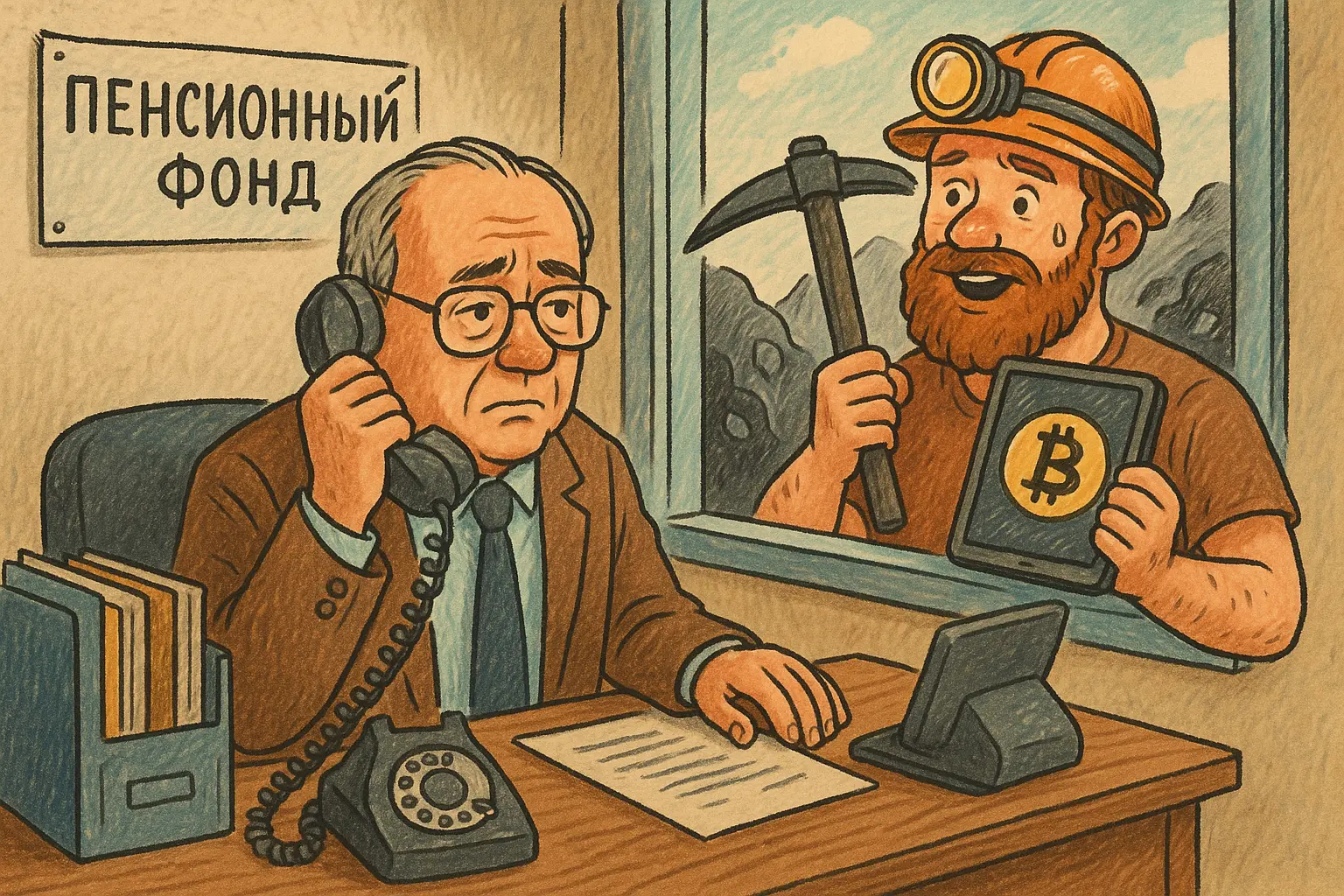
Russian Social Fund received approximately 37 million consultation calls in 2025, with the most popular topic related to cryptocurrencies. Citizens inquired whether retirement funds could be paid with digital assets and if mining income is included in welfare calculations. Officials clarified that payments can only be made in rubles, and taxation is under the jurisdiction of the tax authorities. Mining generates 10 billion rubles daily, and Russia accounts for 16% of global hash rate, ranking second. Moscow and St. Petersburg exchanges confirmed the launch of crypto trading in July 2026.
The Mining Retirement Dilemma Behind 37 Million Calls
In 2025, the Russian Social Fund received about 37 million consultation calls, with inquiries related to cryptocurrencies being the most popular. This number is astonishing in itself, indicating that over 100,000 calls per day asked about crypto issues. Beyond traditional social welfare inquiries, cryptocurrencies have become a new hot topic, reflecting the rapid increase in Russian society’s acceptance of digital assets.
Citizens want to know if retirement funds can be paid in digital assets and whether mining income is included in social welfare and pension calculations. These questions seem simple but are intertwined with complex tax and welfare policies. Fund officials have repeatedly clarified: all national payments are still made exclusively in rubles, and crypto taxes are managed by the Federal Tax Service. The frequency of these clarifications shows that public expectations for cryptocurrencies to integrate into mainstream finance are far ahead of policy development.
The unusually high volume of crypto inquiries reflects Russia’s growing demand for digital assets. Mining in Russia generates about 10 billion rubles daily, and regulatory frameworks are continuously being improved, with implementation expected by mid-2026. This demand is not unfounded but built on Russia’s unique economic environment: ruble depreciation pressure, limited international payment channels, and abundant energy resources that make mining costs extremely low.
For many Russian citizens, cryptocurrencies are not only investment tools but also practical options to hedge against inflation and preserve wealth. When retirement funds are denominated in rubles but ruble purchasing power continues to decline, converting retirement savings into stablecoins or Bitcoin becomes a rational choice. However, the policy framework has not yet permitted such operations, leading many to seek answers from social funds.
The Three Major Crypto Concerns of Russian Citizens
Retirement Payment Methods: Can the state pension be received in Bitcoin or stablecoins?
Mining Income Calculation: Are individual mining earnings included in social welfare and pension base?
Taxation Process: How to report mining income, what are the tax rates, and does it affect other benefits?
This large-scale public inquiry pressure could become a catalyst for policy change. When millions of citizens keep asking the same questions, the government must seriously consider whether to adjust policies to meet these real needs. The dilemma of Russia’s pension fund reveals a broader issue: as cryptocurrencies move from the fringe to the mainstream, the entire social welfare system needs to adapt.
Kremlin Promotes Mining as an Official Export Industry
Last month, senior Kremlin official Maxim Oreshkin proposed classifying cryptocurrency mining as an export activity within Russia’s official trade accounts. He believes that the digital assets mined are actually flowing abroad, even if they never cross physical borders. At the St. Petersburg Investment Forum, Oreshkin called mining “a new export commodity,” stating that Russia “has not paid enough attention to it,” and pointed out how these transactions impact foreign exchange markets and the balance of payments, though these effects are not reflected in official statistics.
This redefinition has profound political and economic implications. If mining is classified as an export, Russia can include it in international trade statistics, improving trade balance figures. More importantly, this provides a legal basis for industry support policies. Traditional export sectors often enjoy tax incentives, policy support, and infrastructure investments; if mining receives similar treatment, it could significantly reduce industry costs.
Industry estimates support his recognition. Russia’s mining industry accounted for over 16% of global hash rate in 2025, ranking second worldwide after the US. With legalization in November 2024, corporate operations now face a 25% tax rate, but legal status clears obstacles for large-scale investments and technological upgrades.
However, Central Bank Governor Elvira Nabiullina remains cautious. She acknowledges that mining contributes to ruble strengthening but emphasizes that quantifying its impact is difficult because much of the industry operates in the gray area. Although laws require legal entities to register with the Federal Tax Service and households with monthly electricity consumption below 6,000 kWh can be exempt from registration, illegal mining activities still cause billions of dollars in losses annually through electricity theft and unpaid taxes.
Opportunities and Risks of Regulatory Implementation in July 2026
(Source: Chainalysis)
At the end of last month, Moscow and St. Petersburg exchanges confirmed that once Russia’s legislative framework takes effect on July 1, 2026, they are ready to launch cryptocurrency trading. The Central Bank of Russia released a regulatory concept on December 23. St. Petersburg Exchange emphasized that it already has the technical infrastructure for trading and settlement, while Moscow Exchange stated it is actively exploring solutions to serve the crypto market.
The regulatory framework will strictly distinguish market access based on investor categories. Non-qualified investors can purchase up to 300,000 rubles worth of cryptocurrencies annually through a single intermediary, limited to a confirmed list of liquid cryptocurrencies, and must pass a mandatory knowledge test; qualified investors face no purchase limits but must demonstrate risk understanding and cannot buy anonymous tokens that hide transaction data.
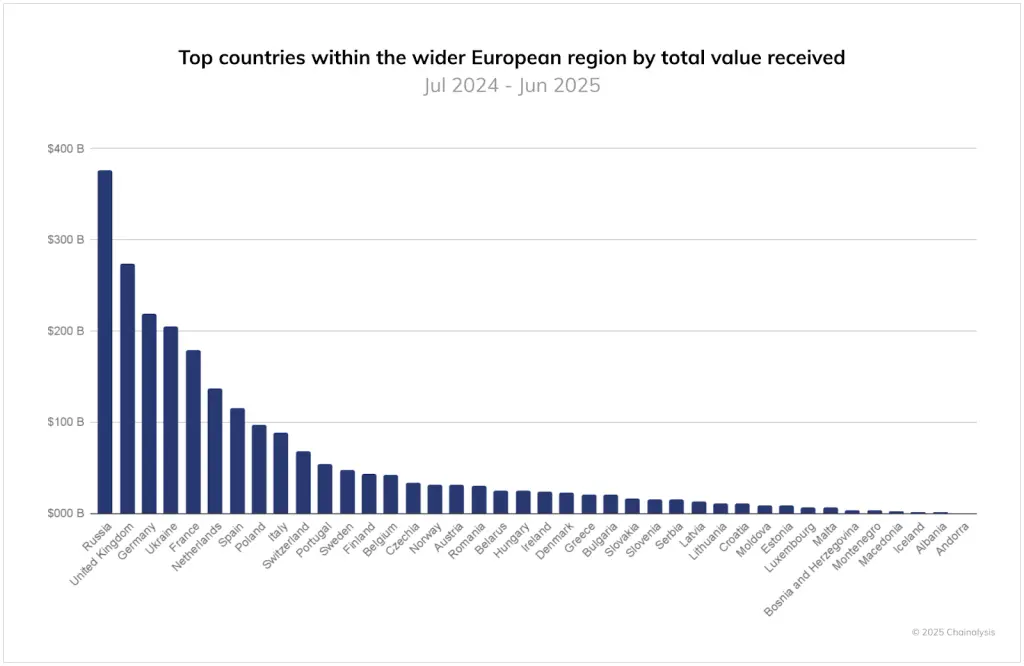
Between July 2024 and June 2025, Russia’s cryptocurrency trading reached $376.3 billion, surpassing the UK’s $273.2 billion, making it Europe’s largest crypto market. Large transfers over $1 million grew by 86%, nearly double Europe’s 44% growth rate.