According to on-chain analyst Willy Woo, Bitcoin’s price is approaching a short-term recovery, amid macroeconomic policy movements in the US that could boost broader cryptocurrency adoption.
Analysis models based on Woo’s data indicate that investment inflows into Bitcoin hit a bottom on 12/24/2025 and have been steadily increasing since then. Although the outlook for 2026 remains cautious due to declining market liquidity, short-term factors open up upside opportunities in the coming weeks.
Bitcoin inflows signal recovery as Trump’s proposed credit card interest rate cap is announced
Currently, Bitcoin is trading around $91,750, below the estimated production cost of approximately $101,000 per BTC for miners.
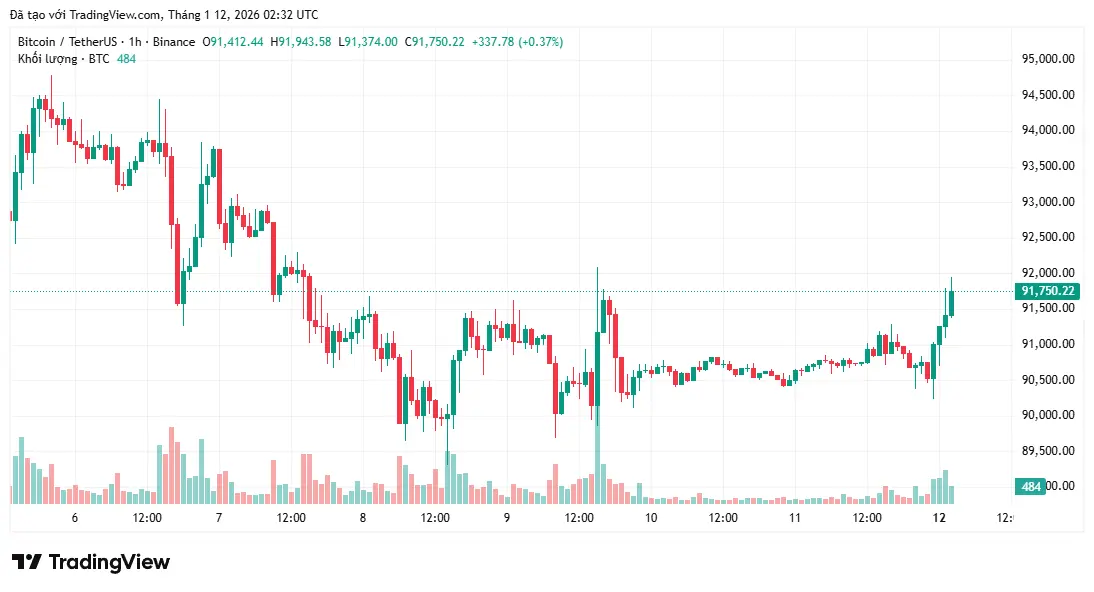 Bitcoin Price Chart | Source: CoinphotonAccording to expert Wimar.X, trading below production costs usually does not lead to panic sell-offs. Miners will reduce output and wait for better prices, creating a low-price zone with limited activity, acting as a temporary support level.
“BTC is currently undervalued compared to production costs. Most investors tend to panic sell in this zone. Then, when BTC surpasses production costs, market sentiment turns optimistic. This cycle repeats every time,” Wimar.X states.
Additionally, Willy Woo emphasizes that actual capital flowing into the spot market—rather than media narratives or stock market correlations—is the key factor driving Bitcoin’s price recovery.
“The market can grow without BTC if investors do not allocate capital here,” he explains. “We focus on measuring real investor capital flows into Bitcoin, rather than hypothetical flows from media stories.”
Technical factors and current capital flows may intersect with a significant macro catalyst: the recent proposal by President Donald Trump to cap credit card interest rates at 10% for one year, starting from 01/20/2026.
Trump’s credit limit could push consumers toward Bitcoin and DeFi
Trump’s move aims to reduce financial burdens for millions of Americans but could also restrict access to traditional credit for those with credit scores below 780.
Analysts and the crypto community warn that this policy might inadvertently encourage consumers to shift toward alternative financial systems, such as Bitcoin and DeFi platforms.
Some suggest that financial giants like Visa and Mastercard could face short-term volatility as they adjust operations for high-risk credit customers.
“Tomorrow, we will see how the market reacts to Trump’s proposed 10% credit card interest rate cap, which could significantly impact Visa and Mastercard,” crypto analyst Crypto Rover predicts.
Financial experts believe this policy could lead banks to exclude low-credit-score customers, who may then turn to DeFi lending platforms like Aave or Compound.
Crypto theorists argue this could create a “seamless adoption cycle,” where stablecoins, Bitcoin, and Ethereum-based DeFi infrastructure benefit from rising demand for decentralized financial services.
While Willy Woo remains cautiously optimistic about short-term recovery prospects, he maintains a long-term cautious outlook for 2026. Liquidity has declined relative to price momentum since January 2025, indicating that temporary rallies may occur but sustaining a sustainable uptrend will be challenging.
However, the convergence of miner cost support, stronger capital flows, and market demand driven by new policies could create a highly volatile environment for Bitcoin.
As the market prepares for the policy to take effect from 01/20 and liquidity trends continue to evolve, the coming weeks will be critical to see if Bitcoin can leverage both real capital inflows and macroeconomic shocks.
This is a rare confluence where short-term bullish drivers face structural market uncertainties.
Mr. Giáo
Disclaimer: The information on this page may come from third parties and does not represent the views or opinions of Gate. The content displayed on this page is for reference only and does not constitute any financial, investment, or legal advice. Gate does not guarantee the accuracy or completeness of the information and shall not be liable for any losses arising from the use of this information. Virtual asset investments carry high risks and are subject to significant price volatility. You may lose all of your invested principal. Please fully understand the relevant risks and make prudent decisions based on your own financial situation and risk tolerance. For details, please refer to
Disclaimer.
Related Articles
Data: 838.89 BTC transferred from an anonymous address, routed through a relay, and flowed into Wintermute
ChainCatcher reports that, according to Arkham data, at 02:51, 838.89 BTC (worth approximately $50.26 million) was transferred from an anonymous address (starting with bc1qzudnxd...) to another anonymous address (starting with bc1qsxjg55...). Subsequently, this address transferred some BTC (130 coins) to Wintermute.
GateNews30m ago
Data: 155.22 BTC transferred from an anonymous address, worth approximately 11.09 million USD
ChainCatcher reports that, according to Arkham data, at 00:43, 155.22 BTC (worth approximately $11.09 million) was transferred from an anonymous address (starting with 1AkTDtK7...) to another anonymous address (starting with 1NErFWRW...).
GateNews2h ago
Bitcoin Poised for Next Leg Down as $73K Precedes Death Cross
Bitcoin is navigating a delicate chart landscape as traders weigh the risk of a protracted bear cycle against the possibility of a renewed bounce. After a March rally, market watchers say a sustained move higher will require a meaningful bullish catalyst to overcome persistent resistance and the wei
CryptoBreaking2h ago
Bitcoin Price Predictions Flip Bullish, But Ethereum Is Still Stuck
Predictors have turned bullish on Bitcoin's near-term price, suggesting a rise to $84,000 before a potential drop. However, analysts remain divided on sustainability, while sentiment for Ethereum is bearish, with expectations of a decline to $1,500.
Decrypt2h ago
Data: In the past 24 hours, the entire network has liquidated $339 million, with long positions liquidated at $182 million and short positions at $157 million.
ChainCatcher reports that, according to Coinglass data, the total liquidations across the entire network in the past 24 hours amounted to $339 million, with long positions liquidated at $182 million and short positions at $157 million. Among these, Bitcoin long positions were liquidated at $67.776 million, Bitcoin short positions at $69.678 million, Ethereum long positions at $38.385 million, and Ethereum short positions at $50.239 million.
GateNews3h ago


