
Pi Coin Team Releases Unified Developer Library, Reducing Integration Time from Hours to Less Than 10 Minutes. The new library supports JavaScript, React, Next.js, and Ruby on Rails frameworks, lowering the technical barrier. This move aligns with Pi Coin’s 2026 strategy to build a practical, utility-oriented ecosystem, promoting rapid deployment of real-world applications.
A Technical Leap from Hours to 10 Minutes
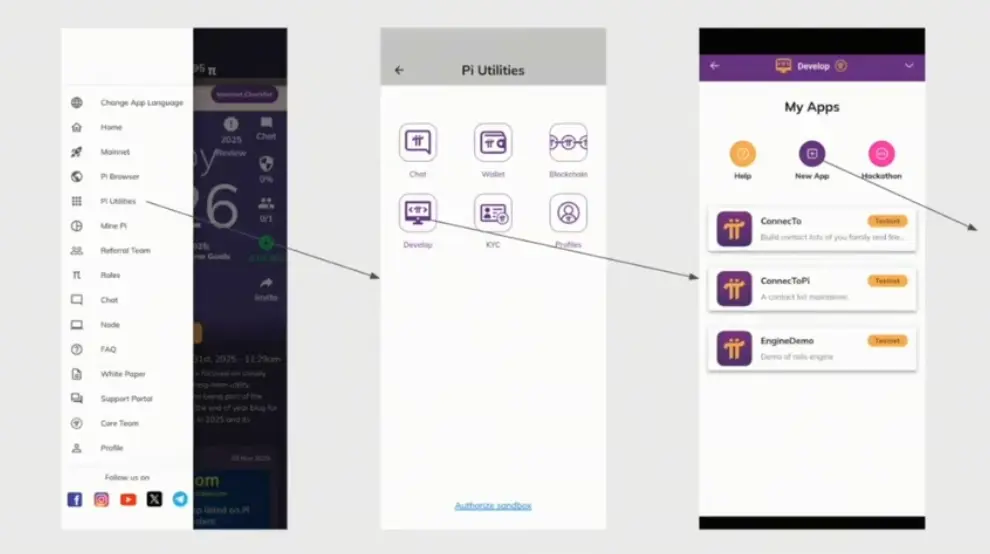
(Source: Pi Network Official Website)
Pi Network announced a new developer library through official channels, solving a key bottleneck in Pi app development. Previously, developers needed to set up Pi SDK and backend APIs separately, a process that consumed significant time and resources. Many developers reported that full payment integration could take hours or even days, especially for teams unfamiliar with blockchain technology, making this complexity a major obstacle to entering the Pi ecosystem.
The newly released library changes this situation by consolidating multiple integration steps into a single process. The unified approach now allows front-end and back-end integration through a simplified setup, completing the entire process within 10 minutes. This speed boost is not just quantitative but a qualitative leap, enabling developers to complete what used to take a full day in a single work session.
The library’s documentation includes demo videos guiding developers through implementation. This hands-on teaching further lowers the learning curve, allowing even blockchain novices to get started quickly. From a technical architecture perspective, the unified library adopts a modular design, enabling developers to selectively incorporate features based on their needs, avoiding unnecessary code bloat.
More importantly, the time saved allows developers to allocate more resources to product improvement and feature development. Instead of spending extensive time on payment infrastructure, teams can focus on creating practical applications that meet real user needs. This shift aligns with Pi Network’s philosophy of building a comprehensive ecosystem where applications provide tangible value beyond speculative gains.
Strategic Choice Covering Four Major Frameworks
The initial version targets common tech stacks to ensure immediate usability for existing development teams. This pragmatic approach shows that Pi Network has deeply studied the actual needs of the developer community. According to Stack Overflow’s annual survey, JavaScript and React are the most widely used technologies worldwide, while Next.js has been one of the fastest-growing frameworks in recent years. Ruby on Rails, though not the newest technology, boasts a large, mature developer base and rich ecosystem tools.
This technical selection covers a range of development teams from startups to enterprises. Small teams may prefer JavaScript for its simplicity, startups might choose Next.js for full-stack capabilities, and large corporations may rely on Ruby on Rails for stability and security. Supporting these frameworks simultaneously maximizes potential developer coverage.
Future iterations may expand support for other frameworks based on community feedback and adoption patterns. Developers using Python, Go, Flutter, and other stacks have already expressed interest on official forums. Pi Network adopts a gradual expansion strategy, first ensuring core framework stability and ease of use, then gradually adding support for new ones. This approach avoids compromising quality by rushing to full coverage prematurely.
Supported Tech Stacks and Application Scenarios
JavaScript: The most fundamental front-end language, suitable for simple payment integrations and web applications
React: The most popular front-end framework today, ideal for building complex single-page applications and user interfaces
Next.js: A full-stack framework combining front-end and back-end, suitable for high-performance applications requiring server-side rendering
Ruby on Rails: A mature backend framework, ideal for rapid MVP development and enterprise-level applications
Practical Ecosystem Strategy Shift
Pi Coin’s payment integration library supports a broader strategy centered on practicality and real-world applications. The network has always emphasized real-world use cases over pure transactions or speculation. By reducing technical complexity, this library encourages developers to experiment and rapidly prototype, otherwise they might hesitate to develop on the platform.
The timing of this release reflects Pi Network’s focus on ecosystem maturity by 2026. Payments are a fundamental element of truly practical applications, and the accessibility of this feature directly impacts ecosystem growth speed. In the past, many creative developers abandoned building applications on Pi due to high technical barriers; now, this obstacle has been significantly lowered.
This library reduces the threshold for developers to test concepts or launch minimum viable products (MVPs) with Pi. In blockchain, rapid iteration of MVPs is crucial. Traditionally, blockchain application development cycles are much longer than Web2, partly due to the complexity of payments and on-chain interactions. Pi Network’s new tools bring blockchain app development closer to the speed of traditional applications.
From a broader perspective, this practicality-oriented shift reflects the overall maturity trend of the cryptocurrency industry. Early blockchain projects often emphasized decentralization and censorship resistance but overlooked user experience and real-world use cases. Pi’s strategic shift shows an awareness that only when ordinary users can use Pi for daily transactions will the network achieve sustainable long-term growth.
The network calls for continued development activities, indicating ongoing commitment to building infrastructure that supports long-term ecosystem sustainability and practical deployment. This is not a one-time tool release but the beginning of a series of ecosystem-building initiatives. Future plans may include more developer-friendly tools, richer incentive programs, and more promotion of real-world application cases.
Disclaimer: The information on this page may come from third parties and does not represent the views or opinions of Gate. The content displayed on this page is for reference only and does not constitute any financial, investment, or legal advice. Gate does not guarantee the accuracy or completeness of the information and shall not be liable for any losses arising from the use of this information. Virtual asset investments carry high risks and are subject to significant price volatility. You may lose all of your invested principal. Please fully understand the relevant risks and make prudent decisions based on your own financial situation and risk tolerance. For details, please refer to
Disclaimer.
Related Articles
Pi Network Explodes 50% – The Rebound Everyone Missed!
Pi Network has experienced a price rebound, rising from $0.128 to approximately $0.1819, approaching a key resistance at $0.20. Traders are optimistic, but liquidity remains low, leading to potential volatility in the market.
Coinfomania12h ago
Pi Network Confirms March 12 DEX Launch, Pi Coin Rallies Over 8% Amid Protocol Upgrades
Pi Network has scheduled the launch of its native decentralized exchange for March 12, 2026, integrated directly into the Pi Wallet, as the project completes mandatory protocol upgrades toward v20.2 ahead of the March 14 Pi Day milestone.
CryptopulseElite17h ago
Pi Network price hits two-week high, protocol upgrade drives 8.5% increase
Pi Network's native token PI rose about 8.5% on March 4th, reaching a nearly two-week high, following the successful upgrade to protocol v19.9. The upgrade aims to strengthen network capabilities and will introduce v20.2 before Pi Day 2026. Despite the short-term increase, the Pi Foundation transferred 60.99 million tokens, which could trigger supply pressure. Technically, PI faces a key resistance level at $0.173.
MarketWhisper20h ago
PI (Pi) increased by 7.51% in the past 24 hours
Gate News Bot Message, March 5th, according to CoinMarketCap data, as of press time, PI (Pi) is trading at $0.18, up 7.51% in the past 24 hours, reaching a high of $0.19 and a low of $0.16. The current market capitalization is approximately $1.748 billion, an increase of $122 million from yesterday.
Pi is the first digital currency that can be mined on a mobile phone, utilizing groundbreaking technology to achieve mining without battery loss on mobile devices. Pi Network aims to make cryptocurrency mining simple and accessible, with features such as decentralization, mobile-first design, user-friendliness, and environmental friendliness. Users can start mining for free by downloading the official mobile app and receiving an invitation from existing trusted members. The project aims to create a secure, tamper-proof, and interoperable digital currency ecosystem.
## Important recent news about PI:
1️
GateNews20h ago
Pi Network’s v19.9 Mainnet Upgrade Just Changed Everything
_Pi Network’s v19.9 mainnet migration is done. Node operators are already eyeing v20.2 before Pi Day 2026. What does this mean?_
Pi Network just crossed a line most projects talk about for years. Protocol v19.9 mainnet migration is done. Confirmed. The Pi Core Team announced the completion
LiveBTCNews03-04 16:50


