


Is the coin stuck in silence? ChatGPT predicts a 55% chance of continued sideways movement this week
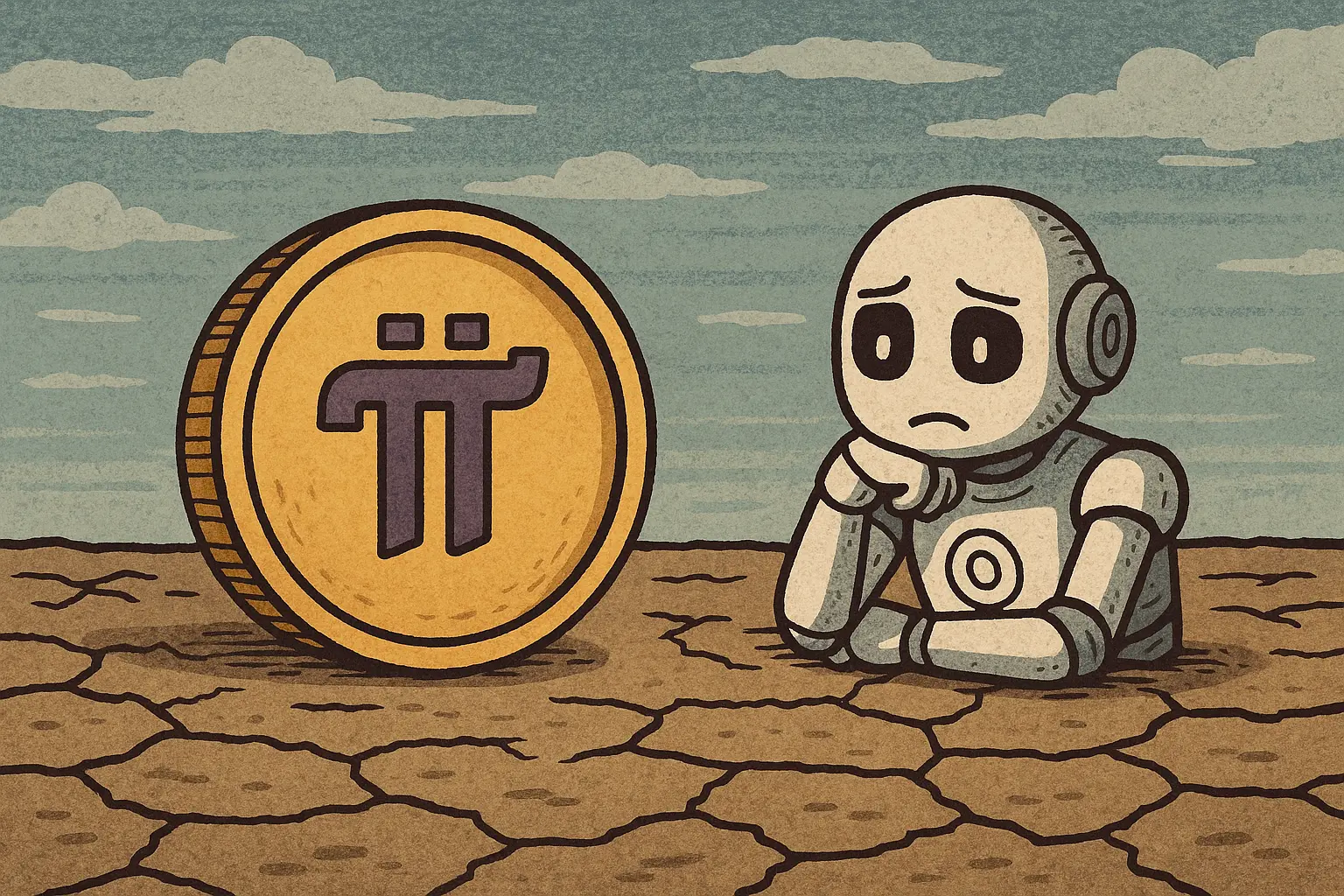
Pi Coin (PI) has been trading within a narrow range of $0.20-$0.22 for nearly a month. It rose against the trend in November but did not follow through during last week’s market recovery. ChatGPT predicts a 55% chance of sideways movement this week, a 25% chance of dropping to $0.18, and a 20% chance of breaking through the $0.25 resistance level. The lack of clear catalysts is the main reason for market hesitation.
Unusual Signals Behind Pi Coin’s One-Month Sideways Trading
Since its inception, Pi Coin’s performance has been markedly different from other altcoins, likely due to its less-than-one-year trading history. Daily, weekly, and monthly charts clearly show the current situation—price almost unchanged, which is very unusual for an altcoin, especially one that typically experiences high volatility during its early trading phase.
Over the past three months, Pi Coin has maintained above $0.20, indicating a relatively healthy level. Even more surprisingly, during the overall correction in November, Pi Coin experienced some upward movement. This counter-market performance led some investors to believe Pi Coin has the potential for independent price action. However, when the entire cryptocurrency market showed signs of recovery last week, Pi Coin failed to keep pace, with its price fluctuating narrowly between $0.20 and $0.22.
This abnormal stability has sparked two very different interpretations. Optimists see it as a sign of a bottoming process, indicating strong buying support in this price range, and a potential breakout could unleash significant momentum. Pessimists, on the other hand, believe it reflects a lack of interest in Pi Coin, with neither bulls nor bears motivated to push the price.
From trading volume data, Pi Coin’s average daily trading volume has indeed declined over the past month, supporting the pessimistic view. When prices move sideways with shrinking volume, it usually indicates market participants are waiting for a clear directional signal. This waiting game could last weeks or even months until a major catalyst appears.
ChatGPT’s Scenario Probability Forecast
ChatGPT’s analysis indicates that Pi Coin has repeatedly been rejected at the $0.22 resistance level, while buyers have continued to accumulate near the $0.20 support level. This price action suggests market indecision rather than distribution. Unless new catalysts emerge, Pi Coin’s price may hover between $0.20 and $0.22.
A sideways consolidation with a 50-55% probability is considered the baseline scenario. While disappointing for short-term traders seeking volatility, it could be positive for long-term holders, allowing them to accumulate within a relatively stable price range. The key questions are how long this sideways trend will last and in which direction a breakout might occur.
The downward breakout has a 25% probability, though not the highest. If the price drops to $0.18 or tests the October low of $0.172, it could reflect broader market weakness rather than specific bad news for Pi Coin, but it would still dampen short-term market sentiment. A worse scenario would be retesting the early October low of $0.172, erasing months of gains.
The upward breakout has only a 20% probability, the lowest among the three scenarios. The report admits that, at present, such a significant rally in the coming days seems unlikely without a clear catalyst. To reach the $0.25 resistance level (last challenged in November of last year), the team would need to release major positive news or the overall crypto market would need to rebound strongly.
Three Major Possibilities for Price Movement This Week
Sideways consolidation (50-55% probability): Price remains in the $0.20-$0.22 range, with no catalysts leading to market hesitation.
Downward breakout (25% probability): Drop to $0.18 or test the October low of $0.172, reflecting broader market weakness.
Upward breakout (20% probability): Reach the $0.25 resistance level, requiring clear bullish news to drive the move.
Lack of Catalysts Is the Biggest Issue
Pi Coin team recently released their first update for 2026, but it did not trigger significant price volatility. This tepid response reflects a core concern in the market about Pi Coin: the lack of clear use cases and ecosystem development. Although Pi Coin claims to have tens of millions of users, it is difficult to verify how many are actively using Pi for transactions or ecosystem participation.
From a technical perspective, the resistance at $0.22 and support at $0.20 have formed a narrow trading range. Technical analysts generally believe that the narrower and longer this range persists, the more powerful the eventual breakout could be. However, the direction depends on which side exhausts its patience first. If bulls lose confidence, the price may break downward; if bears are forced to cover, it could break upward.
Another challenge Pi Coin faces is its listing status on mainstream exchanges. Currently, trading is concentrated on a few small and medium exchanges with limited liquidity. To attract more institutional investors and large capital, Pi Coin needs to be listed on top-tier exchanges like Binance and Coinbase. However, these exchanges have strict listing criteria, and Pi Coin’s mainnet status and decentralization level could be obstacles.
Looking ahead, Pi Coin needs to achieve breakthroughs in three areas to escape the current predicament: first, clarify the mainnet launch schedule and fulfill promises; second, demonstrate real application scenarios and ecosystem growth data; third, secure listings on mainstream exchanges. Until these catalysts appear, Pi Coin’s price may continue to trade sideways within the current range, with investors patiently waiting.
Related Articles
Pi Network Urges Mainnet Node Operators to Upgrade Before Key Deadline
Pi Network Foundation sells 48.88 million tokens, PI technical outlook is bearish
Pi Network Celebrates One Year of Open Network: A Look at the 2026 Key Metrics
Pi Network Rolls Out Phase 2 Protocol Upgrades With Mandatory Node Deadline
Pi Network Price Faces Technical Resistance in March 2026 as GCV Narrative Divides Community
Pi Network Completes March Upgrade With 421K Active Nodes