


Can SOL surpass the $150 mark after trading volume on DEX reaches a record $6.7 billion?
Solana (SOL) once again attracts attention after recording a 24-hour DEX trading volume reaching a record $6.701 billion, surpassing the total activity of all Layer 1 and Layer 2 networks combined.
This growth momentum has sparked a wave of optimism across the entire cryptocurrency market, especially as SOL approaches a key resistance zone around the $150 mark.
The surge in DEX trading volume is not merely a speculative signal but also reflects a clear shift in investor behavior. Capital is flowing back into protocols built on Solana at an unprecedented rate in recent times.
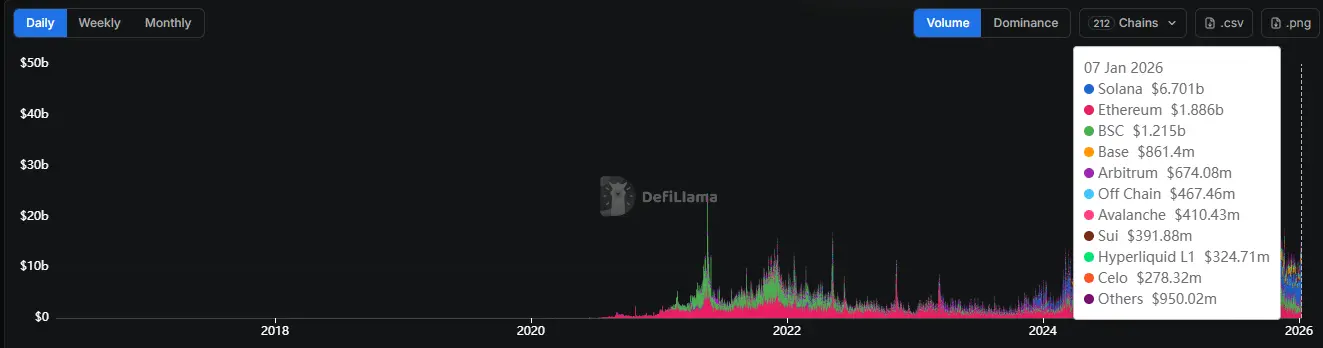 Source: DeFiLlamaAlongside increased activity, liquidity on the network has also become more abundant. This combination often helps stabilize price discovery and minimize risks during periods of significant market volatility.
Solana ETF records record capital inflow
At the same time, interest from major financial institutions is aligning with the on-chain growth trend. Over the past 24 hours, Solana ETFs have attracted a total capital of $801.31 million, indicating that institutional investors are preparing for a long-term holding strategy.
Among them, BSOL leads with $638 million, followed by GSOL with $130 million; only TSOL has recorded a negative capital flow.
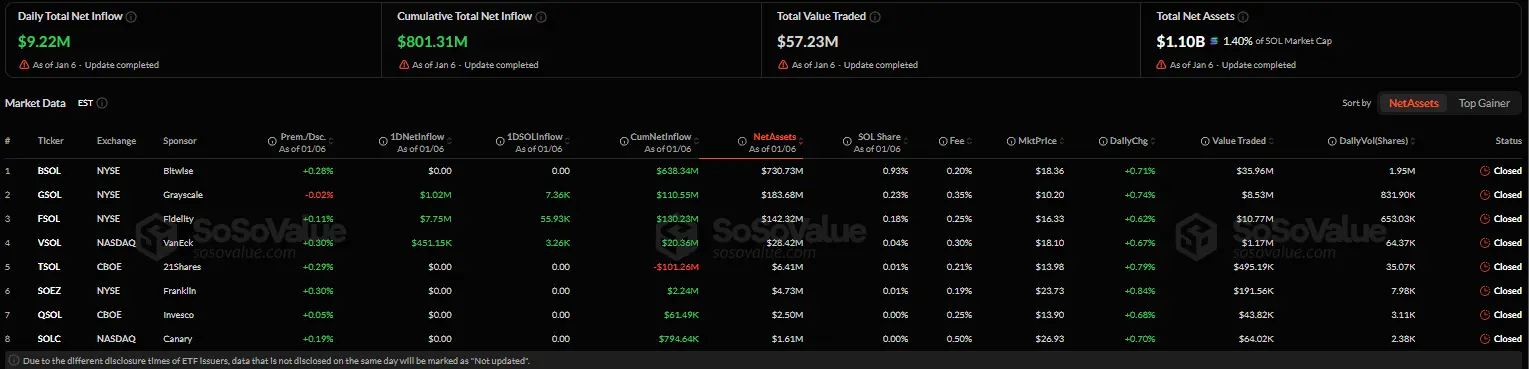 Source: SoSoValueUnlike short-term trades in the spot market, capital inflows into ETFs usually represent strategic funds, helping to stabilize prices during critical technical testing phases.
Institutional demand continues to grow strongly
Additionally, the derivatives market is also sending positive signals. The open interest (OI) in Solana has surged to $3.35 billion, indicating that many new positions are being opened rather than traders withdrawing from the market.
 Source: CoinalyzePrevious observations suggest that rising OI along with active network activity often reflect strong investor confidence. This upward trend also forecasts the potential for significant volatility in SOL in the near future.
Resistance at $150 – a major challenge for SOL
Currently, attention is focused on the $150 resistance zone, which is considered a psychological and technical barrier.
The price reaction here will play a decisive role in determining SOL’s short-term direction. If it breaks through this level decisively, strong demand will be confirmed and could trigger a new acceleration wave as sidelined capital re-enters the market.
However, the resistance zone also serves as a warning signal, as early profit-taking by investors could lead to short-term corrections when profits are secured.
Nevertheless, if corrections occur while trading volume and capital flow remain high, the upward trend is usually reinforced rather than reversed.
Next prospects for Solana
All factors combined: dominance in DEX volume, strong ETF capital inflows, and rising OI are painting a promising picture for Solana. Network activity is increasingly vibrant, institutional confidence is strengthening, and market participation is expanding.
If these trends continue, SOL could be preparing for its next major move. Trading around the $150 zone will be decisive. Currently, the momentum still favors Solana.