In a high-stakes moment for decentralized perpetuals, Hyperliquid faced a technical exposé on December 20, 2025, via a blog post titled “Reverse Engineering Hyperliquid” on blog.can.ac. The article accused the platform of nine serious issues, from “insolvency” to a “God mode backdoor,” labeling it a “centralized exchange masquerading as a blockchain.”
Hyperliquid’s official long-form rebuttal not only dismantled the claims with data and code references but also launched a pointed critique of rivals like Lighter, Aster, and even Binance, framing the incident as a declaration of war on centralized architectures in the perp DEX space. While the response successfully defused the FUD on funds safety, lingering “blank spaces” in decentralization aspects leave room for ongoing scrutiny.
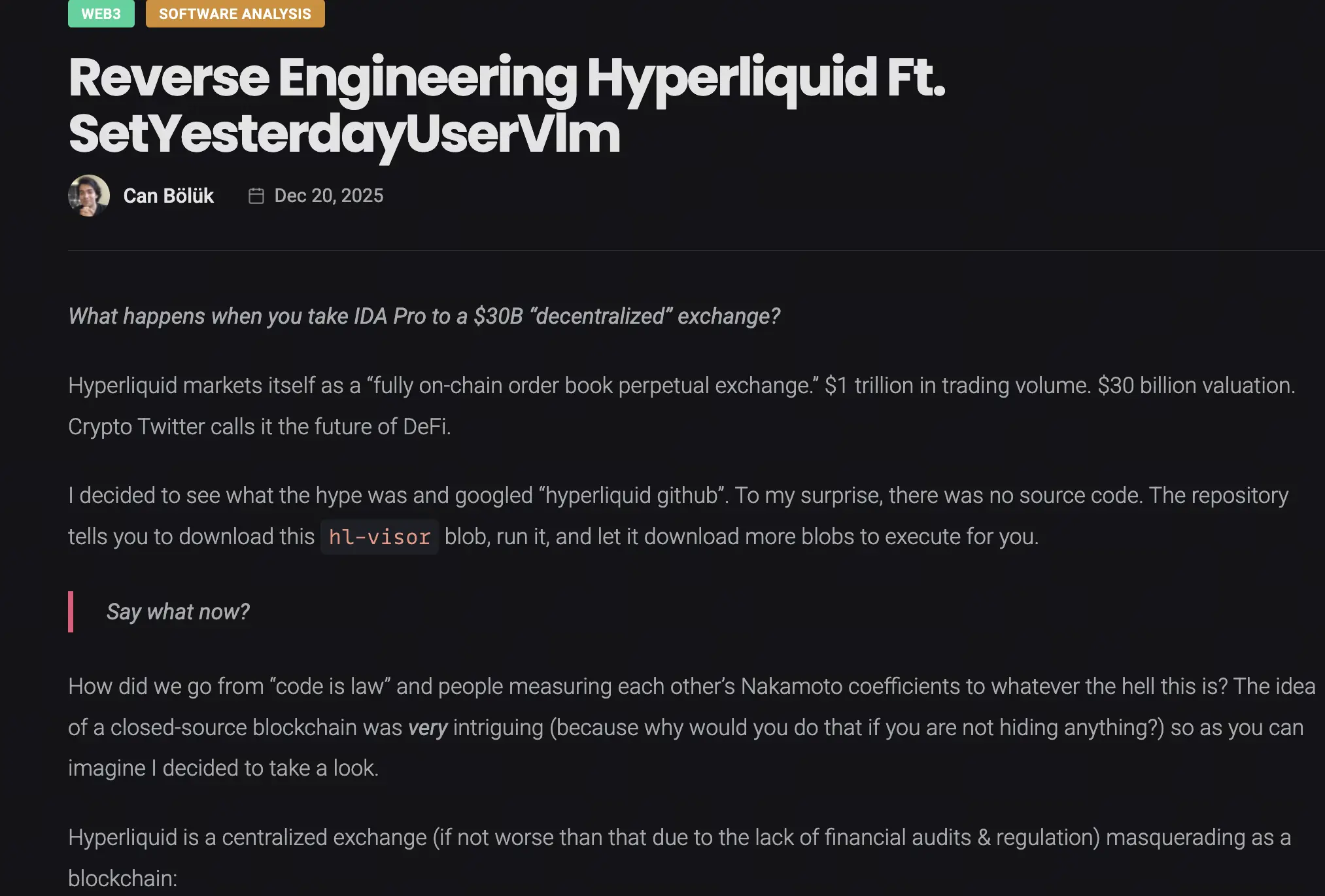
(Sources: Can ac)
The $362M “Missing” Funds: Double-Ledger Audit Blind Spot
The exposé’s most explosive claim was a $362 million shortfall in user assets versus on-chain reserves, implying partial-reserve operation akin to “on-chain FTX.”
Hyperliquid clarified this as a misread stemming from architectural evolution—from L2 AppChain to full independent L1. Reserves now operate on a dual-ledger system:
- Arbitrum Bridge Balance: $3.989 billion USDC (verifiable on Arbiscan).
- HyperEVM Native Balance: $362 million USDC (verifiable on Hyperevmscan).
- HyperEVM Contract Balance: $59 million USDC.
Total solvency: ~$4.351 billion USDC—matching HyperCore user balances exactly. The “gap” is simply migrated native assets, not vanished funds.
9-Point Rebuttal: Clarifications, Admissions, and Omissions
Hyperliquid systematically addressed accusations:
Fully Clarified Claims:
- “CoreWriter God Mode”: Limited interface for L1-HyperEVM interactions (e.g., staking); no fund misappropriation.
- $362M Shortfall: Dual-ledger migration overlooked.
- Hidden Lending Protocol: HIP-1 docs public; pre-release stage only.
Admitted but Explained:
- “Modify Volume” Code: Testnet remnant for fee simulation; mainnet isolated and non-executable.
- 8 Broadcast Addresses: Anti-MEV safeguard; multi-proposer upgrade planned.
- Planned Freezes: Standard for upgrades; network-wide pause required.
- Oracle Price Override: Essential for rapid liquidations in extreme volatility (e.g., 10/10 flash crashes).
Unaddressed or Vague:
- Unqueryable Governance Proposals: Users see votes but not on-chain text—remains a “black box.”
- No Escape Hatch on Bridge: Withdrawals rely on validators; lacks L2-style forced exits.
Striking at Competitors: “Centralized Sequencer” Critique
Hyperliquid turned defense into offense, calling out rivals:
- Lighter: Single centralized sequencer; non-public execution/ZK circuits.
- Aster: Centralized matching with dark pools—impossible without opaque sequencers.
- Others: Even open-source contracts lack verifiable sequencers.
Hyperliquid touts its full on-chain state visibility: “We have 8 centralized broadcast addresses, but everything’s auditable—unlike your black-box ops.”
This jab comes amid market share battles (per DefiLlama 30-day volume):
- Lighter: $23.23B (26.6%).
- Aster: $19.55B (22.3%).
- Hyperliquid: $18.20B (20.8%).
Hyperliquid leads in open interest, leveraging its “transparent centralization” as a brand differentiator.
Addressing Short-Selling Rumors: “Former Employee” Explanation
Community speculation about internal short-selling (e.g., 0x7ae4 address) was met with: “That’s a former employee fired in early 2024—unrelated to current team.” Strict trading bans and compliance for staff were reiterated.
Don’t Trust, Verify: Lessons from the FUD Storm
Hyperliquid’s response was masterclass PR: data-driven, code-linked, and proactive. By exposing rivals’ centralization, it reinforced its “fully on-chain state” edge. Yet, the event exposes DePIN/DeFi’s evolution pains: as AppChains grow complex (Bridge + Native assets), simple “check contract balance” audits fail.
For Hyperliquid, proving solvency is step one. True decentralization requires relinquishing those 8 addresses via multi-proposer upgrades—transitioning from “transparent centralization” to full verifiability.
Ultimately, this reinforces crypto’s golden rule: Don’t trust narratives; verify every byte.
In summary, Hyperliquid’s December 20, 2025, rebuttal to the “Reverse Engineering” FUD debunked insolvency claims via dual-ledger clarification while critiquing competitors’ centralization. Amid $3.62B “gap” resolved and admissions explained, unaddressed governance/bridge issues linger. As perp DEX wars intensify, transparency remains the battleground. Stay vigilant with on-chain verification in this high-stakes sector.
Disclaimer: The information on this page may come from third parties and does not represent the views or opinions of Gate. The content displayed on this page is for reference only and does not constitute any financial, investment, or legal advice. Gate does not guarantee the accuracy or completeness of the information and shall not be liable for any losses arising from the use of this information. Virtual asset investments carry high risks and are subject to significant price volatility. You may lose all of your invested principal. Please fully understand the relevant risks and make prudent decisions based on your own financial situation and risk tolerance. For details, please refer to
Disclaimer.


