


Just now! The Federal Reserve officially withdrew the 2023 restriction on banks' crypto activities ban
The Federal Reserve officially withdrew the 2023 policy statement restricting banks’ crypto activities and replaced it with new regulations, opening a new pathway for state member banks to engage in innovative activities. This historic shift means that stablecoin companies like Circle, Tether, Paxos, and BitGo can now hold customer reserves directly at the Federal Reserve, rather than all funds being routed through commercial banks. The new policy adopts a tiered review system, recognizing that different activities should be subject to different levels of regulation.
Why Was the 2023 Bank Crypto Ban Repealed?
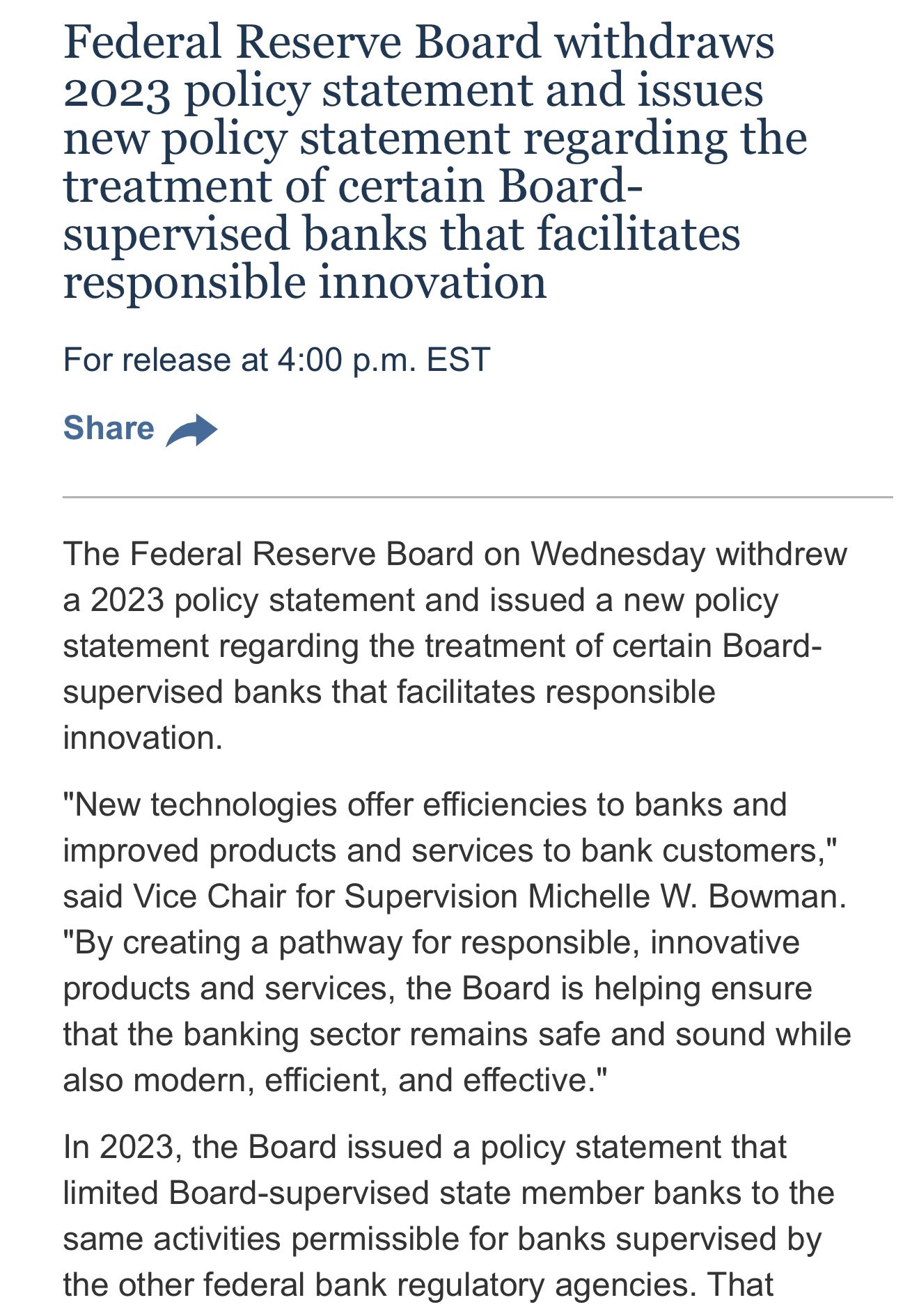
(Source: Federal Reserve)
The 2023 policy statement from the Federal Reserve was viewed by the industry as a “one-size-fits-all” restriction on banks’ crypto activities. The policy mandated that state member banks comply with the same activity rules as other federal regulators and attempted to specify how banks should handle new tools. The core logic of these rules was “the same banking activity should be subject to the same regulation,” aiming to create a fair competitive environment and prevent regulatory arbitrage.
However, within two years of the rule’s announcement, the financial system underwent dramatic changes. Cryptocurrencies shifted from fringe speculative tools to mainstream financial assets, spot ETF approvals were granted, institutional allocations increased significantly, and the market cap of stablecoins surpassed $200 billion. Against this backdrop, the restrictive rules of 2023 began to seem outdated and ill-timed. The Board stated that the financial landscape had changed and their understanding deepened, leading to the decision to revoke the old rules and replace them with new policies.
Deeper reasons include legal pressures. Custodia Bank was one of the earliest crypto banks to operate under a Wyoming Special Purpose Depository Institution (SPDI) license. It sued the Federal Reserve and the Kansas City Fed, accusing them of “blatantly illegal delays” in rejecting its main account application. Although the court dismissed the case, Custodia appealed, and the case is still ongoing. This legal battle and broader legal pressures prompted the Fed to reconsider its regulatory approach.
The core shift in the new policy is abandoning a “one-size-fits-all” approach in favor of “tiered review.” The Board’s memo states that the new statement “recognizes that the Board may permit uninsured state member banks to engage in activities that insured state member banks are not permitted to conduct, provided that such activities are conducted in a manner consistent with safety, soundness, and the maintenance of financial stability in the United States.” This flexibility allows room for innovation but also raises concerns about regulatory arbitrage.
Revolutionary Significance of Direct Fed Reserve Holdings for Circle and Tether
The most revolutionary impact of the new policy is allowing stablecoin companies like Circle, Paxos, Tether, and BitGo to hold customer reserves directly at the Federal Reserve. This change will fundamentally reshape the operation of the stablecoin industry.
Previously, these companies had to deposit customer reserves in commercial banks, incurring three types of costs. First, counterparty risk—if the partner bank failed (as in the 2023 SVB incident that caused USDC to temporarily depeg), stablecoin companies faced reserve losses. Second, operational costs—commercial banks charge account management and transfer fees. Third, efficiency losses—interbank transfers take time, affecting redemption speed.
Holding reserves directly at the Federal Reserve solves these issues. As the ultimate settlement layer, the Fed carries no risk of failure, providing absolute security that commercial banks cannot offer. Direct access reduces intermediaries, lowering operational costs. Faster settlement means stablecoin redemptions can be completed instantly, greatly enhancing user experience. Greater control over fund flows allows stablecoin companies to manage liquidity more flexibly.
Three Revolutionary Impacts of Holding Reserves Directly at the Fed
Elimination of Counterparty Risk: The Fed will not fail; reserve safety reaches the highest level, eliminating depegging risks like SVB
Lower Operational Costs: Bypassing commercial banks as intermediaries saves account management and transfer fees, increasing profitability
Enhanced Redemption Efficiency: Direct access to the Fed’s payment system enables real-time settlement, significantly improving user experience
This change will markedly boost the competitiveness of US stablecoins in the global market. When USDC and USDT reserves reach the safety level of U.S. Treasuries, other countries’ stablecoins will find it hard to compete. This also explains why European and Asian regulators are accelerating the development of local stablecoins—once U.S. stablecoins gain overwhelming dominance, sovereign currency issues will become a real threat.
Political Disputes: Bowman Supports, Barr Opposes
Federal Reserve Vice Chair Michelle Bowman is a strong supporter of the new policy. She stated: “New technology brings efficiency to banks and offers better products and services to bank customers. By creating responsible and innovative products and services, the Board helps ensure that banking remains safe and sound while also modern, efficient, and effective.”
However, Fed Governor Michael Barr voted against it. His dissent reveals potential risks of the policy. Barr pointed out that the original 2023 statement was based on the principle that “the same banking activity should be subject to the same regulation,” which was agreed upon unanimously. “Therefore, I cannot agree to rescind the current policy statement and adopt a new one that, in effect, encourages regulatory arbitrage, undermines fair competition, and creates incentives that conflict with maintaining financial stability.”
Barr’s concerns are not unfounded. While tiered review offers flexibility, it could also concentrate higher-risk activities in less regulated institutions. If uninsured state member banks engage heavily in high-risk crypto activities, problems could spill over into the broader financial system. Such regulatory arbitrage echoes lessons from the 2008 financial crisis.
This political divide reflects fundamental differences within the Fed regarding innovation and risk. Bowman represents an embrace of innovation and market self-regulation, while Barr advocates cautious regulation to prevent systemic risks. Under the broader context of the Trump administration’s crypto-friendly policies, Bowman’s stance currently prevails, but if major risks emerge in the crypto market, the pendulum could swing back to Barr’s cautious approach.
For the crypto industry, this policy shift is a major positive but also brings new responsibilities. The Fed has explicitly supported “responsible innovation,” meaning companies with direct access must establish stricter risk controls and compliance systems. Any major misstep could lead to policy tightening again, a warning the entire industry must heed.
Related Articles
Tether will jointly invest 5 million Swiss Francs with the Lugano City Government to promote Phase 2 of the Plan ₿ project
Deloitte provides the initial reserve backing for Tether's USAT stablecoin
U.S. Attorney Files Forfeiture Action to Recover $327,829 in Tether From Dating App Romance Scam
Tether's issued USAT stablecoin has finally been audited by the Big Four accounting firm Deloitte
Tether, Anchorage Tap Deloitte for First USAT Stablecoin Reserve Report