Gate Options Product Overview
This module introduces Gate's options products, including European options, the cash-settlement mechanism, and a comparison between USDT- and coin-margined options.
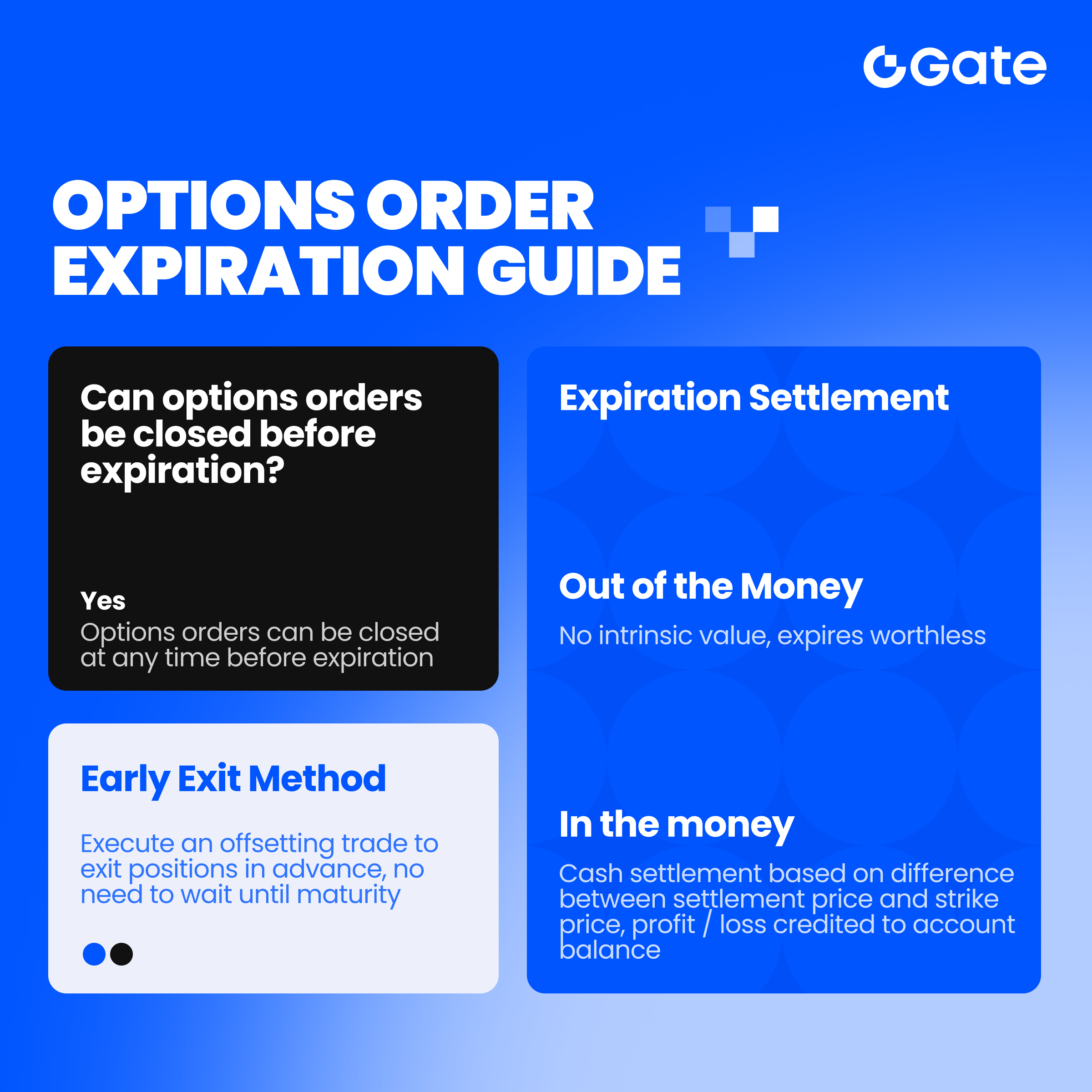
You Can Close Your Position Anytime Before Expiration
Is the expiration date for options trading really that complicated? Can you close your position before expiration? Will not closing your position lead to significant losses? What happens to your options after expiration?
In reality, options expiration is not as complex as it seems. Similar to spot or futures trading, you can close your options position at any time before expiration. By executing a reverse trade, you can settle your position without having to hold it until the expiration date. Most traders use early closing to take profit or cut losses, rather than waiting for expiration settlement.
If you choose to hold until expiration, Gate uses a cash settlement mechanism that is fully automated—no manual action is required:
- If the option is out-of-the-money at expiration, it has no intrinsic value compared to the underlying settlement price, and the option will automatically expire worthless. Your maximum loss is limited to the premium you originally paid.
- If the option is in-the-money, the platform will automatically settle in cash based on the difference between the settlement price and the strike price. Any resulting profit or loss will be directly reflected in your account balance.
Whether you close your position early or hold until expiration, the risk boundaries and settlement rules for options trading are clear and manageable. As long as you understand the basic mechanics, expiration won’t introduce any extra complexity or “uncontrollable losses.”
Gate European Options
European Options vs. American Options
1.European Options
- Exercise Time: Can only be exercised on the Expiration Date itself; early exercise is not allowed.
2.American Options
- Can be exercised at any time up to and including the expiration date (more flexible).
On the Gate platform, options are all exercised as European options upon expiration.
Exercising an option means the buyer is exercising the right to buy or sell the underlying asset.
A call option is the right to buy the underlying asset. Exercising a call option means that the holder exercises their right to purchase the asset at the option’s strike price.
A put option is the right to sell the underlying asset. Exercising a put option means the holder exercises their right to sell the asset at the option’s strike price.
Options can be further categorized as European or American. The main difference between the two lies in when the option can be exercised.
European options can only be exercised at expiration. For example, consider a European call option on BTC with a strike price of 105,000 USDT. The holder has the right to buy BTC at 105,000 USDT, but because it is a European option, this right cannot be exercised before the expiration date. Therefore, even if BTC rises to 107,000 USDT before expiry, the trader cannot immediately exercise the option to purchase BTC at 105,000 USDT.
However, European options can be closed out before expiration by trading the position, without waiting until the expiry date for exercise.
Cash-Settled Options on Gate
All Gate options are settled in cash
Cash-settled options refer to options where, upon expiration or exercise, the buyer and seller do not engage in physical delivery of the underlying asset. Instead, the profit or loss is settled in cash based on the difference between the market price of the underlying asset and the strike price.
- Applicable to: High liquidity, high volatility assets (such as BTC and ETH options).
- Advantages:
- No need to transfer the underlying asset — faster and more cost-efficient settlement.
- Avoids blockchain transaction fees and friction
How It Works
When a cash-settled option contract is exercised, only the difference between the strike price and the current market price is paid into the option buyer’s account. Only the cash value of this difference is settled.
At the time of options expiration
- Call Options:
- If at expiration, the market price > strike price, the buyer receives cash equal to (Market Price – Strike Price) × Contract Multiplier.
- If market price ≤ strike price, the option expires worthless, and the buyer loses the premium.
- Put Options:
- If at expiration, the market price < strike price, the buyer receives cash equal to (Strike Price – Market Price) × Contract Multiplier.
- If market price ≥ strike price, the option expires worthless, and the buyer loses the premium.
Example 1 (BTC Call Options):
- Strike Price: $30,000
- BTC Price at Expiration: $35,000
- Contract Size: 1 BTC
- Settlement Amount = ($35,000 - $30,000) × 1 = $5,000 (paid by the seller to the buyer, excluding fees)
Example 2:
Let us once again assume a BTC call option with a strike price of 105,000 USDT, where the contract is cash-settled. Suppose the current BTC price is 107,000 USDT. The call option buyer exercises their right to purchase BTC at the strike price of 105,000 USDT. Since this is a cash-settled contract, the buyer is paid the difference between the current price (107,000 USDT) and the strike price (105,000 USDT) in cash. In this case, the difference between the current BTC price and the strike price is 2,000 USDT (calculated as 107,000 USDT minus 105,000 USDT). Therefore, 2,000 USDT is credited to the buyer’s account.
USDT-M Options vs. Coin-M Options
In crypto options trading, USDT-margined options and coin-margined options are two mainstream types. In comparison, Gate’s USDT-margined options settle in stablecoins, providing clear PNL and more controllable risk, making them more suitable for most traders, especially beginners. They eliminate the extra risk caused by coin price volatility, allowing you to focus on your strategy itself.
1. Basic Definitions

2. Key Differences and Comparisons

Summary of Advantages of Gate’s USDT-M Options
1.Stable settlement with clear PNL
- All profits and losses are denominated in USDT, unaffected by BTC/ETH price volatility, making it easier for traders to evaluate P&L and manage risk.
2.More favorable margin mechanism
- Using stablecoins as margin to avoid margin shrinkage caused by underlying asset price drops, better suited for quantitative strategies and risk management.
3.Suitable for all types of traders
- Whether novice users or professional traders, USDT-margined options offer a clearer trading experience and higher risk management efficiency.
4.Easier hedging
- When used to hedge spot positions or perpetual positions, USDT-margined options allow flexible and precise locking of USDT value changes.
5.Liquidity and product innovation
- Gate provides a rich variety of USDT-margined options products, featuring multiple strike prices and expiration dates to meet both short-term and long-term strategy needs, with continuous product updates.
Related Courses
Basic Options Strategies & The Greeks