I. An Overlooked Shift: DeFi’s Growth Focus Is Changing
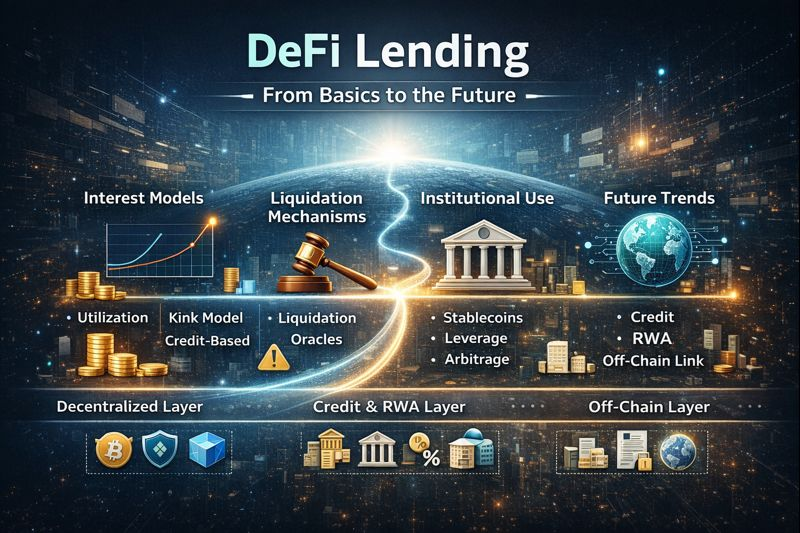
For a long time, DeFi’s core impression on the market has been summed up in two words: high yield. Whether it was early liquidity mining or later incentive-driven protocol designs, users’ primary motivation for entering DeFi has always revolved around short-term APY. The level of returns has almost single-handedly determined the flow of capital.
However, since 2024–2025, this logic has been undergoing a structural shift. New capital no longer prioritizes high-risk, high-volatility strategies. The proportion of stablecoins and low-volatility assets on-chain has continued to rise. The focus of protocol competition has shifted from “who offers more rewards” to “who has more controllable risks”. Against this backdrop, lending protocols—not DEXs, have re-emerged as the core module driving DeFi growth.
This is not a sentiment-driven cyclical rotation, but a fundamental return to financial functionality.
II. Why Lending, Not Trading or Derivatives?
From a financial perspective, lending is the most foundational and scalable functional module in all financial systems.
Whether in traditional finance or on-chain finance, lending always serves three key roles:
- Capital Allocation Hub: Connects capital providers and capital demanders
- Risk Pricing Tool: Reflects market consensus on risk through interest rates
- Source of Leverage and Liquidity: Underpins trading, market making, arbitrage, and hedging activities
In contrast, trading and derivatives are more aligned with the application layer, while lending is closer to the infrastructure layer of the financial system.
In the early days of DeFi, this advantage was not fully realized, not because the models were flawed, but because external conditions were not yet mature:
- Limited stablecoin scale
- Unstable on-chain liquidation and risk control mechanisms
- Lack of compliant, replicable on-chain participation channels for large capital
These constraints are now being gradually lifted.
III. Stablecoins: The True “Fuel” of DeFi Lending
If DeFi lending is the engine, then stablecoins are the fuel.
By 2025, stablecoins have completed three key role transformations:
- From trading pair denomination units
- To on-chain settlement mediums
- And then to the core assets of on-chain asset markets
An important shift is underway: More and more stablecoins are no longer flowing in and out of exchanges frequently, but are staying on-chain for the long term.
When stablecoins “stay put”, two core questions naturally arise:
- Where to store them most safely?
- How to generate sustainable returns under controllable risks?
This is precisely the core use case for lending protocols. For institutional capital, the appeal of on-chain lending does not lie in extreme returns, but in:
- Clarity of return sources
- Quantifiability of risks
- On-demand liquidity exit
At the current stage, lending protocols are the DeFi module that best meets these requirements.
IV. The Ongoing “Institutionalization” Shift of DeFi Lending
The so-called “institutionalization” does not mean that DeFi is copying the traditional banking system, but rather that its operational logic is gradually moving toward low uncertainty and high predictability.
This shift is mainly reflected in three dimensions:
1. From “Highest Returns” to “Stable Returns”
Institutional capital typically does not pursue extreme APY, but instead focuses more on:
- Interest rate volatility ranges
- Liquidation performance under extreme market conditions
- Stability of long-term compound interest
This makes stablecoin-centric lending markets with clear risk parameters a natural entry point.
2. From Anonymous Gambling to Risk Stratification
The current DeFi lending market is witnessing clear stratification:
- Permissionless liquidity pools targeting the open market
- Lending structures targeting specific borrowers with credit screening mechanisms
This change is not a “retreat from decentralization”, but an inevitable result of refined risk pricing.
3. From “Code Is Law” to “Mechanism Is Product”
For institutions, full decentralization is not the sole criterion; what matters more is:
- Whether liquidation is stable and reliable
- Whether risk control parameters can be dynamically adjusted
- Whether there is a risk of systemic failure under extreme conditions
Competition among lending protocols is shifting from feature richness to mechanism maturity.
V. Why Is DeFi Lending Becoming “Financial-Grade Infrastructure”?
To understand this, we need to distinguish between product-level applications and infrastructure-level protocols.
A true financial infrastructure typically has four characteristics:
- Reusability: Continuously integrated by different strategies and protocols
- Risk Transparency: Core parameters can be externally evaluated and modeled
- The larger the scale, the more stable the system becomes, not the more fragile it is
- Does not rely on a single narrative to survive
DeFi lending at the current stage is gradually meeting these criteria:
- Lending positions are widely used for trading, market making, arbitrage, and hedging
- Interest rates have become one of the most important on-chain risk signals
- Leading protocols have verified the effectiveness of their liquidation mechanisms through multiple rounds of extreme market conditions
- Return sources are gradually shifting back to real capital demand rather than incentive subsidies
This is why more and more research institutions and long-term capital are clearly anchoring the next phase of DeFi growth to the lending ecosystem.