Ethereum Expands Security Efforts with Audit Subsidy Program

Last Updated 2026-04-16 10:10:55
Reading Time: 3m
To strengthen blockchain application security, the Ethereum Foundation has introduced a new audit grant program. Through financial support and partnerships with professional institutions, the program reduces the cost threshold for Developers to perform security audits. In this article, you'll learn how the program works, the criteria for participation, and its broader implications for the crypto industry.

Ethereum Unveils Security Audit Subsidy Program
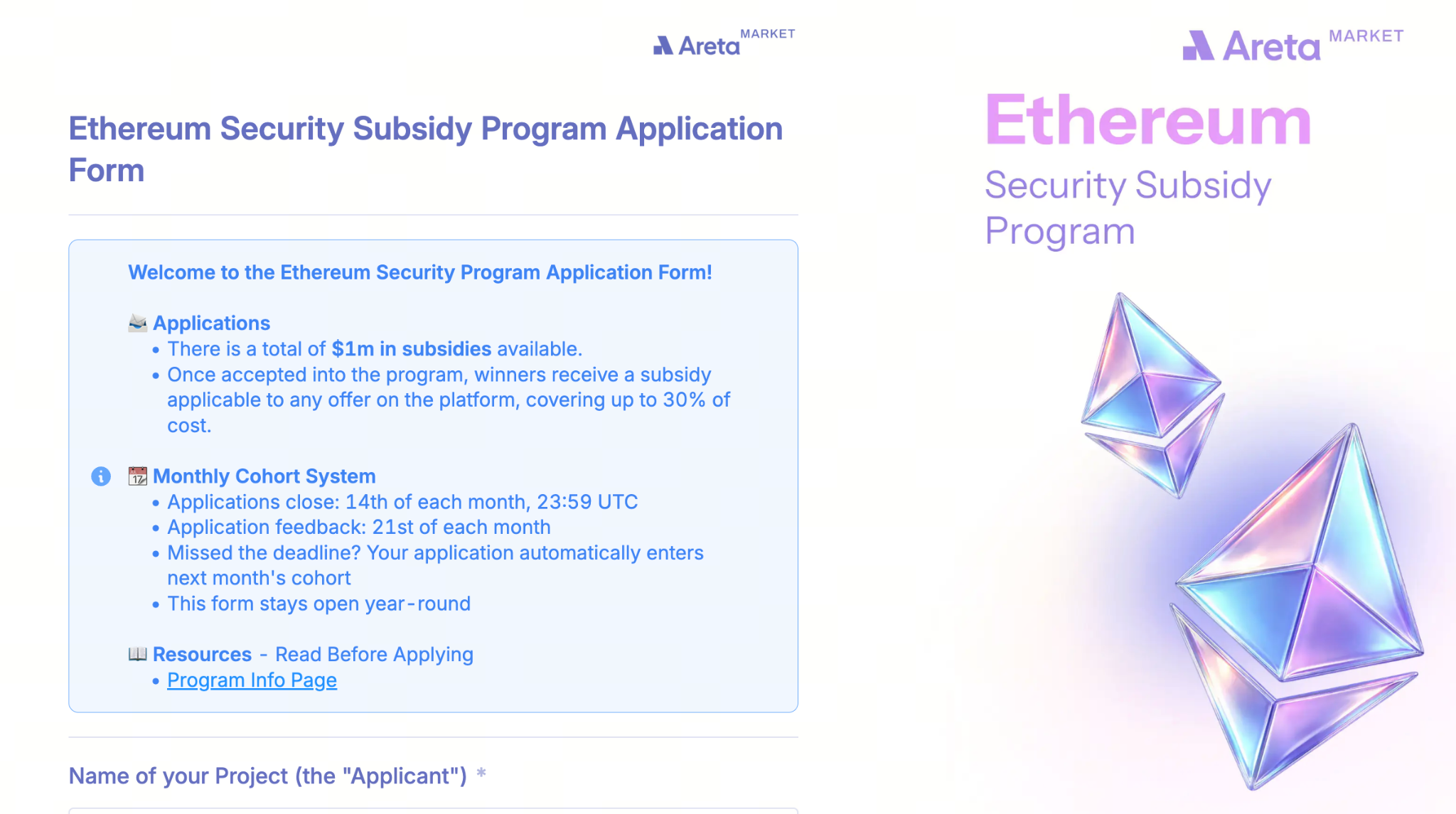
(Source: Areta)

The Ethereum Foundation has recently announced a new security initiative designed to make it easier for blockchain developers to access professional security audit services. The Ethereum Security Subsidy Program aims to lower the high costs of security audits, enabling more teams to thoroughly vet their products before launch.

How It Works: Building an Integrated Audit Platform

This program is a joint effort between the Ethereum Foundation and digital asset advisory firm Areta. Through Areta’s audit matchmaking platform, developers can directly connect with around 20 specialized security audit firms.

Here’s how the program operates:

  • Development teams submit applications and undergo a review process

  • Approved projects receive partial subsidies for audit fees

  • Subsidies can cover up to 30% of audit costs

  • New subsidy recipients are selected on a fixed term each month

Additionally, blockchain data provider Chainlink and Ethereum client developer Nethermind participate in the evaluation process, helping to filter and select high-potential projects.

Program Scale and Evaluation Criteria

The program’s initial funding totals $1 million, allocated to support eligible projects in securing professional security audits. Selection criteria include:

  • Technical strength and innovation

  • Project feasibility

  • Team track record

  • Long-term commitment to the Ethereum ecosystem

(Source: 0xboo)

This initiative is not just about financial support—it also serves as a mechanism to identify and elevate top development teams.

Core Values: Security, Privacy, and Openness

According to the Ethereum Foundation, the program gives priority to projects that align with the CROPs principles: Censorship Resistance, Open Source, Privacy, and Security. These values are recognized as key pillars for the ongoing development of the Ethereum ecosystem.

Previously, the Foundation introduced its Trillion-Dollar Security vision, aiming to raise network security standards to a level capable of safeguarding assets worth trillions of dollars.

Why Security Audits Matter More Than Ever

In blockchain, once a Smart Contract is deployed, it’s nearly impossible to change—meaning any vulnerability can result in severe losses. This makes security audits a critical step in the development lifecycle.

Other projects are also prioritizing security. For example, Aave Labs recently launched a $1.5 million audit program to secure its latest protocol version.

Leading Security Firms Join the Program

More than 20 top security firms have already joined the subsidy program, including Blocksec, Hacken, Quantstamp, and Immunefi. Immunefi is a well-known decentralized bug bounty platform and has received backing from Anchorage Digital.

Conclusion

The audit subsidy program is about more than just cost reduction—it’s about fostering a security-first development culture. As capital and resources continue to flow in, blockchain application security is set to improve, moving the crypto industry toward greater maturity and resilience.

Author:  Allen
Disclaimer
* The information is not intended to be and does not constitute financial advice or any other recommendation of any sort offered or endorsed by Gate.
* This article may not be reproduced, transmitted or copied without referencing Gate. Contravention is an infringement of Copyright Act and may be subject to legal action.

Related Articles

The Future of Cross-Chain Bridges: Full-Chain Interoperability Becomes Inevitable, Liquidity Bridges Will Decline
Beginner

The Future of Cross-Chain Bridges: Full-Chain Interoperability Becomes Inevitable, Liquidity Bridges Will Decline

This article explores the development trends, applications, and prospects of cross-chain bridges.
2026-04-08 17:11:27
Solana Need L2s And Appchains?
Advanced

Solana Need L2s And Appchains?

Solana faces both opportunities and challenges in its development. Recently, severe network congestion has led to a high transaction failure rate and increased fees. Consequently, some have suggested using Layer 2 and appchain technologies to address this issue. This article explores the feasibility of this strategy.
2026-04-06 23:31:03
Sui: How are users leveraging its speed, security, & scalability?
Intermediate

Sui: How are users leveraging its speed, security, & scalability?

Sui is a PoS L1 blockchain with a novel architecture whose object-centric model enables parallelization of transactions through verifier level scaling. In this research paper the unique features of the Sui blockchain will be introduced, the economic prospects of SUI tokens will be presented, and it will be explained how investors can learn about which dApps are driving the use of the chain through the Sui application campaign.
2026-04-07 01:11:45
Navigating the Zero Knowledge Landscape
Advanced

Navigating the Zero Knowledge Landscape

This article introduces the technical principles, framework, and applications of Zero-Knowledge (ZK) technology, covering aspects from privacy, identity (ID), decentralized exchanges (DEX), to oracles.
2026-04-08 15:08:18
What is Tronscan and How Can You Use it in 2025?
Beginner

What is Tronscan and How Can You Use it in 2025?

Tronscan is a blockchain explorer that goes beyond the basics, offering wallet management, token tracking, smart contract insights, and governance participation. By 2025, it has evolved with enhanced security features, expanded analytics, cross-chain integration, and improved mobile experience. The platform now includes advanced biometric authentication, real-time transaction monitoring, and a comprehensive DeFi dashboard. Developers benefit from AI-powered smart contract analysis and improved testing environments, while users enjoy a unified multi-chain portfolio view and gesture-based navigation on mobile devices.
2026-03-24 11:52:42
What Is Ethereum 2.0? Understanding The Merge
Intermediate

What Is Ethereum 2.0? Understanding The Merge

A change in one of the top cryptocurrencies that might impact the whole ecosystem
2026-04-09 09:17:06





