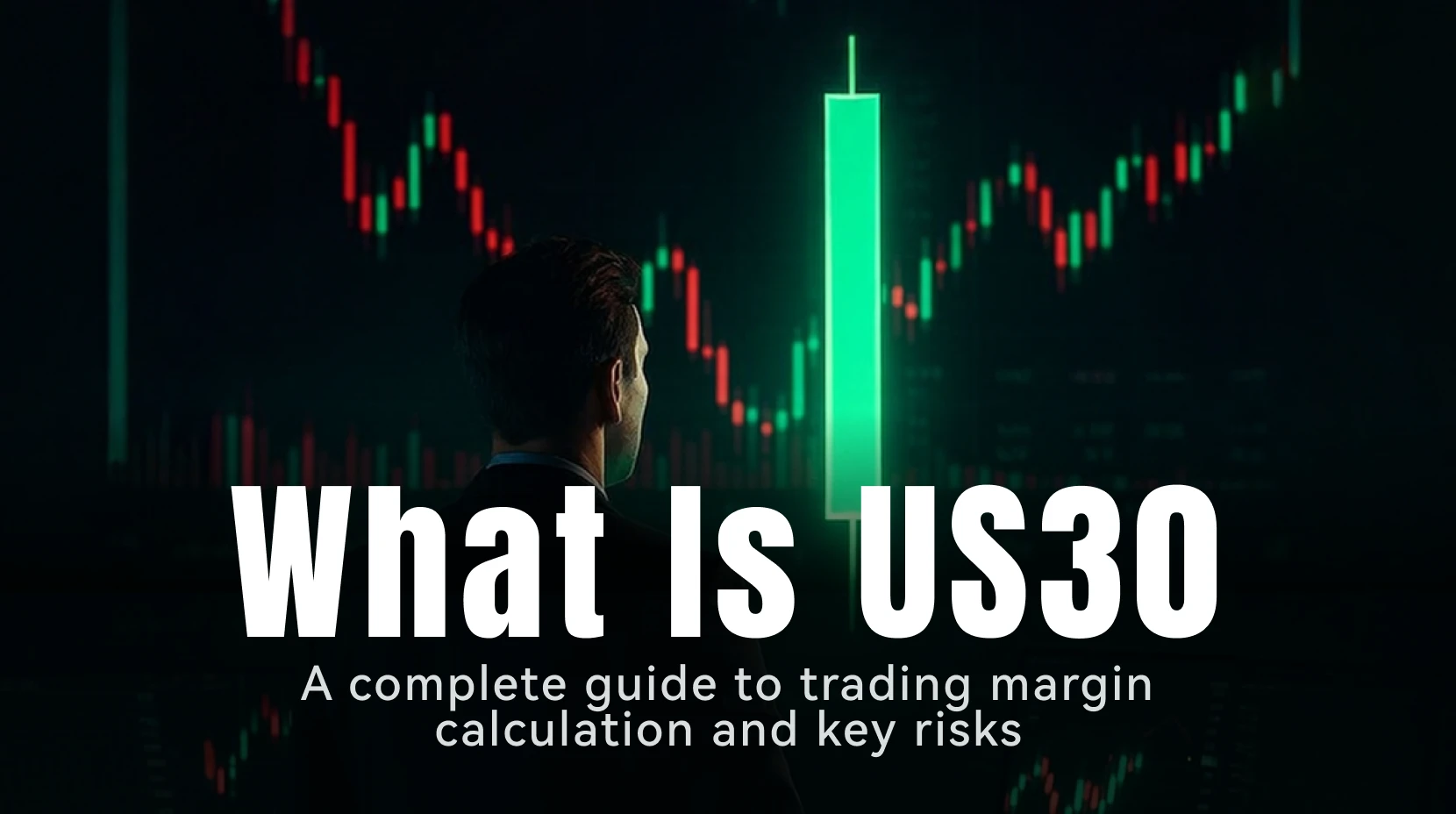
The Dow Jones Industrial Average CFD is a derivative financial instrument that allows traders to participate in index price movements without owning the underlying stocks. Through the Contract for Difference mechanism, investors can take long or short positions based on market expectations while using margin and leverage to control larger notional positions. This makes US30 not only a market benchmark but also a flexible, tradable index asset.
2026-03-24 07:14:13
The Dow Jones Industrial Average, commonly referred to as US30 in trading markets, is one of the most representative stock indices in the world. It consists of 30 blue-chip companies that play a significant role in the U.S. economy, spanning key sectors such as technology, finance, consumer goods, and industrials.
The index uses a price-weighted methodology, meaning companies with higher share prices have a greater impact on index movements. As a result, US30 is widely used to track the performance of major U.S. corporations and broader economic cycles.
2026-03-24 07:12:54
Plasma (XPL) differs from traditional payment systems across several core dimensions. In terms of settlement, Plasma enables direct on-chain asset transfers, while traditional systems rely on account-based ledgers and intermediary clearing. In efficiency and cost, Plasma offers near real-time and low-cost transactions, whereas traditional systems often involve delays and layered fees. For liquidity management, Plasma uses stablecoins for on-demand capital allocation, while traditional systems depend on pre-funded accounts. In programmability and accessibility, Plasma supports smart contracts and operates on an open global network, while traditional systems remain constrained by legacy banking infrastructure.
2026-03-24 06:26:53
Plasma is a blockchain network designed specifically for stablecoin payments. Through PlasmaBFT consensus, a Paymaster gas sponsorship mechanism, and a native Bitcoin bridge, it enables zero-fee transfers and high-performance settlement. Unlike general-purpose blockchains, Plasma treats stablecoins as core assets and optimizes execution and settlement at the protocol level, allowing users to complete on-chain payments with an experience close to Web2. It is suited for cross-border remittance, merchant payments, and high-frequency settlement scenarios.
2026-03-24 06:26:14
Plasma (XPL) is a blockchain infrastructure designed for stablecoin payments. Its native token, XPL, performs core functions across the network, including gas fees, validator incentives, governance participation, and value capture. Built around the central use case of high-frequency payments, the XPL tokenomics model combines inflationary distribution with fee burning in an attempt to balance network growth with long-term asset scarcity.
2026-03-24 06:23:45
Polymarket has revised its market integrity rules, introducing clear definitions for three categories of insider trading for the first time. The update responds to recent disputes and reinforces regulatory principles. This article examines the specifics of the new rules, the relevant background, and their far-reaching implications for the prediction market sector.
2026-03-24 06:04:22
2026 Payment Disruption: As AI Agents Take Over Wallets, the Traditional “Toll Fee” Model Fades Out. In Q1 2026, leading players including Google, Circle, and Stripe rolled out AI payment protocols—UCP, Nanopayments, and MPP—ushering in a new era of “zero-cost” machine-to-machine transactions. Of 140 million agent-driven payments averaging $0.31 each, stablecoins (USDC) made up 98.6% of the total volume. With commission revenues threatened, Stripe repositioned itself as an infrastructure provider by launching the Tempo chain, while Mastercard invested $1.8 billion to acquire BVNK, locking down fiat on- and off-ramps. Payment giants have moved from “territory acquisition” to “territory definition,” with core profits shifting from transaction fees to reserve yield and conversion service charges.
2026-03-23 10:53:19
Lombard is a decentralized protocol focused on cross-chain asset liquidity and security infrastructure. Its core design uses the BARD token to establish a scalable governance system, gradually shifting control from the core team to the community while aligning on-chain decision-making with economic incentives.
2026-03-23 08:49:37
Lombard (BARD) is a DeFi protocol focused on unlocking and reusing Bitcoin liquidity. Its core token, BARD, connects LBTC assets with on-chain financial activity through incentive mechanisms, governance participation, and value capture.
2026-03-23 08:48:29
ether.fi is a non-custodial liquid staking and restaking protocol built on Ethereum that enables users to stake ETH while retaining control over their assets and receiving liquid staking tokens such as eETH. With the expansion of Ethereum staking and decentralized finance, it has become part of a broader infrastructure that combines staking, liquidity, and extended security mechanisms.
2026-03-23 08:41:21
Lombard (BARD) is a decentralized finance platform designed for asset management and yield optimization. Its core objective is to enable efficient capital allocation and risk control through on-chain protocols and automated strategies.
2026-03-23 08:35:35
$500 Million Becomes $30 Billion: An “Investment Legend” Outside a Federal Prison
In 2022, SBF funneled FTX customer funds into Anthropic, investing $500 million for an 8% equity stake. Four years later, as Anthropic’s valuation surged past $38 billion, this stake—liquidated due to fraud—reached a theoretical value of $30 billion.
This article explores the “Effective Altruism (EA)” network linking SBF and Anthropic’s founders, exposing how the most audacious investment in AI history stemmed not from vision, but from a covert cycle of funds within the community. It stands as both a dark comedy of a 60x return and a sober account of EA philosophy’s unraveling amid the pursuit of wealth and power.
2026-03-23 08:31:36
Amid the outbreak of war, why have stablecoin issuers emerged as the biggest winners? From February to March 2026, Circle’s stock price defied the broader market, soaring from $49 to $123. This article provides an in-depth analysis of the truth behind Circle’s “war dividend”: geopolitical tensions have locked in expectations of delayed interest rate cuts, allowing its $79 billion treasury bond reserve to generate sustained excess returns. Meanwhile, USDC’s ability to serve as a “physical safe haven” and facilitate “cross-border settlements” amid the Middle East turmoil has driven its trading volume to surpass that of USDT. However, beneath the surging stock price, structural concerns such as the profit-sharing agreement with Coinbase and a deep dependence on a high-interest-rate environment continue to weigh on Circle.
2026-03-23 08:30:12
The article analyzes the potential of the pay-as-you-go model in the age of agents, while warning about the gray areas of web crawling and the balance between revenue and V2 dynamic routing.
2026-03-23 08:28:59
Through case studies such as Morpho×Apollo and BlackRock×Uniswap, the article reveals the logic that 90% of projects overlook: holder quality matters more than price noise.
2026-03-23 08:27:44