In privacy focused blockchains, a single token often struggles to handle both value transfer and ecosystem governance. For this reason, BEAM separates its Proof of Work token from its DAO governance token, allowing payments, incentives, and decision making to operate at different layers. This structure is common in networks that need to balance security with governance flexibility.
Understanding this model requires looking at three key dimensions: issuance, incentive distribution, and governance design. Together, these determine how value is created and allocated within the BEAM network.
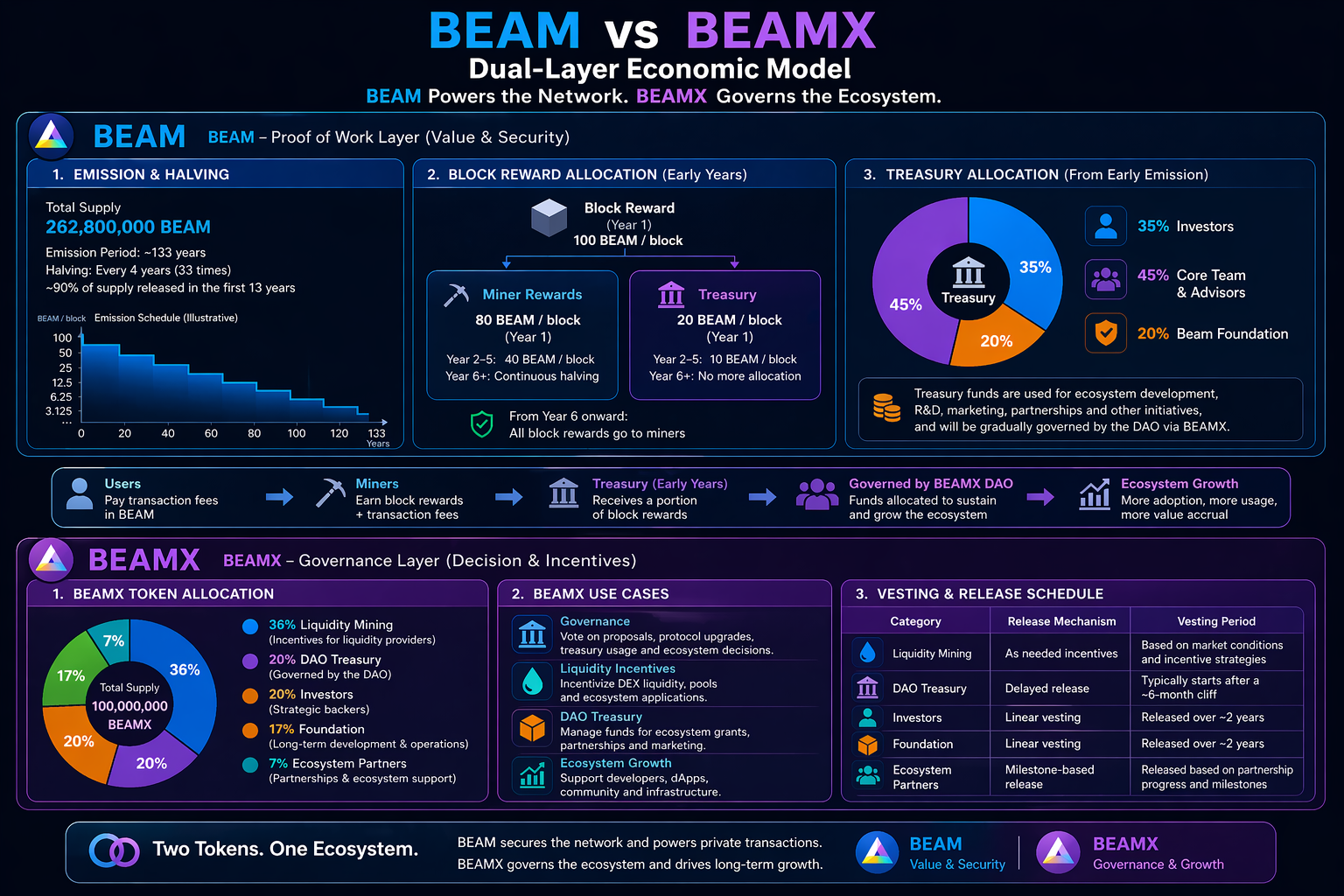
What Role Does the BEAM Token Play in the Economy
As the base layer token, BEAM serves two core functions: payments and security incentives.
At the mechanism level, every transaction requires BEAM as a fee. These fees, combined with block rewards, form the primary income for miners, incentivizing them to contribute computational power to maintain the network. Transaction fees not only compensate for resource usage but also help regulate network load.
Structurally, BEAM connects the user layer and the network layer. Users rely on it for private payments, nodes earn it as rewards, and the network depends on it for security. This unified value layer creates a closed loop within the system.
The importance of this design lies in tying network security directly to real usage rather than external inputs.
How BEAM Issuance and Halving Shape Supply
Supply dynamics are central to understanding the model.
At the mechanism level, BEAM is issued continuously through block rewards and follows a fixed halving schedule that reduces new supply over time. Early on, issuance is relatively high to attract miners, while later stages emphasize scarcity.
Structurally, the total supply is capped at approximately 262.8 million BEAM, with an issuance period of around 133 years. A significant portion of tokens is distributed in the early phase, creating a front loaded emission curve that helps establish network security quickly.
| Dimension |
BEAM Design |
| Total Supply |
262,800,000 BEAM |
| Issuance Period |
~133 years |
| Halving Cycle |
Every 4 years |
| Emission Pattern |
Front loaded |
This design adjusts supply over time, aligning incentives with different stages of network growth.
How Miner Incentives and Block Rewards Are Distributed
Incentive distribution directly affects participation.
At the mechanism level, miners earn rewards by producing blocks. These rewards consist of newly issued tokens and transaction fees. In the early stages, a portion of block rewards is allocated to the Treasury to support ecosystem development.
Structurally, reward distribution evolves over time. The Treasury share gradually declines, while the miner share increases. Eventually, the network transitions to a model sustained entirely by miners and transaction fees.
| Phase |
Miner Reward |
Treasury |
| Year 1 |
80 BEAM |
20 BEAM |
| Years 2–5 |
40 BEAM |
10 BEAM |
| Later Stages |
Continual halving |
Phased out |
This structure shows how BEAM initially supports ecosystem growth, then shifts toward a pure security driven incentive model.
How the Treasury Is Allocated and Used
The Treasury bridges issuance and governance.
At the mechanism level, a portion of block rewards is pooled into the Treasury to fund development, marketing, and ecosystem partnerships. Over time, control of these funds transitions from centralized management to governance based allocation.
Structurally, early stage distribution is managed by core stakeholders, while later stages introduce more decentralized decision making through governance mechanisms.
| Allocation Target |
Share |
| Investors |
35% |
| Core team and advisors |
45% |
| Foundation |
20% |
This approach provides early funding support while laying the groundwork for decentralized governance.
How BEAMX Functions in Governance
Governance within BEAM is enabled by BEAMX.
At the mechanism level, BEAMX is used for proposal voting, fund allocation, and ecosystem level decision making. Unlike the base token, it does not serve as a payment or mining asset, but operates strictly within the governance layer.
Structurally, BEAMX distributes decision making power across token holders, shifting control away from a single authority. The DAO model allows participants to influence the direction of the ecosystem.
This design extends the economic system beyond value creation into value allocation.
How BEAMX Distribution and Vesting Are Structured
The distribution of BEAMX determines how governance power is spread.
At the mechanism level, the total supply is set at 100 million tokens, allocated across different participant groups. Tokens are released gradually to prevent sudden concentration in circulation.
Structurally, liquidity mining holds the largest share to drive ecosystem activity, while the DAO Treasury and investor allocations support long term development.
| Allocation Category |
Share |
| Liquidity mining |
36% |
| DAO Treasury |
20% |
| Investors |
20% |
| Foundation |
17% |
| Ecosystem partners |
7% |
This structure balances short term engagement with long term sustainability.
How the Dual Token Model Works Together
BEAM and BEAMX form a layered system where value and control are separated.
At the mechanism level, BEAM generates value and secures the network, while BEAMX determines how that value is distributed. Transaction fees flow to miners, part of the rewards feed into the Treasury, and governance mechanisms decide how those resources are used.
Structurally, this separation allows the payment system and governance system to operate independently while remaining interconnected.
The result is a system that maintains operational stability while retaining flexibility for future adjustments.
Limitations of the BEAM Economic Model
Every economic model comes with trade offs.
At the mechanism level, the dual token structure adds flexibility but also increases complexity. Users must understand both payment and governance layers to fully participate.
Structurally, the model depends on sustained network activity. If transaction demand is low, the balance between fees and incentives may weaken. In addition, strong privacy features reduce on chain transparency, which can complicate external analysis and regulatory alignment.
These limitations suggest that BEAM is best suited for environments where privacy and efficiency are prioritized over transparency.
Summary
BEAM separates value creation, network security, and resource allocation through a dual token design. By combining a base layer token with a governance token, it enables a privacy focused blockchain to maintain both operational stability and governance flexibility.
FAQ
What is the relationship between BEAM and BEAMX?
BEAM is used for payments and incentives, while BEAMX is used for governance and fund allocation. Together, they form a dual layer economic system.
What are the key features of BEAM’s issuance model?
It uses long term issuance with periodic halving, gradually reducing supply and introducing scarcity over time.
Why does BEAMX exist separately?
It isolates governance functions, allowing network decisions to operate independently from the base token.
What role does the Treasury play?
The Treasury funds ecosystem development and allocates resources through governance mechanisms.
Is the BEAM economic model complex?
It is more complex than single token systems, but this complexity enables a clear separation between payments and governance.







