POLYX is the native token powering Polymesh, an institutional-grade blockchain specifically designed for regulated asset tokenization and security token offerings. Launched in 2021 by Polymath, Polymesh addresses key challenges including governance complexities, identity verification, compliance automation, and settlement inefficiencies in traditional finance. As of January 2026, with 6,077 active holders and a market cap of $80.76 million, POLYX enables governance, staking, and transaction validation through its Nominated Proof-of-Stake consensus mechanism. The platform's purpose-built compliance features, institutional infrastructure, and strategic focus on digital securities distinguish it from general-purpose blockchains. This comprehensive guide explores Polymesh's technical architecture, market performance, ecosystem applications, and how institutional participants can engage with regulated asset infrastructure through Gate and other platforms.
Polymesh's Positioning and Significance
In 2021, Polymath launched Polymesh (POLYX) to address challenges in regulated asset tokenization, including governance complexities, identity verification difficulties, compliance requirements, confidentiality concerns, and settlement inefficiencies.
As an institutional-grade, public-permissioned blockchain built specifically for regulated assets, Polymesh plays a critical role in security token offerings and regulated digital asset management.
As of 2026, Polymesh has established itself as a specialized infrastructure for tokenized securities, with 6,077 holders and an active development community.
This article will provide an in-depth analysis of its technical architecture, market performance, and future potential.
Origin and Development History
Background
Polymesh was created by Polymath in 2021 to solve the complexities of bringing regulated financial assets onto blockchain, including governance challenges, identity verification hurdles, compliance requirements, confidentiality needs, and settlement inefficiencies.
It emerged during the growing institutional interest in blockchain technology and the need for purpose-built infrastructure for regulated assets, aiming to streamline antiquated financial processes and enable new financial instruments through blockchain technology.
Polymesh's launch brought new possibilities to financial institutions, asset managers, and regulated market participants.
Key Milestones
- 2021: Mainnet launch on October 27, establishing the foundation for regulated asset tokenization.
- The platform has continued to evolve under the support of its community and foundation, consistently improving its technical capabilities, security features, and real-world applications.
How Polymesh Works
No Central Control
Polymesh operates on a globally distributed network of nodes, independent of traditional banking or governmental control.
These nodes collaborate to validate transactions, ensuring system transparency and attack resistance, granting users greater autonomy while enhancing network resilience.
Blockchain Foundation
Polymesh's blockchain is a public, immutable digital ledger that records every transaction.
Transactions are grouped into blocks and linked through cryptographic hashing to form a secure chain.
Anyone can view the records, establishing trust without intermediaries.
The platform's permissioned architecture provides an additional layer suitable for regulated environments.
Ensuring Fairness
Polymesh employs a Nominated Proof-of-Stake (NPoS) consensus mechanism to validate transactions and prevent fraudulent activities such as double-spending.
Validators and nominators maintain network security through staking POLYX tokens and participating in block production, earning POLYX rewards in return.
Its innovation includes purpose-built features for regulated assets, including built-in compliance, identity verification, and governance mechanisms.
Secure Transactions
Polymesh uses public-private key cryptography to protect transactions:
- Private keys (similar to secret passwords) are used to sign transactions
- Public keys (similar to account numbers) are used to verify ownership
This mechanism ensures fund security while maintaining transparency appropriate for regulated environments.
The platform incorporates additional security features specifically designed for institutional use, including identity verification requirements and compliance-focused architecture.
Circulation Overview
As of January 18, 2026, Polymesh's circulating supply stands at 1,237,502,742.46 POLYX tokens, with a total supply of 1,237,502,742.46 POLYX. The maximum supply is unlimited, indicating an inflationary token model.
New tokens enter the market through the network's issuance mechanism, which impacts supply and demand dynamics.
Price Fluctuations
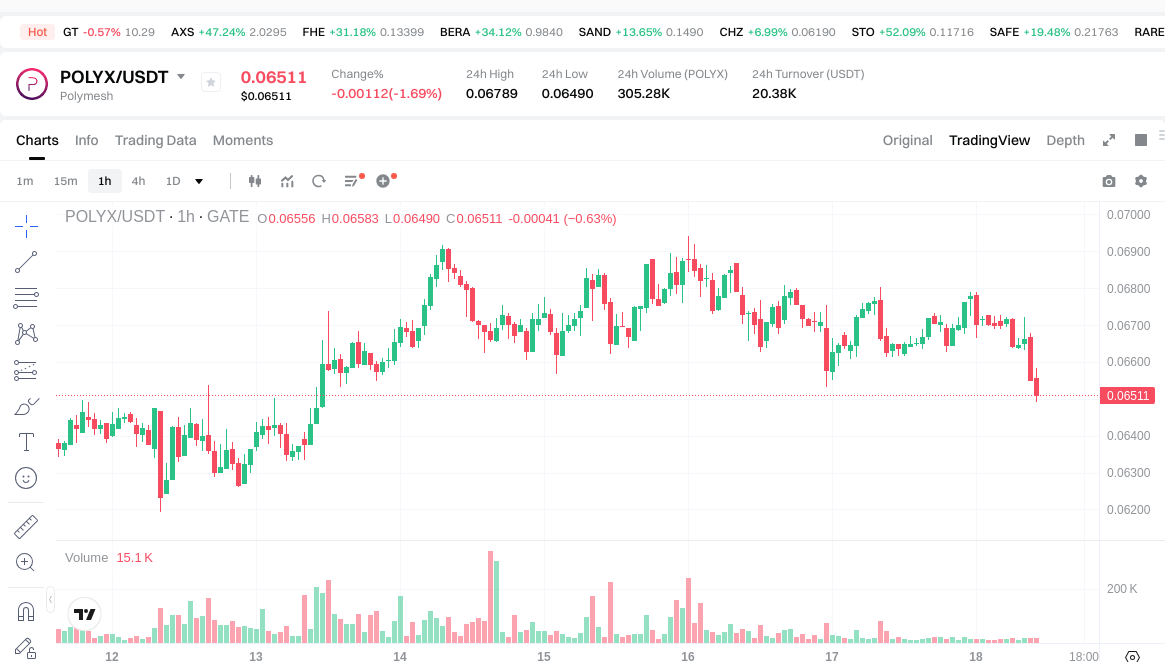
Polymesh reached its all-time high of $0.748771 on April 1, 2024, driven by market momentum and growing institutional interest in regulated digital assets.
Its lowest price of $0.04574115 occurred on December 19, 2025, influenced by broader market conditions and reduced trading activity.
These fluctuations reflect market sentiment, adoption trends, and external factors affecting the regulated blockchain sector.
Click to view the current POLYX market price
On-Chain Metrics
- Active Addresses: Approximately 6,077 holders (reflecting current user participation)
- 24-Hour Trading Volume: $20,432.61 (indicating network activity levels)
- Market Capitalization: $80,759,428.97 (representing the total value of circulating tokens)
Polymesh Ecosystem Applications and Strategic Partnerships
Core Use Cases
Polymesh's ecosystem is specifically designed to support institutional-grade applications in the regulated digital securities space:
- Security Token Issuance: The platform enables compliant tokenization of traditional financial assets, including equities, bonds, and real estate, providing regulatory-compliant on-chain asset management.
- Institutional Infrastructure: Polymesh facilitates identity verification, compliance automation, and settlement processes tailored for regulated financial markets.
Strategic Collaborations
As a purpose-built blockchain for regulated assets, Polymesh focuses on partnerships that enhance its governance, compliance, and settlement capabilities.
These relationships provide a solid foundation for Polymesh's expansion within the institutional digital securities ecosystem.
Challenges and Considerations
Polymesh faces several industry-wide challenges:
- Technical Aspects: Balancing permissioned access with decentralization principles
- Regulatory Landscape: Navigating evolving global securities regulations across different jurisdictions
- Market Competition: Competing with general-purpose blockchains and specialized securities platforms
These considerations drive ongoing discussions within the community and fuel Polymesh's continuous innovation in the regulated asset space.
Polymesh maintains an active community with 6,077 token holders as of January 2026.
On X platform, discussions around Polymesh focus on institutional blockchain adoption and regulatory compliance topics.
Community engagement often centers around protocol updates and developments in the security token ecosystem.
Sentiment on X displays varied perspectives:
- Supporters highlight Polymesh's specialized infrastructure for regulated assets and compliance-focused design, positioning it as purpose-built for institutional adoption.
- Observers monitor market performance, adoption metrics, and regulatory developments affecting the security token sector.
Recent trends reflect interest in institutional blockchain applications and regulated digital asset infrastructure.
Discussion Topics
X users engage with topics around Polymesh including regulatory compliance frameworks, institutional adoption patterns, and the evolution of security token standards,
showcasing both the transformative potential and the pathway toward mainstream institutional integration.
Additional Resources for Polymesh
- Official Website: Visit Polymesh Official Site for features, use cases, and latest developments.
- Whitepaper: The Polymesh Whitepaper details its technical architecture, objectives, and vision for regulated asset infrastructure.
- X Activity: Polymesh maintains an active presence on X through @PolymeshNetwork,
sharing updates on protocol developments, compliance features, and ecosystem partnerships.
Polymesh Development Roadmap
- Ongoing Development: Continuous enhancement of identity management, compliance automation, and settlement protocols to improve institutional-grade functionality
- Ecosystem Objectives: Expanding support for diverse regulated asset classes and institutional participants
- Long-term Vision: Establishing itself as the standard infrastructure for compliant digital securities
How to Participate in Polymesh?
- Acquisition: POLYX tokens are available on multiple platforms including Gate.com
- Storage Options: Utilize compatible wallets that support Polymesh network assets
- Governance Participation: Engage in network governance through established protocols
- Ecosystem Development: Access development resources through official documentation to build compliant applications
Summary
Polymesh represents a specialized approach to blockchain technology, focusing on regulated asset tokenization, compliance automation, and institutional-grade infrastructure.
Its purpose-built design, focused community, and market positioning distinguish it within the blockchain ecosystem.
While navigating regulatory complexities and competitive dynamics, Polymesh's specialized architecture and clear development direction position it as a relevant infrastructure layer for compliant digital securities.
Whether exploring institutional blockchain solutions or digital asset innovation, Polymesh offers a compliance-focused platform worth monitoring.
FAQ
What is Polymesh (POLYX) and what does it do?
Polymesh (POLYX) is a blockchain platform designed for security token issuance, management, and trading. It features automated compliance, identity verification, transaction confidentiality, and near-instant settlement. POLYX is the native token that powers this permissioned blockchain ecosystem.
What are the main use cases and features of POLYX token?
POLYX token enables governance within the Polymath ecosystem, enhances security for token transactions, facilitates fee payments, and rewards ecosystem participants for their contributions and activity.
How can I buy and store POLYX tokens?
Purchase POLYX through spot trading on supported platforms by entering your desired amount. Securely store your tokens in a crypto wallet with strong security features for protection.
What is the total supply and tokenomics of POLYX?
POLYX has a total supply of 1.24 billion tokens. The tokenomics are designed with specific allocations for ecosystem development, staking, and governance to support the Polymesh blockchain infrastructure.
Polymesh is a purpose-built blockchain designed specifically for tokenizing real-world assets, while Ethereum is a general-purpose platform. Polymesh incorporates regulatory compliance, identity, settlement, and governance at its base layer, making it ideal for institutional-grade asset tokenization.
What are the risks and security considerations when investing in POLYX?
POLYX investments carry market volatility risk, potential principal loss, and smart contract security risks. Ensure wallet security, use reputable platforms, verify addresses, and diversify your portfolio to mitigate exposure.
* The information is not intended to be and does not constitute financial advice or any other recommendation of any sort offered or endorsed by Gate.