This comprehensive guide explores Polymesh's native utility token POLYX and its critical role in regulated asset tokenization. Discover how Polymesh functions as an institutional-grade blockchain designed specifically for security tokens, addressing compliance, identity verification, and settlement challenges in traditional finance. Learn about POLYX's tokenomics, current market performance, and ecosystem applications. Explore how to purchase POLYX on Gate and participate in Polymesh's network through staking and governance. Understand the technical architecture behind the Nominated Proof-of-Stake consensus mechanism, market trends, and community sentiment. Whether you're exploring regulated digital assets or seeking blockchain infrastructure solutions for financial institutions, this guide covers everything from core concepts to investment considerations in the evolving regulated asset space.
Polymesh's Positioning and Significance
In 2021, Polymath launched Polymesh (POLYX) to address challenges in regulated asset tokenization, including governance complexity, identity verification, compliance enforcement, confidentiality protection, and settlement inefficiency.
As an institutional-grade, public-permissioned blockchain built specifically for security tokens, Polymesh plays a critical role in regulated financial markets and tokenized securities.
As of 2026, Polymesh has established itself as a specialized infrastructure for compliant digital asset issuance and management, with over 6,000 token holders and an active developer ecosystem.
This article provides an in-depth analysis of its technical architecture, market performance, and future potential.
Origin and Development History
Birth Background
Polymesh was created by Polymath in 2021 to solve the fundamental incompatibility between general-purpose blockchains and the requirements of regulated financial instruments.
It emerged during the growing institutional interest in blockchain technology and the increasing need for compliant tokenization solutions, aiming to provide a purpose-built infrastructure that streamlines processes for security tokens while ensuring regulatory compliance.
Polymesh's launch brought new possibilities to capital markets, asset managers, and financial institutions seeking blockchain-based solutions.
Key Milestones
- 2021: Mainnet launched on October 27, implementing native identity verification, compliance automation, and confidential asset features.
- Ongoing development: The platform continues to enhance settlement mechanisms, governance frameworks, and interoperability capabilities for regulated assets.
With support from the Polymesh Association and the developer community, Polymesh continues to refine its technology, security protocols, and real-world applications in regulated financial markets.
How Does Polymesh Work?
Decentralized Control
Polymesh operates on a global network of decentralized nodes, independent of traditional financial intermediaries.
These nodes collaborate to validate transactions, ensuring system transparency and attack resistance while granting users greater autonomy and enhancing network resilience.
Blockchain Foundation
Polymesh's blockchain is a public, immutable digital ledger that records every transaction.
Transactions are grouped into blocks and linked through cryptographic hashing to form a secure chain.
Anyone can view the records, establishing trust without intermediaries.
The platform incorporates purpose-built modules for identity management, compliance automation, and confidential settlements to enhance functionality for regulated assets.
Ensuring Fairness
Polymesh employs a Nominated Proof-of-Stake (NPoS) consensus mechanism to validate transactions and prevent fraudulent activities such as double-spending.
Validators maintain network security through staking POLYX tokens and operating nodes, earning POLYX rewards in return.
Its innovation includes permissioned participation requiring verified identity credentials, balancing decentralization with regulatory requirements.
Secure Transactions
Polymesh uses public-private key cryptography to protect transactions:
- Private keys (like secret passwords) are used to sign transactions
- Public keys (like account numbers) are used to verify ownership
This mechanism ensures fund security while maintaining pseudonymous privacy with mandatory identity verification at the protocol level.
Additional security features include built-in compliance rules, confidential asset transfers, and granular permission controls for asset issuers.
Circulation Overview
As of January 18, 2026, Polymesh's circulating supply stands at 1,237,502,742.46 POLYX tokens, with a total supply of 1,237,502,742.46 tokens and an unlimited maximum supply, indicating an inflationary token model.
New tokens enter the market through network operations and governance mechanisms, influencing the supply-demand dynamics of the ecosystem.
Price Fluctuations
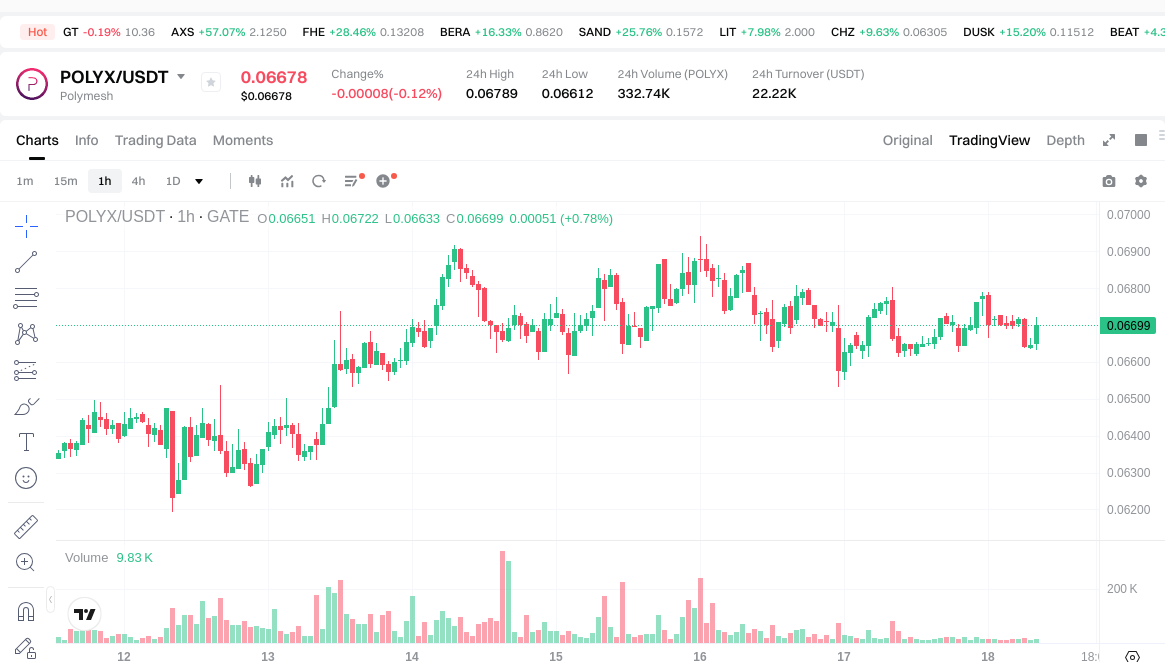
Polymesh reached its all-time high of $0.748771 on April 1, 2024, driven by increased institutional interest in regulated digital assets and broader market momentum during that period.
Its lowest price of $0.04574115 occurred on December 19, 2025, influenced by broader market corrections and reduced trading activity across the digital asset sector.
These fluctuations reflect market sentiment, adoption trends, and external factors affecting the regulated asset blockchain space.
Click to view the current POLYX market price
On-Chain Metrics
- Holder Count: 6,077 addresses (indicating user participation level)
- Market Capitalization: $83.15 million (reflecting current market valuation)
- 24-Hour Trading Volume: $22,304.71 (showing network activity)
Polymesh Ecosystem Applications and Partners
Core Use Cases
Polymesh's ecosystem is specifically designed for regulated assets:
- Securities Tokenization: Supporting institutional-grade tokenization platforms that provide compliant digital securities issuance and management.
- Regulated Asset Management: Facilitating projects focused on governance, identity verification, and regulatory compliance for financial instruments.
Strategic Partnerships
Polymesh has established collaborations with various entities to enhance its technical capabilities and market presence in the regulated asset space.
These partnerships provide a solid foundation for Polymesh's ecosystem expansion.
Controversies and Challenges
Polymesh faces several challenges:
- Technical Challenges: Balancing permissioned access with network decentralization and maintaining scalability for institutional users.
- Regulatory Complexity: Navigating evolving global securities regulations and compliance requirements across different jurisdictions.
- Market Competition: Competing with other blockchain platforms targeting institutional and regulated asset markets.
These issues have sparked discussions within the community and markets, while also driving Polymesh's continuous innovation.
Polymesh's community shows steady growth, with approximately 6,077 token holders as of the latest data.
On X platform, related posts and hashtags (such as #Polymesh and #POLYX) maintain regular engagement.
Factors such as technical developments and institutional partnerships have contributed to community interest.
Sentiment on X presents varied perspectives:
- Supporters praise Polymesh's institutional focus, compliance-first approach, and specialized governance features, viewing it as "infrastructure for regulated digital securities".
- Critics focus on market volatility and the challenges of balancing regulation with decentralization.
Recent trends indicate mixed sentiment influenced by broader market conditions.
Trending Topics
X users actively discuss Polymesh's regulatory positioning, institutional adoption potential, and its role in traditional finance transformation,
showcasing both its innovative potential and the obstacles toward mainstream institutional adoption.
Additional Polymesh Resources
- Official Website: Visit Polymesh Official Site for features, use cases, and latest updates.
- Whitepaper: The Polymesh Whitepaper details its technical architecture, objectives, and vision for regulated asset tokenization.
- X Activity: On X platform, Polymesh maintains an active presence through @PolymeshNetwork,
with posts covering technical upgrades, institutional developments, and compliance innovations.
Polymesh Future Roadmap
- Ongoing Development: Continuing to enhance institutional-grade features such as identity management and compliance automation
- Ecosystem Goals: Expanding support for regulated asset tokenization and institutional adoption
- Long-term Vision: Establishing itself as the standard infrastructure for compliant security tokens and regulated digital assets
How to Participate in Polymesh?
- Purchase Channels: Acquire POLYX on Gate.com and other supported exchanges
- Storage Solutions: Use compatible wallets that support Polymesh network for secure storage
- Ecosystem Participation: Explore opportunities in regulated asset tokenization and compliance-focused applications
- Development: Visit developer documentation to build applications on the Polymesh blockchain
Summary
Polymesh redefines blockchain infrastructure for regulated assets, offering governance, identity, compliance, confidentiality, and settlement solutions specifically designed for institutional requirements.
Its focused approach, growing holder base, and market positioning make it distinctive in the cryptocurrency space.
Despite facing regulatory complexities and market competition, Polymesh's specialized focus and clear development direction position it as a significant player in the evolution of regulated digital asset infrastructure.
Whether you're a newcomer or experienced participant, Polymesh represents an interesting development in compliant blockchain technology.
FAQ
What is POLYX and what is its main purpose in the Polymesh ecosystem?
POLYX is the native utility token of the Polymesh blockchain. It serves as the fuel for the network, used to pay transaction fees and access onchain activities such as token transfers and protocol operations. POLYX ensures operational sustainability and protects against spam through its fee mechanism.
How can I buy and store POLYX tokens?
Buy POLYX via decentralized exchange or custodial exchange platforms. Store securely in your mobile Polyx Crypto Wallet or Binance Chain Wallet for BEP-20 standard tokens.
What are the risks and security considerations when investing in POLYX?
POLYX carries market volatility risks and regulatory uncertainties. Security considerations include smart contract vulnerabilities and potential fraud. Conduct thorough due diligence and research before investing.
What is the difference between POLYX and other blockchain governance tokens?
POLYX enables decentralized DAO governance with unique staking and reward mechanisms that incentivize active participation, distinguishing it from other governance tokens through enhanced incentive structures.
How does POLYX staking work and what are the potential rewards?
POLYX staking involves delegating tokens to node operators to secure the blockchain. Nominators earn rewards automatically based on blocks validated and amount staked. Rewards are distributed in POLYX to both operators and nominators proportionally.
What is the total supply and tokenomics of POLYX?
POLYX has a maximum supply of 1 billion tokens, with approximately 924 million currently in circulation. The remaining tokens are held by the team for future distribution and ecosystem development.
* The information is not intended to be and does not constitute financial advice or any other recommendation of any sort offered or endorsed by Gate.