This comprehensive guide explores Oasys (OAS), a specialized gaming-focused blockchain launched in 2022 by renowned gaming companies. The article covers Oasys's innovative Hub-Layer and Verse-Layer architecture designed to solve gaming infrastructure inefficiencies, providing high scalability and EVM compatibility. It details technical operations including decentralized consensus mechanisms, secure cryptographic transactions, and market performance metrics as of January 2026. The guide examines Oasys's ecosystem applications in GameFi and Layer 2 solutions, current trading availability on Gate.com, strategic partnerships, and community sentiment. Additionally, it addresses technical challenges, competitive pressures, and outlines future roadmap goals for ecosystem expansion. Whether you're a developer or investor, this guide provides essential insights into Oasys's role in shaping Web3 gaming infrastructure.
Oasys's Position and Significance
In 2022, renowned gaming companies launched Oasys (OAS), aiming to address inefficiencies in blockchain gaming infrastructure and limited scalability for game developers.
As a specialized gaming-focused public blockchain with multi-layer architecture, Oasys plays a critical role in blockchain gaming and Web3 entertainment ecosystems.
As of 2026, Oasys has established itself as an EVM-compatible gaming blockchain with an active development community.
This article will provide an in-depth analysis of its technical architecture, market performance, and future potential.
Origin and Development History
Birth Background
Oasys was created by renowned gaming companies in 2022, aiming to solve the challenges of high gas fees, low transaction speeds, and poor user experience that hindered blockchain gaming adoption.
It emerged during the expansion of blockchain technology into gaming and entertainment, with the goal of providing a scalable, developer-friendly infrastructure for Web3 games to transform the industry.
The launch of Oasys brought new possibilities for game developers and blockchain gaming enthusiasts.
Key Milestones
- 2022: Mainnet launch, achieving a unique Hub-Layer and Verse-Layer architecture for enhanced scalability.
- 2022: Listed on Gate.com on December 12, providing users with trading access.
- 2024: Price reached a notable level of $0.141992 in February, reflecting market interest in gaming-focused blockchain solutions.
- 2025-2026: Continued ecosystem development with focus on expanding developer tools and gaming partnerships.
With support from gaming industry partners and the Oasys Foundation, Oasys continues to optimize its technology, security, and real-world gaming applications.
How Oasys Works
No Central Control
Oasys operates on a decentralized network of computers (nodes) distributed globally, free from control by banks or governments.
These nodes collaborate to validate transactions, ensuring system transparency and attack resistance, granting users greater autonomy and enhancing network resilience.
Blockchain Core
Oasys's blockchain is a public, immutable digital ledger that records every transaction.
Transactions are grouped into blocks and linked through cryptographic hashing to form a secure chain.
Anyone can view the records, establishing trust without intermediaries.
Its unique multi-layer architecture consisting of Hub-Layer (a highly scalable Layer 1) and Verse-Layer (specialized Layer 2 using Ethereum scaling solutions) further enhances performance for gaming applications.
Ensuring Fairness
Oasys employs a consensus mechanism to validate transactions and prevent fraud such as double-spending.
Validators maintain network security through staking and running nodes, receiving OAS token rewards.
Its innovation includes optimized architecture specifically designed for gaming workloads with improved transaction throughput.
Secure Transactions
Oasys uses public-private key cryptography to protect transactions:
- Private keys (similar to secret passwords) are used to sign transactions
- Public keys (similar to account numbers) are used to verify ownership
This mechanism ensures fund security while maintaining pseudonymous transaction privacy.
The EVM-compatible protocol allows developers to deploy smart contracts with familiar tools while benefiting from enhanced security features.
Circulation Overview
As of January 25, 2026, the circulating supply of Oasys (OAS) is 6,318,537,327.21 tokens, with a total supply of 10,000,000,000 OAS tokens. The maximum supply is capped at 10 billion tokens, representing a fixed supply model.
The current circulation rate stands at approximately 63.19%, indicating that over half of the total token supply has entered the market. The OAS token serves as the highest-level token within the entire Oasys ecosystem, issued on the Oasys public blockchain.
Price Volatility
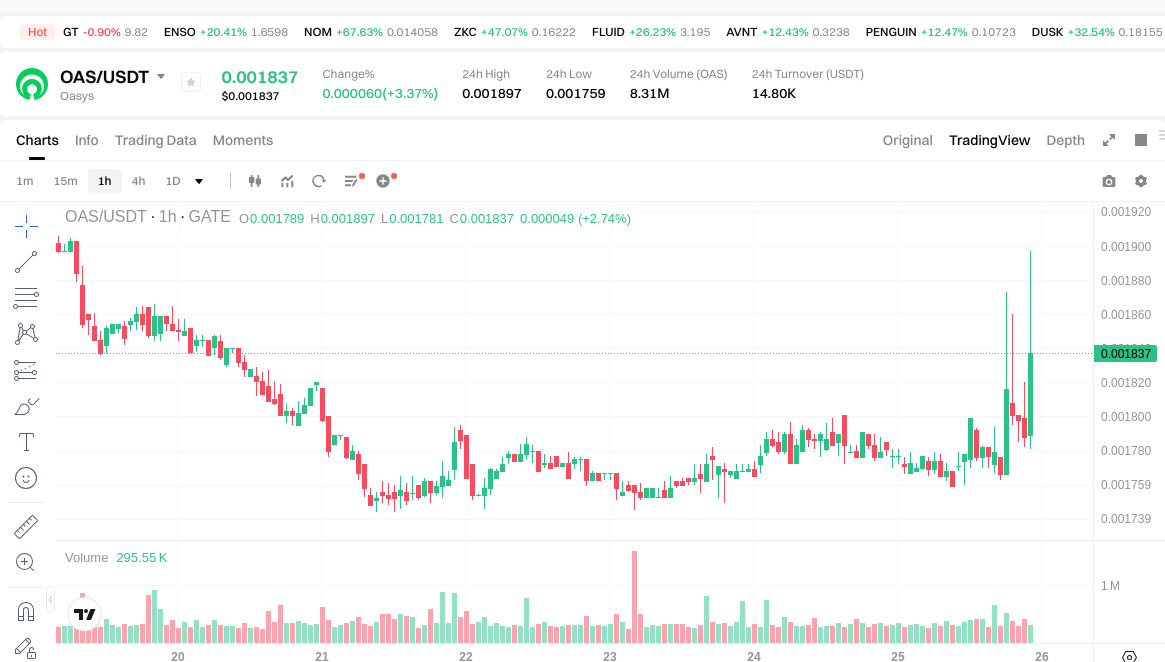
Oasys (OAS) reached a price level of $0.141992 on February 13, 2024, driven by positive market sentiment during that period. The token experienced its lowest price point of $0.00169078 on December 19, 2025, reflecting broader market conditions and volatility.
As of the latest update on January 25, 2026, OAS is trading at $0.001837, showing a 24-hour increase of 3.09% and a 1-hour gain of 2.23%. However, the token has experienced a decline of 4.33% over the past 7 days and 4.63% over the past 30 days. Over the past year, the token has faced significant downward pressure with a 93.62% decline.
The 24-hour trading range shows a high of $0.001897 and a low of $0.001759, demonstrating intraday price fluctuations. These movements reflect ongoing market dynamics, investor sentiment, and the evolving landscape of blockchain gaming projects.
Click to view the current OAS market price
Market Metrics
- Market Capitalization: Approximately $11,607,153, representing 0.00058% of the total crypto market
- Fully Diluted Market Cap: $18,370,000, indicating the potential market value if all tokens were in circulation
- 24-Hour Trading Volume: $14,766.53, reflecting current market activity levels
- Market Cap to FDV Ratio: 63.19%, showing the relationship between current market cap and fully diluted valuation
- Exchange Listings: Available on 5 exchanges, with trading support on Gate.com
Oasys Ecosystem Applications and Partners
Core Use Cases
Oasys's ecosystem supports multiple applications:
- GameFi: Oasys specializes in blockchain gaming, providing seamless gaming experiences with high scalability.
- Layer 2 Solutions: Through its Verse-Layer architecture, Oasys enables efficient scaling for gaming applications.
Strategic Partnerships
Oasys has been launched with the support of renowned gaming companies, enhancing its technical capabilities and market influence.
These partnerships provide a solid foundation for Oasys's ecosystem expansion.
Controversies and Challenges
Oasys faces the following challenges:
- Technical Difficulties: Scaling bottlenecks in gaming blockchain infrastructure
- Competition Pressure: The rise of other gaming-focused blockchains and general-purpose chains like Ethereum and Solana
These issues have sparked discussions within the community and market, while also driving Oasys's continuous innovation.
Fan Enthusiasm
Oasys's community shows vitality with a circulating supply of 6.32 billion OAS tokens and a market presence across 5 exchanges.
On X platform, relevant posts and hashtags (such as #Oasys and #OAS) appear regularly.
Sentiment on X shows polarization:
- Supporters praise Oasys's EVM compatibility and gaming-focused architecture, considering it as "the future of blockchain gaming".
- Critics focus on price volatility and market performance challenges.
Recent trends show mixed sentiment given the token's performance.
Hot Topics
X users discuss Oasys's gaming adoption, technical architecture, and market positioning,
showcasing both its transformative potential and obstacles toward mainstream adoption.
- Official Website: Visit Oasys Official Website for features, use cases, and latest updates.
- X Updates: On X platform, Oasys maintains an active presence at @oasys_games,
with posts covering technical upgrades, community events, and partnership news.
- Block Explorer: Check Oasys Explorer for on-chain data and transactions.
Oasys Future Roadmap
- Ecosystem Goals: Expand gaming DApp support and attract more developers to the platform
- Long-term Vision: Become the leading blockchain infrastructure for gaming
How to Participate in Oasys?
- Purchase Channels: Buy OAS on Gate.com and other supported exchanges
- Storage Solutions: Use compatible wallets to securely store OAS tokens
- Build Ecosystem: Visit Oasys GitHub to develop DApps or contribute code
Summary
Oasys redefines blockchain gaming through its specialized architecture, offering high scalability, EVM compatibility, and gaming-optimized solutions.
Its unique Hub-Layer and Verse-Layer structure, along with support from gaming companies, positions it distinctively in the cryptocurrency field.
Despite facing regulatory uncertainty and competitive pressure, Oasys's innovative approach and clear focus on gaming make it occupy an important position in the future of decentralized gaming technology.
Whether you are a newcomer or a seasoned player, Oasys is worth attention and participation.
FAQ
What is OAS (Option Adjusted Spread) in cryptocurrency?
OAS measures the yield spread of crypto bonds adjusted for embedded options. It reflects the additional return investors receive for bearing credit and volatility risks beyond risk-free rates, helping assess true bond value in digital asset markets.
What are the practical applications of OAS in DeFi?
OAS enables yield optimization through automated strategies, allowing users to maximize returns on staked assets. It facilitates cross-protocol liquidity provision, reduces slippage in trading, and enhances capital efficiency by dynamically allocating funds across lending protocols and liquidity pools for optimal earning potential.
How to calculate and understand OAS yield?
OAS(Option-Adjusted Spread)yield is calculated by adjusting bond spreads for embedded options. Understand it as: bond yield minus risk-free rate, accounting for call/put options. Higher OAS indicates greater compensation for credit and volatility risks. Calculate by discounting cash flows at OAS-adjusted rates.
What is the difference between OAS in crypto and Option-Adjusted Spread in traditional finance?
Crypto OAS measures yield premiums on blockchain assets, adjusting for volatility and smart contract risks. Traditional OAS applies to bonds, accounting for embedded options. Crypto OAS operates 24/7 in decentralized markets, while traditional OAS functions in regulated bond markets with fixed trading hours and standardized instruments.
What are the risks to pay attention to when investing in OAS products?
OAS investment risks include market volatility, liquidity fluctuations, smart contract vulnerabilities, regulatory uncertainty, and token price depreciation. Conduct thorough research before investing.
What is the difference between OAS and other yield metrics like APY and APR?
OAS(Option-Adjusted Spread)reflects yield adjusted for embedded options and interest rate volatility, while APY compounds returns annually and APR shows simple annual rates. OAS provides more accurate risk-adjusted yield analysis for complex instruments.
* The information is not intended to be and does not constitute financial advice or any other recommendation of any sort offered or endorsed by Gate.