ApeCoin (APE) is an Ethereum-based governance token launched by Yuga Labs in 2022, empowering the Bored Ape Yacht Club and Mutant Ape Yacht Club communities through decentralized decision-making. This comprehensive guide explores ApeCoin's decentralized governance structure, blockchain foundation, and role within NFT ecosystems and metaverse development. With 185,465 token holders and 908.67 million circulating tokens, ApeCoin demonstrates significant community adoption across 59 exchanges including Gate. The article examines market performance dynamics, ecosystem applications, strategic partnerships, and community sentiment on social platforms. It addresses challenges including price volatility and regulatory risks while highlighting ApeCoin's innovative approach to community-driven governance. Whether you're a beginner or experienced crypto participant, this guide provides essential insights on purchasing, storing, participating in governance through ApeCoin DAO, and understanding APE's distinctive position
ApeCoin's Positioning and Significance
In 2022, Yuga Labs launched ApeCoin (APE), aiming to address the need for decentralized governance in NFT ecosystems and community-driven cultural development in the metaverse.
As the native governance token for the APE ecosystem, ApeCoin plays a key role in NFT communities and decentralized autonomous organizations (DAOs).
As of 2026, ApeCoin has become a governance asset within the Bored Ape Yacht Club (BAYC) and Mutant Ape Yacht Club (MAYC) ecosystems, with 185,465 holders and an active community of participants.
This article will deeply analyze its governance structure, market performance, and future potential.
Origin and Development History
Birth Background
ApeCoin was created by Yuga Labs in 2022, aiming to solve the lack of structured governance mechanisms in NFT communities and enable decentralized cultural initiatives toward the metaverse.
It was born during the NFT boom period, with the goal of empowering community members through decentralized governance and ecosystem fund management.
ApeCoin's launch brought new possibilities for NFT collectors, creators, and metaverse participants.
Important Milestones
- 2022: ApeCoin officially launched, with tokens distributed to BAYC and MAYC NFT holders through a claim page.
- 2022: ApeCoin DAO was established as a decentralized organization where token holders can vote on ecosystem fund governance and usage.
- 2022: The Ape Foundation was created to serve as the legal steward of ApeCoin and manage decisions made by the ApeCoin DAO community.
- 2022: ApeCoin reached an all-time high price of $26.7 on April 29.
With support from the Ape Foundation and ApeCoin DAO community, ApeCoin continues to develop its governance framework and ecosystem applications.
How ApeCoin Works?
No Central Control
ApeCoin operates through a decentralized governance structure managed by ApeCoin DAO, free from centralized authority control.
Token holders participate in governance by voting on proposals related to ecosystem development, fund allocation, and community initiatives, ensuring transparency and community-driven decision-making, granting users greater autonomy and enhancing network resilience.
Blockchain Foundation
ApeCoin is deployed on the Ethereum blockchain, leveraging its public, immutable digital ledger to record all transactions.
Transactions are grouped into blocks and linked through cryptographic hashes to form a secure chain.
Anyone can view transaction records, establishing trust without intermediaries.
As an ERC-20 token, ApeCoin benefits from Ethereum's established security and widespread adoption.
Ensuring Fairness
ApeCoin relies on Ethereum's Proof of Stake (PoS) consensus mechanism to validate transactions and prevent fraudulent activities such as double-spending.
Ethereum validators maintain network security through staking ETH and validating blocks, while ApeCoin holders participate in governance through DAO voting.
Its innovation lies in enabling community-driven governance for NFT ecosystems and cultural initiatives.
Secure Transactions
ApeCoin uses public-private key cryptography to protect transactions:
- Private key (like a secret password) is used to sign transactions
- Public key (like an account number) is used to verify ownership
This mechanism ensures fund security, and transactions maintain pseudonymous privacy through Ethereum addresses.
Additionally, ApeCoin holders can securely store their tokens in various Ethereum-compatible wallets and participate in governance through the ApeCoin DAO platform.
Circulation Overview
As of January 16, 2026, ApeCoin's circulating supply stands at 908,664,773 tokens, with a total supply of 1,000,000,000 APE tokens, representing a fixed supply model.
The token distribution includes allocations to BAYC/MAYC community members through a claim page mechanism, with the ecosystem fund governance managed by ApeCoin DAO members through voting mechanisms.
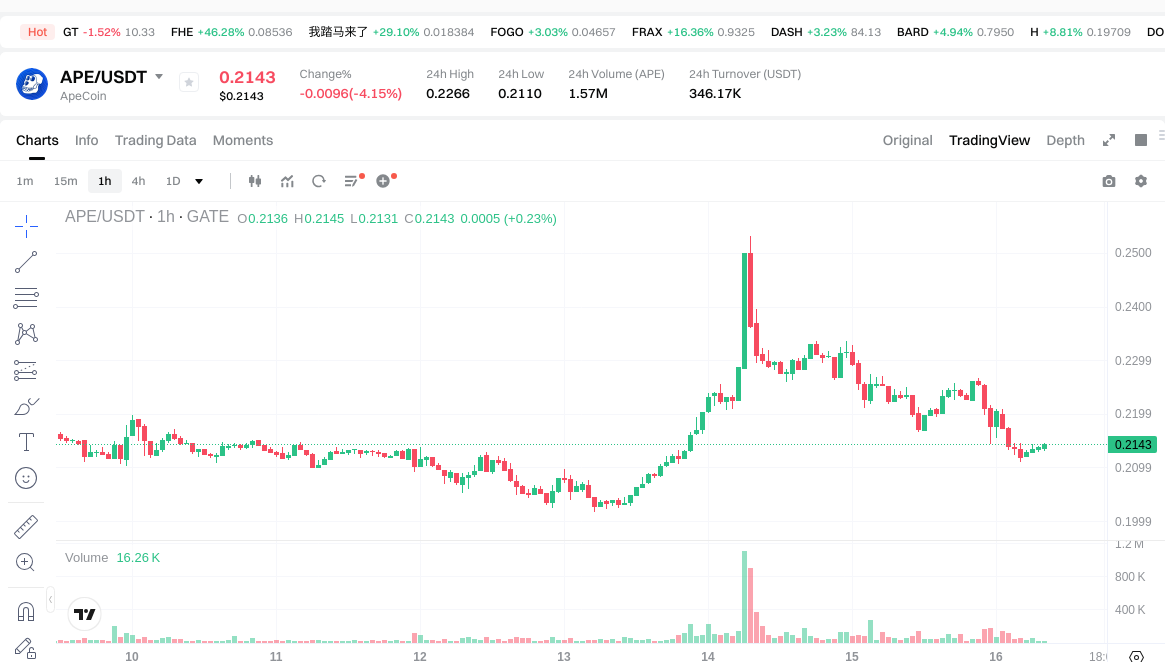
Price Volatility
ApeCoin reached a significant price level of $26.7 on April 29, 2022, driven by strong market interest in NFT-related projects and the Bored Ape Yacht Club ecosystem expansion.
The token experienced its lowest price of $0.180437 on October 11, 2025, reflecting broader market adjustments and shifts in NFT market sentiment.
These fluctuations demonstrate the impact of market dynamics, community adoption patterns, and external factors on token valuation.
Click to view the current APE market price
On-Chain Metrics
- Token Holders: 185,465 addresses (indicating community distribution)
- Circulating Supply Ratio: 90.87% (showing high token circulation)
- Listed Exchanges: 59 platforms (reflecting market accessibility)
ApeCoin Ecosystem Applications and Partners
Core Use Cases
ApeCoin's ecosystem supports multiple applications:
- NFT & Digital Collectibles: Bored Ape Yacht Club (BAYC) and Mutant Ape Yacht Club (MAYC), providing digital ownership and community-driven collectibles.
- Metaverse & Cultural Innovation: ApeCoin serves as a decentralized protocol layer, driving community-led initiatives toward metaverse development.
Strategic Partnerships
ApeCoin has established collaborations with various projects in the NFT and blockchain space, enhancing its technological capabilities and market influence.
These partnerships provide a solid foundation for ApeCoin's ecosystem expansion.
Controversies and Challenges
ApeCoin faces the following challenges:
- Market Volatility: Price fluctuations and significant downward trends over the past year
- Regulatory Risks: Potential regulatory scrutiny affecting NFT and token projects
- Competition Pressure: Competition from other blockchain ecosystems and NFT platforms
These issues have sparked discussions within the community and market, while also driving ApeCoin's continuous innovation.
ApeCoin's community remains vibrant, with 185,465 holders actively participating in the ecosystem.
On X platform, related posts and hashtags (such as #ApeCoin and #BAYC) frequently trend, generating significant engagement.
Community events and NFT launches continue to fuel community enthusiasm.
Sentiment on X shows mixed perspectives:
- Supporters praise ApeCoin's strong community foundation, NFT ecosystem integration, and see it as "a bridge to the metaverse" and "community-owned governance token".
- Critics focus on price volatility, market corrections, and ecosystem development pace.
Recent trends indicate fluctuating sentiment correlating with market conditions and ecosystem developments.
Hot Topics
X users actively discuss ApeCoin's governance decisions, NFT market trends, and ecosystem expansion plans,
showcasing both its transformative potential and the obstacles toward mainstream adoption.
- Official Website: Visit ApeCoin Official Website for features, use cases, and latest updates.
- X Updates: On X platform, ApeCoin maintains an active presence through @apecoin,
with posts covering technical updates, community events, and ecosystem news, generating significant likes and retweets.
- Community Forum: Explore discussions at ApeCoin Forum for governance proposals and community engagement.
ApeCoin Future Roadmap
- Ecosystem Goals: Expanding the APE ecosystem to support more decentralized applications and community initiatives
- Long-term Vision: Establishing ApeCoin as the governance token for metaverse and cultural advancement in Web3
How to Participate in ApeCoin?
- Purchase Channels: Buy ApeCoin on Gate.com and other supported exchanges
- Storage Solutions: Store securely using Ethereum-compatible wallets such as MetaMask
- Participate in Governance: Engage in community decisions through ApeCoin DAO voting mechanisms
- Build the Ecosystem: Visit developer resources to create applications or contribute to the ecosystem
Summary
ApeCoin, through blockchain technology, redefines community-driven governance and NFT ecosystems, offering transparency, decentralization, and cultural innovation.
Its active community, rich resources, and unique positioning within the NFT space make it distinctive in the cryptocurrency field.
Despite facing market volatility and competitive challenges, ApeCoin's innovative spirit and community-first approach position it as an important player in the future of decentralized technology.
Whether you are a newcomer or experienced participant, ApeCoin deserves attention and engagement.
FAQ
What is ApeCoin (APE) and what is its purpose in the crypto ecosystem?
ApeCoin (APE) is an Ethereum-based utility token for the APE ecosystem. It enables governance, in-app purchases, and incentivizes developer participation across games and services integrated with the Bored Ape Yacht Club community.
How can I buy and store APE tokens securely?
Purchase APE tokens through reputable platforms and store them in a secure wallet like MetaMask or hardware wallets such as Ledger. Enable two-factor authentication and keep your private keys confidential for maximum security.
What is the relationship between ApeCoin (APE) and Bored Ape Yacht Club (BAYC)?
ApeCoin (APE) is the governance token for the Bored Ape Yacht Club (BAYC) DAO. It grants holders voting rights to influence BAYC decisions and ecosystem development. APE is essential for decentralized governance and participation in the BAYC community.
What are the main use cases and benefits of holding APE tokens?
APE token holders can participate in ApeCoin DAO governance, vote on ecosystem decisions, use tokens as payment or rewards in compatible projects, and gain access to ecosystem utilities and opportunities.
How does APE compare to other cryptocurrency tokens and what makes it different?
APE is an ERC-20 token focused on NFTs and Web3 governance, emphasizing community-driven projects. Unlike transaction-focused tokens, APE powers decentralized ecosystems and digital collectibles within the Web3 space.
What are the risks associated with investing in APE tokens?
APE tokens carry high volatility risk with significant price fluctuations. Key risks include market risk, regulatory uncertainty, liquidity risk, and project-specific risks. Investors should be aware of potential substantial losses and conduct thorough research before investing.
What is the tokenomics and total supply of ApeCoin (APE)?
ApeCoin (APE) has a fixed total supply of 1 billion tokens. It is an ERC-20 governance and utility token managed by the ApeCoin DAO, enabling holders to participate in decentralized governance and ecosystem activities.
* The information is not intended to be and does not constitute financial advice or any other recommendation of any sort offered or endorsed by Gate.