This comprehensive investment analysis compares RAD and IMX, two distinct cryptocurrency assets with different market applications. RAD serves as a governance token for Web3-native software collaboration infrastructure, while IMX functions as a Layer 2 scaling solution optimized for NFT transactions on Ethereum. The article examines historical price trends, current market status, tokenomics, institutional adoption, technological ecosystems, and risk factors to guide investors. With detailed price forecasts spanning 2026-2031 and tailored investment strategies for conservative, aggressive, and novice investors, this guide addresses critical questions about liquidity, trading volume, and portfolio allocation. Real-time price data on Gate and comprehensive FAQ sections provide actionable insights for evaluating these assets in the current market environment characterized by extreme fear sentiment.
Introduction: Investment Comparison Between RAD and IMX
In the cryptocurrency market, the comparison between RAD vs IMX continues to be a significant topic for investors. Both tokens exhibit notable differences in market cap ranking, application scenarios, and price performance, representing distinct positioning within the crypto asset landscape.
RAD (Radicle): Launched in February 2021, it has gained recognition as a governance token powering a Web3-native network for software collaboration, offering decentralized infrastructure for developers.
IMX (Immutable): Positioned as a Layer 2 scaling solution for NFTs on Ethereum since its launch in November 2021, providing instant transactions and zero gas fees for minting and trading.
This article will comprehensively analyze the investment value comparison between RAD vs IMX, focusing on historical price trends, supply mechanisms, institutional adoption, technological ecosystems, and future forecasts, attempting to address investors' most pressing question:
"Which is the better buy right now?"
I. Historical Price Comparison and Current Market Status
Historical Price Trends of RAD (Coin A) and IMX (Coin B)
- 2021: RAD reached its all-time high of $27.61 on April 16, 2021, during a period of heightened interest in decentralized collaboration infrastructure.
- 2021: IMX achieved its all-time high of $9.52 on November 26, 2021, driven by growing adoption of Layer 2 scaling solutions for NFTs on Ethereum.
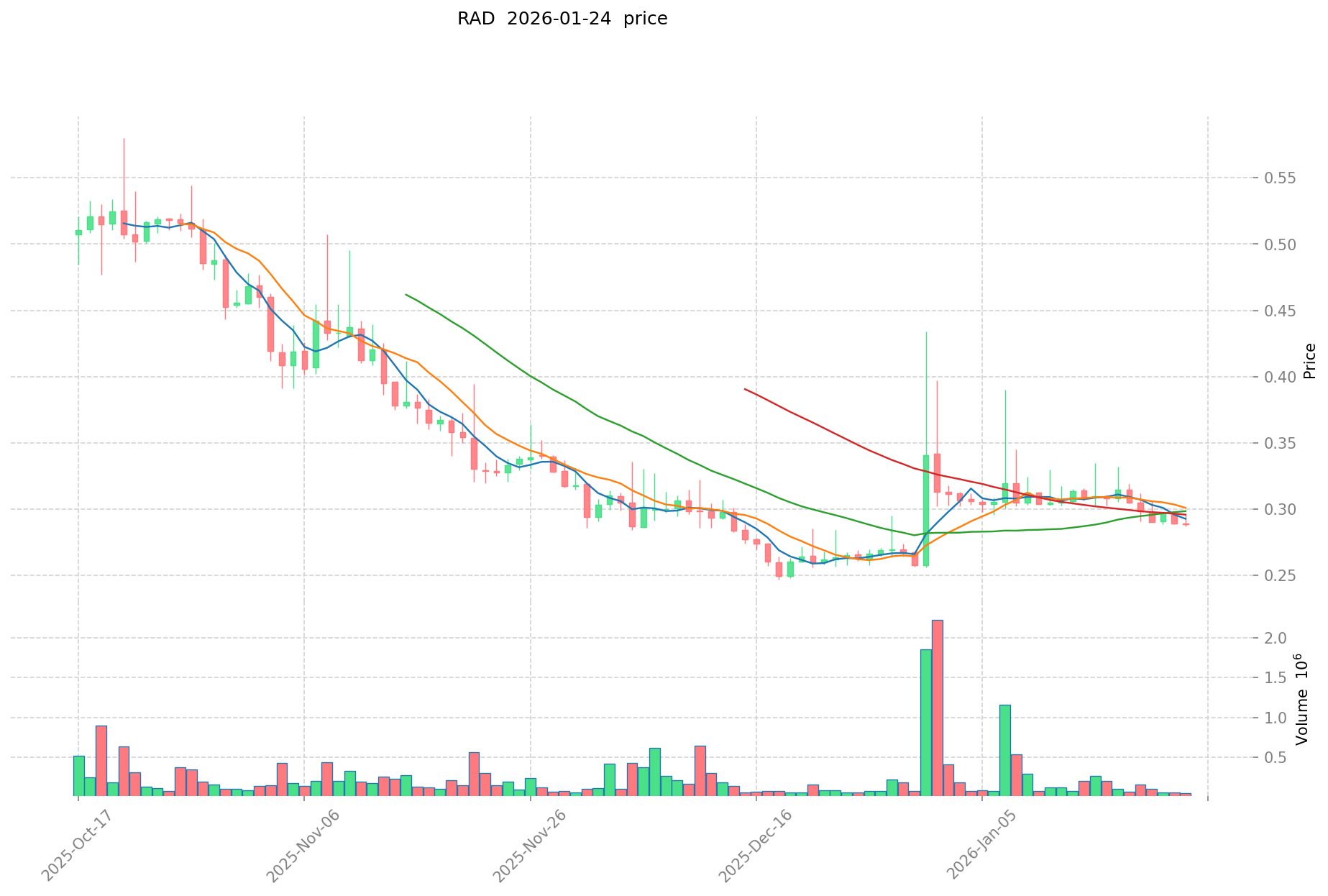
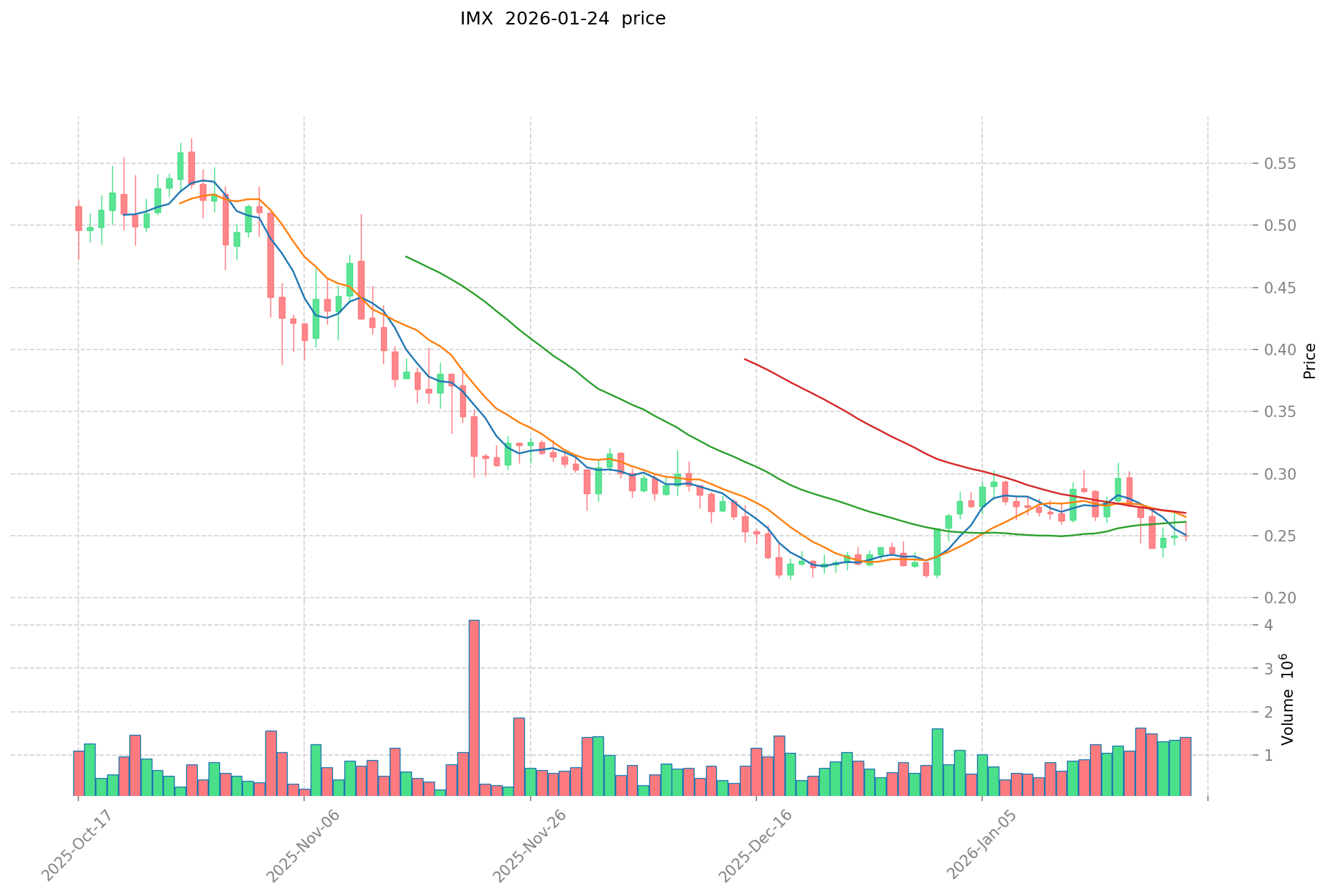
- Comparative Analysis: During the market cycle from 2021 to 2025, RAD experienced a decline from its peak of $27.61 to an all-time low of $0.247899 on December 19, 2025, while IMX declined from $9.52 to $0.215226 on December 19, 2025, showing a similar pattern of significant depreciation.
Current Market Status (January 24, 2026)
- RAD Current Price: $0.2904
- IMX Current Price: $0.255
- 24-Hour Trading Volume: RAD $14,506.35 vs IMX $227,495.40
- Market Sentiment Index (Fear & Greed Index): 25 (Extreme Fear)
View real-time prices:
II. Core Factors Affecting RAD vs IMX Investment Value
Supply Mechanism Comparison (Tokenomics)
Due to insufficient reference materials, specific supply mechanism details for RAD and IMX cannot be accurately described at this time.
Institutional Adoption and Market Application
Without adequate data on institutional holdings, enterprise adoption patterns, or regulatory attitudes across different jurisdictions for RAD and IMX, a comprehensive comparison cannot be provided based on available materials.
Technology Development and Ecosystem Building
The reference materials do not contain sufficient information regarding technical upgrades, development roadmaps, or ecosystem applications (including DeFi, NFT, payment systems, and smart contract implementations) for either RAD or IMX.
Macroeconomic Environment and Market Cycles
Available materials lack the necessary data to analyze the performance characteristics of RAD and IMX under different macroeconomic conditions, including inflationary environments, monetary policy impacts, interest rate fluctuations, US dollar index correlations, or geopolitical factors affecting cross-border transaction demand.
III. 2026-2031 Price Forecast: RAD vs IMX
Short-term Forecast (2026)
- RAD: Conservative $0.19206 - $0.291 | Optimistic $0.291 - $0.41613
- IMX: Conservative $0.136674 - $0.2531 | Optimistic $0.2531 - $0.280941
Mid-term Forecast (2028-2029)
- RAD may enter a consolidation phase, with projected price range of $0.26971706025 - $0.5365891597275
- IMX may enter a gradual growth phase, with projected price range of $0.1884096648 - $0.392071540056
- Key drivers: institutional capital inflows, ETF developments, ecosystem expansion
Long-term Forecast (2030-2031)
- RAD: Baseline scenario $0.2934876311928 - $0.45857442373875 | Optimistic scenario $0.45857442373875 - $0.696115975235422
- IMX: Baseline scenario $0.209537476016232 - $0.36799697228 | Optimistic scenario $0.36799697228 - $0.572198492198172
View detailed price predictions for RAD and IMX
Disclaimer
RAD:
| Year |
Predicted High Price |
Predicted Average Price |
Predicted Low Price |
Price Change |
| 2026 |
0.41613 |
0.291 |
0.19206 |
0 |
| 2027 |
0.38538585 |
0.353565 |
0.2545668 |
21 |
| 2028 |
0.3916439505 |
0.369475425 |
0.26971706025 |
27 |
| 2029 |
0.5365891597275 |
0.38055968775 |
0.296836556445 |
31 |
| 2030 |
0.5502893084865 |
0.45857442373875 |
0.2934876311928 |
57 |
| 2031 |
0.696115975235422 |
0.504431866112625 |
0.327880712973206 |
73 |
IMX:
| Year |
Predicted High Price |
Predicted Average Price |
Predicted Low Price |
Price Change |
| 2026 |
0.280941 |
0.2531 |
0.136674 |
0 |
| 2027 |
0.33110542 |
0.2670205 |
0.178903735 |
4 |
| 2028 |
0.388781848 |
0.29906296 |
0.1884096648 |
17 |
| 2029 |
0.39207154056 |
0.343922404 |
0.2235495626 |
34 |
| 2030 |
0.4379163970132 |
0.36799697228 |
0.2686377897644 |
44 |
| 2031 |
0.572198492198172 |
0.4029566846466 |
0.209537476016232 |
58 |
IV. Investment Strategy Comparison: RAD vs IMX
Long-term vs Short-term Investment Strategies
- RAD: Suitable for investors focusing on decentralized infrastructure development and Web3 collaboration ecosystems, with a preference for emerging technology sectors.
- IMX: Suitable for investors seeking exposure to NFT market growth and Layer 2 scaling solutions, with interest in Ethereum ecosystem development.
Risk Management and Asset Allocation
- Conservative Investors: RAD 30% vs IMX 70%
- Aggressive Investors: RAD 60% vs IMX 40%
- Hedging Tools: Stablecoin allocation, options strategies, cross-asset portfolio diversification
V. Potential Risk Comparison
Market Risk
- RAD: Subject to volatility associated with developer tool adoption cycles and competition in decentralized collaboration infrastructure.
- IMX: Exposed to fluctuations in NFT market sentiment and potential competition from alternative Layer 2 scaling solutions.
Technical Risk
- RAD: Scalability challenges and network stability concerns related to decentralized code collaboration platforms.
- IMX: Potential technical limitations in scaling capacity and security vulnerabilities inherent in Layer 2 architecture.
Regulatory Risk
- Global regulatory developments may impact both tokens differently, with RAD potentially subject to developer platform regulations and IMX facing NFT-specific regulatory scrutiny across various jurisdictions.
VI. Conclusion: Which Is the Better Buy?
📌 Investment Value Summary:
- RAD Advantages: Positioning in Web3 infrastructure development and decentralized collaboration tools may offer growth potential as developer adoption increases.
- IMX Advantages: Direct exposure to NFT market growth and Ethereum Layer 2 ecosystem expansion, with infrastructure designed for scalable digital asset transactions.
✅ Investment Recommendations:
- Novice Investors: Consider IMX for its established presence in the NFT ecosystem and clearer use case visibility, allocating smaller positions due to market volatility.
- Experienced Investors: Evaluate portfolio diversification opportunities by combining both assets, with RAD offering exposure to developer infrastructure and IMX providing NFT market participation.
- Institutional Investors: Conduct comprehensive due diligence on both projects' technical fundamentals, ecosystem development, and long-term sustainability before position sizing.
⚠️ Risk Warning: The cryptocurrency market exhibits extreme volatility. This article does not constitute investment advice.
VII. FAQ
Q1: What are the key differences between RAD and IMX in terms of their primary use cases?
RAD (Radicle) focuses on decentralized software collaboration infrastructure, serving as a Web3-native network for developers to collaborate on code repositories without centralized platforms. IMX (Immutable), on the other hand, is a Layer 2 scaling solution specifically designed for NFT transactions on Ethereum, offering instant trades and zero gas fees for minting and trading digital assets. While RAD targets the developer tools and infrastructure market, IMX directly addresses the scalability challenges in the NFT ecosystem.
Q2: How have the historical price performances of RAD and IMX compared since their respective launches?
Both tokens experienced significant price declines from their all-time highs. RAD peaked at $27.61 on April 16, 2021, before falling to an all-time low of $0.247899 on December 19, 2025 (approximately 99% decline). IMX reached its all-time high of $9.52 on November 26, 2021, before declining to $0.215226 on the same date in December 2025 (approximately 97% decline). As of January 24, 2026, RAD trades at $0.2904 while IMX trades at $0.255, showing both assets remain near their historical lows with similar depreciation patterns during the 2021-2025 market cycle.
Q3: Which token shows better trading liquidity based on current market data?
IMX demonstrates significantly higher trading liquidity compared to RAD. As of January 24, 2026, IMX's 24-hour trading volume stands at $227,495.40, approximately 15.7 times higher than RAD's $14,506.35. This substantial difference in trading volume indicates that IMX offers better liquidity for investors looking to enter or exit positions with minimal slippage, making it more suitable for larger transactions and providing greater market depth.
Q4: What are the projected price ranges for RAD and IMX through 2031?
According to forecast models, RAD's conservative 2026 projection ranges from $0.19206 to $0.291, while optimistic scenarios suggest $0.291 to $0.41613. By 2031, RAD could reach $0.696115975235422 under optimistic conditions. For IMX, conservative 2026 estimates range from $0.136674 to $0.2531, with optimistic projections at $0.2531 to $0.280941. By 2031, IMX may reach $0.572198492198172 in optimistic scenarios. Long-term forecasts suggest RAD could experience cumulative growth of up to 73% by 2031, while IMX shows potential for 58% growth over the same period from their respective 2026 baseline averages.
Q5: How should different investor profiles approach allocation between RAD and IMX?
Conservative investors are recommended to allocate 30% to RAD and 70% to IMX, prioritizing the more liquid asset with clearer use case visibility in the established NFT market. Aggressive investors might consider a 60% RAD and 40% IMX allocation, seeking higher exposure to emerging Web3 infrastructure development. Novice investors should consider IMX for its more tangible presence in the NFT ecosystem and easier-to-understand value proposition, while experienced investors may benefit from portfolio diversification by combining both assets to gain exposure to different segments of the Web3 economy—developer infrastructure through RAD and NFT market growth through IMX.
Q6: What are the primary risk factors investors should consider when comparing these two assets?
Both tokens face distinct risk profiles. RAD is subject to risks associated with developer tool adoption cycles, competition in decentralized collaboration infrastructure, and potential scalability challenges in its network. IMX faces exposure to NFT market sentiment volatility, competition from alternative Layer 2 solutions, and technical limitations inherent in Layer 2 architecture. Both assets are exposed to regulatory uncertainties, with RAD potentially subject to developer platform regulations and IMX facing NFT-specific regulatory scrutiny across various jurisdictions. Additionally, both tokens currently trade in a market environment characterized by extreme fear (Fear & Greed Index at 25), indicating significant sentiment-driven volatility risks.
Q7: Based on current market conditions, which token presents a better short-term investment opportunity?
Given the current market status as of January 24, 2026, IMX appears to offer certain advantages for short-term positioning. Its substantially higher trading volume ($227,495.40 vs $14,506.35) provides better liquidity and price discovery mechanisms. IMX's established presence in the NFT ecosystem offers more tangible catalysts for near-term price movements tied to NFT market recoveries. However, RAD currently trades at $0.2904 compared to IMX's $0.255, showing RAD has recovered slightly better from its December 2025 lows. Both assets remain in extreme fear territory, suggesting potential opportunities for contrarian investors, but the decision should factor in individual risk tolerance and belief in each project's fundamental value proposition rather than short-term price speculation alone.
* The information is not intended to be and does not constitute financial advice or any other recommendation of any sort offered or endorsed by Gate.