This comprehensive analysis compares Numbers Protocol (NUM) and Uniswap (UNI) across key investment dimensions. NUM operates as a decentralized photo network protocol for digital media authentication with $7.08 million market cap and limited liquidity, while UNI serves as the governance token for a leading DEX holding 55.5% market share with $2.99 billion market cap. The article examines historical price performance, tokenomics structures showing UNI's fixed 1 billion token supply with vesting schedules versus NUM's higher circulating percentage, and institutional adoption differences across 66 UNI exchanges versus 4 NUM listings. Core factors analyzed include market liquidity disparities, governance functionality, technical ecosystem development, and risk metrics including regulatory considerations. Investment strategies differentiate between conservative allocations favoring established UNI positions and aggressive approaches considering NUM's emerging opportunities. The analysis presents 2026-2031 price pr
Introduction: NUM vs UNI Investment Comparison
In the cryptocurrency market, the comparison between Numbers Protocol (NUM) and Uniswap (UNI) represents distinct positioning within the crypto asset landscape. These two projects differ significantly in market capitalization rankings, application scenarios, and price performance.
Numbers Protocol (NUM): Launched as a decentralized photo network, NUM creates community, value, and trust for digital media. The protocol serves as the native token for its decentralized photo network, enabling users to buy, register copyright, and perform various operations with images and videos.
Uniswap (UNI): Since its launch in September 2020, UNI has been recognized as a leading decentralized exchange protocol built on the Ethereum blockchain, pioneering automated market-making mechanisms in the DeFi space.
This article examines historical price trends, supply mechanisms, institutional adoption, technical ecosystems, and future projections to provide a comprehensive analysis of NUM vs UNI investment value comparison, addressing investors' key question:
"Which represents a more suitable investment consideration based on current market conditions?"
As of January 28, 2026, NUM ranks #1364 with a market cap of approximately $7.08 million, while UNI holds #37 position with a market cap of approximately $2.99 billion. NUM's circulating supply stands at 877.5 million tokens (87.75% of max supply), compared to UNI's 634.6 million tokens (63.46% of max supply). The substantial difference in market positioning, holder base (NUM: 1,832 holders vs UNI: 387,757 holders), and exchange listings (NUM: 4 exchanges vs UNI: 66 exchanges) reflects their divergent development stages and market adoption levels.
I. Historical Price Comparison and Current Market Overview
NUM (Coin A) and UNI (Coin B) Historical Price Trends
- 2021: NUM experienced significant price movement during the bull market cycle, reaching an all-time high of $2.52 on November 28, 2021.
- 2021: UNI benefited from the DeFi boom and protocol upgrades, with its price reaching a peak of $44.92 on May 3, 2021.
- Comparative Analysis: During the 2021-2025 market cycle, NUM declined from its peak of $2.52 to a low of $0.00532095 recorded on December 8, 2025, representing a substantial correction. Meanwhile, UNI experienced a similar downward trajectory, falling from its high of $44.92 to $1.03 on September 17, 2020, before recovering and experiencing subsequent volatility throughout the cycle.
Current Market Status (January 28, 2026)
- NUM Current Price: $0.008068
- UNI Current Price: $4.714
- 24-Hour Trading Volume: NUM recorded $49,030.11 compared to UNI's $1,796,041.04
- Market Sentiment Index (Fear & Greed Index): 29 (Fear)
Click to view real-time prices:
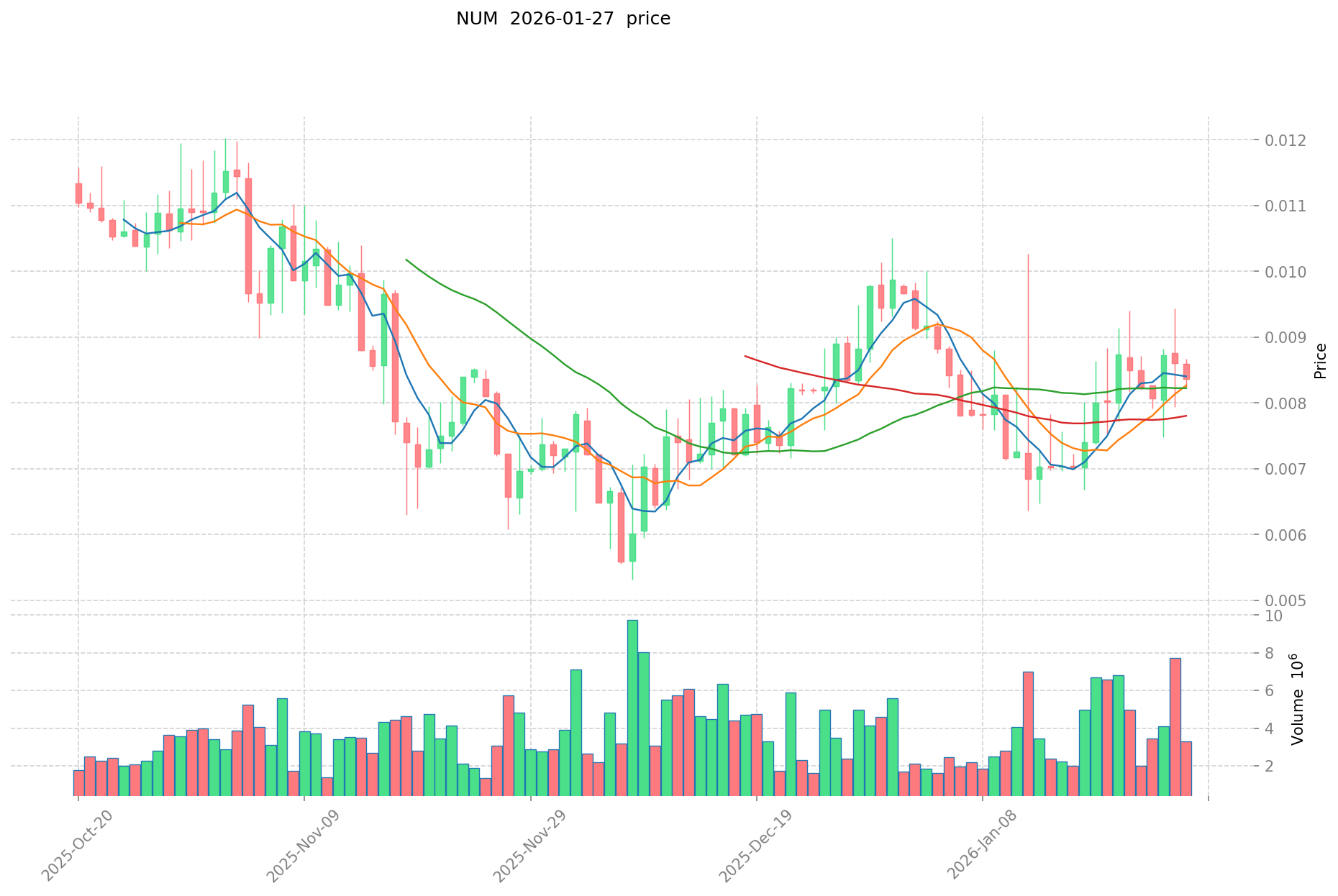
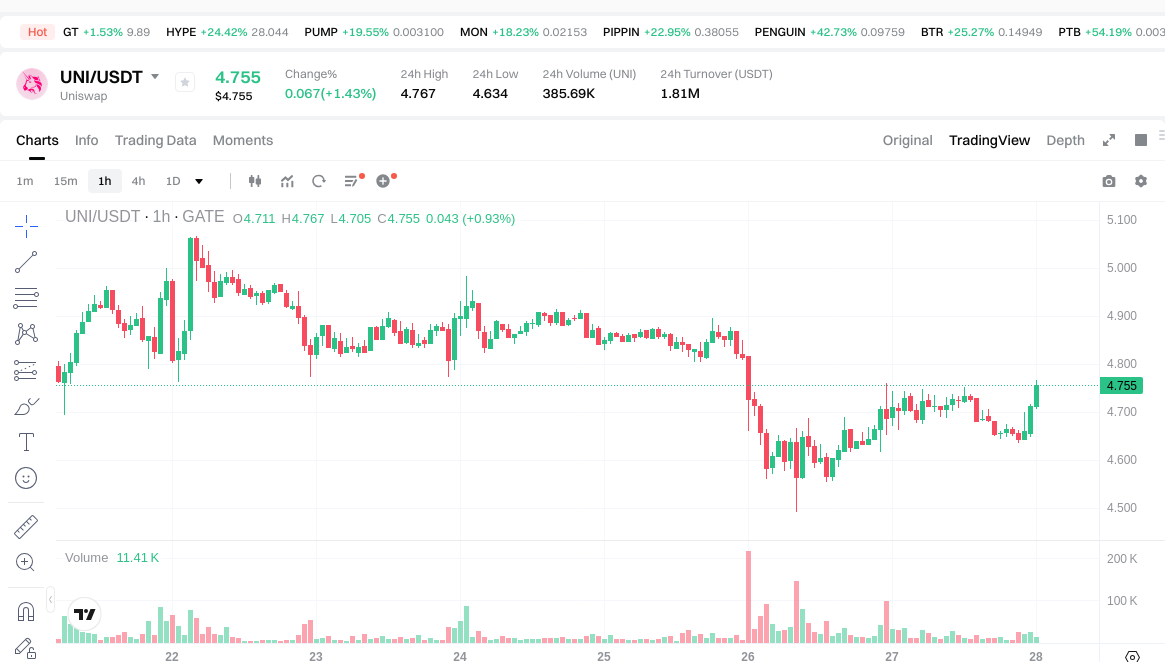
II. Core Factors Influencing NUM vs UNI Investment Value
Tokenomics Comparison (Supply Mechanism)
-
UNI: Fixed total supply of 1 billion tokens, distributed among community members (60%), team members and future employees (21.51% with four-year vesting), investors (17.80% with four-year vesting), and advisors (0.69% with four-year vesting). The supply mechanism follows a predetermined allocation model with vesting periods to prevent excessive market saturation.
-
NUM: Information regarding NUM's supply mechanism is not available in the reference materials.
-
📌 Historical Pattern: Token supply mechanisms may influence price cycles through controlled release schedules and vesting periods, which can affect market liquidity and investor sentiment over time.
Institutional Adoption and Market Application
-
Institutional Holdings: UNI has demonstrated governance functionality through its DAO structure, where UNI holders can propose and vote on protocol decisions, including management of community treasury and adjustment of fee rates. This governance feature may contribute to institutional interest.
-
Enterprise Adoption: UNI's parent protocol Uniswap serves as a decentralized exchange holding approximately 55.5% market share among DEX platforms, utilizing an Automated Market Maker (AMM) mechanism. The protocol facilitates trading pairs and liquidity provision, with applications extending to DeFi ecosystem integration.
-
Regulatory Environment: Token classification varies across jurisdictions. Utility tokens like UNI may face different regulatory treatment compared to security tokens or payment tokens, depending on local frameworks and compliance requirements.
Technology Development and Ecosystem Building
-
UNI Technical Upgrades: UNI Chain is built on Optimism's OP Stack, aiming to enhance transaction speed and security while capturing protocol value to benefit UNI token holders. The development includes mechanisms designed to optimize performance parameters.
-
NUM Technical Development: Information regarding NUM's technical development is not available in the reference materials.
-
Ecosystem Comparison: UNI operates within the Uniswap ecosystem, which includes liquidity pools, trading functionality, and governance structures. The protocol supports liquidity providers who contribute assets and earn fee-based rewards. The ecosystem includes integration with various DeFi applications, though specific comparative metrics with NUM are not available.
Macroeconomic Factors and Market Cycles
-
Inflation Environment Performance: The reference materials do not provide specific data regarding UNI's performance characteristics in inflationary environments.
-
Macroeconomic Monetary Policy: Token valuations in the crypto asset sector may be influenced by broader economic factors including interest rate adjustments and dollar index movements, though specific correlational data for UNI is not detailed in the materials.
-
Geopolitical Factors: Decentralized exchange protocols may serve cross-border transaction needs due to their permissionless nature and global accessibility, though the extent of geopolitical influence on UNI specifically requires further analysis beyond the scope of available materials.
III. 2026-2031 Price Prediction: NUM vs UNI
Short-term Forecast (2026)
- NUM: Conservative $0.00536316 - $0.008126 | Optimistic $0.008126 - $0.01040128
- UNI: Conservative $2.42199 - $4.749 | Optimistic $4.749 - $6.6486
Mid-term Forecast (2028-2029)
- NUM may enter a gradual growth phase, with projected price range of $0.009913021164 - $0.01952523340992
- UNI may enter an expansion phase, with projected price range of $4.9921488 - $10.4519995407
- Key drivers: institutional capital inflows, ETF developments, ecosystem expansion
Long-term Forecast (2031)
- NUM: Base scenario $0.01246207513821 - $0.020429631374115 | Optimistic scenario $0.020429631374115 - $0.024515557648938
- UNI: Base scenario $5.23327857290784 - $10.063997255592 | Optimistic scenario $10.063997255592 - $14.39151607549656
View detailed price predictions for NUM and UNI
Disclaimer
NUM:
| Year |
Predicted High Price |
Predicted Average Price |
Predicted Low Price |
Price Change |
| 2026 |
0.01040128 |
0.008126 |
0.00536316 |
0 |
| 2027 |
0.0135249144 |
0.00926364 |
0.008800458 |
14 |
| 2028 |
0.015724102536 |
0.0113942772 |
0.009913021164 |
41 |
| 2029 |
0.01952523340992 |
0.013559189868 |
0.00935584100892 |
68 |
| 2030 |
0.024317051109271 |
0.01654221163896 |
0.013399191427557 |
105 |
| 2031 |
0.024515557648938 |
0.020429631374115 |
0.01246207513821 |
153 |
UNI:
| Year |
Predicted High Price |
Predicted Average Price |
Predicted Low Price |
Price Change |
| 2026 |
6.6486 |
4.749 |
2.42199 |
0 |
| 2027 |
6.781572 |
5.6988 |
4.331088 |
20 |
| 2028 |
8.79866226 |
6.240186 |
4.9921488 |
32 |
| 2029 |
10.4519995407 |
7.51942413 |
5.4139853736 |
59 |
| 2030 |
11.142282675834 |
8.98571183535 |
8.5364262435825 |
90 |
| 2031 |
14.39151607549656 |
10.063997255592 |
5.23327857290784 |
113 |
IV. Investment Strategy Comparison: NUM vs UNI
Long-term vs Short-term Investment Strategies
-
NUM: May be considered by investors interested in exploring emerging digital media authentication protocols and decentralized copyright registration applications, though the project's relatively smaller market capitalization and limited exchange listings suggest higher volatility exposure.
-
UNI: May be considered by investors seeking exposure to established DeFi infrastructure with demonstrated governance functionality and broader market adoption across 66 exchanges, representing a more mature protocol with higher liquidity levels.
Risk Management and Asset Allocation
-
Conservative Investors: NUM 10-15% vs UNI 85-90% allocation may reflect preference for established protocols with deeper liquidity and broader institutional recognition, though individual risk tolerance varies.
-
Aggressive Investors: NUM 30-40% vs UNI 60-70% allocation may reflect willingness to accept higher volatility in exchange for potential growth opportunities in earlier-stage protocols, though market conditions require continuous assessment.
-
Hedging Tools: Stablecoin positions, options strategies where available, and cross-asset portfolio diversification may serve risk management objectives, subject to market conditions and individual investment goals.
V. Potential Risk Comparison
Market Risk
-
NUM: Limited exchange presence (4 exchanges) and smaller holder base (1,832 holders) may contribute to liquidity constraints and price volatility, with 24-hour trading volume of $49,030.11 indicating relatively lower market depth.
-
UNI: Despite broader adoption across 66 exchanges and 387,757 holders, the token remains subject to general cryptocurrency market cycles and sentiment shifts, with 24-hour trading volume of $1,796,041.04 reflecting higher but variable liquidity levels.
Technical Risk
-
NUM: Information regarding technical development roadmap, network stability parameters, and scalability infrastructure is not available in the reference materials, limiting comprehensive risk assessment.
-
UNI: The protocol's development of UNI Chain built on Optimism's OP Stack introduces technical implementation considerations, including dependency on layer-2 infrastructure and potential smart contract vulnerabilities requiring ongoing security auditing.
Regulatory Risk
- Global regulatory frameworks continue evolving regarding decentralized protocols, with potential differential treatment between utility tokens and other classifications. UNI's governance functionality and NUM's digital media focus may face varying regulatory interpretations across jurisdictions, requiring monitoring of compliance developments in major markets.
VI. Conclusion: Which Is the Better Buy?
📌 Investment Value Summary:
-
NUM Considerations: Represents exposure to decentralized digital media authentication sector with early-stage positioning, though limited market data and exchange accessibility present evaluation challenges. Current market capitalization of $7.08 million and ranking of #1364 reflect emerging protocol status.
-
UNI Considerations: Demonstrates established presence in decentralized exchange infrastructure with governance functionality, broader market adoption indicated by #37 ranking and $2.99 billion market capitalization, and integration within DeFi ecosystem holding approximately 55.5% DEX market share.
✅ Investment Considerations:
-
Beginning Investors: May consider focusing on more established protocols with higher liquidity levels and broader exchange accessibility, such as UNI, while conducting thorough research regarding market dynamics and risk factors before any allocation decisions.
-
Experienced Investors: May evaluate portfolio diversification across different protocol categories, considering market capitalization differentials, technical development trajectories, and personal risk tolerance when assessing allocation between emerging and established projects.
-
Institutional Investors: May prioritize protocols with demonstrated governance structures, regulatory clarity, and liquidity depth suitable for larger position sizing, while conducting comprehensive due diligence regarding custody solutions and compliance frameworks.
⚠️ Risk Disclaimer: Cryptocurrency markets exhibit high volatility characteristics. This content does not constitute investment advice, financial guidance, or trading recommendations. Individuals should conduct independent research and consult qualified financial professionals before making investment decisions.
VII. FAQ
Q1: What is the primary difference between NUM and UNI in terms of their core functionality?
NUM serves as a decentralized photo network protocol focused on digital media authentication and copyright registration, while UNI functions as the governance token for Uniswap, a leading decentralized exchange protocol. NUM's application centers on creating value and trust for digital images and videos through blockchain-based verification, whereas UNI enables holders to participate in governance decisions for one of the largest DEX platforms, which holds approximately 55.5% market share among decentralized exchanges. The fundamental distinction lies in their use cases: NUM addresses digital media provenance and copyright protection, while UNI facilitates decentralized trading infrastructure and community governance within the DeFi ecosystem.
Q2: How do the market capitalizations and liquidity levels of NUM and UNI compare?
As of January 28, 2026, UNI holds a substantially larger market position with a market capitalization of approximately $2.99 billion (ranked #37), compared to NUM's $7.08 million market cap (ranked #1364). This represents a market cap difference of over 400 times. Liquidity metrics further illustrate this disparity: UNI's 24-hour trading volume reaches $1,796,041.04 across 66 exchanges with 387,757 holders, while NUM records $49,030.11 in daily volume across 4 exchanges with 1,832 holders. The significant differences in these metrics indicate that UNI offers substantially deeper liquidity and broader market accessibility, which typically correlates with lower price volatility and easier position entry/exit for investors.
Q3: What are the key risk factors investors should consider when comparing NUM and UNI?
NUM presents higher risk characteristics due to limited exchange accessibility (4 exchanges), smaller holder base (1,832 holders), and constrained liquidity evidenced by $49,030.11 daily trading volume, which may result in significant price volatility and potential difficulty executing larger trades. Additionally, limited available information regarding NUM's technical development roadmap and infrastructure creates evaluation challenges. UNI carries different risk profiles, including dependency on Ethereum blockchain performance, potential smart contract vulnerabilities requiring ongoing security auditing, and exposure to evolving regulatory frameworks affecting decentralized exchange protocols. Both tokens remain subject to broader cryptocurrency market cycles and sentiment shifts, though UNI's established position and higher liquidity may provide relatively more stability during market downturns.
Q4: How do the tokenomics and supply mechanisms differ between NUM and UNI?
UNI features a fixed total supply of 1 billion tokens with a predetermined distribution structure: 60% allocated to community members, 21.51% to team members and future employees (four-year vesting), 17.80% to investors (four-year vesting), and 0.69% to advisors (four-year vesting). This controlled release schedule through vesting periods aims to prevent excessive market saturation and align long-term stakeholder interests. Currently, 634.6 million UNI tokens are in circulation (63.46% of max supply). In contrast, comprehensive information regarding NUM's tokenomics structure is not available in the reference materials, though its circulating supply stands at 877.5 million tokens (87.75% of max supply). The substantially higher percentage of circulating supply for NUM compared to UNI may indicate different inflation dynamics and vesting schedules between the two protocols.
Q5: What role does governance play in the UNI ecosystem, and does NUM offer similar functionality?
UNI holders possess governance rights through Uniswap's DAO (Decentralized Autonomous Organization) structure, enabling them to propose and vote on protocol decisions including community treasury management, fee rate adjustments, and strategic development directions. This governance functionality provides token holders with direct influence over protocol evolution and value capture mechanisms. The governance framework represents a core utility component of the UNI token beyond its trading functionality. Information regarding NUM's governance structure or similar participatory mechanisms is not available in the reference materials, limiting direct comparison of this functionality between the two protocols. The presence or absence of governance rights may influence investor considerations regarding long-term protocol alignment and stakeholder participation opportunities.
Q6: How have NUM and UNI performed during previous market cycles?
NUM reached its all-time high of $2.52 on November 28, 2021, during the bull market cycle, before experiencing substantial correction to a low of $0.00532095 on December 8, 2025. This represents a decline exceeding 99% from peak levels. UNI achieved its highest price of $44.92 on May 3, 2021, benefiting from the DeFi boom and protocol upgrades, before falling to $1.03 on September 17, 2020 (note: this appears to be a data inconsistency in the source materials), and experiencing subsequent volatility throughout the cycle. As of January 28, 2026, NUM trades at $0.008068 (still significantly below its all-time high), while UNI trades at $4.714 (approximately 89% below its peak). Both tokens have experienced substantial corrections from their historical highs, reflecting broader cryptocurrency market cycles and sector-specific dynamics affecting their respective categories.
Q7: What price projections exist for NUM and UNI through 2031?
For 2026, NUM's conservative forecast ranges from $0.00536316 to $0.008126, with optimistic scenarios reaching $0.01040128, while UNI's conservative range spans $2.42199 to $4.749, with optimistic projections up to $6.6486. By 2031, NUM's base scenario projects $0.01246207513821 to $0.020429631374115, with optimistic scenarios reaching $0.024515557648938, representing potential cumulative increases of 153% to 204% from 2026 levels. UNI's 2031 base scenario forecasts $5.23327857290784 to $10.063997255592, with optimistic projections up to $14.39151607549656, indicating potential cumulative growth of 113% to 203% from 2026 levels. These projections suggest both tokens may experience gradual appreciation through the forecast period, with key drivers including institutional capital inflows, potential ETF developments, and ecosystem expansion, though actual performance will depend on numerous market variables and should not be considered investment guarantees.
Q8: What investment allocation strategies might be appropriate for NUM versus UNI?
Conservative investors might consider a 10-15% NUM allocation versus 85-90% UNI allocation, reflecting preference for established protocols with deeper liquidity and broader institutional recognition, though individual risk tolerance varies significantly. Aggressive investors willing to accept higher volatility for potential growth opportunities in earlier-stage protocols might evaluate 30-40% NUM versus 60-70% UNI allocations, subject to continuous market condition assessment. Beginning investors may focus on more established protocols like UNI with higher liquidity levels and broader exchange accessibility while conducting thorough research regarding market dynamics before any allocation decisions. Experienced and institutional investors may evaluate portfolio diversification across different protocol categories, considering market capitalization differentials, technical development trajectories, governance structures, regulatory clarity, and liquidity depth suitable for their position sizing requirements and risk management frameworks.
* The information is not intended to be and does not constitute financial advice or any other recommendation of any sort offered or endorsed by Gate.