This comprehensive analysis compares ELF and DOT, two significant Layer 1 blockchain assets, examining their investment characteristics across multiple dimensions. As of January 2026, ELF trades at $0.10079 with $82.29M market cap, while DOT trades at $2.19 with $3.63B market cap, representing vastly different liquidity and ecosystem maturity levels. The article evaluates historical price performance revealing both assets declined approximately 96% from peaks, tokenomics structures, technical differentiation including ELF's AI integration versus DOT's cross-chain interoperability, and institutional adoption metrics. Investment strategies are presented for conservative, aggressive, and institutional investors, with risk assessments covering market depth, technical complexity, and regulatory considerations. Price projections through 2031 indicate ELF ranging $0.110-$0.194 and DOT ranging $2.71-$5.11 under various scenarios, supported by detailed FAQ addressing investor considerations for portfolio allocation an
Introduction: Investment Value, Price Prediction, and Risk Analysis of ELF
In the cryptocurrency market, ELF has attracted attention as an AI-enhanced Layer 1 blockchain network. As of January 18, 2026, ELF is trading at $0.10079, with a market capitalization ranking of 409 and a circulating supply of approximately 816.47 million tokens. Since its founding in 2017, aelf has positioned itself as a pioneer in Asia's blockchain evolution, leveraging C# programming language for efficiency and scalability across its multi-layered architecture.
Aelf (ELF): Launched in 2017 with its global hub in Singapore, the project has focused on integrating AI technology and modular Layer 2 ZK Rollup solutions. The network completed its testnet launch in 2018, followed by mainnet deployment in 2020. Notable institutional supporters include Arrington Capital, Draper Dragon, and Galaxy Digital.
This analysis will examine ELF's investment characteristics across several dimensions: historical price performance, tokenomics and supply structure, technological ecosystem development, and market positioning. The article will address key considerations for investors:
"What factors influence ELF's price volatility and long-term value proposition?"
With a 24-hour trading volume of $63,683 and year-over-year price changes showing significant fluctuations, understanding ELF's risk-return profile requires careful evaluation of its technical capabilities, market adoption metrics, and competitive positioning within the Layer 1 blockchain segment.
I. Historical Price Comparison and Current Market Status
ELF and DOT Historical Price Trends
- 2018: ELF reached its all-time high of $2.60 in January following its mainnet launch preparations and initial market enthusiasm during the 2017-2018 cryptocurrency bull market cycle.
- 2020: DOT was officially released in August at an initial trading price of approximately $2.49, marking the launch of the Polkadot mainnet and beginning its journey in the blockchain interoperability space.
- 2021: DOT experienced notable growth during the DeFi summer and parachain auction period, reaching its historical peak of $54.98 in November, driven by ecosystem expansion and strong investor interest in cross-chain solutions.
- 2025: Both tokens entered a prolonged correction phase. ELF declined from its historical high to a low of $0.03545756 in March 2020, while DOT recorded its all-time low of $1.66 in December 2025.
- Comparative Analysis: During the 2021-2025 market cycle, ELF experienced a decline from its peak of $2.60 to current levels, representing approximately 96.13% correction from historical highs. DOT, meanwhile, declined from $54.98 to recent lows near $1.66, marking a significant 96.98% correction from its peak value.
Current Market Status (January 18, 2026)
- ELF current price: $0.10079
- DOT current price: $2.19
- 24-hour trading volume: ELF recorded $63,683.16 compared to DOT's $779,962.55
- Market capitalization: ELF stands at approximately $82.29 million, while DOT maintains a market cap of $3.63 billion
- Market sentiment index (Fear & Greed Index): 50 (Neutral)
- Recent price movements: ELF showed a -0.31% change over 24 hours and -12.61% over the past week, while DOT demonstrated +3.20% growth in 24 hours and +4.09% over the past seven days
View real-time prices:
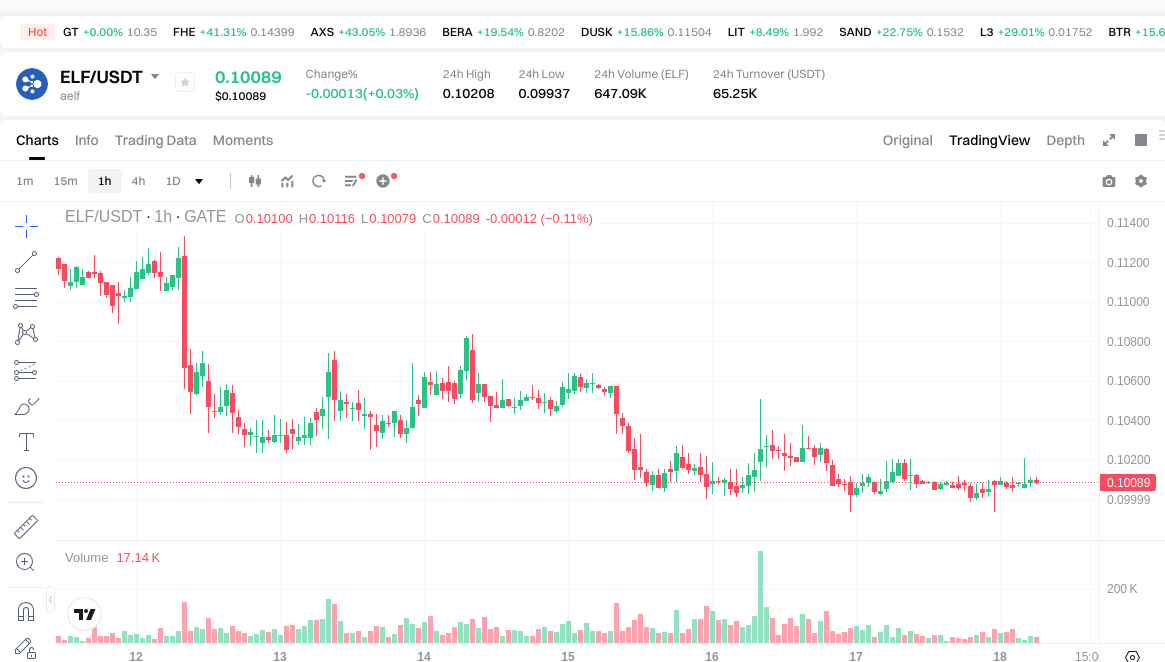
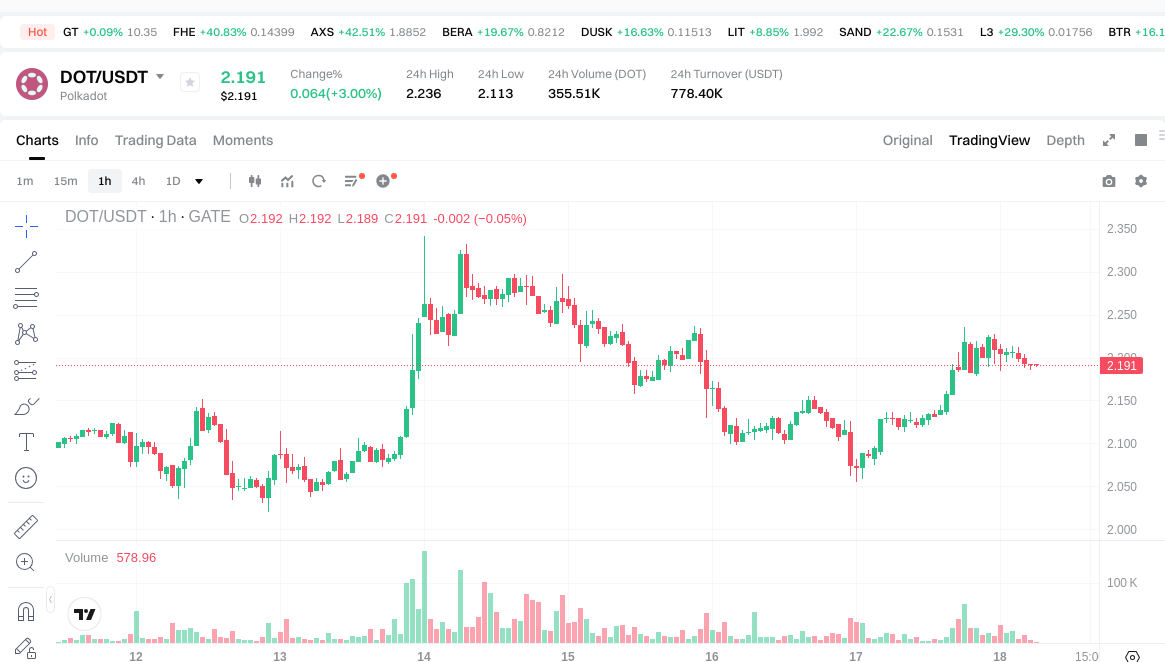
II. Core Factors Influencing ELF vs DOT Investment Value
Supply Mechanism Comparison (Tokenomics)
- ELF: Exchange rate calculations are typically priced in USD or USDT, with valuations influenced by various factors including macroeconomic developments and investor sentiment.
- DOT: Supply mechanisms and ecosystem development are key considerations when evaluating investment potential, with price trends reflecting broader market dynamics.
- 📌 Historical Pattern: Supply mechanisms play a role in shaping price cycle variations, though specific mechanisms require further analysis based on individual project characteristics.
Institutional Adoption and Market Application
- Institutional Holdings: Market demand and technological innovation influence institutional interest in both assets.
- Enterprise Adoption: Both ELF and DOT are subject to evaluation based on ecosystem development and technical progress.
- National Policies: Regulatory attitudes vary across jurisdictions, with macroeconomic factors and central bank announcements affecting exchange rate dynamics.
Technical Development and Ecosystem Building
- ELF Technical Progress: Developments may include protocol upgrades and other cryptocurrency-specific advancements that influence market positioning.
- DOT Technical Development: Ecosystem growth encompasses market capitalization, application domains, and price trend analysis.
- Ecosystem Comparison: Investment value assessment considers technical advancement and ecosystem expansion across various application areas.
Macroeconomic Environment and Market Cycles
- Inflationary Environment Performance: Asset valuations respond to macroeconomic news and inflation reports.
- Macroeconomic Monetary Policy: Interest rates and broader monetary conditions affect exchange rate fluctuations for both assets.
- Geopolitical Factors: Market sentiment and investor behavior are influenced by international developments and policy announcements.
III. 2026-2031 Price Prediction: ELF vs DOT
Short-term Prediction (2026)
- ELF: Conservative $0.094-$0.101 | Optimistic $0.101-$0.104
- DOT: Conservative $1.67-$2.19 | Optimistic $2.19-$2.83
Mid-term Prediction (2028-2029)
- ELF may enter a consolidation phase, with projected prices ranging from $0.072-$0.114 in 2028 and $0.088-$0.141 in 2029
- DOT may enter a growth phase, with projected prices ranging from $1.39-$3.63 in 2028 and $2.73-$4.12 in 2029
- Key drivers: institutional capital inflows, ETF developments, ecosystem expansion
Long-term Prediction (2030-2031)
- ELF: Baseline scenario $0.110-$0.135 | Optimistic scenario $0.128-$0.194
- DOT: Baseline scenario $2.71-$4.19 | Optimistic scenario $3.31-$5.11
View detailed price predictions for ELF and DOT
Disclaimer
ELF:
| Year |
Predicted High Price |
Predicted Average Price |
Predicted Low Price |
Price Change |
| 2026 |
0.103927 |
0.1009 |
0.093837 |
0 |
| 2027 |
0.11675139 |
0.1024135 |
0.05939983 |
1 |
| 2028 |
0.1139657428 |
0.109582445 |
0.0723244137 |
8 |
| 2029 |
0.140835358314 |
0.1117740939 |
0.088301534181 |
10 |
| 2030 |
0.14272434050091 |
0.126304726107 |
0.10988511171309 |
25 |
| 2031 |
0.193700927957695 |
0.134514533303955 |
0.127788806638757 |
33 |
DOT:
| Year |
Predicted High Price |
Predicted Average Price |
Predicted Low Price |
Price Change |
| 2026 |
2.82639 |
2.191 |
1.66516 |
0 |
| 2027 |
2.63412975 |
2.508695 |
1.3045214 |
14 |
| 2028 |
3.62569144875 |
2.571412375 |
1.3885626825 |
17 |
| 2029 |
4.12107404279375 |
3.098551911875 |
2.72672568245 |
41 |
| 2030 |
4.764953130081375 |
3.609812977334375 |
2.707359733000781 |
64 |
| 2031 |
5.108607325523607 |
4.187383053707875 |
3.308032612429221 |
91 |
IV. Investment Strategy Comparison: ELF vs DOT
Long-term vs Short-term Investment Strategies
- ELF: May be considered by investors focused on AI-enhanced blockchain infrastructure and Layer 1 innovation, though current market positioning suggests elevated volatility considerations
- DOT: May attract investors interested in cross-chain interoperability solutions and established ecosystem development, with relatively higher liquidity metrics
Risk Management and Asset Allocation
- Conservative investors: ELF 20-30% vs DOT 70-80% allocation could reflect risk-adjusted positioning based on market capitalization differences and trading volume stability
- Aggressive investors: ELF 40-50% vs DOT 50-60% allocation may suit those seeking higher volatility exposure while maintaining diversification across Layer 1 protocols
- Hedging instruments: stablecoin reserves, options strategies, cross-asset portfolio construction
V. Potential Risk Comparison
Market Risk
- ELF: Lower trading volume of $63,683 indicates reduced liquidity conditions, with 24-hour price change of -0.31% and weekly decline of -12.61% suggesting elevated short-term volatility patterns
- DOT: Higher trading volume of $779,962 reflects improved market depth, with 24-hour gain of +3.20% and weekly increase of +4.09% indicating relatively stable near-term momentum
Technical Risk
- ELF: Scalability considerations, network stability factors, and ecosystem adoption metrics require ongoing evaluation
- DOT: Protocol complexity, parachain performance variables, and cross-chain security considerations warrant continuous monitoring
Regulatory Risk
- Global regulatory developments may affect both assets differently based on their respective use cases, geographic presence, and institutional engagement levels. Policy changes across jurisdictions could influence market access and operational frameworks for Layer 1 protocols.
VI. Conclusion: Which Is the Better Buy?
📌 Investment Value Summary:
- ELF advantages: AI integration focus, C# development environment, modular architecture approach, Singapore-based operational structure
- DOT advantages: Established interoperability framework, higher market capitalization of $3.63 billion, stronger liquidity profile, broader institutional recognition
✅ Investment Recommendations:
- Beginner investors: Consider starting with DOT given its higher market capitalization, improved liquidity conditions, and established ecosystem presence before exploring smaller-cap alternatives
- Experienced investors: Evaluate portfolio diversification across both assets based on risk tolerance, with attention to ELF's AI positioning and DOT's cross-chain capabilities within broader Layer 1 exposure
- Institutional investors: Assess allocation strategies considering market depth requirements, regulatory compliance frameworks, and long-term ecosystem development trajectories across both protocols
⚠️ Risk Disclaimer: Cryptocurrency markets exhibit extreme volatility characteristics. This analysis does not constitute investment advice.
VII. FAQ
Q1: What is the current price difference between ELF and DOT, and why is it significant?
As of January 18, 2026, ELF trades at $0.10079 while DOT trades at $2.19, representing approximately a 21.7x price differential. This significant gap primarily reflects their vastly different market capitalizations ($82.29 million for ELF vs $3.63 billion for DOT) and liquidity profiles. DOT's higher trading volume of $779,962 compared to ELF's $63,683 indicates substantially greater market depth and institutional participation. The price difference also correlates with ecosystem maturity—DOT's established cross-chain interoperability framework and broader adoption have commanded higher valuations, while ELF's AI-enhanced Layer 1 positioning remains in earlier developmental stages with limited market recognition.
Q2: How do the historical price performances of ELF and DOT compare from their peaks?
Both assets have experienced severe corrections from their respective all-time highs, though their trajectories differ significantly. ELF reached its peak of $2.60 in January 2018 and has since declined approximately 96.13% to current levels, while DOT peaked at $54.98 in November 2021 during the DeFi summer and parachain auction period, subsequently declining approximately 96.98%. Despite similar percentage corrections, the contexts differ substantially—ELF's decline followed early mainnet hype in the 2017-2018 bull cycle, whereas DOT's correction came after achieving substantial ecosystem development and institutional adoption. DOT's recovery from its December 2025 low of $1.66 to current $2.19 levels (+31.9%) demonstrates relatively stronger near-term resilience compared to ELF's continued weakness.
Q3: What are the key technical differences between ELF and DOT that impact their investment value?
ELF distinguishes itself through AI integration capabilities, C# programming language implementation for developer accessibility, and modular Layer 2 ZK Rollup architecture designed for scalability. Founded in 2017 with headquarters in Singapore, aelf has positioned itself as an AI-enhanced Layer 1 blockchain focused on Asian market penetration. DOT, conversely, emphasizes cross-chain interoperability through its parachain framework, enabling diverse blockchain networks to communicate and share security. These technical differences translate to distinct value propositions: ELF targets developers seeking AI-enhanced smart contract capabilities and familiar programming environments, while DOT appeals to projects requiring multi-chain connectivity and shared security infrastructure. Institutional backing also varies—ELF has support from Arrington Capital, Draper Dragon, and Galaxy Digital, while DOT has achieved broader institutional recognition reflected in its significantly higher market capitalization.
Q4: How do the tokenomics and supply mechanisms differ between ELF and DOT?
ELF maintains a circulating supply of approximately 816.47 million tokens with market capitalization ranking at #409, indicating limited market penetration and potentially higher supply-side pressure relative to demand. Specific inflation mechanisms and total supply caps require detailed analysis of the project's economic model. DOT operates with a more complex supply structure featuring a dynamic inflation model that adjusts based on network staking participation rates, typically targeting 10% annual inflation with mechanisms to incentivize validator participation and network security. The substantial difference in market caps ($82.29M vs $3.63B) suggests significantly different supply-demand dynamics—DOT's higher valuation reflects broader token distribution, stronger holder conviction, and more established price discovery mechanisms, while ELF's lower capitalization may indicate either undervaluation relative to fundamentals or appropriate pricing given limited adoption metrics.
Q5: What are the projected price ranges for ELF and DOT through 2031?
Conservative projections for ELF suggest 2026 trading ranges of $0.094-$0.101, potentially reaching $0.110-$0.135 by 2030 and $0.128-$0.194 in optimistic scenarios by 2031. DOT's projections indicate 2026 ranges of $1.67-$2.19, expanding to $2.71-$4.19 by 2030 with optimistic scenarios reaching $3.31-$5.11 by 2031. These projections reflect fundamental differences in market positioning—ELF's lower price targets correspond to its earlier-stage ecosystem development and limited liquidity, requiring significant adoption catalysts to achieve meaningful upside. DOT's higher projected values account for established infrastructure, ongoing parachain deployments, and institutional recognition. Key assumptions underlying these predictions include continued blockchain industry growth, successful ecosystem expansion, regulatory clarity improvements, and broader cryptocurrency market recovery from current cycle lows. Investors should note that cryptocurrency price predictions carry substantial uncertainty, with actual outcomes potentially varying significantly from modeled scenarios.
Q6: Which asset presents better risk-adjusted returns for different investor profiles?
For conservative investors, DOT may offer superior risk-adjusted returns given its 70-80% recommended allocation weight, supported by higher liquidity ($779,962 daily volume), established market presence ($3.63B market cap), and demonstrated ecosystem functionality through active parachain operations. The asset's recent positive momentum (+3.20% daily, +4.09% weekly) suggests relative market strength. ELF, recommended at 20-30% allocation for conservative profiles, presents elevated volatility risks evidenced by -12.61% weekly decline and extremely low trading volume, though potential upside exists if AI-blockchain integration gains traction. Aggressive investors might consider 40-50% ELF allocation balanced with 50-60% DOT positioning, accepting higher volatility exposure in exchange for asymmetric upside potential should ELF's AI positioning achieve market differentiation. Institutional investors should prioritize liquidity requirements and regulatory compliance considerations, likely favoring DOT's deeper markets while potentially allocating modest exposure to ELF for portfolio diversification across Layer 1 innovation themes. All investor categories should implement strict risk management protocols including position sizing discipline and correlation analysis within broader portfolio contexts.
Q7: What are the primary regulatory and technical risks differentiating ELF and DOT investments?
Regulatory risks affect both assets but manifest differently based on their operational characteristics and geographic focus. ELF's Singapore-based operations and Asian market orientation expose it to evolving regulatory frameworks in jurisdictions including China, Singapore, and broader Southeast Asian markets, where cryptocurrency policies remain in flux. DOT's more globally distributed ecosystem and established institutional relationships may provide relatively greater regulatory clarity, though cross-chain functionality introduces compliance complexity across multiple jurisdictions. Technical risks for ELF center on unproven scalability at production levels, limited network effects given modest adoption metrics, and execution risks in delivering AI-blockchain integration promises. DOT faces technical risks including parachain security assumptions, protocol complexity potentially limiting developer adoption despite interoperability benefits, and competition from alternative Layer 0 solutions. The critical differentiator lies in proven resilience—DOT has demonstrated operational stability through market cycles and maintained developer activity, while ELF's technical capabilities remain largely theoretical pending significant ecosystem growth. Investors should continuously monitor network activity metrics, developer engagement indicators, and regulatory developments specific to each protocol's primary operational jurisdictions.
Q8: How should investors approach portfolio allocation between ELF and DOT in the current market environment?
Current market conditions characterized by neutral sentiment (Fear & Greed Index: 50) and early 2026 positioning suggest differentiated allocation strategies across investor sophistication levels. Beginner investors should prioritize capital preservation and liquidity access, warranting initial DOT exposure of 80-100% of Layer 1 blockchain allocation before considering higher-risk alternatives like ELF. The substantial liquidity differential ($779,962 vs $63,683 daily volume) creates material execution risks for ELF positions, particularly for larger capital deployments. Experienced investors with demonstrated risk management capabilities might implement 60-70% DOT / 30-40% ELF allocations, treating ELF as a speculative position on AI-blockchain convergence themes while maintaining core exposure to DOT's established infrastructure. Institutional portfolios should weight allocation decisions toward liquidity requirements, regulatory compliance frameworks, and correlation benefits within broader digital asset strategies, likely resulting in DOT-heavy positioning (75-85%) with opportunistic ELF exposure (15-25%) sized appropriately for venture-stage risk profiles. All allocation approaches should incorporate dynamic rebalancing protocols triggered by significant deviation from target weights, material changes in project fundamentals, or broader market regime shifts affecting cryptocurrency sector correlations.
* The information is not intended to be and does not constitute financial advice or any other recommendation of any sort offered or endorsed by Gate.