This comprehensive analysis compares DeepBook (DEEP) and The Graph (GRT), two distinct blockchain infrastructure assets with different market positioning and investment characteristics. DEEP, launched in October 2024, operates as a decentralized central limit order book on Sui blockchain, while GRT serves as a decentralized data indexing protocol since December 2020. The article examines historical price trajectories, tokenomics, market adoption, and technical ecosystems to evaluate their investment potential. As of January 2026, DEEP trades at $0.04932 with higher trading volume, while GRT has a larger market cap at $430.5 million. Through detailed price predictions through 2031, risk assessments, and investment strategy frameworks, this guide helps investors understand which asset aligns better with their risk tolerance and portfolio objectives. Check real-time prices on Gate for both assets.
Introduction: A Comparative Investment Analysis of DEEP and GRT
In the cryptocurrency market, the comparison between DeepBook (DEEP) and The Graph (GRT) represents an intriguing study of two distinct approaches to blockchain infrastructure. These two assets demonstrate notable differences in market capitalization rankings, use cases, and price performance, each representing unique positioning within the crypto ecosystem.
DeepBook (DEEP): Launched in October 2024, DEEP operates as a decentralized central limit order book (CLOB) built on Sui. By leveraging Sui's parallel execution capabilities, sub-second latency, and low transaction costs, it aims to establish itself as foundational liquidity infrastructure for DeFi services within the Sui ecosystem.
The Graph (GRT): Introduced in December 2020, GRT functions as a decentralized protocol for indexing and querying blockchain data, primarily serving Ethereum. The protocol enables simplified data queries through open APIs (subgraphs), positioning itself as essential infrastructure for blockchain data accessibility.
This article examines historical price trajectories, supply mechanisms, technical ecosystems, and future outlooks to provide a comprehensive comparative analysis of DEEP versus GRT investment characteristics. Through this exploration, we address a fundamental question many investors are considering:
"Which presents more compelling investment attributes in the current market environment?"
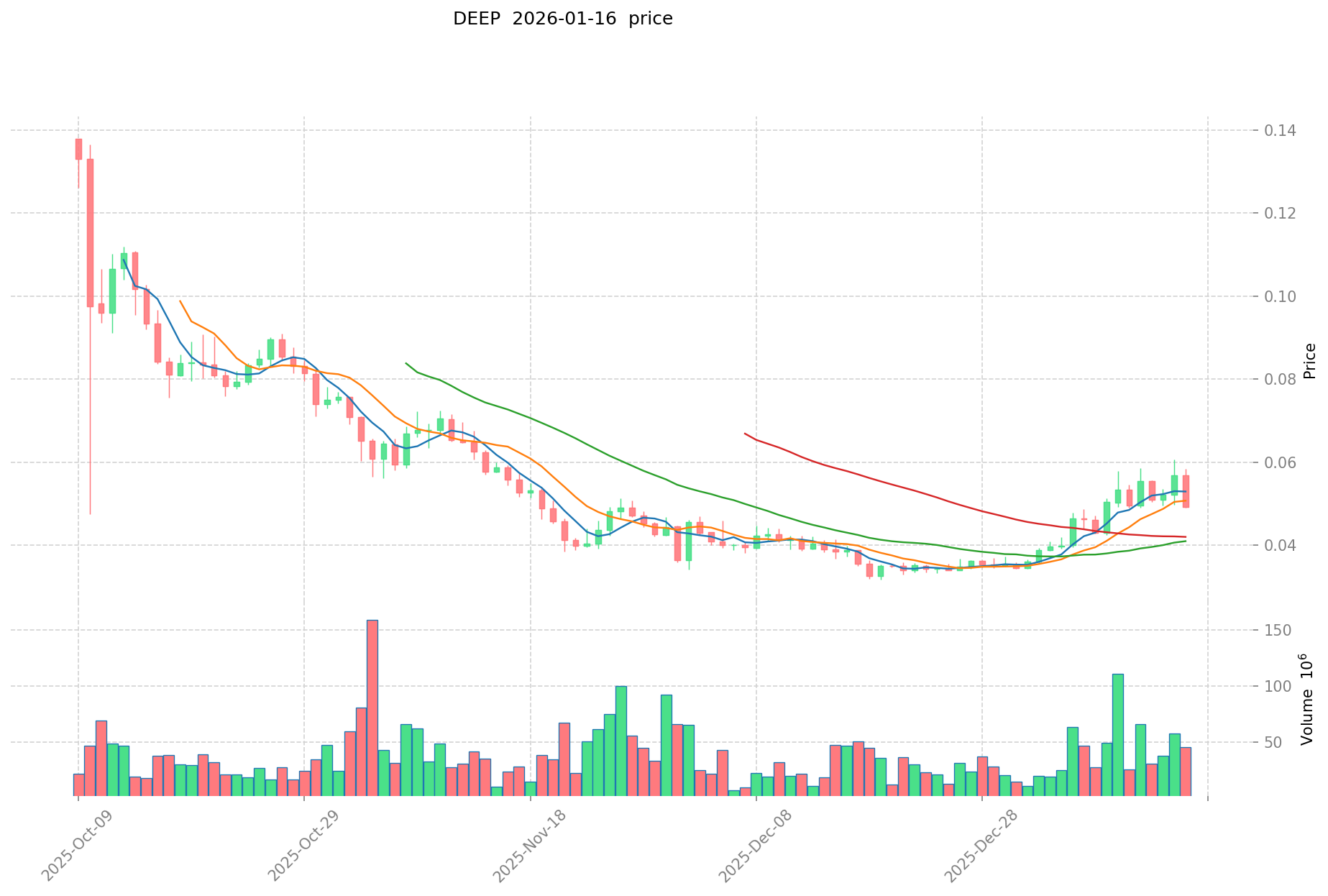
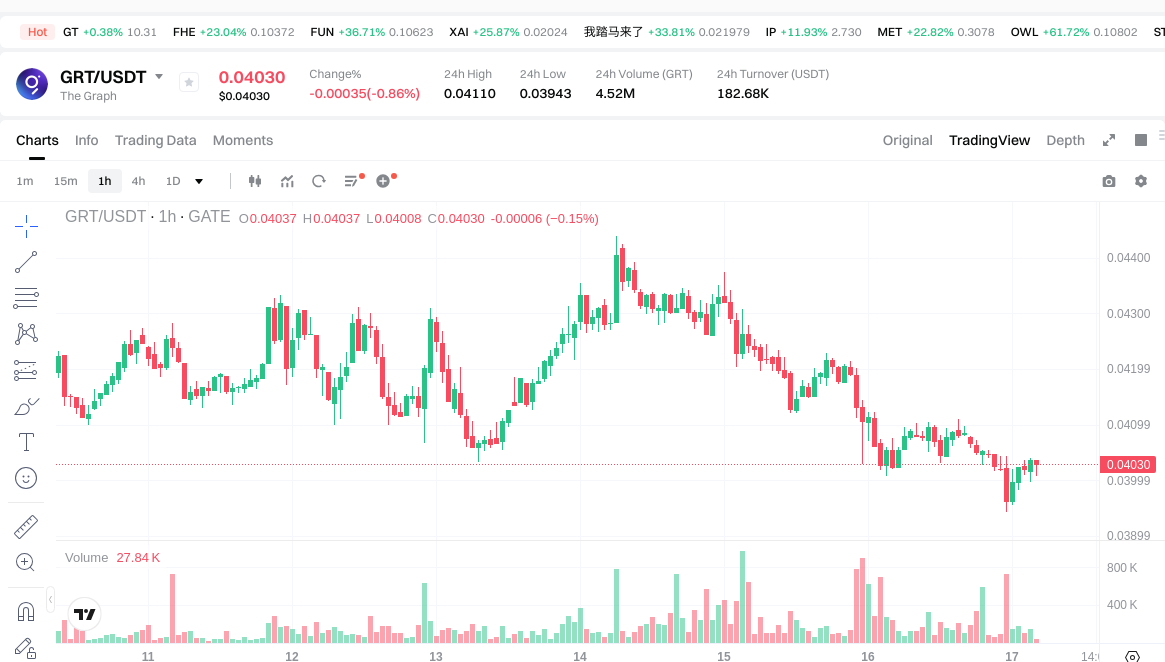
As of January 17, 2026, DEEP trades at $0.04932 with a market cap of $123.3 million (ranking #326), while GRT is priced at $0.04032 with a market cap of $430.5 million (ranking #143). Understanding the factors behind these valuations requires examining their respective technological foundations, market adoption patterns, and growth trajectories.
I. Historical Price Comparison and Current Market Status
Historical Price Trends of DEEP (Coin A) and GRT (Coin B)
-
2024: DEEP experienced significant volatility following its launch in October 2024, with the price reaching a historical low of $0.005263 on October 14, 2024, shortly after deployment.
-
2025: DEEP achieved its all-time high of $0.34572 on January 18, 2025, representing substantial growth from its launch price. However, this peak was followed by a notable correction.
-
2021: GRT reached its historical high of $2.84 on February 12, 2021, during a broader crypto market rally. This represented peak valuation for the protocol.
-
2026: GRT recorded its all-time low of $0.03272768 on January 1, 2026, reflecting prolonged downward pressure.
-
Comparative Analysis: During recent market cycles, DEEP declined from its peak of $0.34572 to current levels around $0.04932, representing an approximate 85.7% correction. In contrast, GRT experienced a more extended decline, falling from its 2021 high of $2.84 to approximately $0.04032, marking a decline of over 98.5% from its peak.
Current Market Status (January 17, 2026)
- DEEP Current Price: $0.04932
- GRT Current Price: $0.04032
- 24-Hour Trading Volume: DEEP recorded $2,431,819.09 compared to GRT's $184,375.97
- Market Sentiment Index (Fear & Greed Index): 49 (Neutral)
View real-time prices:
II. Core Factors Influencing DEEP vs GRT Investment Value
Tokenomics Comparison
-
GRT: The Graph operates within the Web3 ecosystem with a token economic model designed to incentivize network participants including Indexers, Curators, and Delegators. Protocol upgrades play a crucial role in shaping supply dynamics and network sustainability.
-
DEEP: Information regarding DEEP's supply mechanism and tokenomics structure is not available in the reference materials.
-
📌 Historical Pattern: Token supply mechanisms influence price cycles through inflation rates, token burns, and network reward distributions, though specific historical data for these assets requires further research.
Institutional Adoption and Market Application
-
Institutional Holdings: The reference materials mention BlackRock's focus on multi-asset strategies and global investment opportunities, but do not provide specific institutional holding data for either GRT or DEEP.
-
Enterprise Adoption: GRT serves as infrastructure for Web3 applications, enabling data indexing and querying across blockchain networks. DEEP's enterprise adoption patterns are not detailed in the available materials.
-
Policy Environment: Regulatory approaches toward decentralized indexing protocols and AI-enhanced search technologies vary across jurisdictions, though specific policy stances are not outlined in the reference materials.
Technology Development and Ecosystem Building
-
GRT Technology Upgrades: The Graph continues to develop its decentralized indexing protocol, with ongoing enhancements aimed at improving query efficiency and expanding network capabilities within the Web3 infrastructure layer.
-
DEEP Technology Development: Reference materials mention Deep Search functionality integrated with Gemini AI for cross-source data retrieval and analysis, though specific blockchain-related technical developments are not detailed.
-
Ecosystem Comparison: GRT's ecosystem focuses on supporting DeFi protocols, NFT platforms, and decentralized applications requiring indexed blockchain data. DEEP's ecosystem positioning in financial data analytics represents a different market segment, though direct comparisons require additional data.
Macroeconomic Environment and Market Cycles
-
Inflation Environment Performance: The anti-inflation properties of digital assets depend on multiple factors including supply constraints, adoption rates, and correlation with traditional assets. Specific performance data during inflationary periods is not provided in the materials.
-
Monetary Policy Impact: Interest rate adjustments and dollar index movements affect digital asset valuations through liquidity conditions and risk appetite, though asset-specific sensitivities require further analysis.
-
Geopolitical Factors: Cross-border transaction demand and international developments influence adoption patterns, particularly for infrastructure protocols supporting decentralized networks, though specific impact assessments are not available in the reference materials.
III. 2026-2031 Price Prediction: DEEP vs GRT
Short-term Prediction (2026)
- DEEP: Conservative $0.027-$0.049 | Optimistic $0.032-$0.054
- GRT: Conservative $0.030-$0.042 | Optimistic $0.032-$0.045
Mid-term Prediction (2028-2029)
- DEEP may enter a growth phase, with estimated prices ranging from $0.031 to $0.072
- GRT may enter a consolidation phase, with estimated prices ranging from $0.023 to $0.054
- Key drivers: institutional capital inflows, ETF developments, ecosystem expansion
Long-term Prediction (2030-2031)
- DEEP: Baseline scenario $0.059-$0.072 | Optimistic scenario $0.062-$0.088
- GRT: Baseline scenario $0.041-$0.053 | Optimistic scenario $0.041-$0.059
View detailed price predictions for DEEP and GRT
Disclaimer
DEEP:
| Year |
Predicted High Price |
Predicted Average Price |
Predicted Low Price |
Price Change |
| 2026 |
0.054263 |
0.04933 |
0.0271315 |
0 |
| 2027 |
0.06526359 |
0.0517965 |
0.047134815 |
5 |
| 2028 |
0.06613895085 |
0.058530045 |
0.03102092385 |
18 |
| 2029 |
0.07168467261375 |
0.062334497925 |
0.05797108307025 |
26 |
| 2030 |
0.077061023059781 |
0.067009585269375 |
0.061648818447825 |
35 |
| 2031 |
0.087883071080785 |
0.072035304164578 |
0.059068949414954 |
46 |
GRT:
| Year |
Predicted High Price |
Predicted Average Price |
Predicted Low Price |
Price Change |
| 2026 |
0.0445332 |
0.04012 |
0.0324972 |
0 |
| 2027 |
0.045712728 |
0.0423266 |
0.030051886 |
4 |
| 2028 |
0.05370399008 |
0.044019664 |
0.02333042192 |
9 |
| 2029 |
0.0522821549328 |
0.04886182704 |
0.0386008433616 |
21 |
| 2030 |
0.056134909994904 |
0.0505719909864 |
0.04045759278912 |
25 |
| 2031 |
0.058688795539717 |
0.053353450490652 |
0.040548622372895 |
32 |
IV. Investment Strategy Comparison: DEEP vs GRT
Long-term vs Short-term Investment Strategies
-
DEEP: May appeal to investors interested in emerging DeFi infrastructure within the Sui ecosystem, particularly those with higher risk tolerance seeking exposure to newer protocol developments with potential growth trajectories.
-
GRT: May suit investors focused on established Web3 data infrastructure with broader ecosystem integration across multiple blockchain networks, potentially offering more mature market positioning.
Risk Management and Asset Allocation
-
Conservative Investors: A cautious approach might consider limited allocation to either asset given market volatility, with potential weighting favoring GRT's longer operational history (e.g., 30% DEEP vs 70% GRT within crypto portfolio allocation).
-
Aggressive Investors: Those seeking higher risk-reward profiles might allocate more substantially to emerging opportunities (e.g., 60% DEEP vs 40% GRT), though this carries increased volatility exposure.
-
Hedging Tools: Portfolio risk management may incorporate stablecoin reserves for rebalancing opportunities, diversification across multiple infrastructure protocols, and position sizing appropriate to individual risk tolerance.
V. Potential Risk Comparison
Market Risks
-
DEEP: As a protocol launched in October 2024, DEEP faces risks associated with newer market entrants including limited historical performance data, developing liquidity profiles, and establishing network effects within a competitive DeFi landscape.
-
GRT: Despite longer market presence since December 2020, GRT has experienced substantial decline from historical peaks, reflecting challenges in maintaining valuation during extended market cycles and competitive pressures within blockchain indexing services.
Technical Risks
-
DEEP: Technical considerations include scalability testing as transaction volumes increase, network stability during high-demand periods, and successful integration with expanding Sui ecosystem applications.
-
GRT: Infrastructure dependencies include maintaining decentralized indexer networks, query performance optimization across growing data volumes, and protocol security as the network scales.
Regulatory Risks
- Global regulatory frameworks continue evolving regarding decentralized infrastructure protocols, with potential differential impacts on liquidity provision mechanisms versus data indexing services depending on jurisdictional interpretations and enforcement priorities.
VI. Conclusion: Which Is the Better Buy?
📌 Investment Value Summary:
-
DEEP Characteristics: Represents exposure to newer DeFi infrastructure development within the Sui ecosystem, with potential growth linked to ecosystem expansion, though carrying risks associated with shorter operational history and establishing market adoption.
-
GRT Characteristics: Offers positioning in established Web3 data infrastructure with broader ecosystem integration and longer operational track record, though facing challenges in recovering from extended valuation declines and competitive dynamics.
✅ Investment Considerations:
-
Newer Market Participants: May benefit from starting with smaller position sizes in either asset while developing understanding of blockchain infrastructure dynamics, market cycles, and individual risk tolerance levels.
-
Experienced Participants: Might evaluate allocation decisions based on portfolio diversification objectives, assessment of relative risk-reward profiles, and conviction regarding specific protocol development trajectories.
-
Institutional Participants: Investment decisions typically incorporate comprehensive due diligence on protocol fundamentals, liquidity analysis, regulatory compliance frameworks, and alignment with broader portfolio mandates.
⚠️ Risk Disclaimer: Cryptocurrency markets demonstrate substantial volatility and carry significant risks including potential loss of capital. This content does not constitute investment advice, and participants should conduct independent research and consult qualified advisors before making investment decisions.
VII. FAQ
Q1: What are the main differences between DEEP and GRT in terms of their core functionality?
DEEP operates as a decentralized central limit order book (CLOB) for DeFi liquidity infrastructure on the Sui blockchain, while GRT functions as a decentralized protocol for indexing and querying blockchain data primarily on Ethereum. DEEP leverages Sui's parallel execution capabilities to provide low-latency trading infrastructure, whereas GRT enables simplified data queries through open APIs (subgraphs) to serve as essential infrastructure for Web3 applications requiring indexed blockchain data.
Q2: How do the market capitalizations and rankings of DEEP versus GRT compare as of January 17, 2026?
As of January 17, 2026, DEEP has a market capitalization of $123.3 million ranking #326, while GRT has a significantly larger market cap of $430.5 million ranking #143. Despite GRT's higher market cap, DEEP demonstrates higher trading volume ($2,431,819.09 vs $184,375.97 in 24 hours), suggesting different liquidity profiles and market participation patterns between the two assets.
Q3: What have been the historical price performances of DEEP and GRT from their respective peaks?
DEEP has experienced an approximate 85.7% correction from its all-time high of $0.34572 (reached on January 18, 2025) to its current price around $0.04932. In contrast, GRT has undergone a more severe decline of over 98.5%, falling from its peak of $2.84 (February 12, 2021) to approximately $0.04032, reflecting a prolonged multi-year downward trend compared to DEEP's shorter but still significant correction period.
Q4: What are the projected price ranges for DEEP and GRT through 2031?
For 2026, DEEP's conservative prediction ranges from $0.027-$0.049 while optimistic scenarios suggest $0.032-$0.054. GRT's 2026 conservative range is $0.030-$0.042 with optimistic projections at $0.032-$0.045. By 2031, DEEP's baseline scenario projects $0.059-$0.072 (optimistic $0.062-$0.088), while GRT's baseline estimates $0.041-$0.053 (optimistic $0.041-$0.059), suggesting DEEP may have higher potential growth trajectories based on current modeling.
Q5: What investment allocation strategies might different investor profiles consider for DEEP versus GRT?
Conservative investors might consider limited allocation favoring GRT's longer operational history (e.g., 30% DEEP / 70% GRT within crypto portfolio allocation), while aggressive investors seeking higher risk-reward profiles might allocate more to emerging opportunities (e.g., 60% DEEP / 40% GRT). These allocation suggestions reflect risk tolerance differences, with DEEP representing newer protocol exposure and GRT offering more established market positioning within blockchain infrastructure.
Q6: What are the primary technical risks facing DEEP and GRT respectively?
DEEP faces technical risks associated with scalability testing as transaction volumes increase, network stability during high-demand periods, and successful integration with the expanding Sui ecosystem applications. GRT's technical considerations include maintaining decentralized indexer networks, query performance optimization across growing data volumes, and protocol security as the network scales to accommodate increasing Web3 application requirements.
Q7: How do the launch timelines and operational histories of DEEP and GRT differ?
DEEP was launched in October 2024, making it a relatively new entrant with less than two years of operational history and limited historical performance data. GRT was introduced in December 2020, providing over five years of market presence and operational track record. This difference impacts investment considerations, with GRT offering more extensive historical data for analysis while DEEP represents exposure to newer protocol development with potentially higher growth uncertainty.
Q8: What market conditions and ecosystem factors could influence the relative performance of DEEP versus GRT?
DEEP's performance is closely tied to the expansion and adoption of the Sui ecosystem, DeFi liquidity demands, and the success of its CLOB infrastructure model. GRT's trajectory depends on Web3 application growth, blockchain data indexing demand across multiple networks, and competitive positioning within the decentralized data infrastructure segment. Broader factors including institutional capital inflows, regulatory developments affecting DeFi and data protocols, and overall cryptocurrency market cycles will impact both assets differently based on their distinct market positions.
* The information is not intended to be and does not constitute financial advice or any other recommendation of any sort offered or endorsed by Gate.