This comprehensive analysis compares CLOUD and LINK as decentralized infrastructure solutions, examining their distinct market positioning and investment potential. CLOUD, launched July 2024 on Solana, innovates Liquid Staking Token (LST) trading with zero-slippage mechanisms, while LINK, established since September 2017, powers oracle networks connecting smart contracts to real-world data across multiple blockchains. The article evaluates historical price trends, current market conditions, tokenomics, institutional adoption, and technological ecosystems to address investor concerns about performance and cost efficiency. Trading data shows LINK dominates with $1.75M daily volume versus CLOUD's $20K, reflecting market maturity differences. Investment recommendations stratify by investor profile: novice investors favor LINK's stability, while experienced investors may diversify across both assets. Price forecasts through 2031 suggest LINK's broader appreciation potential alongside CLOUD's emerging growth opport
Introduction: CLOUD vs LINK Investment Comparison
In the cryptocurrency market, the comparison between CLOUD vs LINK has been a topic of ongoing interest for investors. The two assets differ notably in market cap ranking, application scenarios, and price performance, representing distinct positioning within the crypto asset landscape.
CLOUD (Sanctum): Launched in July 2024, this token has gained market recognition through its focus on revolutionizing Liquid Staking Token (LST) trading on Solana, offering zero-slippage transactions and enhanced liquidity options.
LINK (Chainlink): Since its launch in September 2017, LINK has established itself as a fundamental infrastructure token in the decentralized finance space, powering oracle networks that connect blockchain smart contracts with real-world data.
This article will provide a comprehensive analysis of CLOUD vs LINK investment value comparison, examining historical price trends, supply mechanisms, institutional adoption, technological ecosystems, and future outlook, while attempting to address the question that concerns investors:
"Which is the better buy right now?"
I. Historical Price Comparison and Current Market Status
CLOUD (Coin A) and LINK (Coin B) Historical Price Trends
- 2024: CLOUD, launched in July 2024, reached an all-time high of $0.6297 on November 14, 2024, driven by initial market enthusiasm for its Liquid Staking Token (LST) trading platform on Solana.
- 2021: LINK experienced a significant milestone event, achieving its all-time high of $52.7 on May 10, 2021, fueled by growing adoption of oracle services in the DeFi ecosystem.
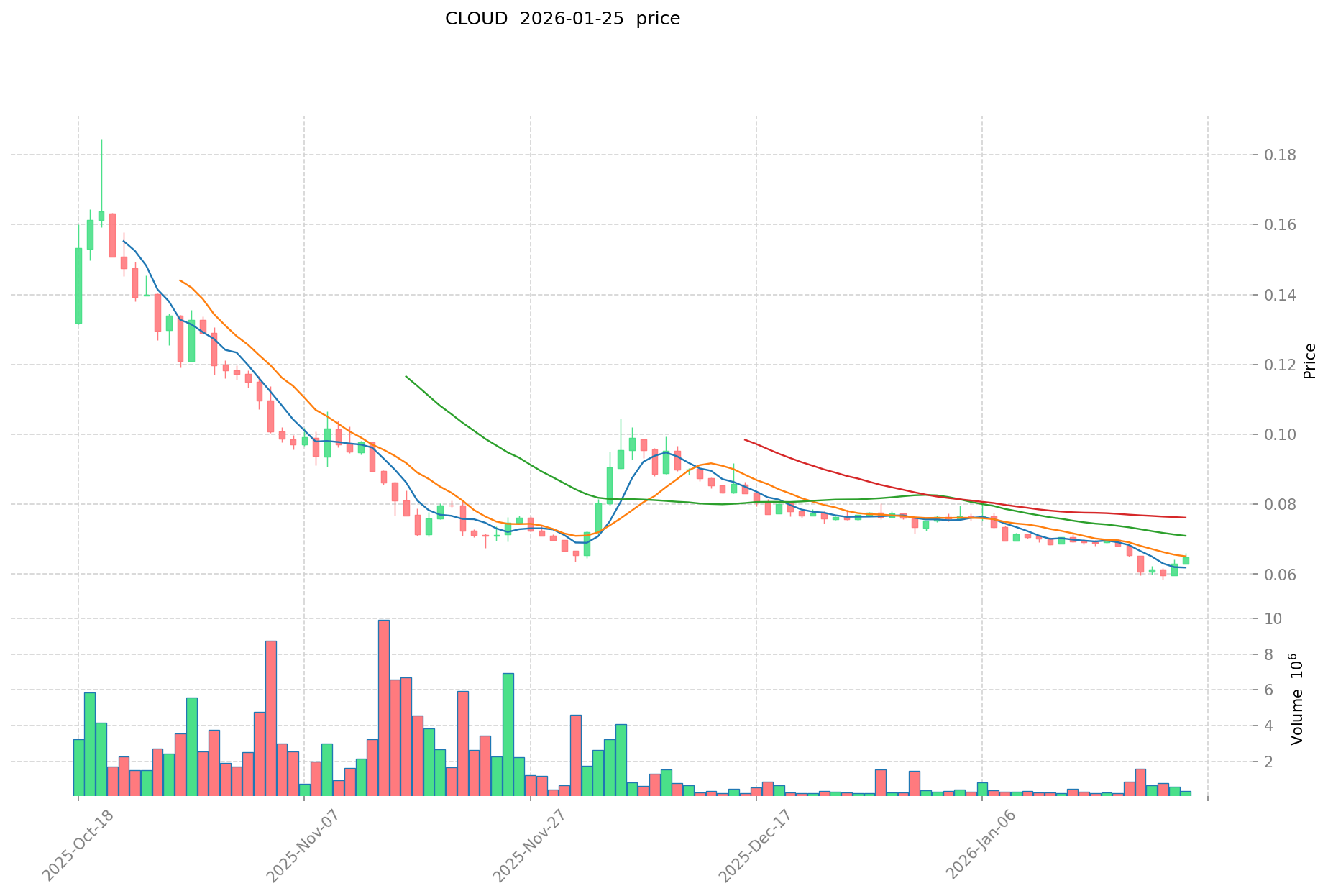
- Comparative Analysis: During different market cycles, CLOUD dropped from its peak of $0.6297 to a low of $0.0584 on January 22, 2026, representing a decline of approximately 90.7%, while LINK fell from its high of $52.7 to a low of $0.148183 in November 2017, though currently trading substantially above that historical floor.
Current Market Conditions (2026-01-25)
- CLOUD Current Price: $0.06389
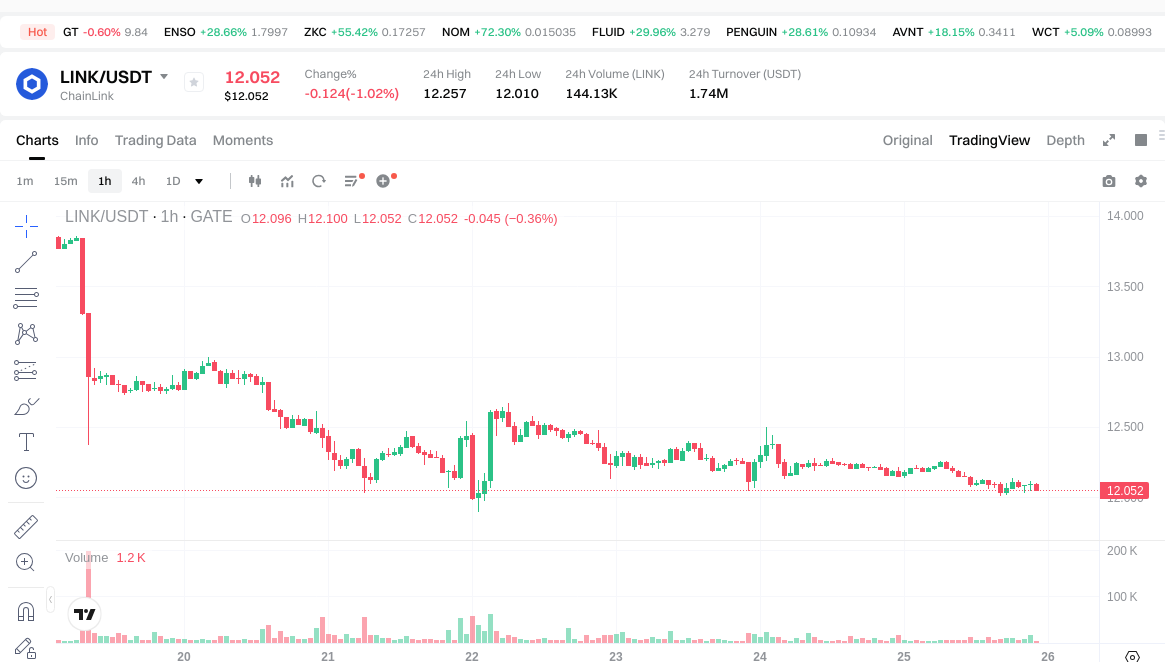
- LINK Current Price: $12.1
- 24-Hour Trading Volume: CLOUD $20,204.12 vs LINK $1,751,323.57
- Market Sentiment Index (Fear & Greed Index): 25 (Extreme Fear)
View real-time prices:
II. Core Factors Affecting CLOUD vs LINK Investment Value
Supply Mechanism Comparison (Tokenomics)
Due to insufficient reference materials, detailed supply mechanism information for CLOUD and LINK cannot be provided at this time.
Institutional Adoption and Market Application
Institutional Holdings
Based on available information, specific institutional holding data for CLOUD and LINK is not provided in the reference materials.
Enterprise Adoption
Reference materials do not contain detailed information regarding the application of CLOUD or LINK in cross-border payments, settlements, or investment portfolios.
National Policies
Regulatory attitudes toward CLOUD and LINK across different jurisdictions are not documented in the provided materials.
Technology Development and Ecosystem Building
CLOUD Technology Upgrades
The reference materials do not include information about CLOUD's technical development or upgrade plans.
LINK Technology Development
The reference materials do not include information about LINK's technical development or upgrade plans.
Ecosystem Comparison
Detailed comparison of DeFi, NFT, payment, and smart contract implementations for both projects is not available in the provided materials.
Macroeconomic Environment and Market Cycles
The reference materials do not provide sufficient data to evaluate the inflation-hedging properties of either CLOUD or LINK.
Macroeconomic Monetary Policy
Specific analysis of how interest rates and the US Dollar Index affect CLOUD and LINK is not available in the provided materials.
Geopolitical Factors
The impact of cross-border transaction demand and international situations on these two assets is not documented in the reference materials.
III. 2026-2031 Price Forecast: CLOUD vs LINK
Short-term Forecast (2026)
- CLOUD: Conservative $0.057-$0.064 | Optimistic $0.064-$0.080
- LINK: Conservative $7.11-$12.06 | Optimistic $12.06-$16.76
Medium-term Forecast (2028-2029)
- CLOUD may enter a consolidation phase, with estimated price range of $0.067-$0.129
- LINK may enter a growth phase, with estimated price range of $14.06-$19.62
- Key drivers: institutional capital inflows, ETF developments, ecosystem expansion
Long-term Forecast (2030-2031)
- CLOUD: Baseline scenario $0.079-$0.136 | Optimistic scenario $0.109-$0.156
- LINK: Baseline scenario $15.48-$21.79 | Optimistic scenario $20.37-$28.72
View detailed price predictions for CLOUD and LINK
Disclaimer
CLOUD:
| Year |
Predicted High Price |
Predicted Average Price |
Predicted Low Price |
Price Change |
| 2026 |
0.0804888 |
0.06388 |
0.057492 |
0 |
| 2027 |
0.10105816 |
0.0721844 |
0.03970142 |
12 |
| 2028 |
0.0944171952 |
0.08662128 |
0.073628088 |
35 |
| 2029 |
0.128537317392 |
0.0905192376 |
0.066984235824 |
41 |
| 2030 |
0.13581506409504 |
0.109528277496 |
0.10514714639616 |
71 |
| 2031 |
0.15579302191031 |
0.12267167079552 |
0.078509869309132 |
92 |
LINK:
| Year |
Predicted High Price |
Predicted Average Price |
Predicted Low Price |
Price Change |
| 2026 |
16.75784 |
12.056 |
7.11304 |
0 |
| 2027 |
20.3137572 |
14.40692 |
8.2119444 |
19 |
| 2028 |
19.617182618 |
17.3603386 |
14.061874266 |
43 |
| 2029 |
19.41319863945 |
18.488760609 |
14.42123327502 |
52 |
| 2030 |
21.79362656785875 |
18.950979624225 |
17.24539145804475 |
56 |
| 2031 |
28.724947365419043 |
20.372303096041875 |
15.482950352991825 |
68 |
IV. Investment Strategy Comparison: CLOUD vs LINK
Long-term vs Short-term Investment Strategies
- CLOUD: May be suitable for investors interested in emerging liquidity solutions within the Solana ecosystem, particularly those focusing on Liquid Staking Token (LST) trading innovation and early-stage DeFi infrastructure.
- LINK: May appeal to investors seeking exposure to established oracle network infrastructure that serves as foundational technology across multiple blockchain platforms and DeFi applications.
Risk Management and Asset Allocation
- Conservative Investors: CLOUD 20-30% vs LINK 70-80%
- Aggressive Investors: CLOUD 40-50% vs LINK 50-60%
- Hedging Tools: stablecoin allocation, options strategies, cross-asset portfolio diversification
V. Potential Risk Comparison
Market Risk
- CLOUD: As a relatively new token launched in July 2024, CLOUD faces higher volatility risk, with historical data showing price fluctuations from $0.6297 to $0.0584, representing substantial downside exposure during market corrections.
- LINK: Despite being established since September 2017, LINK remains subject to crypto market cyclicality, though its longer operational history provides more extensive price performance data for risk assessment.
Technical Risk
- CLOUD: Scalability considerations related to Solana network performance, potential liquidity constraints in LST trading mechanisms
- LINK: Oracle network reliability dependencies, potential vulnerabilities in cross-chain data transmission infrastructure
Regulatory Risk
- Global regulatory developments may impact both assets differently, with DeFi-focused protocols like CLOUD potentially facing evolving regulations around staking derivatives, while oracle infrastructure tokens like LINK may be subject to scrutiny regarding data provision and smart contract facilitation.
VI. Conclusion: Which Is the Better Buy?
📌 Investment Value Summary:
- CLOUD Advantages: Innovative approach to LST trading with zero-slippage mechanisms, early-stage positioning in the growing Solana DeFi ecosystem
- LINK Advantages: Established market presence since 2017, foundational role in oracle infrastructure serving multiple blockchain networks, broader institutional recognition
✅ Investment Recommendations:
- Novice Investors: Consider starting with LINK due to its longer operational history and more extensive market data, allowing for better risk assessment and understanding of asset behavior across market cycles.
- Experienced Investors: May explore diversified exposure across both assets, balancing LINK's established infrastructure positioning with CLOUD's emerging ecosystem opportunities, while maintaining appropriate risk controls.
- Institutional Investors: Evaluate both assets within broader portfolio context, considering LINK's oracle infrastructure utility and CLOUD's specialized LST trading functionality as complementary exposures to different DeFi infrastructure segments.
⚠️ Risk Disclosure: Cryptocurrency markets exhibit extreme volatility. This content does not constitute investment advice. Investors should conduct independent research and consult qualified financial advisors before making investment decisions.
VII. FAQ
Q1: What are the key differences between CLOUD and LINK in terms of their primary use cases?
CLOUD focuses on revolutionizing Liquid Staking Token (LST) trading on the Solana blockchain, offering zero-slippage transactions and enhanced liquidity options for staking derivatives. In contrast, LINK serves as fundamental infrastructure powering oracle networks that connect blockchain smart contracts with real-world data across multiple blockchain platforms. CLOUD represents specialized DeFi infrastructure for staking liquidity, while LINK provides essential data connectivity services that enable smart contracts to interact with external information sources.
Q2: Which asset has shown greater price stability historically?
LINK has demonstrated relatively greater price stability with a longer operational history since September 2017, providing extensive market data across multiple crypto cycles. CLOUD, launched in July 2024, experienced extreme volatility with approximately 90.7% decline from its all-time high of $0.6297 to $0.0584, reflecting its early-stage market positioning. The 24-hour trading volume comparison ($1,751,323.57 for LINK vs $20,204.12 for CLOUD) further indicates LINK's deeper liquidity and more established market presence.
Q3: What allocation ratio should conservative investors consider between CLOUD and LINK?
Conservative investors should consider a portfolio allocation of 20-30% CLOUD and 70-80% LINK based on risk tolerance parameters. This weighting reflects LINK's established infrastructure positioning and longer operational track record, which may offer more predictable behavior patterns during market volatility. The higher LINK allocation provides exposure to proven oracle network infrastructure while limiting risk exposure to CLOUD's early-stage market dynamics and higher volatility profile.
Q4: How do the price forecasts for 2026 compare between CLOUD and LINK?
For 2026, CLOUD shows conservative price estimates ranging from $0.057-$0.064 with optimistic scenarios reaching $0.064-$0.080, representing modest growth potential from current levels around $0.06389. LINK's conservative forecast spans $7.11-$12.06 with optimistic projections of $12.06-$16.76, suggesting broader potential price movement from its current $12.1 level. The forecasts indicate LINK may offer wider potential appreciation ranges while CLOUD presents more compressed near-term price expectations reflecting its emerging market status.
Q5: What are the main technical risks associated with each asset?
CLOUD faces technical risks related to Solana network scalability performance and potential liquidity constraints within its LST trading mechanisms, as its functionality depends heavily on the underlying blockchain infrastructure. LINK's technical risks center on oracle network reliability dependencies and potential vulnerabilities in cross-chain data transmission infrastructure, given its role in providing external data to smart contracts across multiple blockchain ecosystems. Both assets carry distinct technical risk profiles reflecting their different functional roles in DeFi infrastructure.
Q6: Which investor profile is best suited for CLOUD versus LINK?
Novice investors should consider starting with LINK due to its longer operational history since 2017, providing more extensive market data and established behavior patterns for better risk assessment. Experienced investors may explore diversified exposure across both assets, balancing LINK's proven infrastructure utility with CLOUD's emerging ecosystem opportunities within controlled risk parameters. Institutional investors should evaluate both as complementary exposures to different DeFi infrastructure segments—oracle connectivity versus staking liquidity solutions.
Q7: How does the current market sentiment affect CLOUD and LINK differently?
The current market sentiment index shows 25 (Extreme Fear), which typically impacts emerging assets like CLOUD more severely due to lower liquidity and higher volatility sensitivity, as evidenced by its significantly lower 24-hour trading volume. LINK's established market presence and deeper liquidity pool may provide relatively better resilience during extreme fear conditions, though both assets remain subject to broader crypto market cyclicality. The extreme fear environment suggests heightened caution for both assets, with particular attention to CLOUD's limited price history during severe market stress periods.
Q8: What regulatory considerations should investors evaluate for CLOUD versus LINK?
Investors should consider that DeFi-focused protocols like CLOUD may face evolving regulations around staking derivatives and liquidity mechanisms, particularly as regulatory frameworks develop for synthetic assets and tokenized staking positions. LINK may encounter scrutiny regarding its role as a data provider facilitating smart contract operations, potentially subject to regulations governing information services and cross-chain transaction facilitation. Both assets operate in evolving regulatory environments, requiring investors to monitor jurisdictional developments that may impact operational frameworks and market accessibility differently based on their distinct functional roles.
* The information is not intended to be and does not constitute financial advice or any other recommendation of any sort offered or endorsed by Gate.