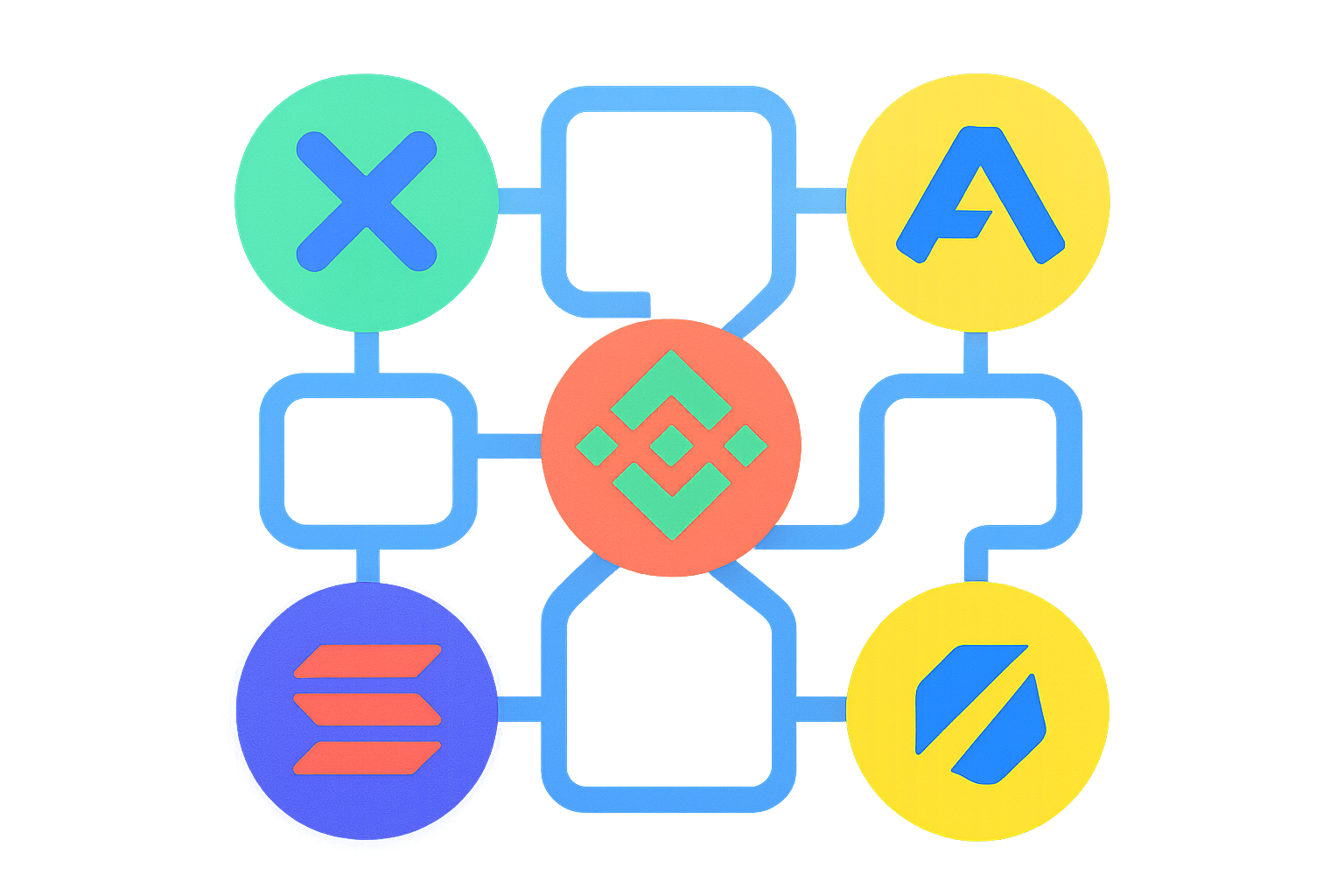
ASTER serves as the native governance and utility token powering a decentralized perpetual futures exchange combining spot and perpetual trading with innovative features like hidden orders, MEV-free execution, and yield-generating collateral. Born from the strategic merger of Astherus and APX Finance, the platform operates across multiple blockchains—BNB Chain, Ethereum, Solana, and Arbitrum—enabling seamless cross-chain liquidity aggregation without bridging friction. With 8 billion total supply and 1.65 billion circulating, ASTER functions through decentralized governance, staking rewards, and growth incentives. The article explores token fundamentals, comprehensive tokenomics with 53.5% community airdrop allocation, functional utilities including governance voting and passive income generation, competitive differentiation against Hyperliquid, robust technical infrastructure featuring a proprietary Layer 1 blockchain, and investment considerations within the $100+ billion monthly perpetual DEX market. Purch
Introduction
ASTER represents a native governance and utility token powering a decentralized perpetual futures exchange designed to facilitate seamless multi-chain trading. Following the strategic merger of Astherus and APX Finance, ASTER has emerged as a comprehensive platform combining advanced features including spot and perpetual trading, hidden orders, MEV-free execution, and yield-generating collateral options. Backed by YZi Labs and supported by prominent industry figures, the platform aims to establish a strong position in the rapidly growing DeFi perpetual futures market, which processes hundreds of billions of dollars in monthly trading volume.
The token serves as the cornerstone of an ecosystem that prioritizes user experience, capital efficiency, and cross-chain liquidity aggregation. By integrating innovative trading mechanisms with robust governance structures, ASTER creates a sustainable framework for decentralized derivatives trading across multiple blockchain networks.
- Token Name: Aster
- Ticker: ASTER
- Contract Address: 0x000Ae314E2A2172a039B26378814C252734f556A
- Total Supply: 8 billion ASTER
- Circulating Supply: 1.65 billion ASTER
- Current Market Capitalization: $988 million
- Token Type: Governance and Utility Token
- Supported Chains: Multi-chain (BNB Chain, Ethereum, Solana, Arbitrum)
- Core Features: Decentralized governance, growth incentives, participant rewards, staking and airdrop support
- Launch Status: Token Generation Event (TGE) completed
Understanding ASTER Token
ASTER functions as the core token within a decentralized exchange ecosystem focused on perpetual contracts and spot trading. The token emerged from the strategic combination of Astherus, known for yield-generating products like liquid staking BNB and interest-bearing stablecoin USDF, with APX Finance, which provided a robust perpetual trading platform. This merger created an integrated DeFi exchange offering both a Simple mode for one-click, MEV-resistant trading and a Pro mode featuring advanced tools such as hidden orders and grid trading.
The token architecture enables decentralized governance, allowing holders to participate in protocol decision-making while contributing to various reward mechanisms, staking opportunities, and ecosystem growth initiatives. ASTER supports the platform's mission of providing liquid and secure multi-chain perpetual futures trading without requiring complex bridging processes.
The Aster Network Ecosystem
The Aster network operates as a multi-chain decentralized exchange aggregating liquidity across diverse blockchain networks including BNB Chain, Ethereum, Solana, and Arbitrum. The platform features its own high-performance Layer 1 blockchain called 'Aster Chain', emphasizing privacy and operational efficiency. Users can leverage yield-generating collateral such as asBNB and USDF to access perpetual and spot trading with leverage up to 100x, maximizing capital efficiency.
According to official platform data, the network has achieved cumulative trading volume exceeding $519 billion, open interest of $255 million, total value locked of $437 million, and supports 101 trading symbols. This substantial market presence demonstrates the platform's ability to attract significant liquidity and user engagement across multiple blockchain ecosystems.
Mission and Vision
The platform's mission centers on building a community-driven, fast, and flexible DeFi infrastructure. By integrating cross-chain liquidity, minimizing trading friction, and maximizing user returns through staking and yield products, the ecosystem aims to deliver superior value to participants. The platform provides excellent user experience through iOS and Android mobile applications, automated intent-based systems, and streamlined interfaces designed to surpass existing perpetual DEX offerings.
The vision extends beyond simple trading functionality to create a comprehensive financial ecosystem where users can simultaneously trade, earn yields on collateral, participate in governance, and benefit from protocol growth through token appreciation and reward mechanisms.
Distinctive Features of ASTER
ASTER offers unique functionality centered on privacy and sustainability, including hidden orders that keep order size and direction confidential until execution to reduce slippage, multi-chain liquidity aggregation eliminating bridging requirements, and comprehensive governance and reward utilities. Unlike single-chain decentralized exchanges, the platform's integration of cross-chain liquidity and yield products provides differentiated competitive advantages in the perpetual futures market, which processes over $100 billion in monthly volume.
The hidden order feature particularly stands out as it allows sophisticated traders to execute large positions without revealing their intentions to the market, thereby minimizing price impact and front-running risks. This privacy-focused approach, combined with MEV-resistant execution mechanisms, creates a more equitable trading environment for all participants.
Token Supply and Distribution
ASTER token employs a systematic tokenomics model designed to support community growth, ecosystem development, and long-term protocol sustainability. The carefully structured distribution ensures balanced incentives across different stakeholder groups while maintaining sufficient reserves for future development.
- Total Supply: 8,000,000,000 ASTER (maximum supply cap)
- Circulating Supply: 1,650,000,000 ASTER (representing 20.7% of total supply at TGE)
- Market Capitalization: $746 million (based on available pricing data)
- Fully Diluted Valuation: $3.6 billion
Token Allocation Structure
Airdrop Allocation (53.5% - 4,280,000,000 tokens): This substantial allocation demonstrates the platform's commitment to community-driven growth. The distribution incentivizes traders, community builders, and ecosystem stakeholders. At TGE, 8.8% (704 million tokens) were immediately released, with remaining tokens distributed gradually over 80 months, subject to governance approval for potential modifications.
Ecosystem and Community Fund (30% - 2,400,000,000 tokens): This allocation supports APX holder conversion pools, grants, marketing initiatives, and exchange liquidity provisions. The tokens vest linearly over 20 months, excluding portions allocated for APX to ASTER swap conversions, ensuring sustained ecosystem development funding.
Treasury Reserve (7% - 560,000,000 tokens): Strategic business operations, operational expenses, and governance flexibility are supported through this reserve. These tokens remain fully locked until deployed through governance-approved mechanisms, ensuring responsible resource management.
Team Allocation (5% - 400,000,000 tokens): Core team members and advisors receive compensation through this allocation, which includes a one-year complete lockup followed by vesting over 40 months. This extended vesting schedule aligns team incentives with long-term protocol success.
Liquidity and Listing (4.5% - 360,000,000 tokens): Exchange listings and liquidity provision are supported through this allocation, with 100% released immediately at TGE to ensure adequate initial trading liquidity.
Key Tokenomics Highlights
The tokenomics design prioritizes community participation by allocating 53.5% of total supply to airdrops, maximizing community rewards and decentralized distribution. Immediate liquidity is ensured through 704 million airdrop tokens and 360 million listing tokens released at TGE, contributing to initial circulation.
The APX upgrade mechanism allows $APX holders to swap to $ASTER during designated periods at progressive conversion rates, facilitating smooth transition for existing community members. Additionally, the protocol implements revenue buyback mechanisms, using a portion of protocol revenues to buyback $ASTER tokens, thereby strengthening long-term price stability and enhancing governance rewards.
Functional Roles of ASTER
ASTER serves multiple critical functions within the ecosystem, enhancing both trading capabilities and community participation. The multi-faceted utility design creates sustainable value capture mechanisms while incentivizing active ecosystem engagement.
Governance Functionality: Token holders receive voting rights on protocol upgrades, fee structures, and new feature implementations. This decentralized governance model ensures that platform evolution reflects community preferences and maintains alignment between protocol development and user needs. Major decisions regarding parameter adjustments, treasury allocation, and strategic partnerships require community approval through governance proposals.
Rewards and Staking Mechanisms: Users can deposit ASTER alongside assets such as USDT and BNB in liquidity pools to generate passive income. Staking participation increases eligibility thresholds for airdrops and additional reward distributions. The staking mechanism creates sustainable yield opportunities while reducing circulating supply, potentially supporting token value appreciation.
Growth Incentive Programs: The token funds ecosystem development initiatives, liquidity provision incentives, and user acquisition campaigns. By allocating substantial resources to growth programs, the protocol accelerates network effects and competitive positioning within the decentralized derivatives market.
Trading Utility Integration: ASTER integrates with Aster Earn products, enabling users to generate additional yields on collateral assets during perpetual trading activities. This innovative approach to capital efficiency allows traders to simultaneously speculate on price movements while earning passive income on their margin collateral.
Comparative Analysis: ASTER vs. Hyperliquid
Understanding the competitive landscape provides important context for evaluating ASTER's positioning within the decentralized perpetual futures market.
Primary Focus Differentiation: ASTER operates as a multi-chain perpetual and spot DEX with yield-generating collateral integration, while Hyperliquid concentrates on single-chain perpetual exchange optimization. This fundamental architectural difference creates distinct value propositions for different user segments.
Backing and Support Structure: ASTER benefits from backing by YZi Labs and support from prominent industry figures, providing significant credibility and resource access. Hyperliquid relies on independent validators and community governance, representing a more decentralized but potentially less resource-rich approach.
Innovation Highlights: ASTER's key innovations include hidden orders, MEV-free one-click trading, and cross-chain liquidity aggregation. Hyperliquid focuses on perpetual-optimized high-performance Layer 1 infrastructure with native stablecoin (USDH) integration. Both approaches offer distinct technical advantages suited to different trading preferences.
Token Utility Comparison: ASTER provides governance rights, staking rewards, and airdrop eligibility, creating multiple value accrual mechanisms. Hyperliquid's HYPE token serves ecosystem coordination functions with different incentive structures.
Chain Support: ASTER supports BNB Chain, Ethereum, Solana, and Arbitrum, offering broad blockchain compatibility. Hyperliquid operates exclusively on its dedicated chain, prioritizing performance optimization over multi-chain flexibility.
Market Adoption: ASTER represents a recent entrant backed by major investors, while Hyperliquid has captured over 70% market share in the DeFi perpetual space. This adoption gap presents both challenges and opportunities for ASTER's growth trajectory.
ASTER's Competitive Differentiation
ASTER's multi-chain architecture and yield-generating collateral options provide flexibility advantages compared to single-chain platforms like Hyperliquid, eliminating user bridging inconvenience. The backing from YZi Labs and prominent industry figures establishes strong credibility, though the platform faces the challenge of competing against established market leaders with significant existing user bases and liquidity depth.
Technical Infrastructure
ASTER employs sophisticated technical infrastructure including a proprietary Layer 1 blockchain (Aster Chain), zero-knowledge proof-based privacy mechanisms, and intent-driven automated cross-chain execution systems. The robust liquidity aggregation framework ensures deep trading pools and minimal slippage across supported assets.
Core Technical Features
Multi-chain Aggregation: The platform enables seamless trading across multiple blockchains without requiring separate bridging transactions. This technical achievement significantly reduces friction in cross-chain trading workflows, allowing users to access liquidity across different networks through a unified interface.
Dual Trading Mode Architecture: Users can choose between one-click simplified trading for quick execution or professional mode featuring advanced tools like grid trading, limit orders, and sophisticated order types. This flexibility accommodates both casual traders and professional market participants.
Yield-Generating Products: Integration of assets like asBNB and USDF allows users to earn interest on trading collateral simultaneously with position management. This capital efficiency innovation maximizes returns on deployed capital compared to traditional margin trading approaches.
Security Infrastructure: MEV prevention mechanisms protect users from front-running and sandwich attacks, while complete self-custody architecture ensures users maintain direct control over their assets. The combination of privacy features and security measures creates a trustless trading environment.
Team and Origins
The platform emerged from the strategic merger of Astherus and APX Finance, combining expertise in yield-generating products with robust perpetual trading infrastructure. YZi Labs provides ongoing support and resources for development initiatives. The team's commitment to decentralized governance is demonstrated through the allocation of 53% of total supply to community distributions.
The founding team brings extensive experience in DeFi protocol development, blockchain infrastructure, and financial markets. This diverse expertise enables comprehensive platform development addressing technical, financial, and user experience considerations.
Significant Developments and Milestones
The platform's evolution includes several important milestones that have shaped its current market position and future trajectory.
Strategic Merger: The combination of Astherus and APX Finance created a comprehensive DeFi trading platform integrating yield products with perpetual trading infrastructure. This merger consolidated resources and expertise to accelerate platform development.
Pre-TGE Preparations: Prior to the Token Generation Event, the platform enabled $APX deposits in Aster Spot, facilitating smooth transition for existing community members and establishing initial liquidity foundations.
Token Generation Event: The TGE marked a significant milestone with 53% community allocation and immediate listing. Within 24 hours, the token experienced substantial price appreciation of 434%, reflecting strong market interest and community enthusiasm.
Points Program Evolution: The platform has implemented a multi-phase points program, with Phase 1 completed and Phase 2 in preparation. These programs incentivize trading activity, liquidity provision, and ecosystem participation while distributing rewards and airdrop eligibility to active users.
Investment Considerations
ASTER presents a governance and reward-focused value proposition rather than purely speculative characteristics, attracting attention within the growing perpetual futures market. Following the TGE, the token experienced significant appreciation driven by investor interest and community engagement initiatives.
Market Context: The perpetual DEX sector processes over $100 billion in monthly trading volume, with ASTER's multi-chain competitive advantages potentially contributing to accelerated adoption. The platform's technical innovations and yield-generating features address key user pain points in existing decentralized derivatives markets.
Technical Development Trajectory: Ongoing development of mobile applications, hidden order functionality, and user experience enhancements demonstrates commitment to platform evolution. The roadmap includes zero-knowledge proof integration, expanded chain support, and Phase 2 points program implementation.
Adoption Metrics: Initial launch metrics showed $174 million in 24-hour trading volume, with staking and other incentive mechanisms driving user participation. These early indicators suggest potential for sustained growth as the platform matures and expands its user base.
Risk Factors: As a newly launched token, ASTER exhibits significant volatility characteristics typical of early-stage crypto assets. Competition from established players like Hyperliquid presents market share challenges. Regulatory uncertainties affecting decentralized derivatives platforms represent additional considerations.
Strategic Considerations: Rather than short-term speculation, ASTER may be more suitable for governance-focused participants interested in medium to long-term holding strategies. Comprehensive research into DeFi market trends and platform growth potential is essential for informed decision-making.
Conclusion
ASTER positions itself as an innovative participant in the DeFi perpetual futures market, combining multi-chain trading capabilities, yield-generating opportunities, and strong investor backing. The platform's growth potential includes the ability to challenge established competitors while providing substantial rewards to early adopters. However, participants should remain aware of adoption risks within a competitive market environment and maintain vigilance regarding platform developments and market conditions.
The token's comprehensive utility framework, substantial community allocation, and technical innovations create a foundation for potential long-term value creation. Success will depend on execution of the development roadmap, user adoption rates, and ability to differentiate within an increasingly crowded decentralized derivatives landscape.
FAQ
What is the ASTER token? What role does it play in the perpetual DEX?
ASTER is the native token of the Aster perpetual DEX platform, serving governance, fee sharing, and user incentives. It enables trading, liquidity provision, and platform development while allowing token holders to participate in community decision-making.
How to buy and hold ASTER tokens? What trading pairs and exchanges are supported?
Purchase ASTER on Gate.com, which offers the deepest liquidity and handles over 250 million USD daily trading volume. Hold tokens in exchange wallets or transfer to self-custody wallets on BNB Chain. Trading pairs include ASTER/USDT and ASTER/USDC with competitive fees starting at 0.1%.
ASTER offers privacy-first trading through Hidden Orders using zero-knowledge proofs, competitive fees (0.010% maker, 0.035% taker), cross-chain support across 7+ networks, 1001x leverage options, and unique features like 24/7 US stock trading and USDF yield-bearing collateral earning up to 12.2% APY.
What are the risks of perpetual trading with ASTER? How to manage leverage risk?
ASTER perpetual trading risks include smart contract vulnerabilities, liquidation risk, and regulatory pressure. Manage leverage risk through strict position sizing, setting stop-loss orders, monitoring collateral ratios, and using lower leverage multipliers to protect capital.
What is the economic model of ASTER token? What returns can holders get?
ASTER employs a deflationary token model with 8 billion total supply. Holders earn rewards through liquidity mining, platform participation, and governance voting rights. The deflationary mechanism gradually reduces token supply, enhancing long-term value appreciation for token holders.
How do ASTER's liquidity mining and staking mechanisms work?
ASTER's liquidity mining and staking mechanisms operate through yield-bearing collateral like asBNB and USDF. Users stake these assets to earn rewards. ASTER tokens provide governance rights and enable users to participate in fee sharing through staking and buyback programs.
What is the difference between ASTER and other mainstream perpetual DEX tokens such as dYdX and GMX?
ASTER focuses on efficient perpetual contract trading on Layer-1 blockchain, offering lower trading fees compared to dYdX and GMX. It provides superior performance and cost-effectiveness for perp trading.
What is ASTER's future development roadmap? What new features are expected to launch?
ASTER's roadmap focuses on enhanced perpetual trading features, advanced risk management tools, and cross-chain integration. Upcoming developments include improved UI/UX, AI-powered trading analytics, and expanded liquidity pools. Major updates expected throughout 2026.
* The information is not intended to be and does not constitute financial advice or any other recommendation of any sort offered or endorsed by Gate.