# GOOGLEarningsBeatButStockDrops3%

26.84K

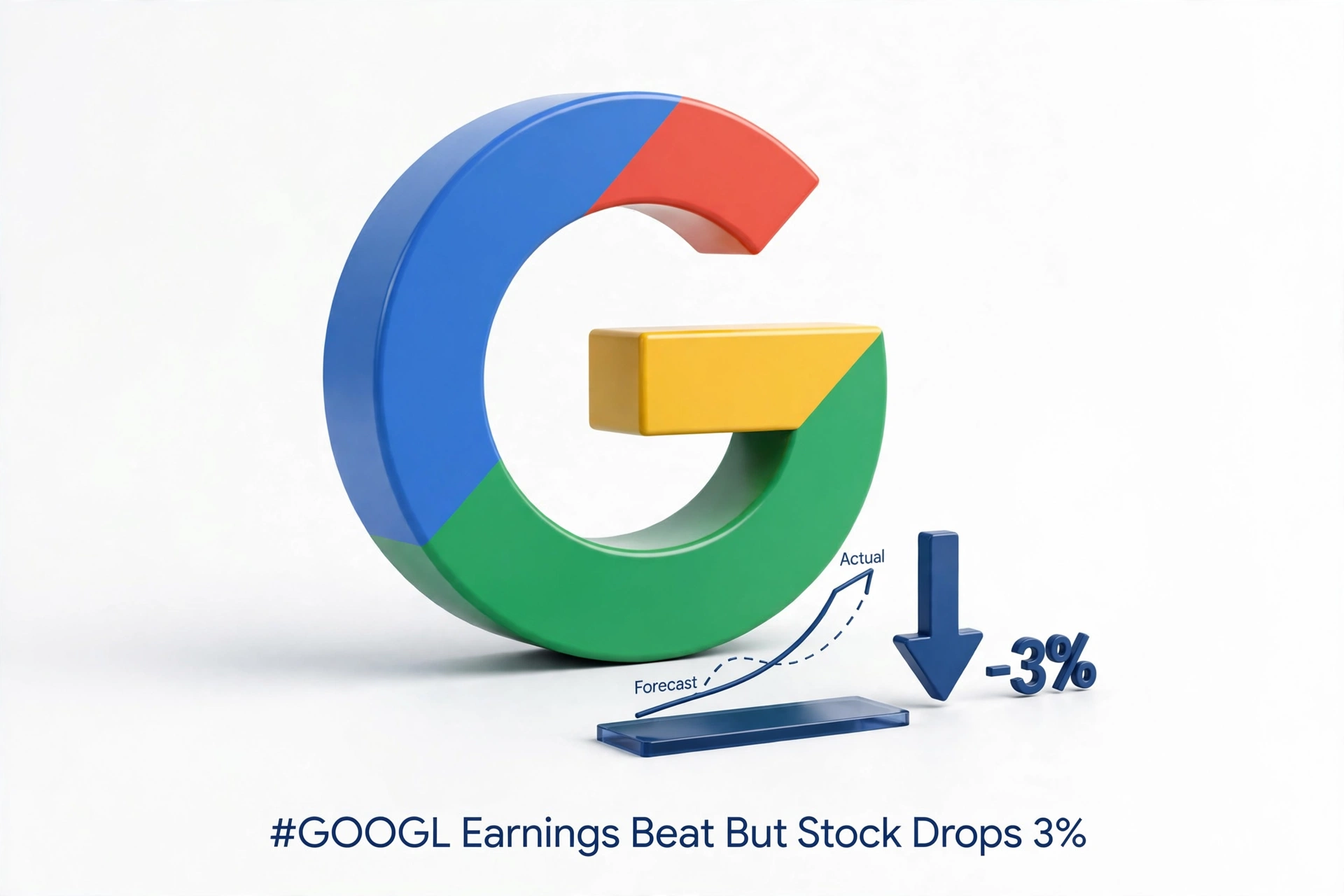
Google parent Alphabet posted impressive Q2 results: revenue hit $119.8 billion, up 24% YoY, with cloud revenue surging 82% to $24.8 billion — the fastest growth on record. Yet the stock still fell over 3% after hours, driven by AI spending once again exceeding expectations. The company raised its full-year capex guidance to $195-205 billion, an increase of $15 billion from previous guidance. More notably, Q2 free cash flow turned negative at -$5.9 billion — the company's first ever quarterly negative FCF. Cloud backlog exceeded $500 billion, but market concerns over the payback period for AI investment outweighed the strong headline numbers.

#GOOGLEarningsBeatButStockDrops3%
Alphabet’s Q2 numbers are a fascinating paradox: record-breaking growth paired with historic investor anxiety. The market's reaction to Alphabet's Q2 results highlights a classic "growth vs. capital efficiency" dilemma. While the top-line numbers show massive AI demand, Wall Street is growing increasingly uneasy over the timeline for turning these heavy investments into cash flow. The market reaction makes sense once you separate operating performance from investor expectations.
ybaser
#GOOGLEarningsBeatButStockDrops3%
Alphabet’s Q2 numbers are a fascinating paradox: record-breaking growth paired with historic investor anxiety.
The market's reaction to Alphabet's Q2 results highlights a classic "growth vs. capital efficiency" dilemma. While the top-line numbers show massive AI demand, Wall Street is growing increasingly uneasy over the timeline for turning these heavy investments into cash flow.
The market reaction makes sense once you separate operating performance from investor expectations.
Top-Line Growth vs. Cash Burn
Alphabet's fundamentals delivered an impressive narrative, but the underlying cash dynamics shifted dramatically:
The Good: Cloud revenue surged 82% YoY to $24.8 billion, driven by enterprise adoption of Gemini and Custom TPU deployments. A $514 billion backlog demonstrates genuine, long-term commercial interest.
The Problem: Delivering that capacity cost $44.9 billion in a single quarter. For the first time in company history, Quarterly Free Cash Flow (FCF) dropped into negative territory at -$5.9 billion.
Why Alphabet beat expectations
The reported operating results were very strong:
Revenue: $119.8 billion (+24% YoY)
Cloud revenue: $24.8 billion (+82% YoY), an exceptionally strong growth rate
Cloud backlog: Over $500 billion, suggesting a large pipeline of future revenue
These figures indicate that demand—particularly for AI infrastructure and cloud services—remains robust.
Why the stock still fell
Investors focused less on current earnings and more on the cost of sustaining AI leadership.
The biggest concerns were:
Higher capital expenditures: Alphabet increased full-year capex guidance to $195–205 billion, roughly $15 billion higher than previously expected.
Negative free cash flow: Q2 free cash flow reportedly came in at –$5.9 billion, reflecting the enormous cash outlay for AI infrastructure.
For many investors, the key question is no longer whether AI demand exists, but when these investments will generate attractive returns. Massive spending today can pressure cash flow and reduce near-term profitability, even if it strengthens the company's long-term competitive position.
What the market is pricing
The decline suggests investors are asking:
How long will Alphabet need to spend at these elevated levels?
Will AI services eventually generate enough incremental revenue and margins to justify the investment?
Could returns on invested capital decline if AI infrastructure spending continues to accelerate?
In other words, the market appears to be saying:
"The business is performing exceptionally well, but the required investment is even larger than we anticipated."
Long-term perspective
From a long-term standpoint, the results can be viewed in two ways:
Bullish case: Record cloud growth, a massive backlog, and continued AI leadership could produce substantial earnings growth once infrastructure spending moderates.
Bearish case: AI may require years of elevated capital spending, delaying meaningful free cash flow generation and reducing shareholder returns in the near term.
This type of reaction is common during heavy investment cycles: companies can report excellent operating results while their shares decline because investors become more concerned about future cash generation than current revenue growth.
repost-content-media
  • Reward
  • 1
  • Repost
  • Share
ybaser:
Get on board now! 🚗
#GOOGLEarningsBeatButStockDrops3%
Alphabet delivered a strong Q2, beating revenue expectations with $119.8B and posting impressive growth across its core businesses. Google Cloud was the standout performer, surging 82% YoY, while YouTube Ads and Search continued to generate solid revenue. Gemini also reached 950 million monthly users, highlighting Google's expanding AI ecosystem.
So why did the stock fall around 3% after hours?
The answer is AI spending. Alphabet raised its 2026 capital expenditure forecast to $195B–$205B, significantly higher than previous guidance. Massive investments in AI
  • Reward
  • 25
  • Repost
  • Share
DuniaForexCrypto:
直接打就行了
View More
Google Announces Negative Free Cash Flow for the First Time ✨
A first in Alphabet history. Free cash flow fell to minus $5.9 billion in Q2, marking the first negative quarter since its August 2004 IPO.
🔹 Minus $5.9 billion free cash flow: First negative quarter since IPO
🔹 Quarterly capital expenditure increased to $44.9 billion
🔹 Annual investment forecast raised from $180-$190 billion to $195-$205 billion: Second revision of the year
🔹 Approximately $100 billion borrowed
🔹 Approximately $85 billion raised through share sale: First share sale in over 20 years
🔹 Sharp shift from a compan
GOOG0.05%
post-image
User_any
Google Increases Spending on AI, and a New Era Begins for Miners ✨
Alphabet has raised its 2026 investment forecast to between $195 and $205 billion and expanded its use of third-party computing infrastructure. This is interpreted as a strong signal that the demand for AI computing continues to accelerate.
🔹 Investment forecast increased to between $195 and $205 billion, an increase of approximately $15 billion compared to the previous forecast
🔹 Expanding use of third-party computing, highlighting the need for additional capacity
🔹 Continued demand for data center and cloud infrastructure
🔹 Transition to AI hosting model on the agenda for Bitcoin miners
From a market perspective, this development is interpreted in two ways. On one hand, a positive picture emerges for data center and cloud infrastructure. On the other hand, the profitability calculation for miners is changing. The return from traditional mining is being compared to the return that will be obtained from AI workloads.
AI and digital infrastructure are becoming increasingly interconnected. Facilities with high-performance energy infrastructure, cooling, and network connectivity can be used for both mining and AI workloads. Therefore, some mining companies are considering shifting a portion of their capacity to AI hosting.
The advantages and risks of this pivot are highlighted:
🔹 Advantage: Energy contracts, ready-made sites, and cooling infrastructure can yield higher returns from AI demand.
🔹 Advantage: Long-term contracts increase revenue predictability.
🔹 Risk: Customer demand and technical requirements for AI differ from mining, requiring higher investment.
🔹 Risk: If mining remains the main business, dependence on the market cycle continues.
In summary, the increase on the Alphabet side shows that the AI infrastructure cycle continues. Bitcoin miners with strong energy and infrastructure management can gain a competitive advantage in AI. However, instead of a complete shift to the main business, a hybrid model – mining plus AI hosting – is considered more likely.
NFA ✔️ DYOR 🔎
#SummerCreationCamp #夏日创作营
  • Reward
  • 37
  • Repost
  • Share
discovery:
2026 GOGOGO 👊
View More
#GOOGLEarningsBeatButStockDrops3%
GOOGL Earnings Beat But Stock Drops 3 Percent On AI Capex Jump
Alphabet just printed a strong Q2 but shares fell about 3 percent after hours and the reason is clear: AI spend is rising faster than even bulls hoped.
News now: Total revenue came at 119.8B versus 116.9B guess, up 24 percent year on year. EPS printed at 9.11 versus 2.88 guess but that included a 6.26 gain on equity holdings like SpaceX and peers. On clean basis EPS was 2.85 versus 2.88 guess, a tiny miss. Google Cloud was star with 24.8B up 82 percent versus 64 percent guess. Ad revenue was 81.6B
GOOGL0.62%
post-image
post-image
  • Reward
  • 31
  • Repost
  • Share
DuniaForexCrypto:
Bull Run 🐂
View More
#GOOGL财报亮眼但盘后跌超3% Google’s 2026 Q2 earnings report may have exceeded expectations significantly on both revenue ($119.8 billion) and its cloud business ($24.8 billion, +82% year over year), but the after-hours stock price still fell by more than 3%. The core reasons are the “expectations gap” in the report and the market’s concerns about future profitability and cash flow. The specific reasons are as follows: 1. Doubts about the “quality” of net profit (one-off gains mask underlying weakness in the core business)
The earnings report shows net profit surged 294% year over year to $112.1 billi
GOOGL0.62%
ThisIsTranslateContent:
#GOOGL财报亮眼但盘后跌超3% Google’s 2026 Q2 earnings report may have exceeded expectations significantly on both revenue ($119.8 billion) and its cloud business ($24.8 billion, +82% year over year), but the after-hours stock price still fell by more than 3%. The core reasons are the “expectations gap” in the report and the market’s concerns about future profitability and cash flow. The specific reasons are as follows: 1. Doubts about the “quality” of net profit (one-off gains mask underlying weakness in the core business)
The earnings report shows net profit surged 294% year over year to $112.1 billion, but about $71.4 billion of that came from one-off equity investment gains (mainly paper gains from Anthropic and SpaceX), not from core operating profit.
·After excluding one-off gains, core operating EPS was only about $2.90-$3.00, slightly above expectations, failing to meet the market’s expectation of “explosive” growth.
2. Capital expenditures surge and free cash flow turns negative (worry over burn rate)
Q2 capital expenditures for the quarter reached $44.9 billion, doubling year over year, and the full-year Capex guidance was raised sharply to $195.0-$205.0 billion, indicating that investment in an AI arms race continues to expand.
Because the major Capex outlay consumes cash flow, free cash flow for the quarter turned to -$5.86B in Q2, the first time since Alphabet’s listing. The market worries whether such heavy investment can translate into profits in the near term, raising doubts about the sustainability of “burning cash for growth.”
3. Core business “Search” growth slows (a subtle concern in the base business)
Search business (including search ads) revenue was $63.3 billion, up 17% year over year, slightly below market expectations ($63.4 billion). Some institutions also point out that search growth may slow due to the high base.
The market originally had high expectations for a “Search + Cloud” dual-engine drive, and the relative weakness in the Search business to a certain extent dampened market sentiment. 4. Core AI model delayed (growth expectations take a hit)
The market expected the frontier AI large model Gemini 3.5 Pro, but it was delayed for reasons, and combined with AI talent loss, it raised concerns about whether its full-stack AI advantages can continue to lead and about the pace of AI commercialization.
5. Valuation has partially “Price in” (good news fully reflected)
Alphabet’s high revenue growth and cloud business growth were already partially reflected in the stock price before the earnings release. In after-hours trading, the market focuses more on “incremental negative factors” (such as negative cash flow and Capex exceeding expectations), leading to profit-taking and a reversal of sentiment in after-hours trading.
In summary, the “impressively strong” surface of Google’s earnings failed to fully offset the market’s concerns about its “high investment, low short-term returns.” Combined with some core metrics falling short of expectations, this led to downward pressure on the stock price in after-hours trading. #夏日创作营
repost-content-media
  • Reward
  • 18
  • Repost
  • Share
Falcon_Official:
LFG 🔥
View More
#GOOGLEarningsBeatButStockDrops3% 🚀 The Future Will Be Built by AI Ecosystems, Not Individual Models
Artificial intelligence is entering a new era. The conversation is no longer centered on which chatbot is the smartest—it is shifting toward how complete AI ecosystems collaborate to solve real-world problems. The next generation of innovation will come from interconnected platforms that combine language, vision, audio, video, research, and automation into one intelligent environment.
We are moving beyond isolated AI tools and into an age where multiple models work together to accelerate produ
  • Reward
  • 6
  • Repost
  • Share
Falcon_Official:
To The Moon 🌕
View More
Completely insane
The cash-flow investments by major AI companies are nothing short of an arms race
It’s unclear whether AI is the biggest future trend
But big institutions have already voted with their money
So how do you capture AI opportunities?
Try to join an AI company as much as possible
Or invest in stocks of high-quality AI companies #Gate事件合约首发狂欢 #GOOGL财报亮眼但盘后跌超3%
GOOGL0.62%
View Original
  • Reward
  • Comment
  • Repost
  • Share
Load More

Join 40 M users in our growing community

⚡️ Join 40 M users in the crypto craze discussion
💬 Engage with your favorite top creators
👍 See what interests you
  • Pinned