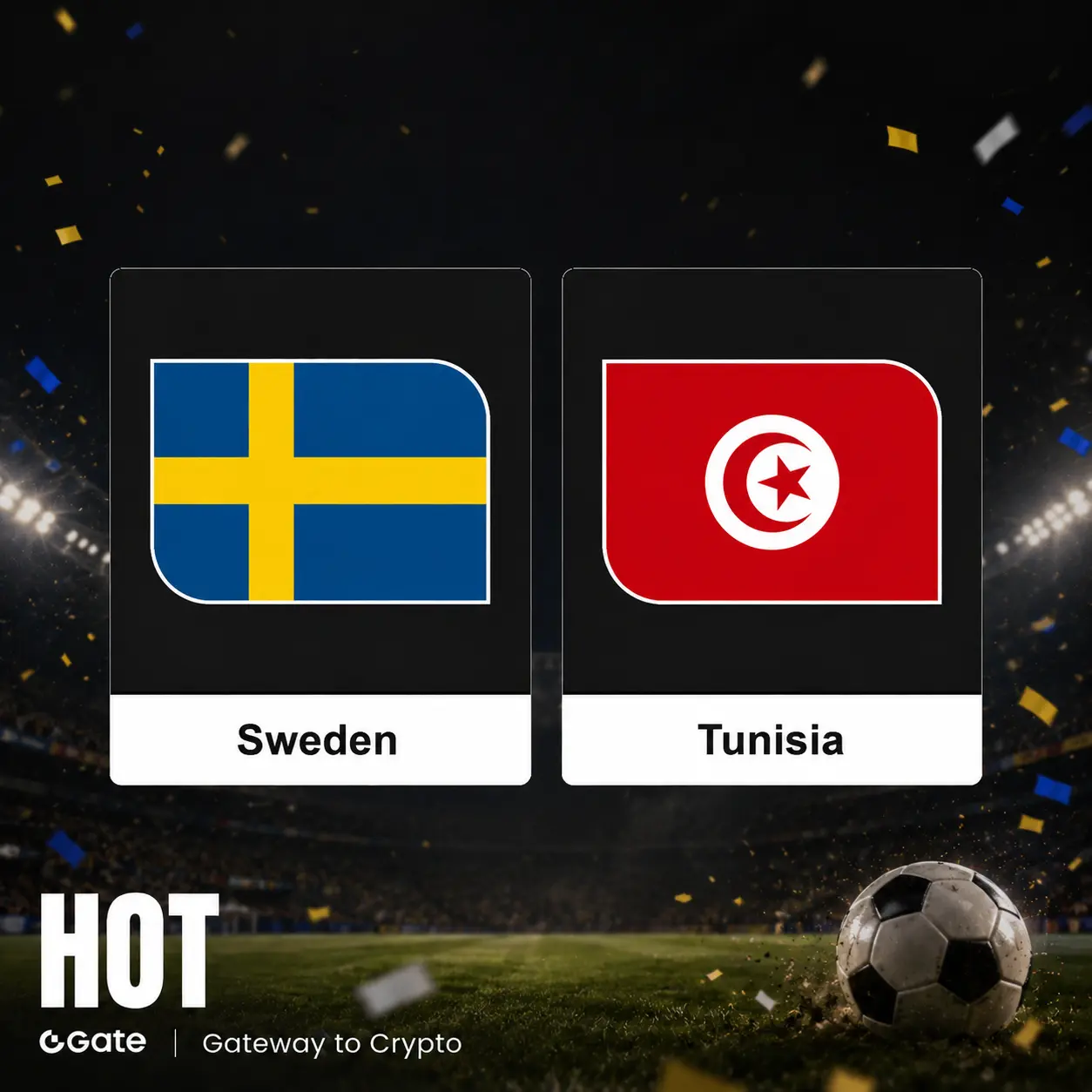
Behind this probability structure is a direct mapping of each team’s positioning in international football and the gap in perceived strength on paper. Sweden are ranked 38th in the world, while Tunisia are ranked 46th. Although the ranking gap is only 8 places, the difference in players’ market values far exceeds what the rankings suggest. Sweden’s total squad value is about €435 million, while Tunisia’s total squad value is about €70 million—more than 6 times higher for Sweden. In Sweden’s announced roster, 11 players come from Europe’s top five leagues, whereas Tunisia has only 5. In terms of squad depth and individual player ability, Sweden has a clear structural advantage—one of the core reasons the market sets Sweden’s win probability at 51%.
How will the two teams reach the World Cup main event through their very different paths?
Sweden’s path to qualification has been full of drama. In the European qualifiers, Sweden were drawn with Switzerland, Slovenia, and Kosovo, but they astonishingly finished bottom in their group with 2 draws and 4 losses, collecting only 2 points—failing to qualify directly for the World Cup. However, by finishing first in their 2024–25 UEFA Nations League League C group, Sweden earned a spot in the playoffs. Under then head coach Graham Potter, Sweden then beat Ukraine and Poland in succession in the playoffs, barely managing to catch the last train to the 2026 World Cup in North America.
Sweden’s playoff performances showcased their ability in tough matches. Against Ukraine, Gyokeres scored a hat-trick, helping the team advance 3-1. In the playoff final versus Poland, Gyokeres fired a late close-range shot to seal the win before full time, beating their opponents 3-2 and booking a place in the tournament. Across the two knockout ties, Sweden scored 6 goals in total, with Gyokeres contributing 4 himself—fully validating the role of the attacking centerpiece. Still, the brilliance of the playoffs cannot completely hide the team’s overall form concerns. In the two warm-up matches before the World Cup, Sweden managed only 1 draw and 1 loss—first losing 1-3 to Norway, then conceding an equalizer to Greece 2-2 despite leading twice, as their back line conceded in all 9 consecutive matches across all competitions.
Tunisia’s performance in the African qualifiers was nothing short of dominant. In Group H, Tunisia topped the table with an undefeated record of 9 wins and 1 draw, scoring 22 goals with zero concessions. They became the third team in World Cup qualification history to advance with a clean-defence record. This defensive statistic is highly valuable and demonstrates Tunisia’s discipline and execution within a low defensive system. However, after entering 2026, Tunisia’s form dropped noticeably. In the Africa Cup earlier in the year, the team lost to Mali on penalties in the Round of 16 and were eliminated, finishing 16th. The head coach who led Tunisia to qualify for the World Cup, Sami Trabelsi, was dismissed after the tournament, and was replaced by Saber Lammouchi. In the two warm-up matches before the World Cup, Tunisia lost 0-1 to Austria and then suffered a 0-5 drubbing by Belgium, with serious problems appearing on both offense and defense. Especially in the match against Belgium, Tunisia conceded 5 goals while holding only 34% possession; the stability of their defense against top-level teams has been called into question.
How do differences in squad strength and core players affect each team’s ceiling?
Sweden’s forward line is the team’s most competitive area. Viktor Gyokeres plays for Arsenal, while Alexander Isak plays for Liverpool. Their combined market value on Transfermarkt is about €165 million, even more than twice Tunisia’s entire squad value. Gyokeres delivered decisive performances in the playoffs and is the No. 1 reason Sweden reached the main tournament. Isak also brings excellent one-on-one突破 and finishing ability inside the box. In addition, players such as Anthony Elanga (Newcastle United), Lucas Beriaval (Tottenham Hotspur), and Yasin Ayari (Brighton) all play in the English Premier League, giving the team plenty of threat on the flanks and midfield energy.
Sweden’s main concerns are concentrated in the midfield and back line. Tottenham’s midfield core Dejan Kulusevski was ruled out due to injury and therefore did not make the World Cup squad. As a result, the team’s main source of creativity in the final third is missing. Without a midfield organizer capable of feeding the two forward stars, Sweden’s attack may become overly dependent on wide crosses and the individual ability of their forwards; their ability to penetrate on the ground when facing compact defenses will be tested. In defense, veteran Victor Lindelof (Aston Villa) anchors a three-center-back system, but his relatively slow turn could become a vulnerability when facing quick counterattacks. At left-back, Gudmundsson had flu before the game but has recovered and trained with the team; he is expected to be able to play, and the squad overall looks fairly complete.
Tunisia’s advantage lies in defensive discipline. Frankfurt midfield captain Eljes Skhiri patrols the center, while the back line is made up of experienced players such as Nîmes defender Ali Abdi and Lorient defender Montassar Talbi. Tunisia’s record of 10 clean sheets in the qualifiers was not accidental—it is the result of years of refinement within a low defensive system. Lammouchi has stated that in the first match, Tunisia will not be satisfied with only defending but will actively attack to chase goals. However, Tunisia’s attacking ability is severely lacking: they lost all three warm-ups and failed to score a single goal, lacking a reliable finisher. Their midfield core Hannibal Mejbri (Burnley) was previously in doubt due to a hamstring injury, and his match readiness still needs to be assessed, further weakening the team’s ability to drive counterattacks forward.
A clash of tactical styles: can a Northern European hammer crack a North African iron shield?
The tactical direction of this match is very likely to be the classic matchup of “strong possession pressure against a low, stubborn defense.” Under Potter, Sweden usually plays a 3-4-2-1 or 3-5-2 setup, emphasizing physical duels, crosses from the flanks, and the individual finishing ability of two forwards in the attacking areas. Against Tunisia’s expected 4-2-3-1 dense defensive shape, Sweden’s challenge will be how to break open the opponent’s low defensive line in settled-position attacks. Tunisia’s zero-concession record in the qualifiers proves that their defensive system is extremely solid when facing opponents of equal or even weaker strength. But the 0-5 loss to Belgium also reveals that when the opponent has a front line with top-level individual talent, this defensive structure is not invincible.
Sweden clearly have an advantage in set pieces. Several Sweden players have height advantages, and crosses from the flanks as well as aerial duels in front of goal will be important weapons for breaking down Tunisia’s compact defense. Tunisia’s back line is relatively weak in aerial ability—an obvious tactical breakthrough point for Sweden. On the other hand, Tunisia’s counterattacks carry some threat: Skhiri is energetic in his runs and the team’s forward interlinking is strong, letting them exploit the space behind when the opponent’s wide defenders step forward to create pressure. Yet Tunisia’s weaker finishing ability upfront will limit how efficiently they can turn counterattacking chances into actual goals.
The match will be played at BBVA Stadium in Monterrey, Mexico. Local weather is expected to be hot and humid, which could affect how the players manage their stamina. For Sweden, who will likely play with high pressing, stamina concerns are even more worth watching. For Tunisia, who are likely to adopt a dense defensive approach, the fatigue factor in hot weather is also not something to ignore. The match referee is an Argentine whistle-blower, and the level of strictness in officiating will directly influence the intensity and tempo of both teams’ tactical execution.
How does the Group F setup amplify the strategic weight of this match?
Group F is widely viewed externally as one of the “groups of death” of this World Cup, alongside teams including the Netherlands and Japan, both of whom have very distinct styles. For Sweden and Tunisia, the outcome of the first match will directly determine subsequent schedule pressure and who has the initiative to qualify. In Group F, the Netherlands are ahead on paper, while Japan are known for technical, possession-based football, a style that clashes to some degree with Sweden’s. Under this scenario, Sweden’s and Tunisia’s direct matchup is not only a key positioning battle for qualification from the group, but also a crucial fight for the teams’ standing in the group’s third tier.
In terms of the qualification route, if Sweden can secure three points in the opening match, they will have more room for error when facing the Netherlands and Japan afterward. Conversely, if they lose, the difficulty of qualifying will increase significantly. Tunisia face a similarly tough situation, but with even more pressure: as an African team, it is their seventh consecutive appearance at the World Cup main event and they have never progressed beyond the group stage; their goal this time is to break that historical curse. With this background, neither team is likely to take overly risky tactics in the first round; a cautious start and avoiding an early concession are likely choices.
What do the numerical signals from the prediction market imply about the likely match direction?
Gate’s prediction market gives a probability distribution of 51%-29%-21%, reflecting one core judgment: Sweden’s advantage on paper is recognized by the market, but not in the form of an absolute one. This partially diverges from the huge gap on paper between the teams (their squad values differ by 6 times). That divergence itself is an important signal that the market is divided on the sides. Sweden’s poor performance in the qualifier group stage (finishing bottom with 2 draws and 4 losses) and their run of not winning in warm-ups stand in sharp contrast to Tunisia’s clean-sheet record in the qualifiers. When pricing the probabilities, the market does not consider only the teams’ strength on paper, but also incorporates their recent participation/form into the evaluation.
It’s worth noting that the tactical characteristics linked to the 60-minute mark, before full time, and the attacking threat from set pieces form the main logic chain behind Sweden’s chances. The key variable leading the market to undervalue Tunisia’s win probability is this: if Tunisia can withstand defensive pressure for the first 60 minutes, then exploit defensive gaps after Sweden’s stamina declines to create threats through counterattacks, the match trajectory could deviate from expectations. In addition, although Tunisia suffered a 0-5 defeat to Belgium in the warm-up, that loss was influenced by a combination of being down a player and the opponent having an exceptional day; it does not necessarily mean the defensive system has completely broken down.
From a match-tempo perspective, the opening duel is likely to be tightly contested. Sweden will look to control the tempo and push with high-intensity pressing, while Tunisia will aim to compress space, slow the tempo, and wait for opportunities to strike on the counter. If no goal is produced within the first 60 minutes, the probability of a draw will rise accordingly, which is logically consistent with the 29% draw probability currently assigned by the Gate prediction market.
Which off-field variables might affect the accuracy of the market’s judgment?
There are several variables that need to be observed for this match. First is the injury and suspension situation. For Sweden, left-back Gudmundsson had flu before the match; he has recovered, trained with the squad, and is likely able to play. The squad is basically complete, and players such as Lindelof, who were previously on the injury list, have all fully recovered. For Tunisia, the team’s main winger has been confirmed to miss the match due to a muscle issue, but the core defender and main midfield player are available, so the overall framework remains intact. Neither side has any key injuries that would structurally undermine their overall strength.
Second is the atmosphere and psychological state in the dressing room. Sweden captain Isak previously said publicly during the qualifiers, “This is too awful—it’s embarrassing,” reflecting the team’s low morale during the qualifier period. But after Potter took over, the team’s comeback in the playoffs showed strong cohesion. For Tunisia, head coach Lammouchi only took charge this January, giving him limited time with the squad. Whether the team can transition smoothly between his tactical setup and that of the previous coach still needs to be tested in the match.
Third is the psychological factor from historical head-to-heads. The two sides have played each other 4 times in history, all of them friendlies: Sweden have won 2, drawn 1, and lost 1, slightly ahead. The most recent meeting dates back to 2003, when Tunisia won 1-0. Because it is long ago and all were friendlies, historical head-to-head data has relatively limited reference value for this match. Their first meeting at a World Cup main stage means both teams will face each other with relatively little familiarity.
Finally is the referee factor. The main referee for this match is from Argentina, and the officiating strictness will directly influence the intensity of duels and tempo. In terms of style, Sweden lean toward physical contests, and Tunisia may use tactical fouls to disrupt the opponent’s rhythm; how lenient the referee is could become a hidden factor affecting the match’s course.
FAQ
Q: What win rate does the Gate prediction market currently set for Sweden?
A: As of June 14, 2026, the probability of Sweden winning in the Gate prediction market is 51%, the probability of a draw is 29%, and the probability of Tunisia winning is 21%.
Q: In what aspects does the gap in paper strength between Sweden and Tunisia show?
A: Sweden are ranked 38th in the world. Their total squad value is about €435 million, and 11 players in the announced roster come from Europe’s top five leagues. Tunisia are ranked 46th in the world. Their total squad value is about €70 million, and only 5 players play in the top five leagues—there is a significant gap between the two sides in squad depth and individual player ability.
Q: How are the teams’ recent match/form situations?
A: Sweden’s first two warm-ups before the World Cup were 1 draw and 1 loss, with their defense conceding in each of the last 9 matches. Tunisia lost all three warm-ups before the World Cup and failed to score, including a 0-5 drubbing by Belgium, but previously in the African qualifiers they maintained an undefeated record with 10 clean sheets.
Q: Do either of the teams have any important injury issues?
A: For Sweden, Kulusevski is out due to injury and misses this World Cup, while left-back Gudmundsson has recovered and trained with the squad. For Tunisia, the main winger has been confirmed to miss the match, Hannibal is in doubt, and both the defensive core and the main midfield player are available.
Q: Why did Tunisia keep a clean sheet in the qualifiers but suffer a 0-5 drubbing to Belgium in the warm-up?
A: Tunisia’s opponents in the African qualifiers were overall not as strong, and their low defensive system faces higher pressure when up against European powerhouses with top-level individual talent. In addition, the match against Belgium was also affected by a combination of being down a player and the opponent’s exceptional performance, so it should not be directly equated with a complete collapse of the defensive system.