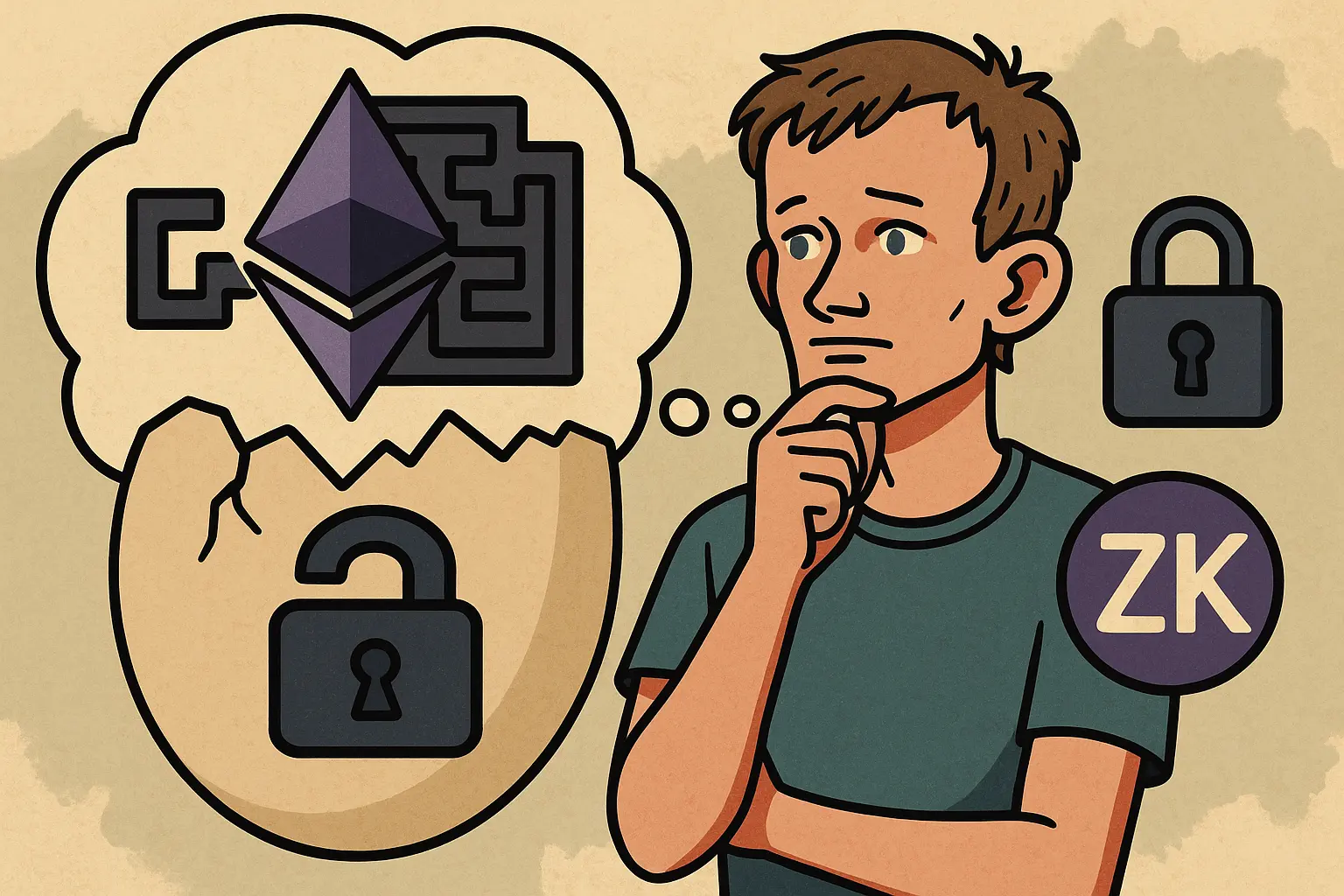
Vitalik reveals Ethereum storage challenges, saying ZK payments will become the default privacy standard

MarketWhisper
ETH-2.97%

以太坊存儲難題

On May 17, Ethereum co-founder Vitalik Buterin commented on X about Ethereum’s state storage issue. He pointed out that even if users store the data themselves, the blockchain stores only hashes, and transactions contain only proofs, the data still needs to be stored and updated for verifying proofs—and ultimately this data is “almost as large as the state itself.” Vitalik previously said that ZK payments are the next key standard for the global digital economy.

State Storage Problem: The Core Technical Challenge Confirmed by Vitalik

In his comments, Vitalik confirmed a core technical contradiction: in a design where the chain stores only hashes, verifiers still need to access or reconstruct auxiliary data (witness data) used to verify ZK proofs, whose size is nearly the same as the original state data. This means that a purely “store only hashes on-chain” design cannot fully solve the state bloat problem. Vitalik confirmed that there are solutions, but emphasized that all of them involve Ethereum. As a relevant current proposal, EIP-8037’s core mechanism is to significantly increase the upfront Gas cost for creating new contracts, accounts, and storage slots. It is a one-time upfront cost adjustment, not a continuously time-weighted rent model.

ZK Payments Vision: Three Core Claims from the May 10 Blog

In his May 10 research article, Vitalik confirmed the following positions:

Problem Definition: The transparency and public nature of blockchains is the main obstacle preventing crypto payments from replacing traditional fiat currencies in everyday retail. The solution needs “default privacy,” not “selective anonymity.”

Technical Solution: Replace traditional transfers with ZK-proof transactions. Users don’t need to reveal their entire balances or transaction history to verify that a payment is valid. Layer 2 can handle private payments with the same speed and cost as transparent payments through “recursive SNARKs.”

Compliance Mechanism: Introduce “selective disclosure” and “proof of innocence” mechanisms into ZK payment standards. This allows users to provide specific “compliance proofs” to authorized institutions or tax authorities without disclosing complete transaction data to the public, resolving compatibility issues with AML regulations.

AI Agent Use Cases: Zero-Knowledge API Usage Credits

In the blog, Vitalik said that autonomous AI agents need to pay for services such as LLM API usage credits without leaving any trace that can be traced back to their human owners. His proposed “zero-knowledge API usage credits” allow agents to complete payment verification on Ethereum Layer 2 while preserving the privacy of payment records—balancing the agent’s operational autonomy and the owner’s data security.

FAQ

What is the technical meaning of “storing hashes on-chain still requires full verification data”?

In ZK proof systems, verifiers need auxiliary data (witness) to verify the correctness of a ZK proof. Even if the blockchain stores only a state hash, verifying new ZK proofs still requires accessing this auxiliary data, whose size is close to the original state data. Therefore, the state bloat problem cannot be fully avoided through “storing only hashes.”

What is the fundamental difference between EIP-8037’s upfront fee mechanism and ongoing storage rent?

EIP-8037’s approach is a one-time increase in upfront Gas costs for newly created contracts, accounts, and storage slots, and it does not charge ongoing fees for existing storage slots. Ongoing storage rent charges all data occupying on-chain storage by time, affecting all existing contracts and making it more difficult to implement.

How does Vitalik’s ZK payment approach balance user privacy and AML compliance requirements?

According to Vitalik’s blog proposal, ZK payment standards include “selective disclosure” and “proof of innocence” mechanisms: users keep privacy at the public level, but when needed they can generate verifiable compliance proofs for specific authorized institutions without publishing all transaction history, thereby resolving the long-standing contradiction between privacy protection and anti-money-laundering (AML) regulations.

Disclaimer: The information on this page may come from third parties and does not represent the views or opinions of Gate. The content displayed on this page is for reference only and does not constitute any financial, investment, or legal advice. Gate does not guarantee the accuracy or completeness of the information and shall not be liable for any losses arising from the use of this information. Virtual asset investments carry high risks and are subject to significant price volatility. You may lose all of your invested principal. Please fully understand the relevant risks and make prudent decisions based on your own financial situation and risk tolerance. For details, please refer to Disclaimer.
Comment
0/400
No comments