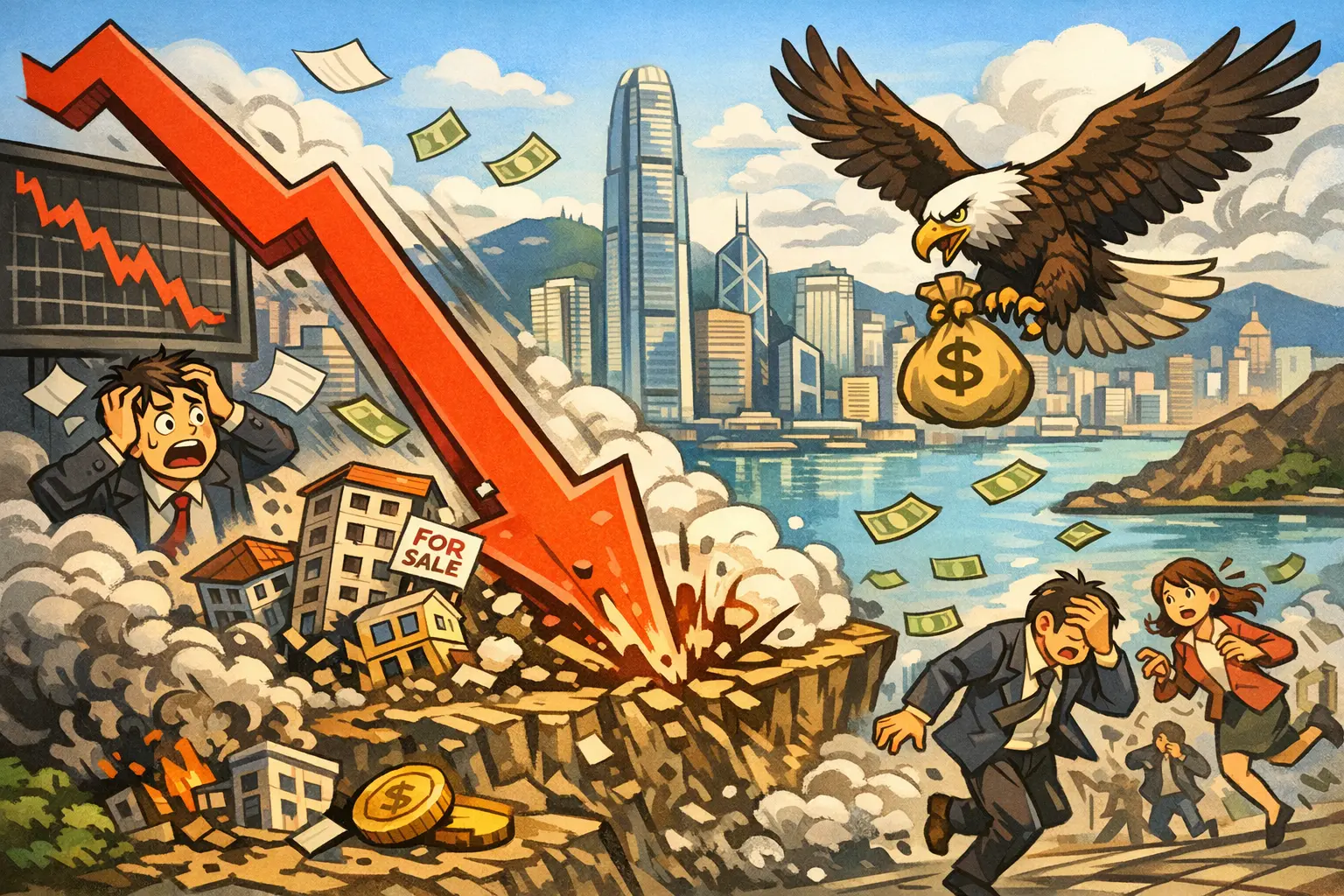
On June 18, Hong Kong stocks’ Hang Seng Index opened down by 166 points, before the decline rapidly widened. During the session, it dropped by as much as 445 points, hitting a low of 23,866 points and setting a new one-year low. The main factor triggering this sell-off was market speculation that the Federal Reserve may raise rates once before the end of this year. Although the Federal Reserve kept interest rates unchanged as expected, several officials hinted that there could be a rate hike this year. US stocks’ three major indexes fell about 1% the night before, the Hang Seng China Enterprises Index (HSCEI, “Golden Dragon” index) dropped 1.14%, and the selling pressure was most pronounced among property stocks—especially those most sensitive to interest rates.
Intraday Decline Rankings for Mainland Property Stocks
The intraday percentage declines of major listed China real estate stocks were as follows (as of 10:48 am):
Country Garden (03383): down 6.1% (largest decline)
Greentown China (03900), Yuexiu Property (00123), Shimao Group (00813), China Jinmao (00817): each down 4.1% to 5.2%
China Overseas Development (00688): down 4.8%, at 14.19 yuan, temporarily the worst-performing blue chip
Longfor Group (00960): down 3.7% to 2.4%, at 7.35 yuan (Morgan Stanley raised its target price for the day to 8.23 yuan, maintaining a “perform in line with the broader market” rating)
China Resources Land (01109): down 2.9%
C&D International (01908): down 3%
Sunac China (01918), Country Garden (02007): down 1% to 1.3%
Xincheng Development (01030), R&F Properties (02777): down 2% to 2.6%; Sunac (01918), Country Garden (02007): down 1% to 1.3%
According to National Bureau of Statistics data, in May the sales price of newly built commodity residential properties in 70 large and medium-sized cities fell 0.2% month-on-month (April’s decline was 0.19%). Morningstar analyst Jeff Zhang said that prices in high-tier cities improved in May, but pressure remained in lower-tier cities, and national new home prices are unlikely to bottom out before 2027.
Tech Stocks’ Intraday Performance: Tencent, Alibaba, and Other Major Tech Stocks Fall
Tech stocks generally came under pressure: Tencent (00700) fell 1.9% to 437 yuan; Alibaba (09988) fell 3.4% to 103.3 yuan; Baidu (09888) fell 2.2% to 109.7 yuan; JD.com (09618) fell 2.4% to 108.4 yuan; Xiaomi (01810) fell 3.2% to 24.6 yuan; Meituan (03690) fell 1.8% to 73.05 yuan; NetEase (09999) fell 2% to 191.8 yuan; Kuaishou (01024), which surged more than 7% yesterday, gave back 0.2% to 47.62 yuan.
Markets in the Asia-Pacific Region Hitting New Highs on the Same Day: Taiwan, Japan, and South Korea Stocks
As Hong Kong stocks fell, several major markets in the Asia-Pacific region also hit new highs on the same day: Taiwan stocks were up 1.2% intraday to 46,565 points, setting a record high; Japan’s Nikkei broke through the 71,000 level to reach 71,398 points at a new high, closing the first half at 71,052 points, up 1,150 points (+1.65%); South Korea’s Kospi index rose to an intraday high of 8,976 points, closing at 8,925 points (+0.7%).
Deloitte’s Mid-Year Forecast for the Hong Kong IPO Market in 2026
Deloitte, in its report “Mid-Year Review and Outlook of China and Hong Kong New Stock Markets in 2026” released on June 17, maintained its full-year forecast: there will be 160 IPOs in Hong Kong for the full year, fundraising size targets 300 billion HKD, and Hong Kong is expected to rank as the world’s third-largest market by scale. Deloitte said it expects that 5 super-large IPOs and 12 large IPOs combined will contribute more than 60% of the total fundraising amount; as of the end of May, there are still more than 600 listing application cases under review in Hong Kong (including more than 100 A-share companies).
In the first half of 2026, Hong Kong still maintains its position as the world’s second-largest fundraising market. In the first half, the share of IPO count for new economy companies exceeded 70%, and their share of fundraising amount was close to 80%.
Frequently Asked Questions
If the Federal Reserve kept interest rates unchanged this time, why did Hong Kong stocks fall sharply?
According to reports, although the Federal Reserve kept interest rates unchanged, several officials hinted that there could be a rate hike this year, and the market expects that there may be one rate hike by year-end. With the three major US stock indexes down about 1% the night before and the Hang Seng China Enterprises Index down 1.14%, plus the sentiment after Hong Kong stocks fell for two consecutive days, the gap-down at the start of trading ahead of the Dragon Boat Festival holidays was followed by bears quickly expanding the decline to more than 400 points.
How did China Overseas Development become the worst-performing blue chip of the day?
According to reports, China Overseas Development (00688) fell 4.8% intraday to 14.19 yuan, making it the blue-chip constituent with the largest decline among Hang Seng Index stocks. Property stocks overall suffered selling pressure as rate-hike expectations in the market heated up, and China Overseas’ decline was the most pronounced among major blue chips.
What is the main support source for Deloitte’s forecast that Hong Kong IPOs will raise 300 billion HKD?
According to Deloitte’s report, the main support comes from the emergence of new economy companies (semiconductors, the AI industry chain, robotics, biotechnology, and more). These companies accounted for nearly 80% of IPO fundraising in the first half. At the same time, reform measures—such as optimized approval procedures for secondary listings of large A-share technology companies and reforms to the listing mechanism for specialist and special technology enterprises—are also important driving forces.


