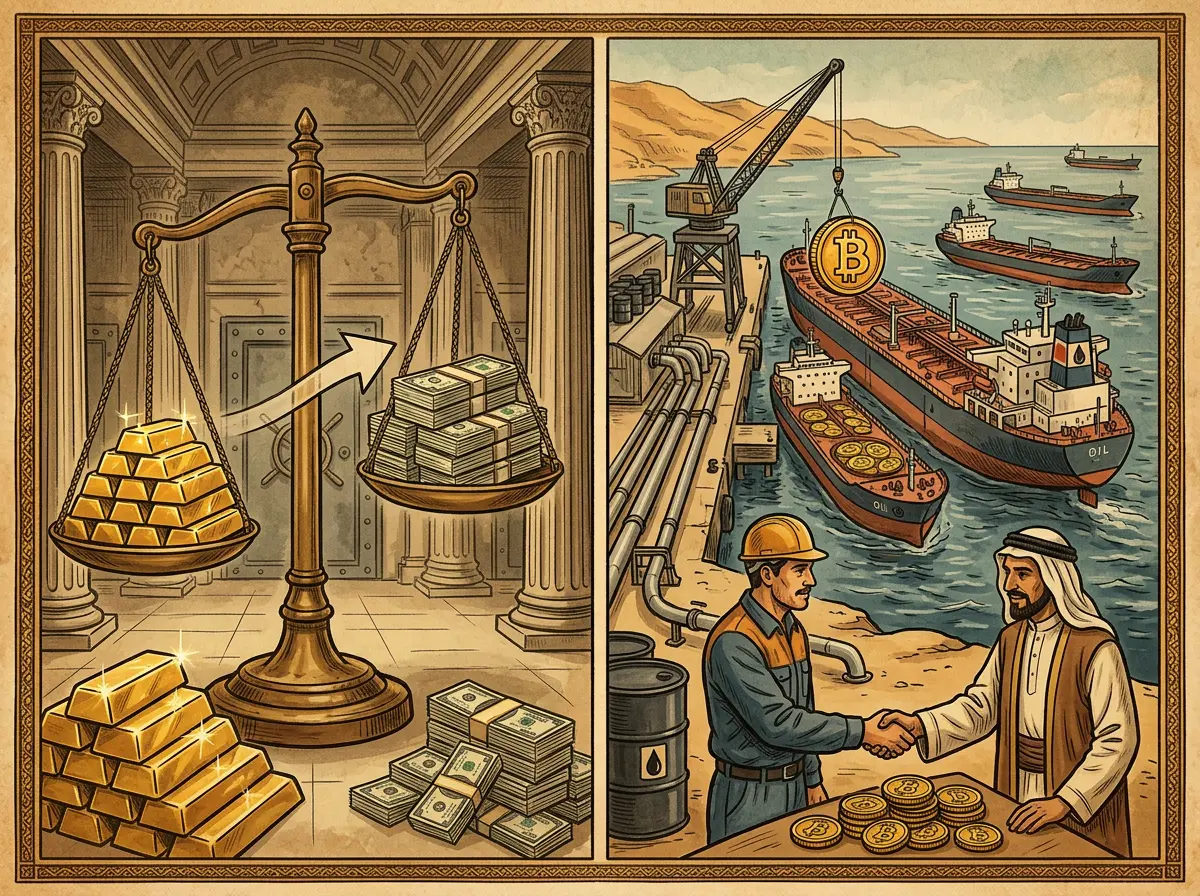
Fidelity Digital Investments’ report “Six Key Trends Shaping Digital Assets in 2026,” released in May, said that in April the Iranian government announced that it would accept bitcoin, stablecoins pegged to the US dollar, and payments in renminbi to cover oil transit fees for shipments crossing the Strait of Hormuz. Fidelity in the report cited this as a sign of the emergence of an “alternative settlement mechanism.” In the same period, the report noted that gold’s share in central bank reserves has surpassed that of US-dollar-denominated assets.
Iran Bitcoin Oil Transit Fees: Confirmed Policy Timeline
In April 2026, the Iranian government announced that it would accept bitcoin, stablecoins, and renminbi payments for oil transit fees for shipments crossing the Strait of Hormuz. Previously, in May 2025, Iran’s state-run Fars News Agency, citing plans from the Ministry of Economic, reported that Iran was considering developing a maritime transport insurance model for oil tankers transiting the strait paid in bitcoin, “settling at the speed of blockchain.”
In the same month (April 2026), US authorities froze $344 million worth of stablecoins related to the Iranian government and the Islamic Revolutionary Guard Corps (IRGC).
Fidelity Report’s Confirmatory Assessment of Gold and Bitcoin
The Fidelity report confirmed that central banks’ continued demand for gold is “basically consistent” with Fidelity’s earlier arguments. Gold’s share in global central bank reserves has surpassed US-dollar assets (based on Kitco data). The report also said: “The anticipated subsequent excess returns for Bitcoin have not been realized.”
Bitcoin proponents believe that Iran’s acceptance of bitcoin payments for transit fees validates bitcoin’s potential to become an alternative global settlement asset, thanks to its neutrality, confiscation resistance, and decentralization. This point is presented as fact in the Fidelity report, but it is labeled as “anticipated excess returns have not yet been realized.”
The Confirmed Role of Dollar-Pegged Stablecoins in Iran’s Oil Transit Fees
BPI research director Sam Lyman said that despite US authorities freezing $344 million worth of stablecoins related to Iran in April 2026, Tether’s USDT still dominates the payment flows for oil transit fees, showing that dollar-pegged stablecoins are still widely used in oil-price settlement.
FAQ
What is the “alternative settlement mechanism” defined in the Fidelity report?
In the report, Fidelity uses the example of Iran accepting bitcoin, stablecoins, and renminbi to pay oil transit fees to explain that, amid limitations on dollar settlement channels, parties are gradually adopting alternative payment and settlement systems not directly controlled by the United States.
How is the data showing gold surpassing the US in central bank reserves calculated?
Based on Kitco data cited in the Fidelity report, gold’s share in global central bank reserves has exceeded that of US-dollar assets. Fidelity also stated that central banks’ demand for gold has remained “strong” even after the gold price fell about 20% from its previous peak, following gold’s historic high of about $5,600 per ounce in January 2026.
After the US froze Iran’s stablecoins, how much did Iran shift to bitcoin in crypto payments?
BPI research director Sam Lyman confirmed that after the US froze $344 million in stablecoins, Tether USDT still dominates the payment of oil transit fees. The actual payment size for bitcoin has not been separately quantified in the currently reported information.


