2026 FIFA World Cup champion prediction: Polymarket market probabilities and in-depth analysis of the top teams

GateInstantTrends

In 2026, the FIFA World Cup will first expand the participating teams from 32 to 48. The tournament will reach a total of 104 matches, spanning 16 cities across the United States, Canada, and Mexico, and lasting as long as 39 days. Such a fundamental change to the competition format means that the traditional analytical frameworks—previously relying on historical data and knockout-path assumptions—face a need for reconstruction. Against the backdrop of the tournament’s expansion in scale and a reshaping of the competitive landscape, the intensity of discussion about who will win the title and the demand for information have also climbed to historic highs. Only on the Polymarket platform, the “2026 World Cup Champion” prediction event has already surpassed $908 million in total trading volume, becoming the largest single event by volume among the platform’s sports prediction markets.

How does data from prediction markets reflect collective rationality and capital battles?

Unlike traditional bookmakers that directly set prices, Polymarket-style blockchain-based prediction markets use event contract mechanisms: users buy and sell share quantities on specific outcomes, and the share trading price directly reflects the market’s probability expectation for that outcome. The higher the unit price, the more likely the market believes that outcome will occur. When a large number of participants use their own funds to express their views, the market price gradually converges toward a consensus representing “wisdom of crowds.” This capital-driven pricing mechanism has special value in predicting sports events with high uncertainty: the faster information spreads and the more dispersed the participating capital is, the higher the market’s error-correction efficiency. As of May 8, 2026, this market has gathered more than $900 million in liquidity, meaning that more than $900 million is being deployed to express judgment on the outcome of this single event.

Who occupies the first tier in Polymarket’s World Cup title probability ranking?

Source: Polymarket

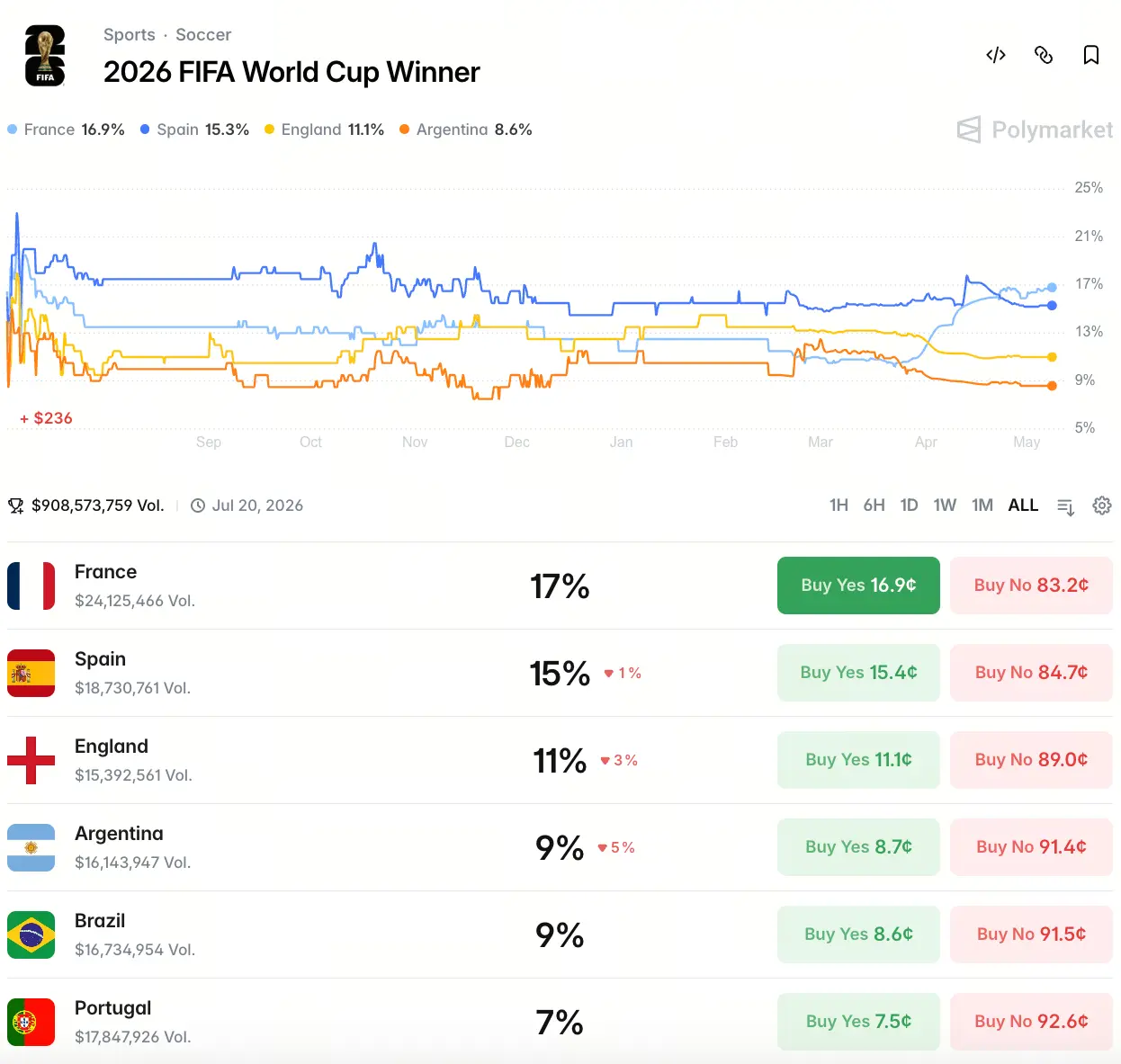
Based on Polymarket’s real-time data, France currently leads with a 17% chance of winning the title, followed closely by Spain with 15%, while England ranks third with 11%. The defending World Cup champion Argentina (9%) and Brazil (9%) are tied for fourth, Portugal follows with 7%, and Germany ranks seventh with 5%.

This tiered structure shows that the market’s concentrated confidence in Europe’s traditional strong teams is clearly higher than that in South American strong teams—Europe takes three of the top four spots. Notably, the teams at the bottom of the ranking still fall outside the top 35; overall, the probability distribution has an extremely long tail, reflecting the huge gap in market “consensus” among the 48 participating teams.

What underlying fundamentals drive France’s 17% lead?

From an on-field standpoint, France’s core advantages come from three areas:

  1. First, squad depth and the maturity of key players. Mbappé is in his prime at age 27; he has scored 56 goals for the national team so far, just 1 goal shy of France’s all-time record. Transfermarkt estimates France’s starting XI’s total squad value at €870 million, of which Mbappé alone accounts for €180 million.
  2. Second, major-tournament experience and knockout resilience. France reached the final twice in the last three World Cups (won in 2018, runner-up in 2022), making them one of the most consistent national teams in the same period.
  3. Third, the group situation is relatively favorable. France is placed in Group I, with opponents Senegal, Iraq, and Norway—avoiding early direct clashes with other traditional powerhouses.

The market’s 17% probability leading position is a composite pricing of the above fundamentals.

Why do Spain and England have market disagreement right behind France?

Spain has a 15% probability to finish second, but the gap with France is only 2 percentage points, indicating a subtle battle for capital between the two big favorites. Spain’s advantage lies in midfield control and the smooth transition between generations; younger players such as Pedri and Gavi have already proven themselves in major tournaments.

However, the market disagreement is equally clear: some traditional betting institutions’ supercomputer simulations have Spain as the top favorite with a probability of 17.0%, above France’s 14.1%. Differences between these data sources reflect that different forecasting models assign different weights to assessments of each team’s current form. England, with 11%, ranks third; its market positioning is relatively solid but lacks strong momentum to challenge the top two. Harry Kane’s age and the team’s mentality in key matches remain core variables affecting market pricing. England has reached the semifinals in each of the last three major tournaments but has not yet crossed the threshold of winning the title. As a result, the market’s pricing of the “Premier League system uplift” effect is also correspondingly more conservative.

Why aren’t defending champions Argentina and Brazil five-star favorites meeting expectations in probability?

Argentina has a 9% probability, tied with Brazil for fourth, and this figure is clearly below the traditional expectations outsiders have for the two South American giants. The biggest variable facing Argentina is that the team’s overall age structure is relatively older; Messi has entered the late stage of his professional career, and the team’s tactical system that relies on a handful of core players faces even tougher strain in the current 104-match dense schedule, where fitness allocation demands are more severe. In addition, after winning the last World Cup, the squad’s competitive freshness and tactical sharpness inevitably begin to decline.

Brazil is also seeing signals of weaker market confidence: Neymar did not make Brazil’s national team roster for the friendly match in March 2026 due to form issues, and subsequent discussions about whether he will participate in the World Cup further amplified market doubts. Brazil’s fluctuation in the World Cup qualifiers combined with uncertainty around key players has kept the market’s confidence in this traditional title contender trending downward. A 9% probability both reflects the teams’ actual competitiveness and indicates that the market only partially recognizes the narrative of “defending the title.”

What deeper information can the probability distribution tell us?

The meaning of the probability distribution goes far beyond the conclusion of “who is most likely to win the title.”

First, the combined probability of the top three—France (17%), Spain (15%), and England (11%)—adds up to only 43%. This means that as much as 57% is distributed across the other 45 teams, showing that with the tournament expanded to 48 teams, uncertainty in this World Cup has increased significantly.

Second, differences in probability magnitude have reference value. Teams such as Portugal, Germany, and the Netherlands form a clear “second group” with tiered distributions of 7%, 5%, and 3%, respectively. While this probability level is not enough to support a championship prediction, it gives the market more layered room for investment and hedging.

Third, the process of probability changing over time is itself information—once warm-up match results come out, injury lists get updated, and group-stage progress continues, Polymarket’s real-time price fluctuations will keep reflecting how incoming information shocks market sentiment. For observers in the crypto industry, this kind of collective judgment backed by real money is becoming a new dimension of information.

Summary

Because of format reforms, the 2026 World Cup has become the most uncertain football tournament in history. With more than $900 million participating in Polymarket’s prediction market, it reflects strong demand in the market for definitive answers and only partial trust in traditional analytical frameworks.

France’s 17% leading probability reflects the market’s comprehensive recognition of the team’s squad depth, major-tournament experience, and group situation. Spain’s 15% follow-up shows that the market’s weighting between traditional advantages and modern football trends is still dynamically adjusting. The challenges facing England, Argentina, and Brazil are also fully mapped in the probability data—everything from age-related issues and uncertainty in key players’ form to historical mentality bottlenecks illustrates the multi-dimensional complexity of modern football competition.

Prediction markets are not just a simple reflection of “known answers” about the champion. Instead, they are a dynamic probability map continuously updated by tens of thousands of traders worldwide, capturing the market’s latest interpretation and judgment of information.

FAQ

Q: How are Polymarket’s prediction probabilities different from traditional betting odds?

Polymarket is a blockchain-based prediction market. Users express their judgment by buying or selling event contract share quantities, and the trading price directly converts into probability. This mechanism drives participants to “battle” with their own funds, creating an “information aggregation” effect—rather than the odds provided by traditional bookmakers after they build in an implicit margin.

Q: Why is Argentina the defending champion but only has a 9% chance to win?

The market believes Argentina’s squad overall is older, uncertainty in the form of key players has increased, and the higher fitness-allocation requirements of a 104-match schedule make defending the title far harder than a normal World Cup cycle. The 9% probability reflects the market’s combined assessment of these factors.

Q: Germany has only a 5% chance—do they still have a chance?

Germany showed decent attacking firepower in recent friendlies, beating Switzerland 4-3 and narrowly winning against Ghana 2-1, but the stability of their back line is a concern. A 5% probability means the market thinks Germany is still some distance away from the title, but within the long tail of the probability distribution there remains potential for an upset breakthrough.

Q: Will Polymarket’s probabilities change as matches are played?

Yes. Polymarket uses a real-time pricing mechanism: prices update dynamically with trading activity. From the group stage to the knockout rounds, as new information emerges—match results, player injuries, tactical adjustments—the market’s probability distribution will adjust accordingly, reflecting the latest collective judgment.

Disclaimer: The information on this page may come from third parties and does not represent the views or opinions of Gate. The content displayed on this page is for reference only and does not constitute any financial, investment, or legal advice. Gate does not guarantee the accuracy or completeness of the information and shall not be liable for any losses arising from the use of this information. Virtual asset investments carry high risks and are subject to significant price volatility. You may lose all of your invested principal. Please fully understand the relevant risks and make prudent decisions based on your own financial situation and risk tolerance. For details, please refer to Disclaimer.

Related Articles

Predict.fun Launches Polymarket 2026 Migration Prediction Market, $1.71M Volume

According to CatcherPredict, Predict.fun launched a new prediction market on Polymarket's 2026 blockchain migration, with $1.71 million in total trading volume. The 'new Polymarket chain' option currently leads at 67% probability, followed by '2026 no migration' at 26%, while Arbitrum stands at 2% a

GateNews4h ago

Kalshi Doubles Valuation to $22B After $1B Series F Funding Round

According to Bloomberg, prediction market platform Kalshi raised $1 billion in a Series F funding round led by Coatue Management, doubling its valuation to $22 billion from $11 billion five months earlier. Other investors included Sequoia Capital, Andreessen Horowitz, IVP, Paradigm, Morgan

GateNews10h ago

Loss-Making Wallet Purchases $210K Pistons Spread Bet on Polymarket, Up $60K as Game 2 Unfolds

According to Odaily Seer, a wallet address that has incurred over $2.3 million in losses purchased $210,000 in Pistons spread bets (3.5-point favorites) on Polymarket today, with an average entry price of 51 cents. The position has generated $60,000 in unrealized gains as of the second quarter of

GateNews11h ago

Kalshi Hits $22 Billion Valuation After $1 Billion Series F Raise Led by Coatue

Kalshi reached a $22 billion valuation on Thursday after raising $1 billion in a Series F round led by Coatue, according to the company's statement. The round also included participation from Sequoia Capital, Andreessen Horowitz, IVP, Paradigm, Morgan Stanley, and ARK Invest. The funding marks the p

GateNews17h ago

Kalshi Traders See Rising Odds of U.S.-Iran Nuclear Deal Before 2027

According to Kalshi traders, the probability of the United States and Iran reaching a nuclear agreement before 2027 is rising, the prediction platform data shows.

GateNews18h ago
Comment
0/400
No comments