Astera Labs is a semiconductor connectivity solutions provider serving cloud and AI infrastructure, specializing in high-speed connection technologies such as PCIe, CXL, and Ethernet. In Gate’s official announcements, ALAB is described as a company focused on semiconductor connectivity solutions for cloud and AI infrastructure.
On these trading pages, the emphasis is not only on whether you can buy, but also on understanding USDT settlement, order execution, position records, price fluctuations, and platform rules. For users familiar with crypto asset trading, the key difference in Gate stock trading is that the funding currency remains USDT, but the tradable assets now include US equities in addition to crypto.

What to Prepare Before Trading ALAB Stock on Gate
Before trading ALAB stock on Gate, users typically need to complete Gate account registration, identity verification, deposit or asset transfer, and confirm whether the relevant stock trading service is supported in their region. Stock trading is a TradFi feature provided by the platform, and its availability, trading permissions, and product structure may vary depending on region, account status, and platform rules. Users should always refer to the information shown on the Gate platform.
Before placing a trade, you must also ensure your account has sufficient available USDT. Since trades are settled in USDT, users should verify that their funds in the spot account, unified account, or stock trading account are available for order placement, and check whether a transfer between accounts is necessary.
Users should also become familiar with the basic details of ALAB stock, including the company name, ticker, market, and business focus. ALAB represents Astera Labs, Inc., a company engaged in high-speed connectivity chips for AI data centers. As such, its stock price may be influenced by the US equities market, the AI semiconductor sector, company performance, and overall market sentiment.
How to Find the Astera Labs (ALAB) Stock Trading Page
To find the Astera Labs (ALAB) stock trading page on Gate, use the stock section or the platform’s search feature to enter “ALAB” or “Astera Labs.” ALAB’s stock page is already available in Gate’s search results, and the page title indicates you can view ALAB’s real-time price, charts, and market performance on Gate Stocks.
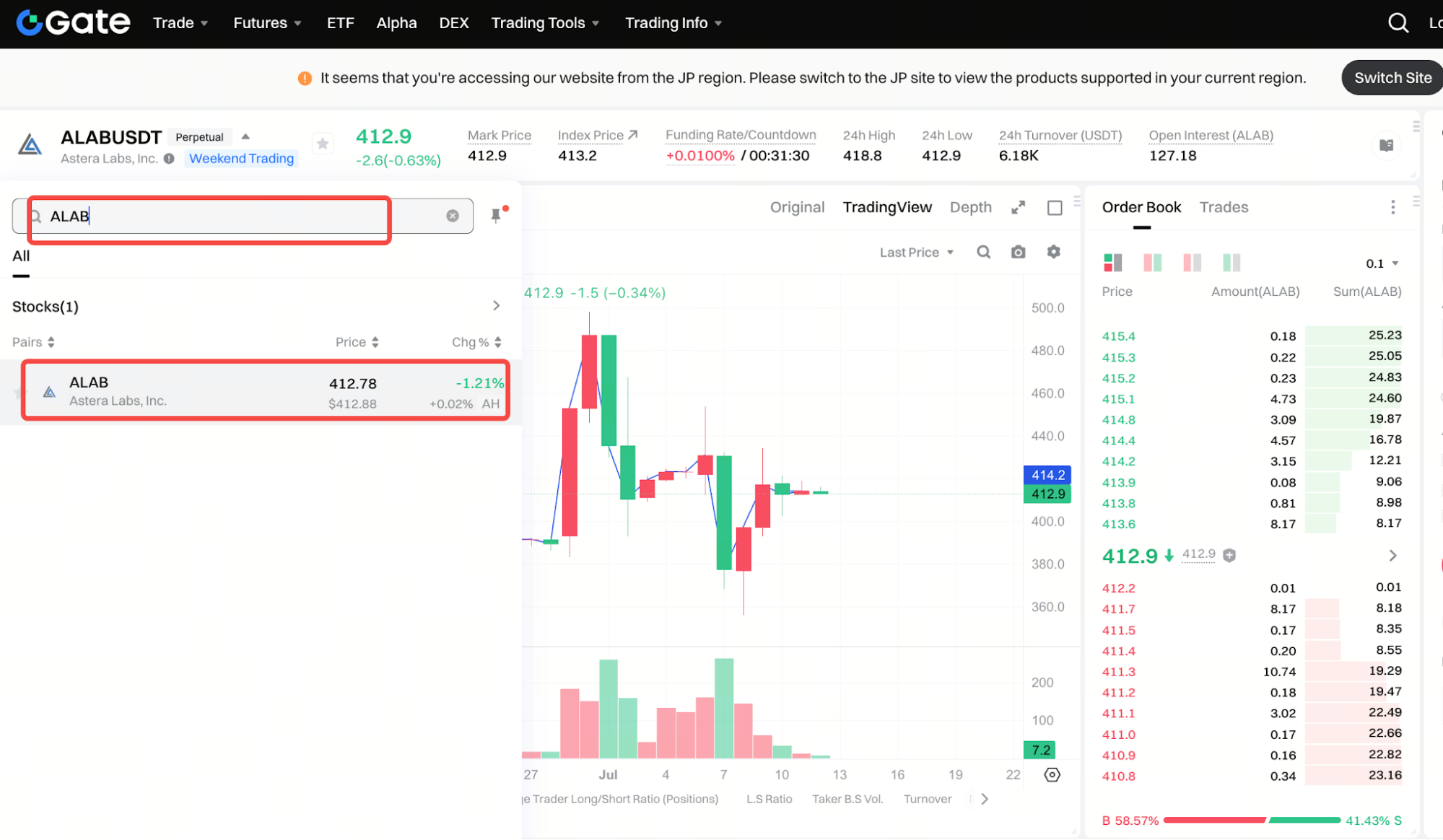
Once on the page, confirm you are viewing the stock trading page—not a futures, ETF, or other derivatives page. Gate also offers an ALAB USDT Perpetual Futures page, so users should verify the trading product, leverage, margin rules, and settlement method before proceeding to avoid confusing stock trades with futures.
| Page Type |
Main Features |
Key Information to Monitor |
| Gate Stocks Page |
Displays ALAB stock price, charts, trading access |
Stock price, trading entry, position records |
| USDT Perpetual Futures |
Shows ALAB_USDT futures trading details |
Leverage, margin, liquidation, funding rate |
| Market Page |
Shows price and market performance |
Price trend, price change %, trade data |
| Account Page |
Shows fund and asset records |
Available USDT balance, positions, orders |
This distinction is critical, as each product carries distinct risks and trading mechanisms. Stock trading involves direct equity ownership, while Perpetual Futures involve leverage, margin, and forced liquidation—these are fundamentally different products.
How to Buy ALAB Stock with USDT
To buy ALAB stock with USDT, the core steps are: access the ALAB stock page, check the trading price, select the buy direction, enter the purchase quantity or amount, and submit the order. Before submitting, confirm your available USDT balance, estimated fill amount, fee details, and order type to avoid failed orders due to insufficient funds or price deviation.
If both market and limit orders are supported, their execution logic differs: market orders are filled quickly but may be affected by order book liquidity, while limit orders let you set a maximum buy price, but may not execute immediately if the market does not reach your price.
Using USDT to purchase ALAB stock means you are using a stablecoin as the settlement currency for US equity trades. Gate’s stock feature allows users to trade US equities directly from their crypto asset account using USDT, with no need to first convert funds into fiat in a traditional brokerage account.
How to Check ALAB Stock Positions and Order History
After buying ALAB stock, users need to check their holdings via the assets, stock account, or order history pages on Gate. Position details typically include the ticker, quantity held, cost, current price, unrealized PnL, and available quantity for sale, with specific fields displayed according to the platform interface.
Order history tracks whether buy or sell orders have been filled. Unfilled orders may remain as maker orders, while partially filled orders reflect only a portion of the total quantity. Users should distinguish between “submitted orders,” “filled orders,” and “canceled orders” to avoid misinterpreting their actual holdings.
| Record Type |
Main Purpose |
Key Details to Monitor |
| Position Records |
View current ALAB stock holdings |
Quantity, cost, current valuation, quantity available to sell |
| Open Orders |
View orders not yet filled |
Price, quantity, whether to cancel |
| Order History |
Review buy/sell records |
Fill price, filled quantity, timestamp |
| Asset Records |
Track changes in USDT and stock assets |
Fund transfers, settlement, fee changes |
| Fill Details |
View actual fill results |
Partial fills, average fill price |
Reviewing these records is essential for confirming whether funds and stocks have been settled. For US equities like ALAB, price movements may be affected by US trading hours, company news, and sector trends, so interpret order and position records in the context of actual fills.
How to Sell ALAB Stock and Settle in USDT
To sell ALAB stock, access your positions or the ALAB stock trading page, select the sell direction, enter the quantity, and confirm the order price and estimated settlement amount. After submitting, the system will match your order or place it as a maker order, depending on market price, order type, and liquidity.
Once the sale is filled, the proceeds are typically credited as USDT to your account or designated stock trading account. Confirm fund arrival, average fill price, filled quantity, and fee details in your fill and asset records.
Note that selling does not guarantee immediate execution—orders may remain unfilled, be partially filled, or experience price slippage. For volatile stocks, verify the market price, trading hours, and order type before submitting to avoid unexpected results due to price swings.
How Does Trading ALAB Stock with USDT on Gate Differ from Traditional Brokers?
Trading ALAB stock with USDT on Gate differs from traditional US stock brokers primarily in the funding and settlement currency. Traditional brokers require deposits in USD or local fiat, while Gate uses USDT as the trading unit, enabling crypto asset users to access equities within the same platform.
Another difference is the account structure. Traditional brokers operate around securities accounts, bank funding, and securities clearing, while Gate integrates stock trading with crypto asset accounts, USDT balances, and in-platform asset management. Users must understand account transfers, product pages, and trading rules.
A third difference is the need to confirm product boundaries. Gate may simultaneously list stocks, futures, and other ALAB-related products, each with different trading mechanisms, risk profiles, and settlement rules. For example, ALAB_USDT Perpetual Futures follows futures trading logic, whereas the ALAB stock page pertains to the Gate Stocks environment. Always confirm the product type before trading.
| Comparison Dimension |
Gate: Trading ALAB Stock with USDT |
Traditional Broker: Trading US Stocks |
| Funding Currency |
Primarily USDT |
USD or local fiat |
| Account Structure |
Crypto asset account plus stock trading |
Securities account plus bank account |
| Trading Access |
Gate Stocks page or platform search |
Broker app or trading terminal |
| Asset Management |
View stocks and crypto assets together |
Stock assets kept separate from crypto |
| User Focus |
USDT balance, order type, product type |
Fiat funding, securities clearing, order type |
| Key Considerations |
Distinguish stocks, futures, derivatives |
Distinguish cash, margin, and securities access |
These differences make Gate’s stock trading more suitable for users already familiar with USDT and the platform’s account system, while traditional brokers are better for those experienced with securities accounts, fiat funding, and standard US equity trading workflows.
Summary
When trading ALAB stock with USDT on Gate, the process involves preparing your Gate account and USDT balance, locating the ALAB stock page, confirming the trading product, submitting buy or sell orders, and checking fills in your position and order records. The core is understanding USDT settlement, order mechanics, and the distinction between stock and futures pages.
ALAB refers to Astera Labs, Inc., a company specializing in AI data center connectivity chips. Before trading, users should not only follow the operational steps but also recognize that stock prices are influenced by the US equities market, the AI semiconductor sector, company fundamentals, and platform trading rules.
FAQ
How do I trade ALAB stock with USDT on Gate?
To trade ALAB stock with USDT on Gate, prepare your account, ensure you have available USDT, access the ALAB stock page, select buy or sell, and check order fills in your order history.
Are ALAB stock and ALAB_USDT Perpetual Futures the same on Gate?
No. ALAB stock and ALAB_USDT Perpetual Futures are separate products. The stock page is for Gate Stocks, while the futures page involves Perpetual Futures, margin, and leverage. Always confirm the product before trading.
Do I need USDT before trading ALAB stock?
Yes. You need available USDT before trading ALAB stock, as Gate Stocks are priced and settled in USDT. Confirm that your funds are in an account eligible for order placement.
How do I confirm if my ALAB stock purchase was successful?
To confirm a successful ALAB stock purchase, check your order status, fill details, and position records. Only after the order is filled will your position and asset records update.
What asset do I receive after selling ALAB stock?
After selling ALAB stock, the proceeds are typically credited as USDT to your account. Check the Gate platform for the specific account, settlement time, and fee details.
What should I pay attention to when trading ALAB stock with USDT?
When trading ALAB stock with USDT, pay attention to the page type, order price, market volatility, trading hours, platform rules, and asset records. Avoid confusing stock trades with Perpetual Futures.