Mardi, l’analyste on-chain et fondateur de Timechainindex.com Sani a signalé une transaction bitcoin dans laquelle le propriétaire a transféré 107 BTC, d’une valeur de 8,2 millions de dollars aux taux de change actuels, vers une adresse de burn, rendant les fonds définitivement inaccessibles et impossibles à dépenser.
- Points clés.
-
- Le fondateur de Timechainindex.com, Sani, a signalé un burn de 107 BTC le 25 mai, d’une valeur de plus de 8,2 millions de dollars.
-
- Les avoirs des portefeuilles de burn Bitcoin ont atteint 807 BTC, d’une valeur d’environ 62,15 millions de dollars.
-
- La contrepartie avait brûlé 2 131 BTC en 2014, alimentant un regain du débat sur la preuve-de-brûlage.
Bitcoin Burn Wallet Jumps to 807 BTC After Mystery User Burns $8.2 Million
According to onchain data, on Monday, May 25, an unidentified wallet transferred 107.1302 BTC valued at more than $8.2 million to what is known as a burn address. In simple terms, a burn address is a public cryptographic destination with no known private key, meaning any bitcoin sent there becomes permanently locked and entirely unspendable. It is, quite literally, comparable to tossing $8.2 million in U.S. dollar bills into a fire.
Onchain analyst and Timechainindex.com founder Sani was the first to identify the unusual transfer. “Someone just broadcasted 5 transactions totaling 107 BTC to the bitcoin ‘burn address’ 1111111111111111111114oLvT2,” Sani wrote on Tuesday. Hardware wallet manufacturer Trezor responded to Sani’s X post with a meme depicting Sesame Street’s Elmo standing in front of roaring flames.
Blockstream founder Adam Back also responded to Sani’s post. “Accidental quantum bounty?” Back asked in the thread. Sani replied, “Looks like Maximus Retardimus.” A bitcoin burn address is often created by intentionally generating a valid public key or script with a recognizable, text-based pattern instead of deriving it from a randomly generated private key.
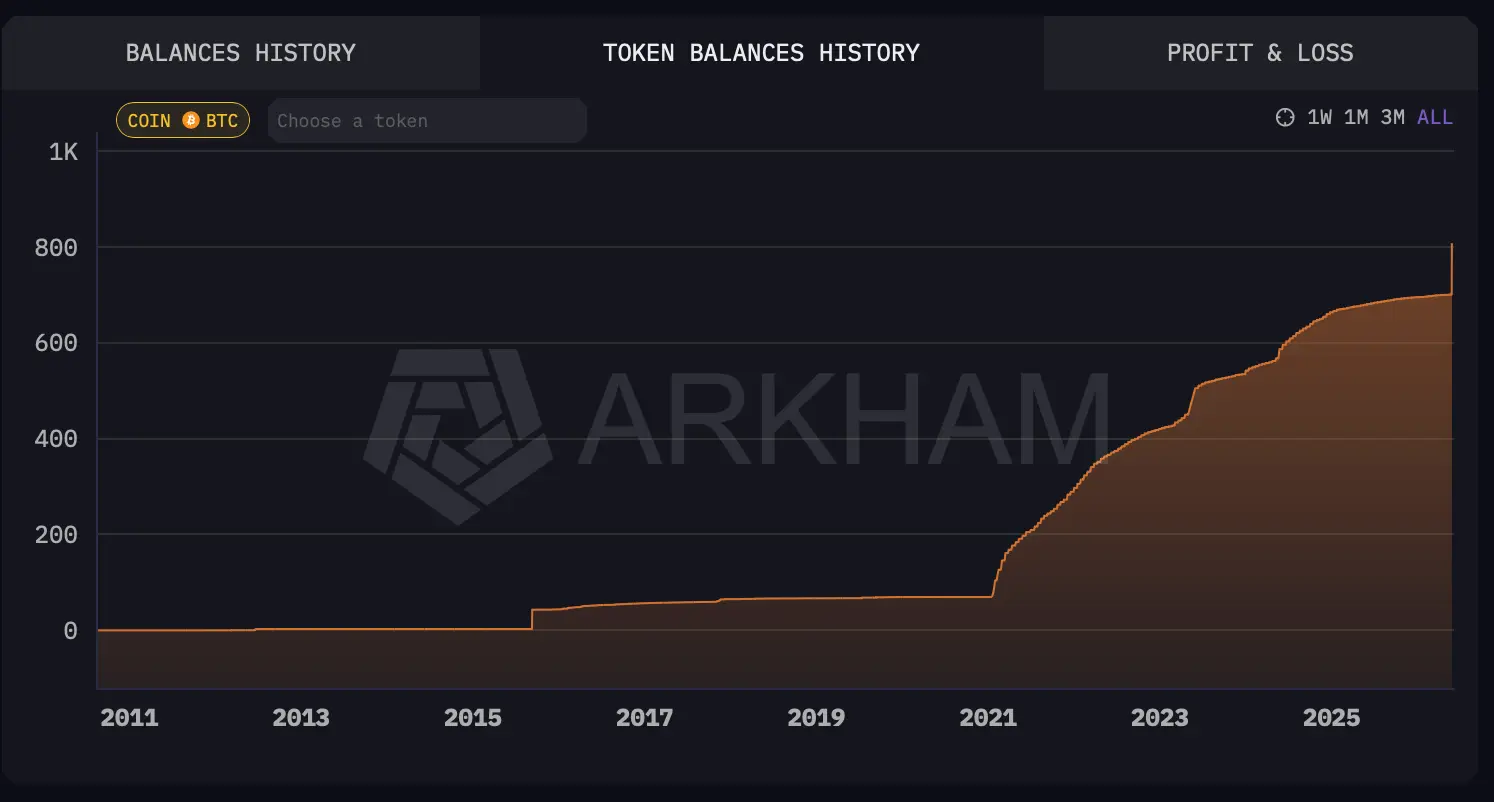 The wallet “1111111111111111111114oLvT2” balance history according to Arkham Intelligence’s explorer.
Because the Bitcoin network only requires a mathematically valid destination format to accept a transaction, anyone can send funds to such an address. Yet, since the probability of discovering the corresponding private key is effectively nonexistent, any bitcoin transferred there is permanently inaccessible and cannot be spent.
The wallet “1111111111111111111114oLvT2” balance history according to Arkham Intelligence’s explorer.
Because the Bitcoin network only requires a mathematically valid destination format to accept a transaction, anyone can send funds to such an address. Yet, since the probability of discovering the corresponding private key is effectively nonexistent, any bitcoin transferred there is permanently inaccessible and cannot be spent.
Counterparty Project Showcases a Historic Burn Address Example
A notable example came in January 2014 when the Counterparty project launched by asking participants to destroy bitcoin through transfers to the burn address 1CounterpartyXXXXXXXXXXXXXXXUFS6t. Over 20 days, users burned 2,131.11 BTC, now worth millions of dollars. In return, the protocol automatically distributed 2.6 million XCP tokens without an initial coin offering ( ICO) or founder allocation.
This particular burn address that received 107 BTC contains 21 consecutive ones followed by “14oLvT2” at the end of the wallet string. Oddly enough, the address now holds 807.238 BTC worth $62.15 million after accumulating 385,811 confirmed unspent transaction outputs ( UTXOs). Another curious detail is that the burn wallet was created on Aug. 10, 2010. Since then, it has never sent a single satoshi because doing so is impossible.
The wallet was largely dormant from 2010 through early 2014, maintaining a near-zero BTC balance. Around late 2014 to early 2015, however, the address began accumulating funds, climbing to roughly 30 to 40 BTC before gradually reaching approximately 50 to 60 BTC by 2016.
The balance remained fairly stable throughout 2017, 2018, and into 2019, hovering between 60 and 80 BTC with very little movement. That extended plateau continued through 2020 with only minor changes. The largest shift came between late 2020 and early 2021, when the balance jumped from roughly 80 BTC to about 150–175 BTC in what appears to have been a major transfer event.
Growth accelerated further through 2022 and 2023, with the wallet climbing from around 175 BTC to nearly 500 BTC by mid-2022 before reaching approximately 500–520 BTC by early 2023. Another sizable increase arrived around mid-2023, lifting the balance to roughly 600–650 BTC. Accumulation continued steadily through 2024, eventually approaching 700 BTC.
Pourquoi les gens ont brûlé autant de BTC reste inconnu, du moins pour l’instant
Le dernier transfert de 107 BTC signalé par Sani a porté le solde du portefeuille à son niveau actuel. Pour le moment, aucune explication n’a émergé quant à la raison pour laquelle un propriétaire de portefeuille non identifié détruirait volontairement plus de 8,2 millions de dollars de bitcoin. La transaction ne comporte aucune identité associée et ne montre aucun lien évident avec un lancement de protocole, un mécanisme de preuve-de-brûlage ou un projet connu, laissant la communauté crypto à spéculer.
Qu’il s’agisse d’un acte de protestation, d’une déclaration élaborée, d’une erreur catastrophique de l’utilisateur, ou de quelque chose d’autre encore, reste inconnu. Ce qui est certain, c’est que les 807 BTC détenus dans ce portefeuille ont tous disparu à jamais, absorbés par une adresse qui a consommé l’équivalent de dizaines de millions de dollars sur plus d’une décennie et ne libérera jamais un seul satoshi. La motivation derrière le burn, pour l’instant, reste aussi permanente que la perte elle-même.
Pourtant, le mystère pourrait finir par se dévoiler.


