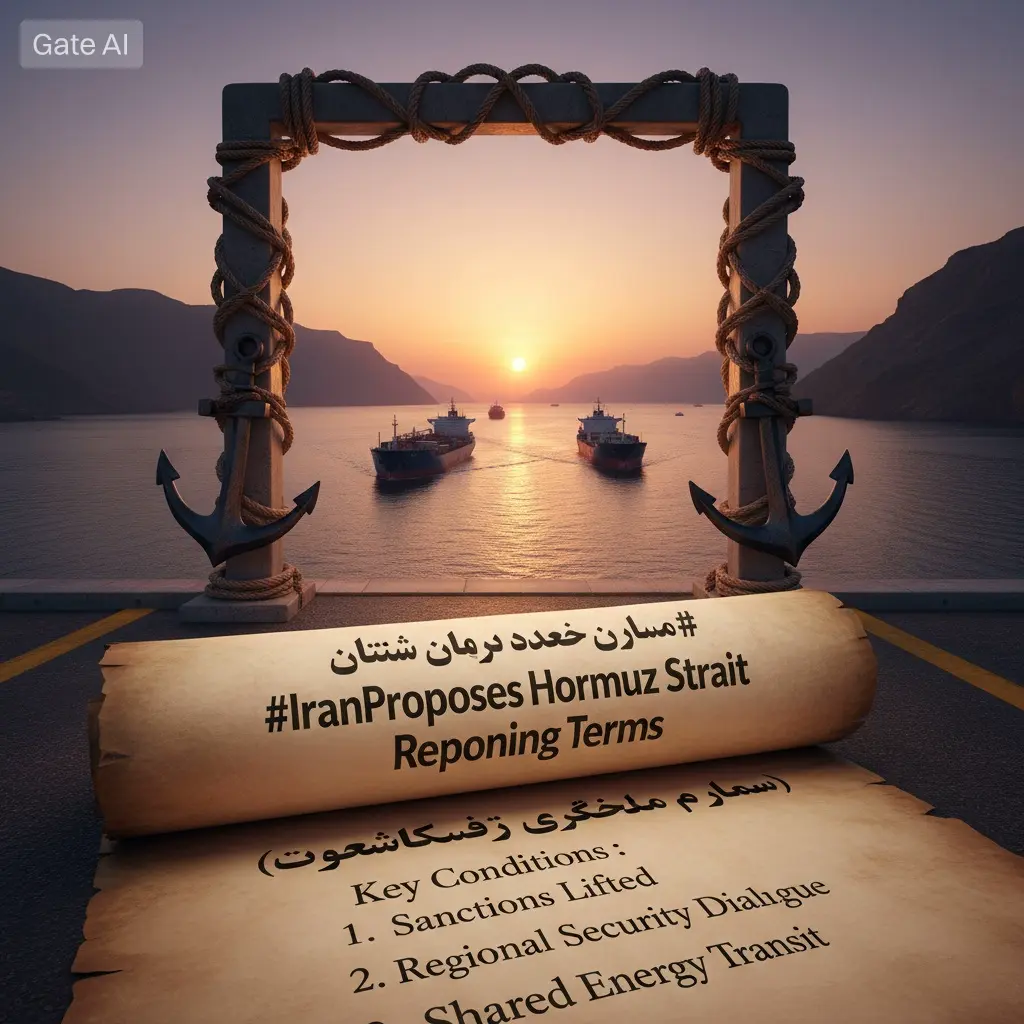





#IranProposesHormuzStraitReopeningTerms
Iran–Strait of Hormuz Crisis, US Negotiation Dynamics & Global Market Impact (Extended High-Level Update Analysis)
The geopolitical situation surrounding the Strait of Hormuz has entered one of its most delicate and strategically important phases in recent months. What was initially a direct military and naval standoff has now gradually shifted into a hybrid space of conditional diplomacy, mediated communication, and high-stakes economic pressure. Despite the appearance of negotiation progress, the underlying conflict structure remains unresolved, and the region continues to operate under a heightened risk premium that affects global energy flows, inflation expectations, and risk asset behavior.
1. Strategic Evolution: From Direct Confrontation to Conditional Diplomacy
Iran’s latest reported diplomatic communication reflects a notable strategic recalibration. Instead of maintaining a purely confrontational posture, Tehran has reportedly introduced a structured negotiation framework aimed at prioritizing immediate maritime de-escalation over broader geopolitical disputes.
This shift suggests three key strategic motivations:
(A) Economic Pressure Management
The sustained disruption risk in the Strait of Hormuz has created indirect pressure on Iran’s own trade ecosystem, shipping access, and regional economic stability. A partial reopening proposal indicates recognition that prolonged maritime instability can become economically self-damaging.
(B) Controlled De-escalation Strategy
Rather than fully withdrawing leverage, Iran appears to be attempting a phased negotiation model—where maritime access is used as a primary bargaining instrument, while nuclear and sanctions issues are delayed into secondary negotiation stages.
(C) Diplomatic Repositioning via Mediators
The involvement of third-party intermediaries (including regional diplomatic channels) signals an attempt to avoid direct bilateral breakdown and instead maintain indirect communication pathways that reduce immediate escalation risk.
However, Iran continues to maintain a critical strategic condition: any ceasefire or maritime adjustment does not represent full normalization, preserving optionality for future leverage.
2. United States Position: Strategic Hardline with Conditional Flexibility
The United States maintains a fundamentally security-driven stance focused on ensuring uninterrupted global maritime trade. The US position is shaped by three core priorities:
(A) Freedom of Navigation Doctrine
Washington continues to emphasize unconditional access through the Strait of Hormuz as a non-negotiable principle of international maritime law and global energy security.
(B) Military Deterrence Framework
The continued presence of US naval assets in the region is intended to function as a deterrent mechanism against any attempt to control or restrict shipping lanes.
(C) Conditional Diplomatic Engagement
While diplomatic channels remain open, the US position does not currently accept preconditions tied to sanctions relief or military repositioning as a prerequisite for reopening maritime routes.
This creates a structural negotiation gap: Iran seeks phased concessions, while the US demands immediate normalization.
3. The Core Sticking Point: Maritime Access vs Security Guarantees
At the center of the crisis lies a fundamental disagreement:
Iran views naval blockade conditions as economic coercion
The US views unrestricted shipping access as a global security requirement
Neither side is currently willing to fully concede its core position, which means that even if temporary agreements are reached, structural instability is likely to persist.
This explains why the situation remains in a “managed tension” phase rather than moving toward full resolution.
4. Energy Market Impact: Structural Risk Premium Persists
The Strait of Hormuz is responsible for a significant portion of global oil transit, meaning even partial disruption immediately translates into global price sensitivity.
Current Market Behavior:
Brent crude remains elevated near the psychologically sensitive $100 level
WTI continues to fluctuate within a volatile mid-$90s to $100 range
Shipping insurance costs remain elevated due to perceived geopolitical risk
Energy markets continue pricing in “probability of disruption,” not resolution
Even when diplomatic headlines appear optimistic, markets remain cautious because historical precedent shows that temporary agreements in this region often fail to stabilize long-term flow conditions.
5. Crypto Market Response: Structural Shift in Risk Asset Behavior
One of the most significant macro developments in this cycle is the way digital assets—particularly Bitcoin—have responded to geopolitical instability.
Traditionally, geopolitical crises drive capital into gold and US Treasuries. However, recent behavior suggests a more complex shift.
Key Observations:
(A) Bitcoin Strength During Macro Stress
Bitcoin has demonstrated resilience during the crisis period, maintaining upward structure despite volatility spikes in traditional markets.
(B) Relative Underperformance of Gold (Short-Term)
Gold initially surged on conflict escalation but later entered a consolidation phase, indicating profit-taking and rotation dynamics.
(C) Institutional Flow Influence
ETF-driven demand and institutional accumulation have created a structural bid beneath Bitcoin, reducing downside depth compared to previous cycles.
6. Bitcoin Market Structure: Technical and Macro Alignment
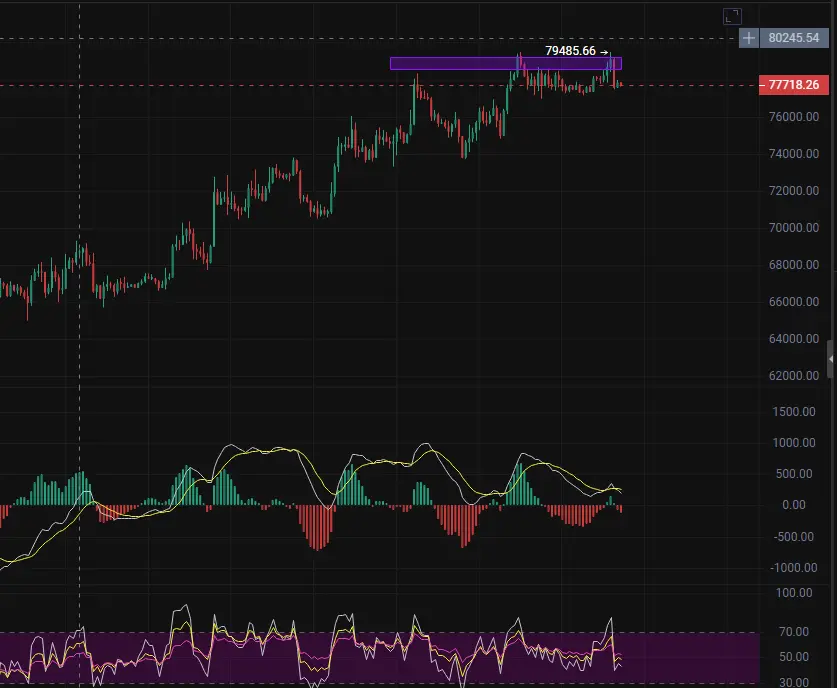
Bitcoin’s current price behavior reflects a compression phase between macro uncertainty and structural demand.
Key Technical Zones:
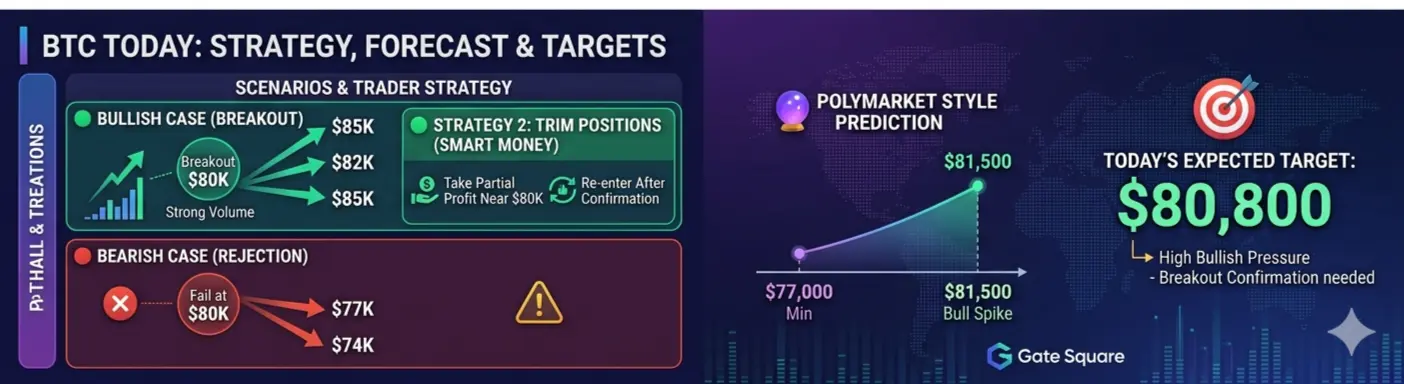
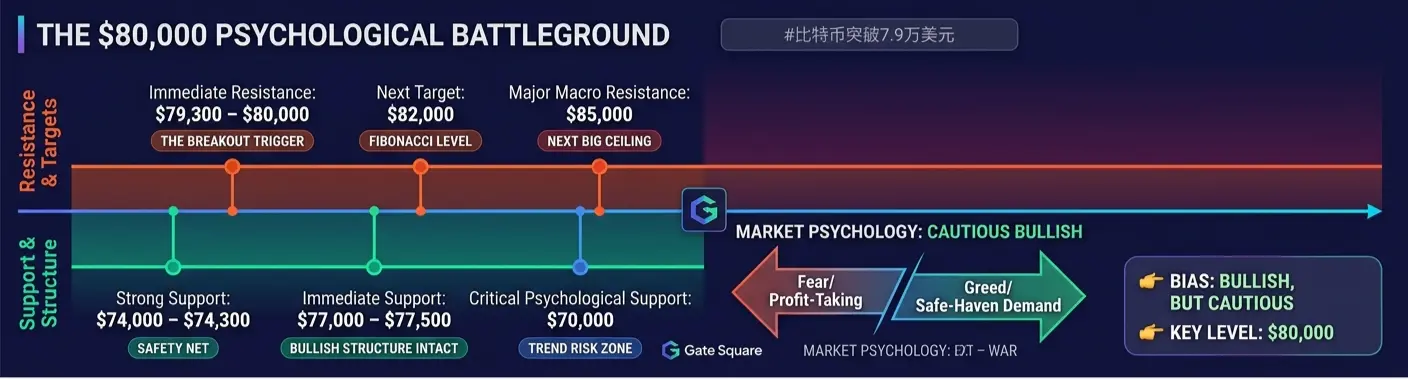
Strong support: $75,000 – $77,000
Mid resistance: $79,000 – $80,000
Breakout acceleration zone: above $80,000
Higher liquidity target region: $83,000 – $84,000
Market Interpretation:
Above resistance breakout would likely trigger momentum acceleration
Failure to break resistance could lead to liquidity re-accumulation phase
Volatility compression suggests imminent directional expansion
The market is essentially coiling under geopolitical uncertainty while waiting for macro confirmation.
7. Institutional Behavior: Silent Accumulation Phase
A critical underlying factor is institutional positioning.
Rather than reacting emotionally to headlines, large capital flows appear to be:
Accumulating Bitcoin on dips
Hedging macro uncertainty through diversified digital exposure
Maintaining exposure despite geopolitical volatility
Reducing reliance on traditional safe-haven assets alone
This suggests a longer-term structural belief that digital assets are becoming a parallel macro liquidity instrument rather than purely speculative risk assets.
8. Scenario Outlook: Three Possible Paths Forward
Scenario 1: Controlled De-escalation (Moderate Probability)
Partial reopening of maritime routes
Temporary stabilization of oil prices
Bitcoin continues upward trend with volatility
Scenario 2: Negotiation Breakdown (High Volatility Scenario)
Rapid escalation in naval tension
Oil spikes above current range
Crypto experiences sharp liquidation followed by recovery
Scenario 3: Extended Stalemate (Base Case)
No full agreement, but no full escalation
Markets remain range-bound
Gradual institutional accumulation continues
9. Risk Management Perspective for Traders
Given current conditions, the market is highly reactive to geopolitical headlines and liquidity shifts.
Conservative Approach:
Focus on accumulation zones rather than chasing breakouts
Maintain exposure control during headline volatility
Prioritize capital preservation over aggressive leverage
Momentum Approach:
Breakout confirmation above resistance levels
Tight risk management with volatility-based stops
Avoid overexposure during news-driven spikes
---
10. Macro Conclusion: A Multi-Layered Global Pressure System
This situation is no longer just a regional geopolitical conflict. It has evolved into a multi-layered global system affecting:
Energy security
Inflation expectations
Central bank policy sensitivity
Institutional capital allocation
Digital asset market structure
The key takeaway is that markets are not pricing certainty—they are pricing continuous uncertainty with shifting probabilities.
Bitcoin’s behavior, oil volatility, and gold consolidation together reflect a global system transitioning into a new phase where traditional safe-haven logic is no longer absolute, and capital is increasingly distributed across multiple competing hedging instruments.
Iran–Strait of Hormuz Crisis, US Negotiation Dynamics & Global Market Impact (Extended High-Level Update Analysis)
The geopolitical situation surrounding the Strait of Hormuz has entered one of its most delicate and strategically important phases in recent months. What was initially a direct military and naval standoff has now gradually shifted into a hybrid space of conditional diplomacy, mediated communication, and high-stakes economic pressure. Despite the appearance of negotiation progress, the underlying conflict structure remains unresolved, and the region continues to operate under a heightened risk premium that affects global energy flows, inflation expectations, and risk asset behavior.
1. Strategic Evolution: From Direct Confrontation to Conditional Diplomacy
Iran’s latest reported diplomatic communication reflects a notable strategic recalibration. Instead of maintaining a purely confrontational posture, Tehran has reportedly introduced a structured negotiation framework aimed at prioritizing immediate maritime de-escalation over broader geopolitical disputes.
This shift suggests three key strategic motivations:
(A) Economic Pressure Management
The sustained disruption risk in the Strait of Hormuz has created indirect pressure on Iran’s own trade ecosystem, shipping access, and regional economic stability. A partial reopening proposal indicates recognition that prolonged maritime instability can become economically self-damaging.
(B) Controlled De-escalation Strategy
Rather than fully withdrawing leverage, Iran appears to be attempting a phased negotiation model—where maritime access is used as a primary bargaining instrument, while nuclear and sanctions issues are delayed into secondary negotiation stages.
(C) Diplomatic Repositioning via Mediators
The involvement of third-party intermediaries (including regional diplomatic channels) signals an attempt to avoid direct bilateral breakdown and instead maintain indirect communication pathways that reduce immediate escalation risk.
However, Iran continues to maintain a critical strategic condition: any ceasefire or maritime adjustment does not represent full normalization, preserving optionality for future leverage.
2. United States Position: Strategic Hardline with Conditional Flexibility
The United States maintains a fundamentally security-driven stance focused on ensuring uninterrupted global maritime trade. The US position is shaped by three core priorities:
(A) Freedom of Navigation Doctrine
Washington continues to emphasize unconditional access through the Strait of Hormuz as a non-negotiable principle of international maritime law and global energy security.
(B) Military Deterrence Framework
The continued presence of US naval assets in the region is intended to function as a deterrent mechanism against any attempt to control or restrict shipping lanes.
(C) Conditional Diplomatic Engagement
While diplomatic channels remain open, the US position does not currently accept preconditions tied to sanctions relief or military repositioning as a prerequisite for reopening maritime routes.
This creates a structural negotiation gap: Iran seeks phased concessions, while the US demands immediate normalization.
3. The Core Sticking Point: Maritime Access vs Security Guarantees
At the center of the crisis lies a fundamental disagreement:
Iran views naval blockade conditions as economic coercion
The US views unrestricted shipping access as a global security requirement
Neither side is currently willing to fully concede its core position, which means that even if temporary agreements are reached, structural instability is likely to persist.
This explains why the situation remains in a “managed tension” phase rather than moving toward full resolution.
4. Energy Market Impact: Structural Risk Premium Persists
The Strait of Hormuz is responsible for a significant portion of global oil transit, meaning even partial disruption immediately translates into global price sensitivity.
Current Market Behavior:
Brent crude remains elevated near the psychologically sensitive $100 level
WTI continues to fluctuate within a volatile mid-$90s to $100 range
Shipping insurance costs remain elevated due to perceived geopolitical risk
Energy markets continue pricing in “probability of disruption,” not resolution
Even when diplomatic headlines appear optimistic, markets remain cautious because historical precedent shows that temporary agreements in this region often fail to stabilize long-term flow conditions.
5. Crypto Market Response: Structural Shift in Risk Asset Behavior
One of the most significant macro developments in this cycle is the way digital assets—particularly Bitcoin—have responded to geopolitical instability.
Traditionally, geopolitical crises drive capital into gold and US Treasuries. However, recent behavior suggests a more complex shift.
Key Observations:
(A) Bitcoin Strength During Macro Stress
Bitcoin has demonstrated resilience during the crisis period, maintaining upward structure despite volatility spikes in traditional markets.
(B) Relative Underperformance of Gold (Short-Term)
Gold initially surged on conflict escalation but later entered a consolidation phase, indicating profit-taking and rotation dynamics.
(C) Institutional Flow Influence
ETF-driven demand and institutional accumulation have created a structural bid beneath Bitcoin, reducing downside depth compared to previous cycles.
6. Bitcoin Market Structure: Technical and Macro Alignment
Bitcoin’s current price behavior reflects a compression phase between macro uncertainty and structural demand.
Key Technical Zones:
Strong support: $75,000 – $77,000
Mid resistance: $79,000 – $80,000
Breakout acceleration zone: above $80,000
Higher liquidity target region: $83,000 – $84,000
Market Interpretation:
Above resistance breakout would likely trigger momentum acceleration
Failure to break resistance could lead to liquidity re-accumulation phase
Volatility compression suggests imminent directional expansion
The market is essentially coiling under geopolitical uncertainty while waiting for macro confirmation.
7. Institutional Behavior: Silent Accumulation Phase
A critical underlying factor is institutional positioning.
Rather than reacting emotionally to headlines, large capital flows appear to be:
Accumulating Bitcoin on dips
Hedging macro uncertainty through diversified digital exposure
Maintaining exposure despite geopolitical volatility
Reducing reliance on traditional safe-haven assets alone
This suggests a longer-term structural belief that digital assets are becoming a parallel macro liquidity instrument rather than purely speculative risk assets.
8. Scenario Outlook: Three Possible Paths Forward
Scenario 1: Controlled De-escalation (Moderate Probability)
Partial reopening of maritime routes
Temporary stabilization of oil prices
Bitcoin continues upward trend with volatility
Scenario 2: Negotiation Breakdown (High Volatility Scenario)
Rapid escalation in naval tension
Oil spikes above current range
Crypto experiences sharp liquidation followed by recovery
Scenario 3: Extended Stalemate (Base Case)
No full agreement, but no full escalation
Markets remain range-bound
Gradual institutional accumulation continues
9. Risk Management Perspective for Traders
Given current conditions, the market is highly reactive to geopolitical headlines and liquidity shifts.
Conservative Approach:
Focus on accumulation zones rather than chasing breakouts
Maintain exposure control during headline volatility
Prioritize capital preservation over aggressive leverage
Momentum Approach:
Breakout confirmation above resistance levels
Tight risk management with volatility-based stops
Avoid overexposure during news-driven spikes
---
10. Macro Conclusion: A Multi-Layered Global Pressure System
This situation is no longer just a regional geopolitical conflict. It has evolved into a multi-layered global system affecting:
Energy security
Inflation expectations
Central bank policy sensitivity
Institutional capital allocation
Digital asset market structure
The key takeaway is that markets are not pricing certainty—they are pricing continuous uncertainty with shifting probabilities.
Bitcoin’s behavior, oil volatility, and gold consolidation together reflect a global system transitioning into a new phase where traditional safe-haven logic is no longer absolute, and capital is increasingly distributed across multiple competing hedging instruments.