# StablecoinDebateHeatsUp

7M
#TetherEyes$500BFundraising
The crypto market is now watching one of the most ambitious capital moves in its history as Tether positions itself for a fundraising round targeting a staggering $500 billion valuation. This is not just another funding story. This is a moment that could redefine how the market values stablecoin infrastructure, liquidity providers, and the financial backbone of the entire digital asset ecosystem. If successful, this would place Tether among the largest financial entities in the world, rivaling or even surpassing most traditional banking giants in terms of implied v
BTC0,29%
Mr_Thynkvip
#TetherEyes$500BFundraising
The crypto market is now watching one of the most ambitious capital moves in its history as Tether positions itself for a fundraising round targeting a staggering $500 billion valuation. This is not just another funding story. This is a moment that could redefine how the market values stablecoin infrastructure, liquidity providers, and the financial backbone of the entire digital asset ecosystem. If successful, this would place Tether among the largest financial entities in the world, rivaling or even surpassing most traditional banking giants in terms of implied valuation.
At the center of this narrative is a simple reality: Tether is not just a stablecoin issuer anymore. It is the single most dominant liquidity layer in crypto. USDT remains the most widely used stablecoin globally, with a circulating supply exceeding $180 billion, acting as the primary bridge between fiat and crypto markets. Every major exchange, trading pair, and DeFi ecosystem relies on Tether liquidity at some level. This gives the company a unique position — it is not competing within the system, it is embedded into the system itself.
The reported fundraising structure highlights the scale of ambition. Earlier discussions suggested raising between $15 billion and $20 billion through private placements, potentially selling only a small percentage of the company to justify the $500 billion valuation. More recent developments indicate that Tether is pushing investors to commit within a tight timeline, signaling that the deal has entered a critical phase. This creates a high-pressure environment where institutional confidence will ultimately determine whether the valuation holds or the deal gets delayed.
And that is where the real tension lies. Investor interest is strong — but not unconditional. The $500 billion valuation has raised concerns across the market, especially when compared to traditional financial institutions. At that level, Tether would be worth more than nearly every major U.S. bank except the very largest, which immediately forces investors to ask a fundamental question: is Tether being valued on current fundamentals, or future dominance?
The answer is clearly the latter. Tether’s valuation narrative is built on expansion beyond stablecoins. The company has been aggressively diversifying its balance sheet and operations, investing in U.S. Treasuries, Bitcoin, gold, and emerging technology sectors. It has also moved into areas like mining, payments infrastructure, and AI-linked investments. This transforms Tether from a single-product company into a multi-layer financial platform. Markets are not just pricing USDT — they are pricing an evolving digital financial ecosystem.
However, this expansion also introduces risk — and the market is aware of it. Transparency has been a consistent concern in Tether’s history, with investors pushing for clearer visibility into the composition of its reserves and balance sheet. Reports indicate that Tether has been taking steps toward stronger auditing and disclosure practices, signaling that it understands the importance of institutional trust at this scale. But until full transparency is achieved, some hesitation will remain part of investor behavior.
Another key factor shaping this fundraising attempt is competition. The stablecoin market is no longer uncontested. USDC and other emerging digital dollar solutions are expanding aggressively, backed by traditional financial institutions and regulatory alignment. This means Tether is no longer just defending market share — it is defending its position as the default liquidity layer of crypto. The $500 billion raise, in this context, becomes both a growth strategy and a defensive move to maintain dominance.
Timing also plays a crucial role. The fundraising push is happening in a macro environment that remains uncertain. Interest rates, global liquidity conditions, and regulatory developments are all influencing investor appetite. In a high-liquidity environment, a $500 billion valuation might be absorbed more easily. In a tighter environment, investors become more selective, forcing companies to justify every premium. This is why there are indications that if demand does not meet expectations, Tether may delay the raise rather than compromise on valuation.
What makes this situation even more significant is what it represents for the broader crypto market. If Tether successfully secures funding at or near a $500 billion valuation, it would send a powerful signal that crypto infrastructure companies can command valuations on par with the largest institutions in traditional finance. It would validate the idea that stablecoins are not just tools — they are foundational financial rails for the digital economy. On the other hand, if the deal struggles or gets delayed, it could signal that the market is not yet ready to assign such massive valuations without deeper transparency and regulatory clarity.
For traders and market participants, this is not just a corporate finance story — it is a liquidity story. Tether sits at the core of crypto trading activity. Any major shift in its structure, funding, or strategy has ripple effects across exchanges, DeFi protocols, and market stability itself. Confidence in Tether directly translates into confidence in market liquidity. That is why this fundraising event is being watched so closely — not just by investors, but by the entire ecosystem.
There is also a psychological layer to this narrative. A $500 billion valuation changes perception. It moves Tether from being a crypto company to being a global financial power. That shift matters because markets are driven as much by perception as by fundamentals. Once an entity is seen as systemically important, capital flows toward it differently. Partnerships expand. Influence grows. And its role in shaping market direction becomes significantly stronger.
At its core, this entire development highlights a broader transformation happening in finance. Stablecoins are evolving from simple dollar-pegged tokens into full-scale financial infrastructure layers. They facilitate trading, enable cross-border payments, provide liquidity, and increasingly integrate with traditional financial systems. Tether happens to be the largest player in this space, which is why its valuation ambitions are so aggressive — and so closely watched.
The final outcome of this fundraising attempt will depend on one thing: belief. Not just belief in Tether as a company, but belief in the future of stablecoins as a dominant financial layer. If institutions buy into that vision, $500 billion may not seem extreme — it may seem early. If they don’t, the market will force a recalibration.
Either way, this is a defining moment. Because what is being tested right now is not just Tether’s valuation — it is the market’s willingness to price the future of digital finance at a scale that rivals the traditional system itself.
#Stablecoins #CryptoMarkets #GateSquareAprilPostingChallenge #CreatorLeaderboard

repost-content-media
  • Reward
  • Comment
  • Repost
  • Share
#StablecoinDebateHeatsUp
The debate around stablecoins is intensifying as regulators, investors, and crypto innovators clash over their future role in the global financial system. Stablecoins—digital assets pegged to fiat currencies like the US dollar—have become a cornerstone of the crypto ecosystem. However, their rapid growth has raised serious questions about regulation, transparency, and systemic risk.
Below is a structured breakdown of the key points driving the heated discussion:
🔹 1. What Are Stablecoins & Why They Matter
Stablecoins are designed to maintain a stable value by being b
USDC0,01%
DAI-0,03%
DEFI2,71%
post-image
post-image
  • Reward
  • 1
  • Repost
  • Share
HighAmbitionvip:
2026 GOGOGO 👊
#StablecoinDebateHeatsUp
THE STABLECOIN MARKET IS QUIETLY UNDERGOING A STRUCTURAL RESET THAT MOST TRADERS ARE NOT PREPARED FOR
The majority of participants still treat stablecoins as neutral tools, simple dollar equivalents used for trading, liquidity, and storage. That assumption is becoming increasingly dangerous. What is happening now is not a surface-level regulatory adjustment. It is a foundational redesign of how stablecoins operate, who controls them, and how liquidity flows through the crypto ecosystem.
At present, the stablecoin market exceeds $300 billion in total capitalization. Tw
post-image
post-image
post-image
  • Reward
  • 8
  • Repost
  • Share
MasterChuTheOldDemonMasterChuvip:
Chong Chong GT 🚀
View More
#StablecoinDebateHeatsUp
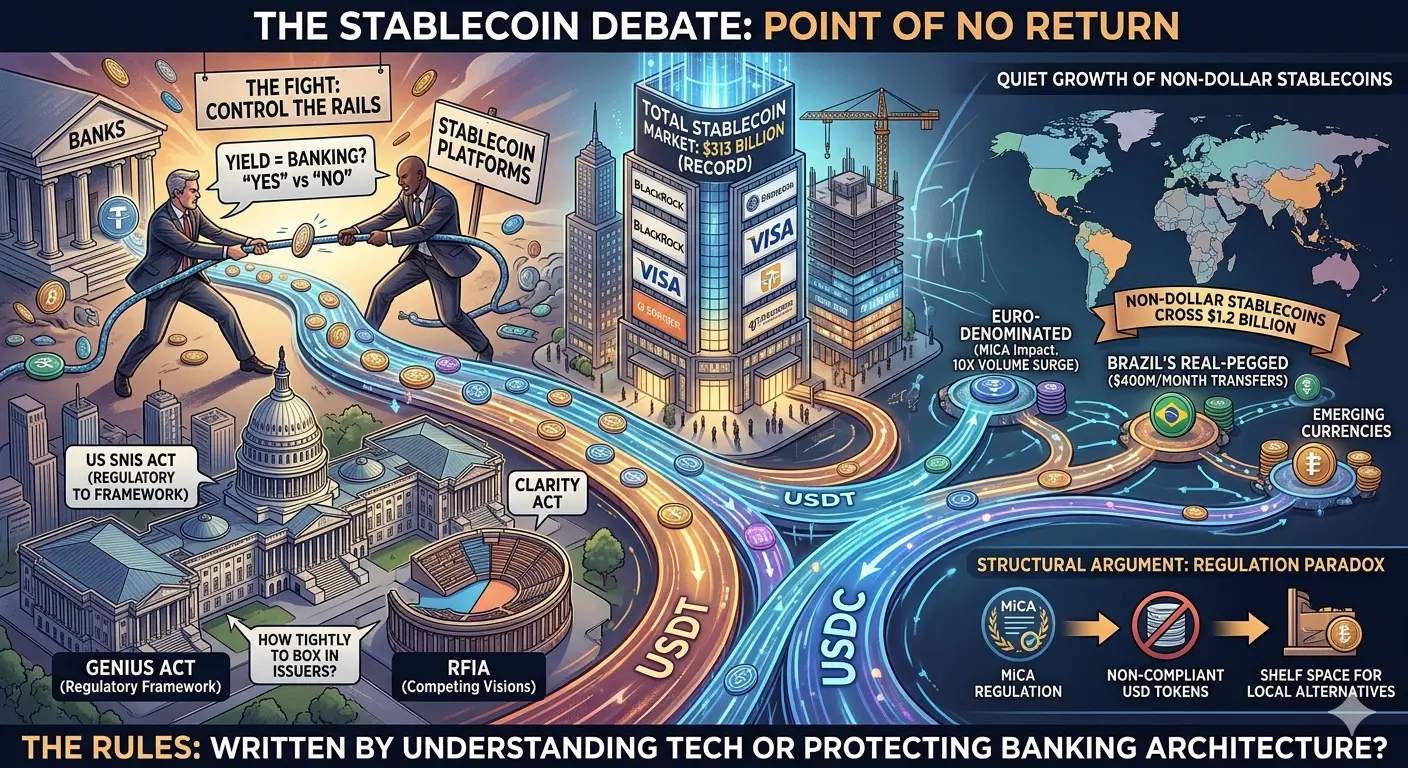
The stablecoin debate has quietly crossed a point of no return. The total stablecoin market just hit a record $313 billion, and every major financial institution from BlackRock to Visa is now racing to stake a claim — which tells you more about where this is going than any policy paper ever could.
But the real fight is not about whether stablecoins are useful. Everyone agrees they are. The fight is about who controls the rails, who holds the reserves, and whether paying yield on stablecoin deposits makes you a bank whether you call yourself one or not.
The GENIUS Act
USDC0,01%
post-image
  • Reward
  • 1
  • Repost
  • Share
Luna_Starvip:
To The Moon 🌕
#TetherEyes$500BFundraising
The crypto market is now watching one of the most ambitious capital moves in its history as Tether positions itself for a fundraising round targeting a staggering $500 billion valuation. This is not just another funding story. This is a moment that could redefine how the market values stablecoin infrastructure, liquidity providers, and the financial backbone of the entire digital asset ecosystem. If successful, this would place Tether among the largest financial entities in the world, rivaling or even surpassing most traditional banking giants in terms of implied v
BTC0,29%
USDC0,01%
post-image
post-image
post-image
  • Reward
  • 5
  • Repost
  • Share
Luna_Starvip:
1000x VIbes 🤑
View More
#StablecoinDebateHeatsUp
The $315 billion stablecoin market is no longer a "crypto-native" sandbox; it’s the new frontline for global financial sovereignty. While the passing of the GENIUS Act provided a skeleton for regulation, the current gridlock over the "Clarity Act" in the Senate proves that Washington is terrified of one specific thing: yield.
The core of the "Stablecoin Debate" in April 2026 isn't just about reserve transparency—it's about whether a stablecoin is a payment tool or a high-yield bank account. Circle’s USDC is aggressively capturing the institutional "compliance" narrati
USDC0,01%
BTC0,29%
post-image
  • Reward
  • 6
  • Repost
  • Share
HighAmbitionvip:
坚定HODL💎
View More
#StablecoinDebateHeatsUp
THE STABLECOIN MARKET IS QUIETLY UNDERGOING A STRUCTURAL RESET THAT MOST TRADERS ARE NOT PREPARED FOR
The majority of participants still treat stablecoins as neutral tools, simple dollar equivalents used for trading, liquidity, and storage. That assumption is becoming increasingly dangerous. What is happening now is not a surface-level regulatory adjustment. It is a foundational redesign of how stablecoins operate, who controls them, and how liquidity flows through the crypto ecosystem.
At present, the stablecoin market exceeds $300 billion in total capitalization. Tw
post-image
dragon_fly2vip
#StablecoinDebateHeatsUp
THE STABLECOIN MARKET IS QUIETLY UNDERGOING A STRUCTURAL RESET THAT MOST TRADERS ARE NOT PREPARED FOR
The majority of participants still treat stablecoins as neutral tools, simple dollar equivalents used for trading, liquidity, and storage. That assumption is becoming increasingly dangerous. What is happening now is not a surface-level regulatory adjustment. It is a foundational redesign of how stablecoins operate, who controls them, and how liquidity flows through the crypto ecosystem.
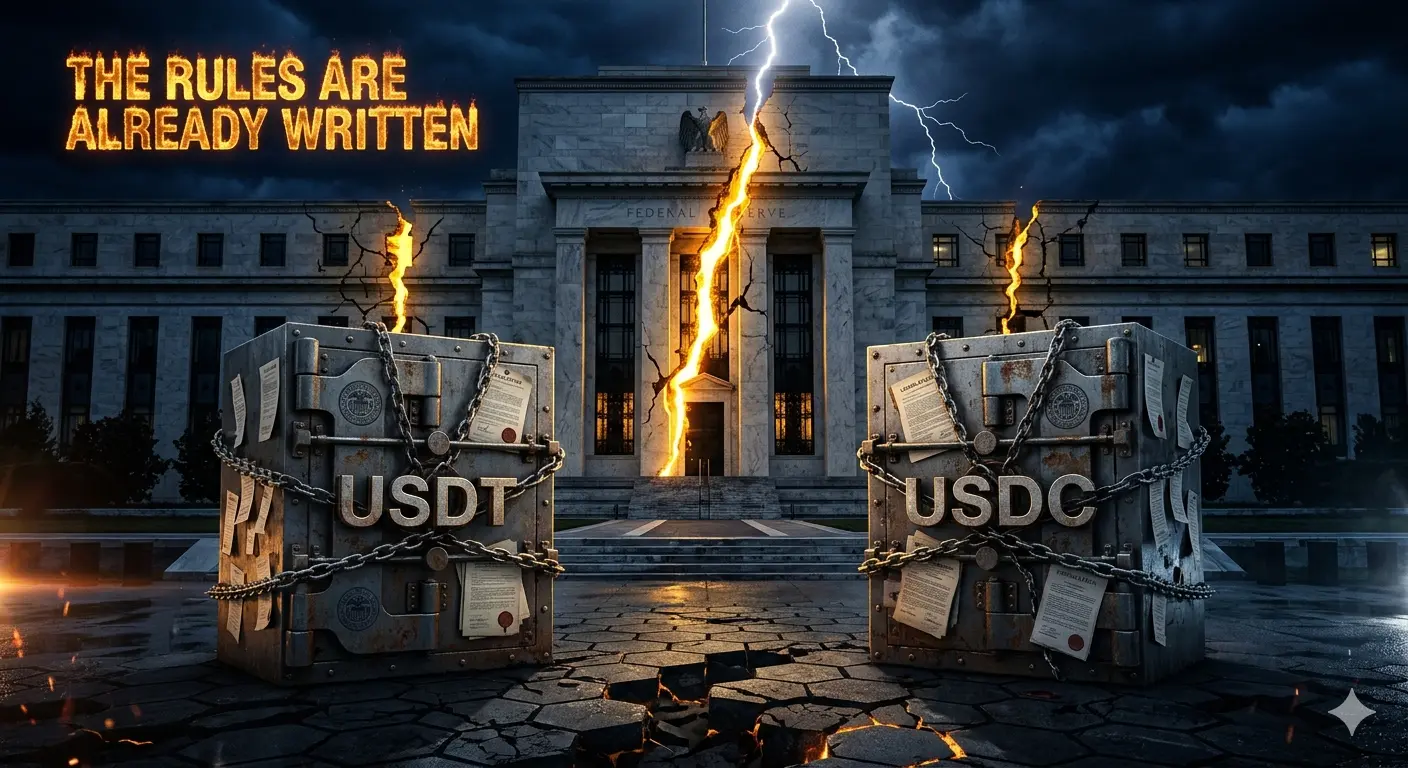
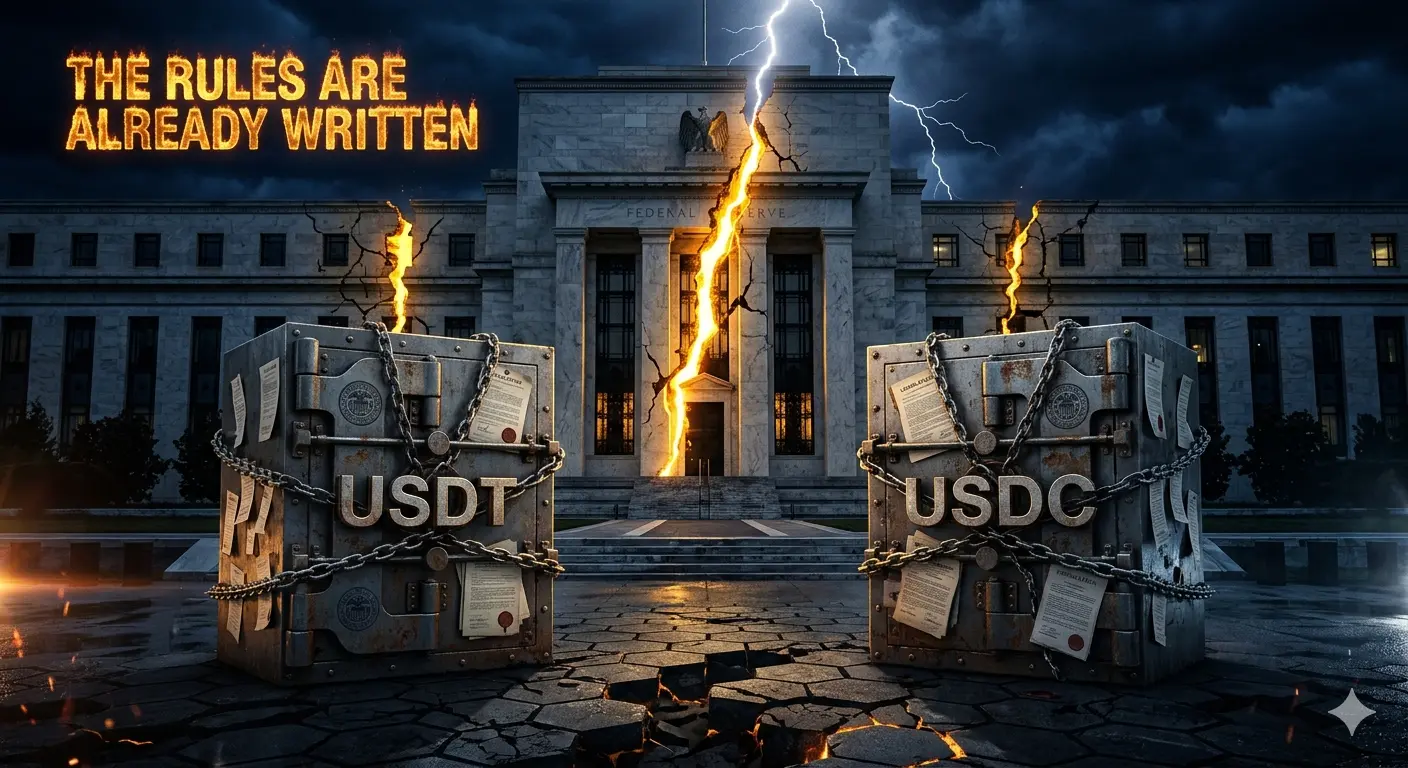
At present, the stablecoin market exceeds $300 billion in total capitalization. Two issuers dominate the entire system. USDT holds the majority share, acting as the primary liquidity engine across global exchanges, particularly in offshore environments. USDC operates as the institutional bridge, deeply integrated with regulated financial infrastructure and increasingly aligned with traditional banking systems. Together, they form the backbone of nearly every trading pair, derivatives position, and DeFi strategy currently active in the market.
This concentration of power is precisely why regulatory focus has intensified. Governments are no longer observing stablecoins as an external innovation. They are now actively integrating them into national financial strategy. The result is a new framework that is not designed to restrict growth, but to control and standardize it under enforceable rules.
The new legal direction introduces strict reserve requirements. Stablecoins must now maintain full backing with highly liquid, low-risk assets such as short-term government securities and cash equivalents. This eliminates the possibility of riskier reserve compositions that previously allowed issuers to enhance profitability through corporate debt or other yield-generating instruments. At the same time, rehypothecation is being restricted, meaning reserve assets cannot be reused as collateral for additional leverage. This effectively removes hidden layers of systemic risk that existed beneath the surface of stablecoin operations.
Transparency requirements are also being elevated to a level that fundamentally changes the industry. Regular public disclosures, standardized reporting formats, and audited financial statements are becoming mandatory for large issuers. The era of selective transparency and loosely verified reserve attestations is ending. Stablecoin issuers are transitioning into entities that resemble regulated financial institutions rather than flexible crypto-native organizations.
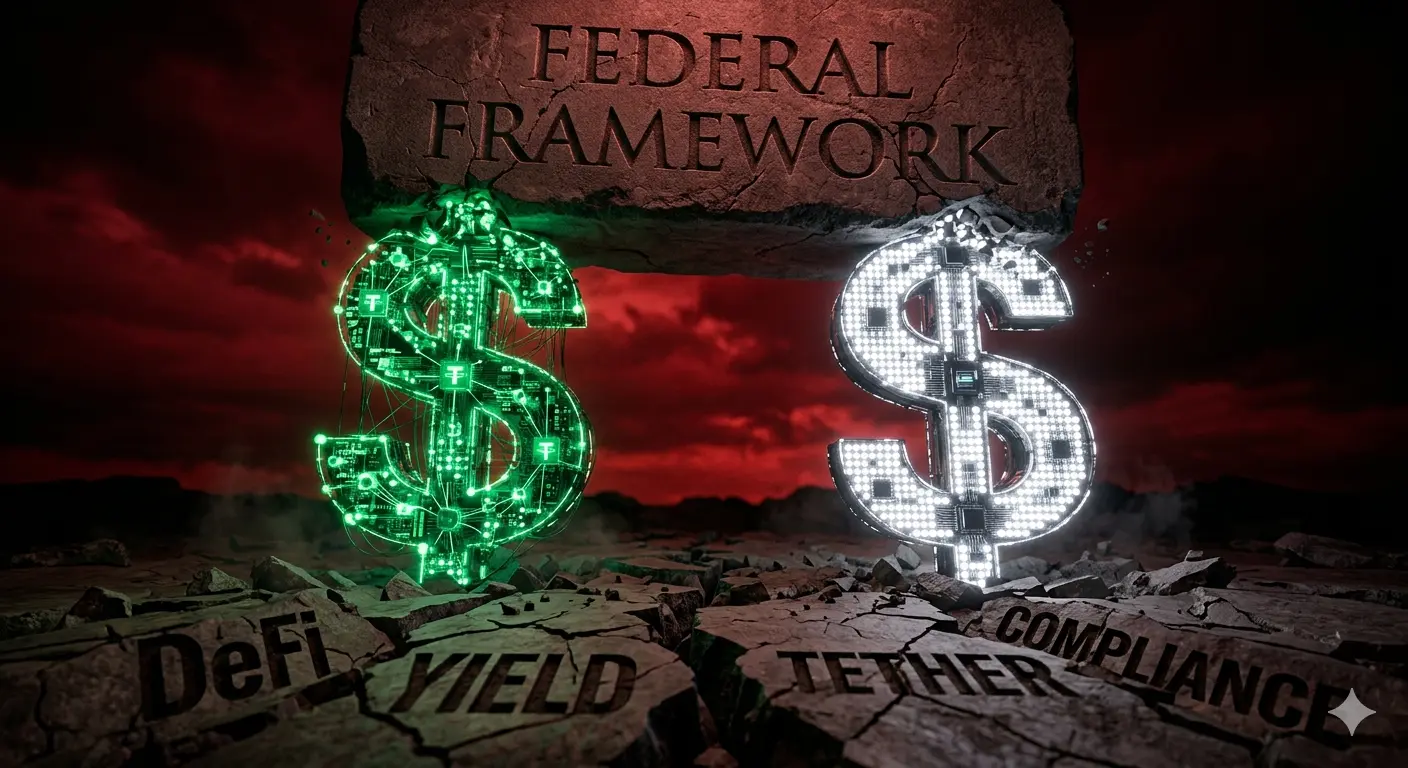
One of the most critical elements of this shift is the restriction on yield distribution. Stablecoin holders will not be able to receive interest simply for holding a dollar-pegged asset. This is a direct attempt to prevent stablecoins from functioning as unregulated deposit substitutes that compete with traditional banks. While this rule appears narrow, its implications are far-reaching. A significant portion of DeFi yield structures indirectly depend on stablecoin reserve dynamics. As these constraints tighten, the flow of yield across the ecosystem will inevitably change.
For traders, this introduces a new layer of complexity. Yield is no longer a uniform concept. It must now be analyzed based on its source. Returns generated from protocol activity, such as lending or trading fees, remain structurally different from returns linked to underlying reserve interest. The latter is where regulatory pressure is being applied, and it is likely to be repriced as frameworks become fully enforced.
The most immediate pressure point lies with USDT. Its dominance is undeniable, but its regulatory positioning is less clear. Operating outside direct U.S. jurisdiction, it faces a structural challenge if it intends to maintain access to regulated markets. Compliance would require significant operational transformation, including alignment with strict reserve rules, enhanced transparency, and integration into a regulatory system that it has historically operated independently from. If this transition does not occur in a defined timeframe, access restrictions could emerge, particularly on platforms that interact with regulated financial institutions.
USDC, on the other hand, is structurally aligned with the direction regulation is moving toward. Its reserves are already composed of cash and short-term government instruments, and its reporting standards exceed many of the upcoming requirements. However, this does not make it risk-free. Its business model includes revenue-sharing mechanisms with distribution partners, which may come under scrutiny depending on how regulators interpret indirect yield flows. This creates a different type of uncertainty, one rooted not in compliance failure but in regulatory interpretation.
Beyond individual issuers, the broader market impact is a gradual but inevitable bifurcation of liquidity. On one side, regulated capital will concentrate around compliant stablecoins, integrated with banks, custodians, and institutional-grade infrastructure. This environment will prioritize stability, transparency, and legal clarity, but may offer reduced yield potential and stricter operational constraints. On the other side, permissionless capital will continue to operate in less regulated environments, maintaining flexibility and higher yield opportunities, but carrying increased counterparty and regulatory risk.
This division is not theoretical. It represents a structural evolution of the market. Traders will need to decide where their capital operates and understand the trade-offs involved. The assumption that all stablecoin liquidity is interchangeable will no longer hold under these conditions.
Another critical aspect often overlooked is the geopolitical dimension of this transformation. Stablecoins are becoming instruments of monetary influence. By requiring reserves to be held in government-backed securities, regulatory frameworks effectively tie stablecoin growth to national debt markets. As adoption increases, so does demand for these underlying instruments, reinforcing the position of the issuing country’s currency in global financial systems. This is not just about crypto regulation. It is about extending monetary reach through digital infrastructure.
From a trading perspective, this environment creates both risk and opportunity. Monitoring stablecoin dominance, liquidity distribution, and exchange support becomes as important as tracking price action. Deviations between stablecoin pegs, even minor ones, may begin to reflect deeper structural shifts rather than temporary inefficiencies. These movements can evolve into tradeable signals for those who understand their underlying causes.
Preparation is not optional. Traders should conduct a full assessment of their stablecoin exposure, identifying which assets they rely on and the regulatory trajectory of each issuer. Yield sources should be analyzed and categorized based on their sustainability under the emerging framework. Market developments, particularly those related to institutional adoption and regulatory clarification, should be treated as leading indicators of future liquidity flows.
The timeline for these changes is not indefinite. Implementation phases are already in motion, and enforcement mechanisms are being defined. As clarity increases, market behavior will adjust rapidly. Liquidity does not wait for consensus. It moves where conditions are most favorable, often before the majority recognizes the shift.
The key takeaway is simple but critical. Stablecoins are no longer passive instruments within the crypto ecosystem. They are becoming controlled financial infrastructure with direct connections to global monetary systems. Ignoring this transition is equivalent to trading without understanding the underlying market structure.
The next phase of crypto will not be defined solely by innovation at the application layer. It will be shaped by the infrastructure that supports value transfer, liquidity distribution, and institutional participation. Stablecoins sit at the center of that infrastructure, and their transformation will influence every segment of the market.
Traders who recognize this early will position themselves ahead of structural change. Those who do not will experience it only after its effects are reflected in price, liquidity, and access.
The market is not waiting. It is already adapting.
#Stablecoins #GateSquareAprilPostingChallenge #CreatorLeaderboard
repost-content-media
  • Reward
  • Comment
  • Repost
  • Share
#StablecoinDebateHeatsUp
The global debate around stablecoins has entered a new phase as of 2026. The question is no longer whether these assets will exist, but how they will be regulated, who will control them, and what role they will play in the global financial system. Recent developments clearly show that stablecoins are no longer confined to crypto markets they are becoming a core component of the broader financial architecture.
Stablecoins Go Mainstream
Recent data indicates that annual stablecoin transaction volumes have reached tens of trillions of dollars, surpassing traditional pay
  • Reward
  • Comment
  • Repost
  • Share
#StablecoinDebateHeatsUp 🚨
The conversation around stablecoins is intensifying as regulators, investors, and crypto platforms carefully weigh their risks and benefits. With adoption growing rapidly, questions about backing, transparency, and systemic impact are now at the forefront.
Key Points Driving the Debate:
1️⃣ Regulatory Scrutiny
Governments around the world are pushing for stricter oversight. The goal: ensure that stablecoins are fully backed by real assets and reduce the risk of market disruptions or sudden crashes. Regulators are also considering reporting standards, auditing requir
USDC0,01%
DEFI2,71%
DragonFlyOfficialvip
#StablecoinDebateHeatsUp
The conversation around stablecoins is intensifying as regulators, investors, and crypto platforms weigh their risks and benefits. With growing adoption, questions about backing, transparency, and systemic impact are under the spotlight.
Key Points Driving the Debate:
Regulatory Scrutiny: Governments are pushing for stricter oversight to ensure stablecoins are fully backed and prevent market disruptions.
Market Confidence: Investors demand assurance that stablecoins maintain their peg even in volatile markets.
Innovation vs Risk: While stablecoins drive DeFi and cross-border payments, unbacked or poorly managed coins can amplify financial risks.
Competition Among Coins: USDT, USDC, and newer entrants are vying for trust and market share, fueling discussion about standards and governance.
⚖️ The stablecoin landscape is evolving rapidly — keeping tabs on regulation, market confidence, and coin transparency is crucial for traders and investors.
repost-content-media
  • Reward
  • 1
  • Repost
  • Share
Luna_Starvip:
2026 GOGOGO 👊
#StablecoinDebateHeatsUp
...The Stablecoin Debate: What's Heating Up, Why It Matters, and Where the Crypto Market Goes from Here
---
...Parts 1 — What Is the Stablecoin Debate, Actually?
Stablecoins are cryptocurrencies pegged 1:1 to a real-world asset — almost always the US Dollar. Think USDT (Tether), USDC (Circle), and now even bank-issued tokenized deposits. They do not swing wildly in price. They are the "calm water" inside the stormy crypto ocean.
So what is the debate about?
Simple: **Who controls them. Who audits them. Who profits from them. And who gets hurt when they break.**
The ha
HighAmbitionvip
#StablecoinDebateHeatsUp
...The Stablecoin Debate: What's Heating Up, Why It Matters, and Where the Crypto Market Goes from Here
---
...Parts 1 — What Is the Stablecoin Debate, Actually?
Stablecoins are cryptocurrencies pegged 1:1 to a real-world asset — almost always the US Dollar. Think USDT (Tether), USDC (Circle), and now even bank-issued tokenized deposits. They do not swing wildly in price. They are the "calm water" inside the stormy crypto ocean.
So what is the debate about?
Simple: **Who controls them. Who audits them. Who profits from them. And who gets hurt when they break.**
The hashtag #StablecoinDebateHeatsUp captures a global regulatory and ideological war that has been building for years — and in 2025-2026, it finally boiled over.
---
...Parts 2 — The GENIUS Act: The First Major Crypto Law in US History
In 2025, the US House of Representatives passed the **GENIUS Act** (Guiding and Establishing National Innovation for US Stablecoins) with a 308-122 vote — a bipartisan landslide. This is the **first major federal crypto legislation ever passed** in the United States.
**What the GENIUS Act does:**
- Every stablecoin issuer must hold **1:1 reserves** — dollar for dollar, no fractional nonsense.
- Reserves must be held in: US dollars, Federal Reserve notes, short-term US Treasuries, or regulated bank accounts.
- Only **OCC-licensed depository institutions** can issue stablecoins from 2027 onward.
- **Foreign stablecoin issuers** (like Tether, technically based in the British Virgin Islands) must register with the OCC and hold US-based reserves — or they cannot operate in America.
- **Stablecoin yield is banned.** You cannot earn interest just for holding a stablecoin. This is enormous — and it is one of the most debated clauses right now.
**Why is Trump involved?** He, his family, and companies connected to him have direct financial stakes in crypto entities that issue stablecoins. This makes the law politically messy — critics argue the President personally benefits from legislation he signed.
---
....Parts 3— The CLARITY Act: The Next Battle
Right after GENIUS, Congress started drafting the **Digital Asset Market Clarity Act (CLARITY Act)** — this one is even bigger.
It decides: **Is a crypto token a security (SEC) or a commodity (CFTC)?**
This question has paralyzed the industry for a decade. The CLARITY Act tries to draw a clean line:
- Decentralized digital commodities → CFTC oversight
- Tokens with issuer control → SEC oversight
But in late March 2026, the debate got explosive again. Senate negotiators reached a deal that could **ban stablecoin yield altogether** — even in DeFi protocols. Circle's stock led a crypto sell-off the same day the news broke.
---
...Parts 4 — The Core Arguments: Both Sides
.....The Pro-Stablecoin Camp says:
- Stablecoins hit **$33 trillion in transaction volume in 2025** — up 72% from 2024. This is not niche finance anymore. This is infrastructure.
- They allow **instant cross-border payments** without bank fees. A worker in Pakistan sending money home pays near-zero with USDT vs. 5-7% via Western Union.
- Stablecoin issuers (Tether, Circle) collectively hold over **$155 billion in US Treasuries** — they are literally funding US government debt. Regulating them out of existence weakens dollar demand globally.
- In emerging markets — Pakistan, Nigeria, Argentina — dollar stablecoins are often the only accessible inflation hedge for ordinary people.
....The Anti/Cautious Camp says:
- If a major stablecoin **de-pegs** (like TerraUST did in 2022, wiping out $40B overnight), it can trigger a global financial stability crisis. The FSB (Financial Stability Board) has explicitly warned of this.
- Reserve transparency is still weak. Tether's KPMG audit is a first step, but it came years late.
- Big banks are fighting stablecoin yield because it threatens their core business model — if people park money in USDC and earn yield, they do not need savings accounts.
- **China angle:** The Washington Post published an opinion piece arguing that if US banks kill stablecoin yields and restrict the dollar stablecoin ecosystem, China's digital yuan (e-CNY) fills the vacuum globally. The banks may be protecting their margins while harming America's financial dominance.
---
...Parts 5 — The Non-Dollar Stablecoin Rise
Here is a trend most people miss:
The total stablecoin market reached **$313 billion in March 2026** (per DefiLlama). But now **non-dollar stablecoins** are growing fast:
- Euro stablecoin monthly volume went from $383 million to **$3.83 billion** in one year after EU regulation (MiCA) kicked in.
- Brazil's BRLA (real-pegged) hit **$400M/month** in transfers, up 8x year-over-year.
- Singapore's XSGD and XUSD processed **$18B in on-chain volume** in 2025.
This means the stablecoin world is quietly becoming **multi-currency** — and the dollar's dominance in this space, while still overwhelming, is being challenged.
---
......Parts 6 — What Does This Mean for the Crypto Market?
Now to the core question you asked: **where does the crypto market trend go from here?**
Current market snapshot (as of April 4, 2026):
- **BTC: $66,930** — essentially flat, -0.01% in 24h, trapped in a $66,500-$67,350 range
- **ETH: $2,050** — down -0.42%, range $2,041-$2,080
- **Fear & Greed Index: 11 — Extreme Fear**
The market is not panicking because of stablecoins alone. It is in a broader macro compression — oil above $103, Fed locked in restrictive mode, geopolitical tension elevated. But stablecoin regulation is a **structural factor** that will reshape the market in the following ways:
---
....
Trend 1 — Short-Term: Uncertainty = Sell-Side Pressure
Regulatory debates create legal uncertainty. Funds and institutions hold back deployment until the rules are clear. This is part of why we are at Extreme Fear (11) right now. Expect sideways to mildly bearish price action until the CLARITY Act is finalized.
---
......Trend 2 — Medium-Term: Stablecoin Legitimacy = Institutional On-Ramp
If the GENIUS Act framework stabilizes, it becomes dramatically easier for institutional money — hedge funds, pension funds, corporations — to enter crypto. Because stablecoins are the on-ramp. You do not buy BTC directly with your corporate treasury. You buy USDC first. If USDC is now federally regulated and fully audited, the hesitation disappears.
**Bullish for BTC and ETH** in the 6-18 month window if GENIUS implementation goes smoothly.
---
.....
Trend 3 — DeFi Gets Pressured Hard
The yield ban clause in the CLARITY Act is potentially devastating for DeFi. Protocols like Aave, Compound, and Maker build their entire model on lending stablecoins for yield. If stablecoin yield is criminalized in the US, these protocols either geo-block Americans or restructure entirely.
**Bearish for DeFi tokens (AAVE, MKR, COMP)** in the near term. Watch this space closely.
---
.....Trend 4 — Tether's Uncertain Position
Tether (USDT) is the largest stablecoin at over $130B. But it is not US-registered. Under the GENIUS Act, it must either register with the OCC or get locked out of US markets by 2027.
If Tether **complies** → bullish signal, legitimacy surge.
If Tether **cannot comply or retreats** → liquidity shock for the entire crypto market. USDT is the lifeblood of most crypto trading pairs globally.
This is the single biggest tail risk in the stablecoin space right now.
---
....Trend 5 — Dollar Dominance vs. Multi-Polar Stablecoins
As euro, real, and Singapore dollar stablecoins grow, cross-chain liquidity diversifies. This is actually **good for crypto infrastructure broadly** — it reduces single points of failure. But it also reduces the structural demand for USDT specifically.
Watch for **Circle (USDC)** to be the biggest winner here. Circle is fully US-compliant, already audited, registered, and positioned perfectly for the post-GENIUS world.
---
....Part 7 — Pakistan/Emerging Market Angle
Since you are asking from that context — here is what this debate means for Pakistan and similar markets:
- Stablecoins like USDT are currently used by millions in Pakistan to hedge against PKR depreciation, receive freelance payments, and do cross-border commerce.
- If Tether gets cut off from US markets or faces severe restrictions, the most accessible dollar stablecoin for Pakistani users gets shakier.
- However, USDC or regulated alternatives stepping in could actually make things **more stable**, not less — fully audited reserves mean a de-peg event becomes far less likely.
- The non-dollar stablecoin trend also opens a future possibility of PKR-pegged or regional stablecoins for local use cases.
---
.....SUMMARY TAHE 5-Point Cheat Sheet
| Factor | Impact |
|---|---|
| GENIUS Act passed | Short-term uncertainty, long-term institutional bullish |
| CLARITY Act yield ban | Bearish for DeFi, bearish for Circle in short run |
| Tether compliance question | Biggest tail risk for overall crypto liquidity |
| Institutional on-ramp legitimized | Bullish for BTC/ETH over 6-18 months |
| Non-dollar stablecoin rise | Healthy diversification, reduces systemic USD concentration risk |
The stablecoin debate is not just regulatory noise. It is the **structural foundation** being poured for the next phase of crypto's existence — either as regulated global financial infrastructure, or as a legally fractured mess that forces the industry offshore. The next 12-18 months decide which way it goes.
And right now, at Fear & Greed Index of 11, the market is pricing in the worst. That historically tends to be where the long-term opportunities are — not promises, just patterns.
repost-content-media
  • Reward
  • Comment
  • Repost
  • Share
Load More