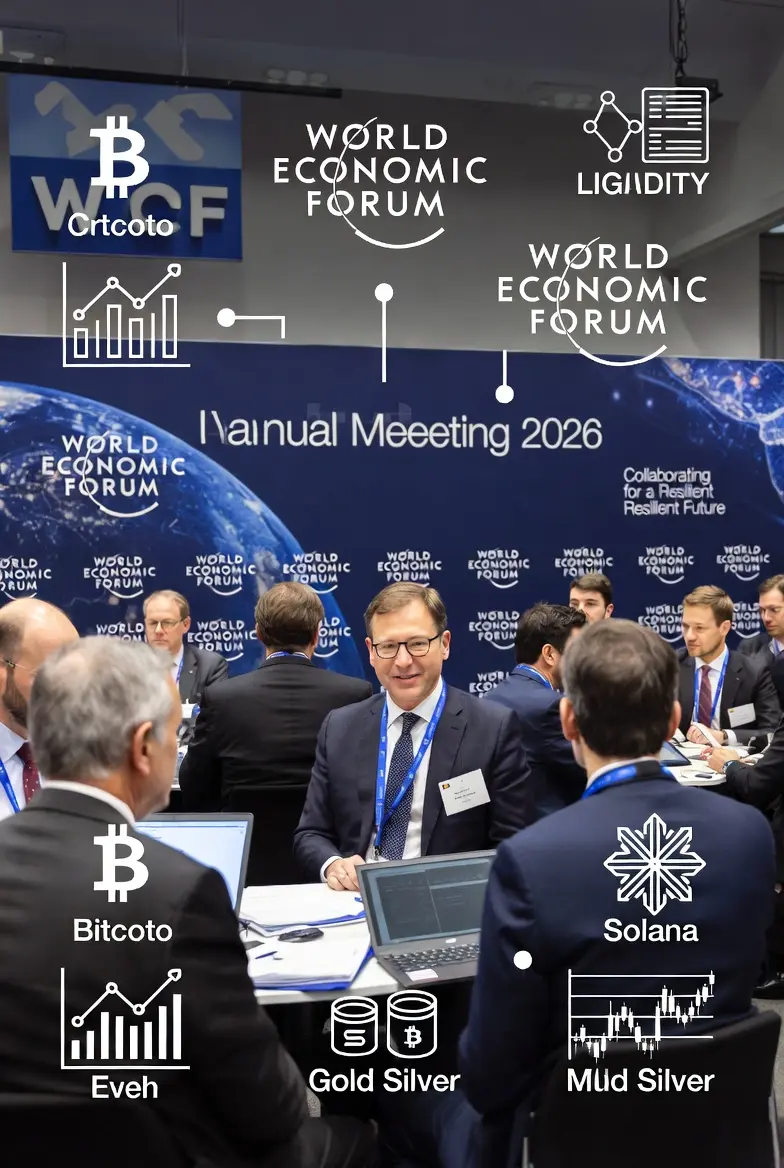
# TheWorldEconomicForum

35.64K

The World Economic Forum in Davos has wrapped up. What key insights or notable remarks on crypto and digital assets stood out to you? Share your thoughts and takeaways!

#TheWorldEconomicForum 🌍
Davos 2026 and Beyond: How Crypto Is Becoming Global Financial Infrastructure
As the conversations from Davos 2026 settle, one message is becoming increasingly clear: crypto and blockchain are no longer experimental technologies sitting on the edge of finance. They are steadily being absorbed into the core of the global economic system.
This year’s World Economic Forum marked a turning point — not through hype or price talk, but through practical alignment between governments, institutions, and technology leaders.
Here’s what the future narrative looks like after Davo
StylishKurivip
#TheWorldEconomicForum Architect of the Future or Gatekeeper of the Past?
The World Economic Forum (WEF), known for its annual Davos gathering, is far more than a meeting of global elites. For crypto investors and Gate.io users, it represents both a bridge and a barrier between traditional finance (TradFi) and the decentralized future (DeFi). Understanding its influence is crucial for anticipating how global finance and digital assets might evolve.
At the heart of the WEF’s philosophy is “Stakeholder Capitalism,” championed by Klaus Schwab. This concept shifts the focus from shareholder profit alone to broader environmental, social, and governance (ESG) priorities. For crypto markets, this philosophy drives interest in sustainable blockchain solutions, pushing innovations like Proof of Stake (PoS) and energy-efficient mining toward institutional approval.
The “Great Reset” initiative, perhaps the most discussed WEF program, calls for a fundamental restructuring of the global economy in response to recent disruptions. For the crypto community, this highlights the potential for blockchain and tokenization to underpin new economic frameworks, from tokenized real estate and carbon credits to digital identity systems.
Central Bank Digital Currencies (CBDCs) are another area where the WEF has exerted influence. The forum promotes CBDCs for inclusion, transparency, and regulatory compliance. At the same time, this raises tension with Bitcoin and decentralized protocols, which prioritize privacy and sovereignty. Understanding this balance is critical for Gate.io users navigating both regulatory and market shifts.
While the WEF does not legislate, it shapes the decision-making of those who do. Heads of state, regulators, and major bank executives converge here, often coordinating toward global regulatory frameworks. For crypto markets, this means the “Wild West” era is transitioning toward structured, institutional-friendly systems.
The creation of the Digital Assets Council within the WEF demonstrates its focus on integrating stablecoins and DeFi into mainstream finance. The council’s goal is to ensure digital assets are adopted without destabilizing traditional financial systems, a critical lens for institutional investors evaluating market entry.
Institutional adoption of crypto is increasingly guided by the forum’s endorsements. When the WEF signals support for certain digital assets, pension funds, insurance companies, and global banks interpret it as a “green light” to participate. This influx of capital can reshape liquidity conditions across Gate.io trading pairs.
Regulatory harmonization is another WEF priority. By aligning global standards, the forum reduces friction for cross-border crypto operations, making compliance predictable for institutional players. Gate.io users benefit indirectly, as this promotes stable and sustainable growth for digital asset markets.
Market volatility often spikes around WEF events, particularly during Davos week. Hints from global leaders regarding monetary policy, taxation, and digital asset regulation can trigger rapid adjustments in both crypto and traditional markets. Traders who understand these signals can anticipate liquidity flows and position accordingly.
The tension between innovation and privacy is central to WEF-driven narratives. While institutions favor traceable, auditable digital finance, decentralization advocates emphasize sovereignty and autonomy. This dichotomy will define the next decade of crypto adoption and technological evolution.
The WEF’s influence also extends to ESG-compliant investment trends. “Green Bitcoin” and other environmentally conscious protocols receive institutional attention because they align with the forum’s broader climate agenda, impacting which projects attract early-stage funding.
Tokenization of real-world assets is a recurring theme. Beyond just cryptocurrencies, blockchain is increasingly seen as the infrastructure for an entire digital economy, from fractionalized property to carbon credits, enabling new forms of investment previously unavailable to retail and institutional participants alike.
Understanding the WEF’s signaling is as important as tracking market prices. Gate.io users should watch for comments about digital asset regulation, taxation, and financial infrastructure, as these often presage macro shifts that impact both liquidity and market sentiment.
Ultimately, the World Economic Forum represents the formalization of crypto. While some view its involvement as a threat to decentralization, others see it as essential for scaling adoption to millions or billions of users globally. For Gate.io traders, the lesson is clear: success comes from monitoring structural changes, not simply chasing short-term price movements.
In conclusion, Davos is no longer just a gathering for global elites—it is a lens into the future of money, finance, and digital assets. Crypto participants who track WEF trends gain a strategic edge, understanding how institutional adoption, regulation, and macroeconomic alignment will shape markets long before headlines reflect the impact.

repost-content-media
  • Reward
  • 3
  • Repost
  • Share
Yunnavip:
2026 gogo
View More
#TheWorldEconomicForum
The conversations around crypto and digital assets at this year’s World Economic Forum in Davos felt noticeably more mature than in previous years. What stood out most to me was the clear shift in tone: crypto is no longer being discussed as a speculative side experiment, but as an emerging layer of global financial infrastructure. The debate has moved away from whether digital assets should exist and toward how they should be integrated responsibly into existing economic systems.
One of the strongest recurring themes was regulation as an enabler rather than an obstacle
DEFI2,43%
  • Reward
  • 8
  • Repost
  • Share
Yusfirahvip:
HODL Tight 💪
View More
#TheWorldEconomicForum
The World Economic Forum in Davos 2026 marked a significant turning point for the discussion of cryptocurrency and digital assets on the global stage. For years, crypto was treated as a peripheral topic, largely confined to technology-focused panels or speculative investment debates. This year, however, it emerged as a central theme of economic and policy discussions, integrated into dialogues about global finance, cross-border payments, trade competitiveness, monetary policy, and financial innovation. Leaders from governments, central banks, institutional investors, an
  • Reward
  • Comment
  • Repost
  • Share
#TheWorldEconomicForum The 2026 World Economic Forum: Dialogue, AI, and Geopolitical Crossroads
1️⃣ A Record-Breaking Davos:
The 56th Annual Meeting of the World Economic Forum (WEF) in Davos (January 19–23, 2026) brought together nearly 3,000 participants from over 130 countries, including leaders, CEOs, and policymakers. Under the theme “A Spirit of Dialogue,” the forum reflected the growing complexity of global geopolitical and economic challenges.
2️⃣ Geopolitical Strains:
Trade tensions and economic nationalism dominated discussions, particularly between the United States, Europe, and oth
  • Reward
  • 2
  • Repost
  • Share
MasterChuTheOldDemonMasterChuvip:
Stay strong and HODL💎
View More
#TheWorldEconomicForum
The World Economic Forum in Davos 2026 marked a significant turning point for the discussion of cryptocurrency and digital assets on the global stage. For years, crypto was treated as a peripheral topic, largely confined to technology-focused panels or speculative investment debates. This year, however, it emerged as a central theme of economic and policy discussions, integrated into dialogues about global finance, cross-border payments, trade competitiveness, monetary policy, and financial innovation. Leaders from governments, central banks, institutional investors, an
IN-4,55%
ON14,75%
CROSS-0,71%
EagleEyevip
#TheWorldEconomicForum
The World Economic Forum in Davos 2026 marked a significant turning point for the discussion of cryptocurrency and digital assets on the global stage. For years, crypto was treated as a peripheral topic, largely confined to technology-focused panels or speculative investment debates. This year, however, it emerged as a central theme of economic and policy discussions, integrated into dialogues about global finance, cross-border payments, trade competitiveness, monetary policy, and financial innovation. Leaders from governments, central banks, institutional investors, and blockchain companies all highlighted the growing importance of digital assets in shaping the future of global finance.
The forum emphasized that cryptocurrencies, stablecoins, and tokenized assets are no longer experimental instruments. Instead, they are increasingly viewed as foundational elements of the modern financial system. Stablecoins, for example, were discussed as critical infrastructure capable of facilitating rapid, cross-border payments and efficient settlement systems, reducing reliance on slow and fragmented legacy banking processes. Similarly, tokenized assets — from bonds and real estate to sovereign resources — were highlighted as tools that could enhance liquidity, transparency, and access to global markets.
Tokenization of Real-World Assets: From Concept to Practice
A major focus at Davos was the tokenization of real-world assets (RWA). Discussions moved beyond theory to highlight tangible progress in integrating tokenized instruments into institutional and public finance. Financial leaders underscored that tokenization enables 24/7 settlement, improved transparency, and broader market participation, transforming traditional markets that have historically been limited by legacy operational constraints.
Executives from global investment firms emphasized that tokenized funds, bonds, and money-market products represent the next generation of financial instruments. They allow for fractional ownership, instantaneous settlement, and enhanced liquidity, creating opportunities for both retail and institutional investors. Discussions also included government interest in tokenizing sovereign assets, such as infrastructure projects or state-owned enterprises, which could open new avenues for public capital formation while increasing market efficiency.
Stablecoins as the Backbone of Digital Finance
Stablecoins received substantial attention as practical tools for payments, settlements, and financial integration. Unlike early years, when stablecoins were often viewed solely as speculative instruments, this year’s discussions recognized their functional value. Stablecoins were highlighted as reliable settlement rails capable of bridging traditional finance and decentralized networks, offering instant and programmable payment solutions.
Speakers emphasized the potential of stablecoins to support institutional adoption and cross-border trade. They noted that when properly regulated, stablecoins could enhance efficiency, reduce transaction costs, and provide alternative liquidity channels, particularly in regions with unstable financial systems. The forum also considered the emerging role of stablecoins as the native currency for AI-driven economic systems, envisioning billions of autonomous agents conducting transactions using programmable digital money.
The Intersection of Crypto and Artificial Intelligence
One of the most forward-looking themes at Davos 2026 was the intersection of blockchain, digital assets, and artificial intelligence. Panelists and industry leaders discussed how crypto could become the infrastructure for machine-to-machine economic activity, enabling AI agents to autonomously execute transactions, negotiate contracts, and manage financial operations.
This vision positions blockchain not merely as a financial tool, but as a foundational layer for a new digital economy, where autonomous systems, smart contracts, and tokenized assets interact seamlessly. Speakers emphasized that such developments could fundamentally reshape commerce, trade, and financial services in ways that extend beyond traditional banking and investment models.
Institutional Adoption and Strategic Integration
Institutional participation in digital assets was a recurring focus, signaling a transition from experimentation to production. Major banks, asset managers, and financial institutions highlighted plans to integrate tokenized assets and blockchain infrastructure into traditional operations. This includes custody solutions, tokenized securities, and settlement mechanisms designed to improve operational efficiency while maintaining compliance and regulatory oversight.
Executives indicated that digital assets are no longer niche initiatives but core components of long-term strategic planning. Banks are increasingly viewing blockchain technology as a tool for modernizing back-office operations, enhancing transparency, and lowering transaction costs, while also exploring the potential for offering tokenized investment products to clients.
Regulation, Policy, and Global Competition
Regulatory clarity emerged as a crucial theme. Governments and global financial authorities are actively engaging with digital assets to balance innovation with consumer protection and financial stability. Discussions emphasized the need for clear frameworks for stablecoins, tokenized products, and blockchain-based transactions, ensuring that new financial instruments can operate at scale without compromising trust or market integrity.
The geopolitical dimension of crypto also received attention. Nations are competing to attract digital asset investment, innovation, and expertise. Forums highlighted how countries with proactive regulatory frameworks and innovation-friendly policies are better positioned to benefit from the next wave of blockchain-driven financial infrastructure. Discussions underscored that leadership in digital assets has implications not only for domestic finance but also for international economic competitiveness and trade dynamics.
Challenges and Debates
While enthusiasm for digital assets was high, several debates underscored the challenges ahead. Central questions included how to regulate decentralized systems effectively, prevent market manipulation, manage systemic risks, and maintain monetary sovereignty. Discussions also explored potential unintended consequences of stablecoin proliferation, such as pressures on traditional banking systems and monetary policy frameworks.
Industry leaders and regulators engaged in pointed debates, highlighting the tension between innovation and oversight. These discussions reinforced that while digital assets are maturing, the path toward widespread adoption requires careful management, robust compliance structures, and ongoing dialogue between public and private stakeholders.
Key Takeaways
Crypto is now a mainstream economic topic: Digital assets are central to discussions on global finance, trade, and monetary policy.
Tokenization is advancing rapidly: Real-world asset tokenization is moving from pilot projects to operational infrastructure, reshaping investment and settlement processes.
Stablecoins are foundational infrastructure: Beyond speculative use, stablecoins are increasingly essential for cross-border payments, liquidity management, and future AI-driven commerce.
Institutional and sovereign adoption is accelerating: Banks, asset managers, and governments are actively integrating digital assets into strategic financial planning.
Regulation and policy clarity are paramount: Clear frameworks are critical for sustainable growth, financial stability, and consumer protection.
AI integration signals a new economic paradigm: Crypto is increasingly envisioned as the underlying infrastructure for autonomous economic systems and machine-mediated transactions.
Conclusion
The World Economic Forum in Davos 2026 demonstrated that cryptocurrency and digital assets are no longer niche innovations but integral components of global economic strategy. Discussions reflected a shift from speculative debate to strategic integration, emphasizing the transformative potential of blockchain, tokenization, and stablecoins in reshaping global finance, payments, and economic governance. Leaders across sectors agreed that the coming years will define how digital assets are institutionalized, regulated, and leveraged to support innovation, efficiency, and competitiveness in the global economy.
This professional framing highlights the breadth of impact, from technological evolution to policy and international competitiveness, positioning crypto and digital assets as essential tools for shaping the financial architecture of the future.
  • Reward
  • 8
  • Repost
  • Share
ybaservip:
Buy To Earn 💎
View More
#TheWorldEconomicForum
The World Economic Forum in Davos 2026 marked a significant turning point for the discussion of cryptocurrency and digital assets on the global stage. For years, crypto was treated as a peripheral topic, largely confined to technology-focused panels or speculative investment debates. This year, however, it emerged as a central theme of economic and policy discussions, integrated into dialogues about global finance, cross-border payments, trade competitiveness, monetary policy, and financial innovation. Leaders from governments, central banks, institutional investors, an
IN-4,55%
ON14,75%
CROSS-0,71%
  • Reward
  • 1
  • Repost
  • Share
BigBoss07vip:
Happy New Year! 🤑
#TheWorldEconomicForum
🌈🌈The World Economic Forum in Davos 2026 marked a significant turning point for the discussion of cryptocurrency and digital assets on the global stage. For years, crypto was treated as a peripheral topic, largely confined to technology-focused panels or speculative investment debates. This year, however, it emerged as a central theme of economic and policy discussions, integrated into dialogues about global finance, cross-border payments, trade competitiveness, monetary policy, and financial innovation. Leaders from governments, central banks, institutional investors
IN-4,55%
ON14,75%
CROSS-0,71%
  • Reward
  • 1
  • Repost
  • Share
ybaservip:
Happy New Year! 🤑
#TheWorldEconomicForum
World Economic Forum (WEF) 2026 – Implications for Crypto and Precious Metals
1. Introduction
The World Economic Forum (WEF), headquartered in Geneva, Switzerland, is a leading international non-governmental organization that brings together global leaders from business, politics, civil society, and academia. Founded in 1971 by Klaus Schwab, the WEF has evolved into a platform for shaping global economic, technological, and geopolitical agendas. Its activities include the annual Davos meeting, regional summits, research, and reports such as the Global Risks Report and G
BTC0,44%
ETH0,3%
SOL0,47%
HighAmbitionvip
#TheWorldEconomicForum
World Economic Forum (WEF) 2026 – Implications for Crypto and Precious Metals
1. Introduction
The World Economic Forum (WEF), headquartered in Geneva, Switzerland, is a leading international non-governmental organization that brings together global leaders from business, politics, civil society, and academia. Founded in 1971 by Klaus Schwab, the WEF has evolved into a platform for shaping global economic, technological, and geopolitical agendas. Its activities include the annual Davos meeting, regional summits, research, and reports such as the Global Risks Report and Global Cooperation Barometer.
In 2026, the WEF continues to address fragmented alliances, emerging technologies, and sustainability, providing a strong signal to markets worldwide.
2. Key Themes of WEF 2026
The 2026 Annual Meeting in Davos, themed “A Spirit of Dialogue,” focused on:
Geo-economics & selective alliances amid U.S.-Europe-China tensions
AI scaling & ethical deployment, including quantum-resistant technologies
Sustainability initiatives, like the Forest Future Alliance
Financial innovation, emphasizing tokenized assets and staking ecosystems ($400B+ supported)
These discussions directly impact crypto markets, liquidity, and investor sentiment, while also influencing precious metals as global risk hedges.
3. WEF Influence on Crypto Markets
Bitcoin (BTC)
Acts as a macro hedge amid geopolitical and economic fragmentation.
Institutional participation increases due to WEF-backed regulatory clarity and tokenization initiatives.
Price range: ~$89,500–$91,500, with higher liquidity and moderate short-term volatility.
Ethereum (ETH)
Adoption driven by AI and DeFi projects, reinforced by WEF initiatives.
Staking and tokenized asset projects support medium-term price stability.
Price range: ~$2,950–$3,400, with 8% short-term volume increase expected post-WEF.
Solana (SOL)
High-speed blockchain remains attractive for enterprise and AI applications highlighted at WEF 2026.
Price: $127, reflecting selective adoption but significant liquidity support from tech-focused initiatives.
4. WEF Influence on Precious Metals
Gold
Safe-haven asset benefiting from geopolitical risks and global economic uncertainty.
Price: $5,033, with stable liquidity due to hedge demand from institutional and retail investors.
Silver
Industrial and tech demand influenced by WEF climate-tech and renewable energy initiatives.
Price: $103, reflecting both investment and industrial use, with moderate liquidity flows.
5. Market Dynamics & WEF Signals
Liquidity Flows: WEF-backed projects increase participation in crypto, DeFi, and tokenized assets.
Price Volatility: BTC, ETH, and SOL may react 5–15% to geopolitical and tech announcements.
Safe-Haven Demand: Gold and Silver prices remain supported amid selective global alliances.
Institutional Adoption: Multistakeholder capitalism frameworks promote long-term confidence in crypto markets.
6. Summary Table: WEF 2026 Market Snapshot
Asset
Price
24h Volume % Change
Liquidity Impact
WEF Influence
BTC
$89,500–$91,500
+12%
Higher liquidity via institutional inflows
Regulatory clarity, macro hedge flows
ETH
$2,950–$3,400
+8%
Staking projects & tokenized assets
AI & DeFi adoption signals
SOL
$127
+15%
Enterprise/tech adoption
High-speed blockchain relevance
Gold
$5,033
+5%
Safe-haven buying
Geopolitical & market risk
Silver
$103
+3%
Industrial & tech demand
Climate-tech initiatives
7. Conclusion
The WEF 2026 Annual Meeting continues to be a major driver of global market sentiment, especially for crypto and precious metals. BTC, ETH, and SOL benefit from technology adoption, staking, and tokenization initiatives, while Gold and Silver remain safe-haven hedges during periods of geopolitical and economic uncertainty. Investors and traders should closely monitor WEF reports, Davos announcements, and regional summits to anticipate liquidity flows, price shifts, and market trends.
repost-content-media
  • Reward
  • 2
  • Repost
  • Share
MasterChuTheOldDemonMasterChuvip:
2026 Go Go Go 👊
View More
#TheWorldEconomicForum
The World Economic Forum sits at the crossroads of global influence, policy discussion, and economic direction. Each year, it brings together political leaders, central bankers, corporate executives, technologists, and academics — not to make laws, but to shape the conversations that often precede them.
Supporters see the WEF as a necessary platform for coordination in an increasingly interconnected world. Global supply chains, climate policy, financial stability, emerging technologies, and geopolitical risk don’t stop at borders. Dialogue, at lea
  • Reward
  • Comment
  • Repost
  • Share
Davos is a backdrop, not an operational guide
From an investment and trading perspective, Davos is more like a macro backdrop rather than a specific operational manual. It provides a framework for how the world views risk and growth, not explicit buy or sell signals.
In this environment, the most common mistake is treating macro consensus as short-term logic. In fact, what Davos conveys is the medium- to long-term tone, and real trading opportunities still come from the market’s own rhythm, capital structure, and technical patterns.
A more mature approach is: use Davos to calibrate expectation
View Original
[The user has shared his/her trading data. Go to the App to view more.]
  • Reward
  • 3
  • Repost
  • Share
Ryakpandavip:
2026 Go Go Go 👊
View More
Load More

Join 40M users in our growing community

⚡️ Join 40M users in the crypto craze discussion
💬 Engage with your favorite top creators
👍 See what interests you
  • Pin