
Aptos Foundation released a comprehensive tokenomics update on April 14, using seven mechanisms to drive the protocol’s supply model transition from a “subsidy-driven” approach to a “performance-driven” approach. Key adjustments include lowering the staking annualized rate from 5.19% to 2.6%, increasing Gas fees by 10x, setting a hard cap of 2.1 billion tokens for the protocol layer, and permanently locking 210 million APT.
Seven Core Token Reform Measures
Staking annualized rate lowered to 2.6%: Reduced from the current 5.19%; at the same time, exploring differentiated designs that can offer higher reward rates for long-term staking commitments; validator operating costs will be significantly reduced according to AIP-139
Gas fees increased by 10x: After the increase, stablecoin transfers remain as low as about 0.00014 USD, maintaining their status among the world’s lowest fees; all Gas fees paid in APT are permanently burned
Set a hard cap of 2.1 billion tokens for total supply: The protocol layer’s total supply cap is established through governance; with the current circulating supply at 1.2B, there are still 904 million within the hard-cap space (about 43%)
Permanently lock 210 million APT: The Foundation permanently locks and stakes them, accounting for about 18% of the current circulating supply; these tokens are never sold or distributed, effectively equivalent to burning
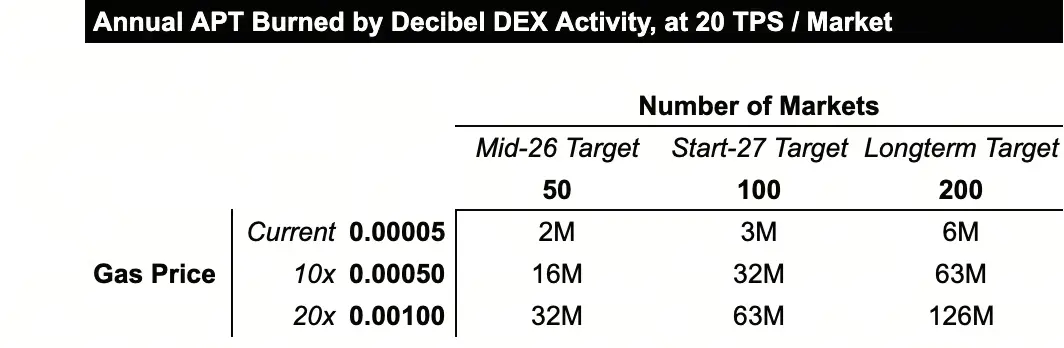
Decibel DEX burns over 32 million tokens annually: The first fully on-chain decentralized exchange, planned to cover 100+ markets; once each market reaches 10k TPS, the annual burn volume will further grow
Milestone-triggered incentives: In the future, subsidies and rewards will be tied to KPIs; if performance targets are not met, token allocations are delayed rather than canceled
Programmatic buyback plan: The Foundation explores using existing cash or future authorized income, along with ecosystem investment income, to programmatically buy back APT on the open market
Structural Background for a Deflationary Transition: 2026 Is a Critical Turning Point
This reform timing has structural support. The four-year unlock cycle for initial investors and key contributors will end in October 2026; at that time, the annual token supply unlock amount will naturally decrease by about 60%; the Foundation’s grant allocations will also reduce by over 50% year over year between 2026 and 2027. Aptos’s supply pressure was already at a natural turning point; with these seven mechanisms layered with structural constraints, the goal is for the annual APT removal amount to exceed the issuance amount after Decibel DEX scales up, achieving deflationary supply.
From the demand side, institutions such as BlackRock, Franklin Templeton, and Apollo have already deployed hundreds of millions of dollars on Aptos. Application revenue growth reached 1,552%, rising to $33.5 million, providing a sustained foundation for trading activity for the deflationary model.
Frequently Asked Questions
What is the real impact of Aptos lowering its staking annualized rate from 5.19% to 2.6% on stakers?
Staking rewards shrink by about half; returns for stakers whose purpose is purely passive holding yield will decrease. But the Foundation is also exploring differentiated mechanisms that offer higher reward rates for long-term commitments, encouraging long-term network participation; with validator hardware costs reduced significantly under AIP-139, it also offsets, to some extent, the impact of the reward reduction.
Does increasing Gas fees by 10x affect Aptos’s cost-competitiveness for usage?
The impact is extremely small. Even after the 10x increase, the stablecoin transfer cost is still about $0.00014, remaining among the world’s lowest fees across mainstream blockchains. The main purpose of raising Gas fees is to increase the amount of APT burned, not to change the cost-competitiveness landscape—so it has almost no effect on the real day-to-day usage costs for individual users and institutions.
How does Decibel DEX drive deflationary momentum for APT?
As a fully on-chain decentralized exchange that executes every trade on-chain, Decibel consumes APT as Gas fees for each order, matching, and cancellation, and burns all of it permanently. After it is expected to cover 100+ markets, it is projected to burn over 32 million APT per year. As TPS and market scale expand, the burn volume will continue to grow, forming a deflationary flywheel effect driven by trading activity.
Disclaimer: The information on this page may come from third parties and does not represent the views or opinions of Gate. The content displayed on this page is for reference only and does not constitute any financial, investment, or legal advice. Gate does not guarantee the accuracy or completeness of the information and shall not be liable for any losses arising from the use of this information. Virtual asset investments carry high risks and are subject to significant price volatility. You may lose all of your invested principal. Please fully understand the relevant risks and make prudent decisions based on your own financial situation and risk tolerance. For details, please refer to
Disclaimer.
Related Articles
Monad Co-Founder Suggests Dynamic Caps on Collateral Deposits to Mitigate Hacking Risks
Keone Hon suggests that pooled lending protocols should implement gradual rate limits on collateral asset increases to mitigate risks during hacks. He argues this could have prevented significant losses, as seen with rsETH depositors.
GateNews1h ago
SGB Launches USDC Mint Service on Solana Network
SGB enables instant USDC minting and redemption on Solana, improving cross-border payments with real-time settlement.
Service targets institutions, removing intermediaries and supporting 24/7 liquidity and treasury management.
Expansion plans include more stablecoins and retail access, li
CryptoFrontNews2h ago
Morpho Pauses MORPHO OFT Cross-Chain Bridge on Arbitrum Following Kelp DAO and LayerZero Events
Morpho Association has temporarily suspended the OFT cross-chain bridge for MORPHO tokens on Arbitrum due to recent issues with Kelp DAO and LayerZero Bridge, pending confirmation of the rsETH incident's cause.
GateNews2h ago
Spark Protocol's January delisting of rsETH proves prudent as Aave faces ETH liquidity crisis
Spark Protocol's strategy of delisting low-usage assets and tightening collateral has faced initial backlash but proved wise during market turmoil. While maintaining higher interest rate caps, SparkLend ensures liquidity, unlike Aave, which now faces significant risks.
GateNews5h ago
Kamino Pauses LayerZero-Related Asset Interactions, Closes Deposit and Lending Functions
Kamino has temporarily suspended interactions with LayerZero-related tokens as a precaution, while allowing withdrawals and debt repayments. They emphasize that this measure is for risk management and that user funds are safe.
GateNews7h ago
Aave Core Member Marc Zeller Proposes End to ACI Frontier Project, Plans to Exit Validator Role
Marc Zeller of Aave announced his proposal to end the Aave-Chan Initiative Frontier project. He will exit his validator roles, return ETH to protect wETH depositors, and forgo potential income to minimize user impact. Zeller has significantly influenced Aave's incentive mechanisms and plans to exit Aave in July.
GateNews7h ago


