
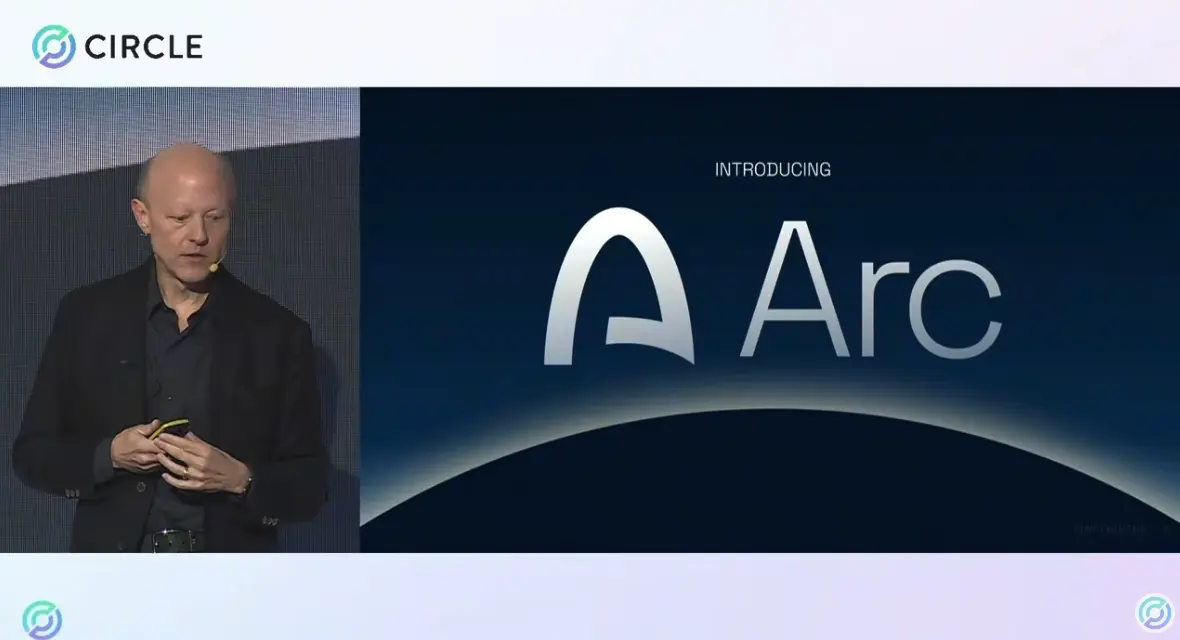
Circle co-founder and CEO Jeremy Allaire confirmed on April 14 during an in-person event in Seoul, South Korea, that Circle is exploring the issuance of a native token for Arc Network, its stablecoin payment public chain. The design goals cover three core functions: governance, ecosystem incentives, and economic incentives aligned with stakeholders. It also plans to gradually transition to a proof-of-stake (PoS) system.
Core Token Plan Architecture: Governance, Incentives, and PoS Transition
 (Source: Youtube)
According to Allaire’s remarks, Arc Network’s token issuance plan is designed around three main directions: first, protocol governance, allowing token holders to participate in network decision-making; second, ecosystem incentives, using token mechanisms to attract validators, developers, and users to actively participate; and third, economic alignment, ensuring the protocol’s long-term interests remain consistent with those of all participants.
This path is highly aligned with the tokenized models of existing mainstream Layer-1 blockchains, but Arc Network’s special aspect is that it is backed by Circle, the issuer of the USDC stablecoin, and is positioned around a design whose core use case is stablecoin payments using fiat-pegged stablecoins. As of now, Allaire has not disclosed the token’s issuance timeline, total supply, or specific allocation plan, indicating that more complete details will be formally announced “in the not-too-distant future.”
Arc Network’s Technical Differences: Post-Quantum Signatures Built In from Day One of the Mainnet
Behind the confirmed token plan is the technical architecture difference Arc Network has already established. This Circle-supported Ethereum Virtual Machine (EVM)-compatible Layer-1 blockchain will have post-quantum signature support built in starting from the very first day its mainnet goes live—rare among mainstream Layer-1 projects for such front-loaded deployment.
Arc Network Post-Quantum Security Phased Roadmap
Mainnet launch in sync: Post-quantum signature support; wallets get quantum resistance first
Near-term enhancements: Quantum-resistant private smart contract state protection, preventing on-chain data from being decrypted by future quantum computers
Mid-term goals: Full construction of the underlying infrastructure for quantum resistance
Long-term upgrades: Validator signature hardening to achieve quantum security across the network’s validation layer
Arc adopts a “voluntary migration” design rather than forcing a network-wide reset—something that could require months of processing time in large networks like Bitcoin. Arc’s sub-second block finality mechanism (500 milliseconds) also compresses the effective time window for an attacker to forge validator signatures from the design level. On the technical challenge side, while traditional signatures are 64 to 65 bytes, post-quantum signatures may be larger by an order of magnitude, posing engineering difficulties for throughput and storage efficiency.
Background on the Quantum Threat: Why Deployment in 2026 Is Crucial
Arc Network’s decision to build quantum resistance into the mainnet from day one reflects a clear market-timing judgment. Recently, Google researchers warned that advances in quantum computing may threaten existing cryptographic infrastructure faster than expected, and they predict that by 2032 Bitcoin could face real quantum attacks. The U.S. National Institute of Standards and Technology (NIST) has also warned about the risks of “collect now, decrypt later” attacks: an attacker intercepts encrypted data now, then decrypts it once quantum computing becomes powerful enough. This means the security threat to the data exists earlier than the point at which quantum computers are officially usable.
Upgrading quantum resistance in existing mainstream blockchains also faces complex coordination problems. Arc’s documentation states: “The organizations that will lead this transformation are those that start building before the urgency becomes unmistakable.”
Frequently Asked Questions
What is the relationship between Arc Network’s native token and Circle’s USDC?
Arc Network’s token design is positioned as a governance and PoS staking tool, not a stablecoin. USDC is a U.S. dollar-pegged stablecoin issued under Circle, and the two belong to different asset categories. Arc Network’s token plan is used for protocol governance decisions and validator incentives, while USDC continues to circulate in the ecosystem as a payment medium.
Why can Arc Network deploy post-quantum signatures on day one of the mainnet?
Arc’s advantage is that it builds a new chain from scratch, allowing it to adopt post-quantum cryptography standards directly during the architecture design phase, without having to deal with coordination issues for migrating the huge existing user base and infrastructure of an established network. Arc also adopts a voluntary onboarding model, further reducing resistance to quantum upgrades, offering a sharp contrast to solutions that might require forced migration for months in large networks such as Bitcoin.
How should Circle track the next steps of Arc Network’s token issuance plan?
After Allaire’s confirmation of the token plan in Seoul, he said more detailed information will be formally released “in the not-too-distant future,” including key parameters that have not been disclosed yet, such as the token issuance structure, total supply, and PoS transition timeline. Market attention will focus on whether the token allocation plan tilts toward the community, the mainnet launch timeline, and the specific design of the PoS validation mechanism.
Disclaimer: The information on this page may come from third parties and does not represent the views or opinions of Gate. The content displayed on this page is for reference only and does not constitute any financial, investment, or legal advice. Gate does not guarantee the accuracy or completeness of the information and shall not be liable for any losses arising from the use of this information. Virtual asset investments carry high risks and are subject to significant price volatility. You may lose all of your invested principal. Please fully understand the relevant risks and make prudent decisions based on your own financial situation and risk tolerance. For details, please refer to
Disclaimer.
Related Articles
RaveDAO Denies Price Manipulation, Plans Token Releases and 20% Charity Commitment
RaveDAO addressed recent inquiries about RAVE price changes, denying any team involvement in price manipulation. It underlined its focus on long-term growth in building a music ecosystem and plans to align community incentives, sell unlocked tokens strategically, and donate profits to charity.
GateNews1h ago
Aave Multisig Guardian Freezes rsETH on Lending Markets
Gate News message, according to Onchain, the Aave Multisig Guardian has frozen rsETH on lending markets. This action has been implemented across Aave's lending platforms.
GateNews6h ago
Tobu Top Tours Launches XRP Ledger-Based Prepaid Payment Platform, Targeting Japan's ¥30T Market
Tobu Top Tours has partnered with SBI Ripple Asia to launch a prepaid token payment platform on the XRP Ledger, gaining regulatory approval in Japan. Set for rollout later this year, it allows users to convert yen into blockchain tokens for various tourism services. SBI Ripple Asia also announced research to enhance Japan-South Korea cross-border payments using the XRP Ledger.
GateNews6h ago
MicroStrategy Proposes Semi-Monthly Dividends for STRC to Improve Liquidity and Stabilize Stock Price
MicroStrategy has proposed changing its STRC preferred stock dividends from monthly to semi-monthly to enhance liquidity and stabilize stock prices, maintaining an 11.5% annual yield. Concerns about this structure have been raised by Bitcoin critic Peter Schiff.
GateNews18h ago
Pi Network Launches First Smart Contract Feature on Testnet, Enabling Subscription Payments
Pi Network has launched its first Smart Contract feature on Testnet, enabling users to set up automatic subscription payments while maintaining control of their funds. This marks a shift toward ecosystem utility and lays the groundwork for potential mainnet deployment.
GateNews19h ago
Topnod Self-Custody Wallet Becomes Official Partner of Layer1 Blockchain Pharos
Topnod has partnered with Layer1 blockchain Pharos, providing a user-friendly self-custody wallet that simplifies access to real-world assets. It will support Pharos's airdrop activities and facilitate the distribution of RWA assets on the Pharos chain.
GateNews23h ago


