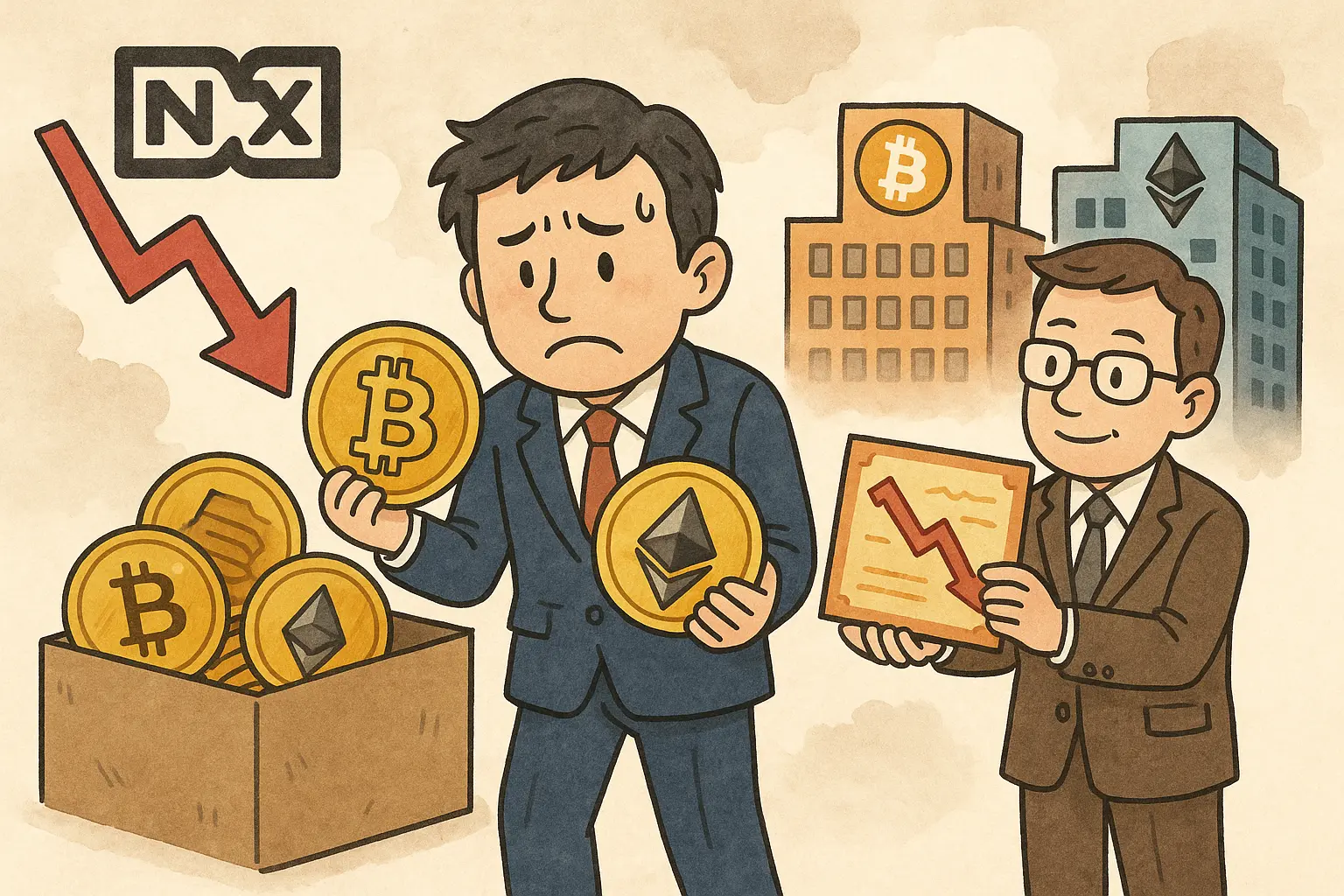
NXC, the parent company of South Korean gaming giant Nexon, is systematically shrinking its cryptocurrency asset portfolio. According to NXC’s 2025 annual consolidated audit report, the company’s total cryptocurrency assets as of the end of 2025 amounted to 147.6 billion won (about $108 million). NXC has completed the sale of its stake in the overseas exchange Bitstamp and, through a board resolution, fully sold its shares in the Korean exchange Korbit.
Crypto Asset Footprint Shrinks by 15%: Snapshot of Holdings
According to NXC’s latest audit report, the details of its cryptocurrency holdings as of the end of 2025 are as follows:
NXC’s Cryptocurrency Asset Status
Bitcoin held: 2,356 BTC
Ethereum held: 22,420 ETH
Total market value of cryptocurrency assets: 147.6 billion won (about $108 million)
Year-over-year change: down 15.2% from 174.0 billion won at the end of 2024
This divestment reflects NXC’s proactive adjustments to its cryptocurrency assets rather than losses driven by passive market factors. While cutting its holdings, the company is also withdrawing, at the strategy level, from two core crypto ecosystem assets.
Exiting Two Exchanges: A Roadmap for Fully Stepping Away from Bitstamp and Korbit
In terms of investments in crypto exchanges, NXC has adopted a clear comprehensive exit strategy.
Bitstamp (overseas exchange): NXC has completed the sale of its stake in Bitstamp. The subsidiary has been formally removed from NXC’s consolidated financial statements, and the transaction has been effectively completed.
Korbit (Korean crypto exchange): In February 2026, NXC’s board passed a resolution to sell all of its stake in Korbit. The transaction is currently still in progress. This full exit shows that NXC no longer views domestic crypto exchanges as a core business pillar.
Business Transformation: Exiting Crypto Assets, Shifting Toward European Industrial Exposure
NXC’s reduction of cryptocurrency assets is not an isolated event, but part of a broader business diversification strategy. This February, NXC, through its Belgian investment subsidiary NXMH, acquired equity in the European industrial solutions company CLI Group (CLI Group BV) and incorporated it into its consolidated financial statements. The specific acquisition amount and ownership percentage have not yet been publicly disclosed.
This move indicates that NXC’s strategic focus is shifting from the virtual-asset ecosystem toward Europe’s real-world industrial sector, continuing the overall direction established in recent years: divesting crypto-related subsidiaries and simultaneously expanding investments in non-gaming real businesses.
Nexon Group Financial Performance: Revenue Grows, Profits Drop Sharply
According to NXC’s consolidated audit report, Nexon Group’s full-year 2025 revenue reached 5.1751 trillion won, up 3.8% year over year, sustaining growth. However, profitability is under clear pressure:
Operating profit: 960.9 billion won, down 17.4% year over year
Net profit: fell sharply from 2.2467 trillion won in 2024 to 85.9 billion won
The sharp contraction in net profit is mainly due to a base-effect factor. In 2024, net profit included a one-time gain of about 1.4485 trillion won from the sale of subsidiaries. This year, in the absence of similar non-recurring income, net profit naturally fell significantly, which does not mean the underlying business has deteriorated fundamentally.
Frequently Asked Questions
Why did NXC reduce its holdings of Bitcoin and Ethereum?
According to the audit report, NXC’s cryptocurrency asset size declined by about 15.2% from the previous year. At the same time, it is selling its stakes in Bitstamp and Korbit, indicating that the company is proactively shrinking strategy-related crypto currency business activities. It is then increasing investment in the European industrial sector and advancing business diversification.
Which crypto exchange stakes did NXC sell?
NXC has completed the sale of its stake in the overseas exchange Bitstamp, and Bitstamp has been removed from the consolidated financial statements. In addition, NXC’s board decided in February 2026 to sell all of its shares in the Korean exchange Korbit. The transaction is still underway.
How did Nexon Group perform in 2025?
Full-year revenue reached 5.1751 trillion won, up 3.8% year over year. However, affected by a base-effect from one-time gains, net profit fell sharply from 2.2467 trillion won in 2024 to 85.9 billion won, and operating profit also declined 17.4% to 960.9 billion won.
Disclaimer: The information on this page may come from third parties and does not represent the views or opinions of Gate. The content displayed on this page is for reference only and does not constitute any financial, investment, or legal advice. Gate does not guarantee the accuracy or completeness of the information and shall not be liable for any losses arising from the use of this information. Virtual asset investments carry high risks and are subject to significant price volatility. You may lose all of your invested principal. Please fully understand the relevant risks and make prudent decisions based on your own financial situation and risk tolerance. For details, please refer to
Disclaimer.
Related Articles
ETH drops 0.76% in 15 minutes: Dual pressure from whales’ proactive deleveraging and ETF fund outflows
Between 07:15 and 07:30 (UTC) on 2026-04-19, the ETH spot price fluctuated in the 2298.13 to 2322.69 USDT range, with an amplitude of 1.06% and a return of -0.76%. During this period, market attention increased; the sharp drop in price triggered widespread user focus, along with a clear surge in trading volume within a short time, indicating a sudden escalation in liquidity pressure.
The main driver behind this deviation is that on-chain whale accounts actively sold ETH to repay DeFi platform borrowings in order to avoid forced liquidation. Based on on-chain tracking and fund-flow monitoring, from April 18 to 19, more than 42,000 ETH per-transaction large transfers were rapidly sent into a certain mainstream exchange, and at the same time there was a sharp spike in net inflows to the exchange. This concentrated sell pressure directly weakened spot market prices. Under proactive deleveraging behavior, selling pressure was released in the short term, creating a sudden market shock.
In addition, during the period of price deviation, the ETH derivatives market saw a significant rise in passive liquidation volume, especially as leveraged long positions encountered strong liquidations during the price decline, further increasing supply pressure in the spot market. Meanwhile, ETH spot ETF funds continued to see net outflows; in mid-April, there were multiple days with single-day outflows exceeding $40-50M, with the largest single day reaching $200M. This reflects a warming of short-term institutional risk-avoidance sentiment, which led to a deeper shift downward in buy-side liquidity depth. The launch of a new public chain ecosystem also attracted some ETH liquidity migration, further weakening the capital protection layer of the mainnet. Multiple structural feedback effects amplified the downside move.
At present, leverage risk in the ETH market remains prominent. Some whales still have large borrowings outstanding; if the price continues to move downward, potential liquidation risks may flare up again. ETF fund flows, on-chain large transfers, and capital-attraction moves tied to the new-chain ecosystem all need close monitoring. With increased short-term volatility risk, it is recommended to watch key support zones, exchange net inflow indicators, and DeFi on-chain liquidation dynamics in order to promptly grasp the latest market signals.
GateNews22m ago
ETH breaks below 2300 USDT
Gate News bot message, Gate market data shows that ETH has broken below 2300 USDT, with the current price at 2298.67 USDT.
CryptoRadar32m ago
ETH drops 0.58% in 15 minutes: derivatives liquidity contraction and proactive position reduction dominate short-term pullback
From 2026-04-19 04:30 to 2026-04-19 04:45 (UTC), within ETH’s 15-minute candlestick chart, the return recorded -0.58%, and the price range was 2321.62 to 2342.04 USDT, with an amplitude of 0.87%. The short-term selloff occurred against a backdrop of increased overall market volatility and a broad decline in the prices of major crypto assets; overall market risk appetite clearly fell, and traders’ wait-and-see sentiment strengthened.
The main driver behind this abnormal move is a sharp contraction in liquidity in the derivatives market and leveraged funds proactively reducing positions. Data shows that over the past 24 hours, the ETH/USD perpetual contract trading volume dropped 67.16% to approximately 74.87 million, open interest edged down 3.33% to 329 million, and liquidation amounts did not expand unusually. This structure indicates that the market lacks the risk of passive cascades; more funds chose to proactively step aside and wait on the sidelines, intensifying short-term selling pressure.
In addition, the long/short structure in which shorts held the upper hand (long/short ratio 47.48%:52.52%) and sentiment synchronization with the panic range reinforced the downward price trend. During the same period, major coins such as BTC and SOL also fell 2%-3.4% in tandem, further showing that this pullback was driven by system-wide risk sentiment. On-chain funds did not show any large abnormal transfers or large-scale liquidations of DeFi protocols; spot and on-chain liquidity remained generally stable, and no sudden system risk resonance was observed.
Current volatility-related risks still need close monitoring, especially as overall risk appetite continues to contract—ETH’s short-term price may face further downside probing. Watch subsequent changes in derivatives trading volume and open interest, extreme shifts in the long/short ratio and funding rate, and promptly monitor on-chain fund flows, large transfers, and any signs of amplified platform net outflows. For more market anomalies and deeper analysis, please continue to follow our upcoming market updates.
GateNews3h ago
Spark Protocol's January delisting of rsETH proves prudent as Aave faces ETH liquidity crisis
Spark Protocol's strategy of delisting low-usage assets and tightening collateral has faced initial backlash but proved wise during market turmoil. While maintaining higher interest rate caps, SparkLend ensures liquidity, unlike Aave, which now faces significant risks.
GateNews3h ago
Ethereum Processes 200M Transactions in Q1 2026, Up 43% QoQ
Ethereum experienced its highest quarterly transaction volume in Q1 2026 with over 200 million transactions, marking 43% growth from the previous quarter. Layer 2 solutions and stablecoin usage drove this surge, indicating a utility-focused adoption trend.
GateNews17h ago


