


Inside the Image AI Leap: How Google and ByteDance’s Latest Models Stack Up
In brief
- Both models introduce multi-step reasoning before image generation, enabling more reliable handling of complex prompts, reference images and extended editing workflows than earlier diffusion systems.
- Seedream undercuts Google on price and permits local execution and real-image editing, while Nano Banana is tightly embedded across Google’s consumer and enterprise ecosystem.
- Testing showed Seedream better preserved character identity and spatial consistency across multi-round edits, while Nano Banana delivered faster output and superior text rendering within images.
Two of the most capable AI image models available right now launched within days of each other this week, promising to reshape how users will create content. Nano Banana 2—Google’s internal name for Gemini 3.1 Flash Image—dropped on February 26 and dominated the AI discourse almost immediately. It’s the successor to Nano Banana Pro, the model that became the gold standard for AI image editing after its November 2025 launch. Seedream 5 Lite, ByteDance’s newest entry in its image generation lineup, shipped a few days earlier. While the former arrived with much fanfare from Google’s marketing machine, the latter slipped through with barely a press release. Even though the gap in coverage was immense, the difference in capability was narrower.
What’s the big deal? Both models are built around the same core architectural idea of giving an image generator the ability to think before it draws. That means real-time web search integration before generation even begins, as well as multi-step chain-of-thought reasoning to interpret complex or ambiguous prompts, and the ability to handle reference images across extended editing workflows. This is a genuine shift from the generation models of a year ago, when Stable Diffusion was widely considered revolutionary. They both output up to 4K resolution. Both support multi-image reference inputs for consistency workflows. Both can maintain visual coherence across characters and objects within a single session.
Both can generate styled, legible text inside images, though not equally well. And both entered a market that already includes GPT Image 1.5 from OpenAI, Flux.2 from Black Forest Labs, and a rapidly growing catalog of Chinese models competing aggressively on price and flexibility. But which option is best for the end user? We tested both models to help find the answer. Technical, price comparison The pricing gap is the first thing to understand. Google prices Nano through the Gemini API at $60 per million output image tokens. In practical terms, that breaks down to roughly $0.045 for a 512px image, $0.067 at 1K resolution, $0.101 at 2K, and $0.151 at 4K. Seedream charges a flat $0.035 per image, regardless of output resolution, so at any size above 512px, Seedream is the cheaper option. At 4K, Nano costs more than four times as much per image. For high-volume production pipelines, that compounds quickly. Availability follows completely different distribution paths. Nano is live across Google’s full consumer and developer ecosystem, the Gemini app, Google Search’s AI Mode, Google Lens, AI Studio, Vertex AI, and Google Flow for video creation. It’s embedded in infrastructure that hundreds of millions of people already use daily. Seedream reaches users through ByteDance’s CapCut and Jianying creative apps, through third-party API aggregator platforms, and via Dreamina, ByteDance’s dedicated image generation interface. One key distinction: Seedream can be run locally. Google does not allow this.
The platform experience is another difference to consider. Gemini is a chatbot first, an image generator second. It generates images very well and does so fast; Google’s speed claims hold up in practice. But you’re working inside a conversational interface that wasn’t designed for iterative visual workflows. Dreamina was built specifically for image creation. It has purpose-built tooling for reference management, multi-step editing, and composition control. Also, Dreamina’s generation queue takes meaningfully longer than Nano through Gemini’s interface. For a quick test or a single image, Gemini gets you there faster. For sustained multi-round editing sessions, Dreamina’s structure is more coherent. In terms of content moderation, Gemini refuses to work with real people in most scenarios—prompt it toward a likeness edit, a photo manipulation involving a public figure, or anything suggestive involving an identifiable subject, and it declines. Seedream operates under considerably more permissive rules. ByteDance allows editing of real images and working with identifiable subjects in ways Google won’t engage with, which explains a significant portion of Seedream’s community following among content creators. On the API specifically, both models support configurable reasoning depth. Nano lets developers set thinking levels from Minimal to High or Dynamic, allowing the model to reason through complex prompts before committing to a render. Seedream implements chain-of-thought supervision in its architecture, thereby improving prompt fidelity for multi-constraint and spatially complex generation tasks.
Neither model makes reasoning entirely transparent to the developer, but both perform better on hard prompts than their predecessors did without it. Character consistency: Mini campaign test
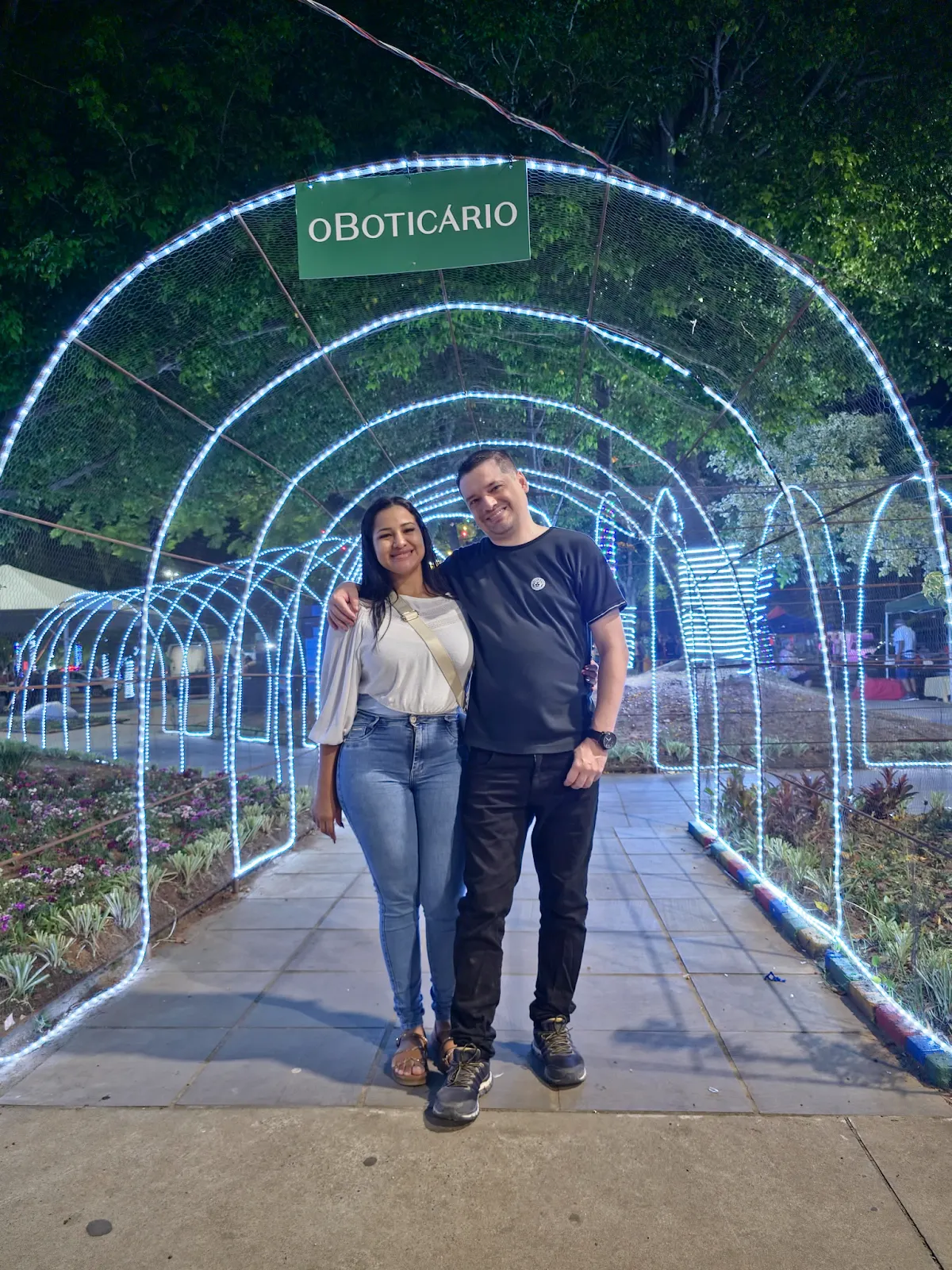
This tests whether the models can maintain a recognizable identity across multiple edited iterations of a real image. The original subject was a real couple photographed at a shopping center. The goal was to swap their outfits and other elements in the photo across five iterations, keeping the same faces, builds, and visual identity recognizable throughout. The Gemini chatbot refused to engage with the real photo outright—consistent with its content policy. Testing Nano Banana 2 required going through the API directly. Nano:

Nano’s results, while visually polished, showed significant identity drift by the later iterations.
The scene geometry held—the LED tunnel environment, the tiled walkway perspective, and the background sign placement all remained coherent. But the subjects themselves were effectively recast. By the end of the iterations, the woman was no longer the original. The man was replaced almost entirely across the iterations: different age range, different build, different facial structure, different hair. The model produced something beautiful, but not the people who were actually there. This can be somewhat fixed if the references used for editing originals are uploaded without faces that can confuse the model. Seedream:
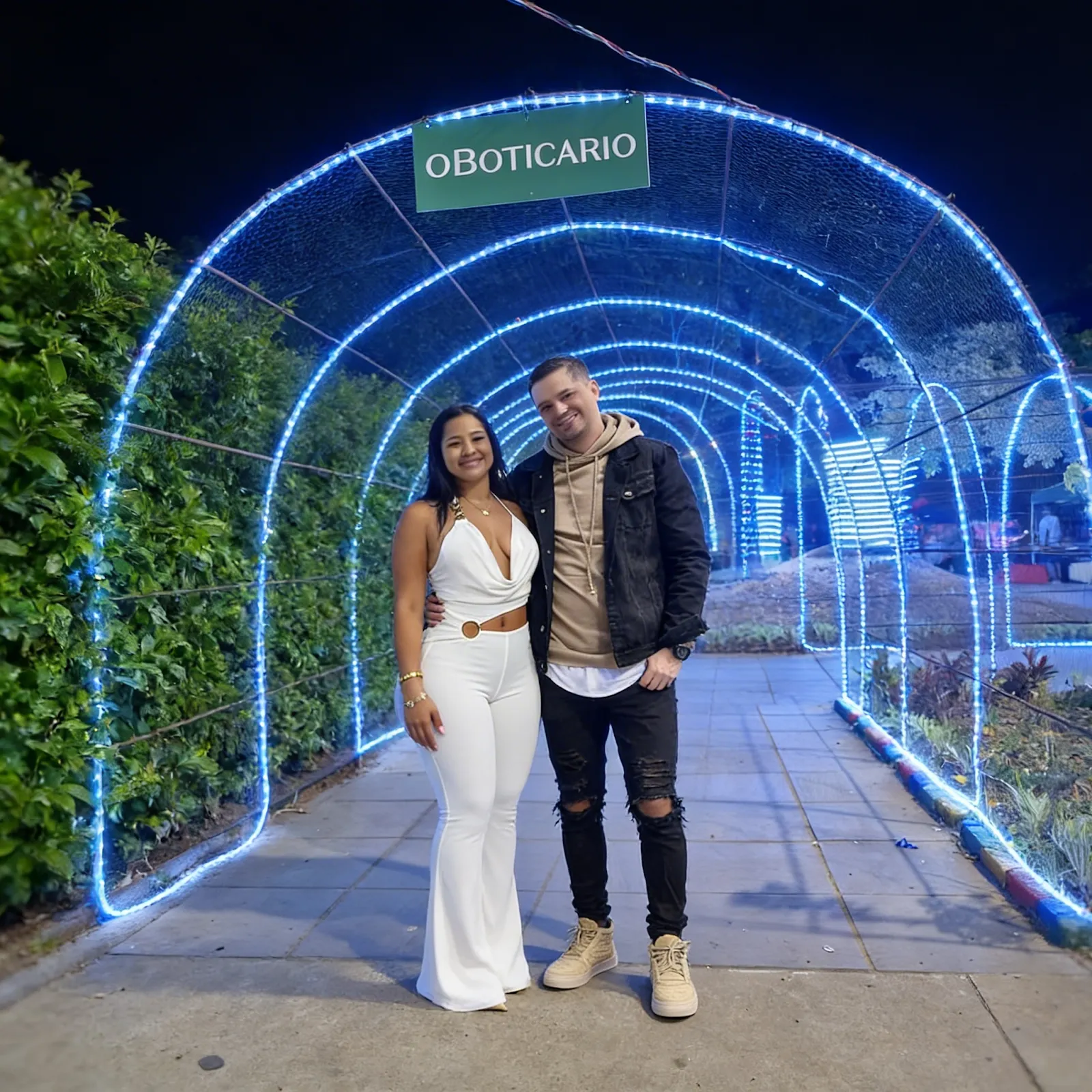
Seedream performed noticeably better on identity retention across the same workflow. The woman’s facial structure, smile geometry, and head tilt stayed anchored to the source image through multiple rounds. The man retained more of his original build and physical presence. Pose continuity between the two subjects was also better preserved—arm placement, proximity, and stance alignment remained consistent, which matters for anything that needs to feel like the same scene rather than a new one. Small tells were present, though, in mild skin smoothing, slight waist reshaping, and overall quality degradation in the subjects.
But the couple remained recognizably the couple. For a campaign workflow where the same people need to appear across multiple creative outputs, that difference is not minor. Outpainting and canvas extension The outpainting test had both models extend a modern minimalist living room image to 16:9, expanding the scene naturally to the left and right while maintaining lighting consistency and spatial logic. The prompt specified white walls, a beige sofa, a wooden coffee table, and indoor plants—a straightforward brief with clear architectural parameters. Nano:


Nano Banana 2 produced clean, seamless results with no visible stitching artifacts or tonal banding at the original crop boundaries. Wall color, daylight balance, and floor material all remained consistent across the extension. The lighting direction from the implied window source continued plausibly into the expanded frame. Technically, the blend was near-flawless. But the model introduced a few elements that were not part of the scene, such as a basket on the right and a building in the background. That said, it is very impressive when compared to previous models.
Seedream:

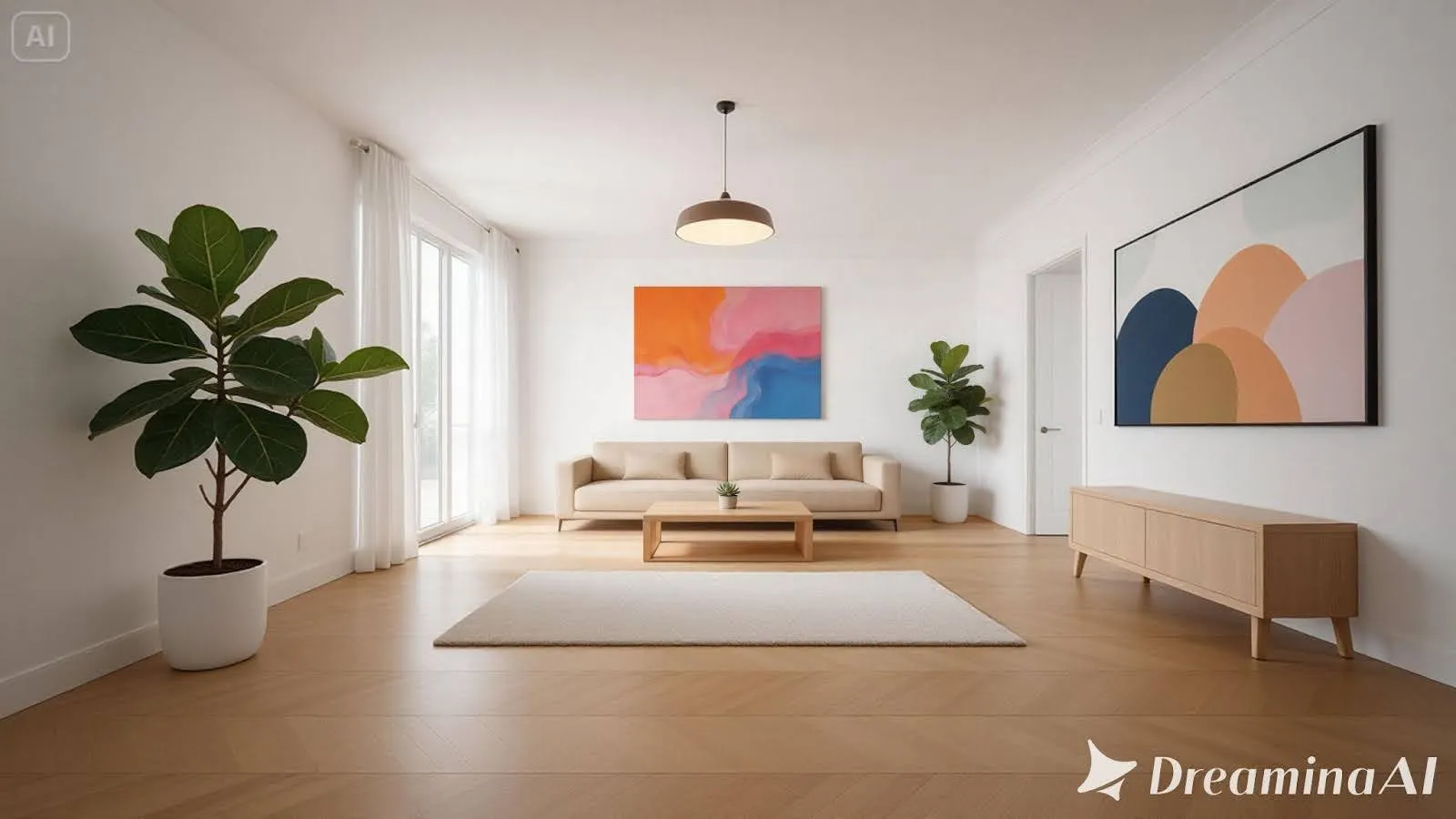
Seedream was more basic in the original output, which made the edits easier. The expanded left side introduced a second large potted plant and full curtain flow that felt spatially justified relative to the implied window source. The right extended into a secondary wall, framed art, and a low wooden console, maintaining the minimalist material language throughout—light wood, soft neutrals, nothing that contradicted the original’s aesthetic rules. Lighting remained directionally coherent across the full extended frame. Ceiling plane, pendant light placement, and floor herringbone pattern all maintained logical alignment. The room felt like a believable wider frame rather than a recomposed concept. We didn’t spot any noticeable artifact or bug. For production contexts where spatial fidelity and architectural honesty matter, Seedream 5 Lite is the more reliable tool here. If realism matters more than fidelity, Nano Bana 2 can be the better option. Non-realistic image generation: YouTube thumbnail test This test moved from editing and extension into pure generative territory with a high-specificity brief: a YouTube thumbnail reading “AI IMAGE WAR” with a subtitle naming both models, a split-screen layout with large bold title text on the left, contrasting high-energy colors, and 16:9 framing.
Thumbnail generation requires accurate typography, deliberate compositional hierarchy, and immediate visual energy—all at once. Nano:
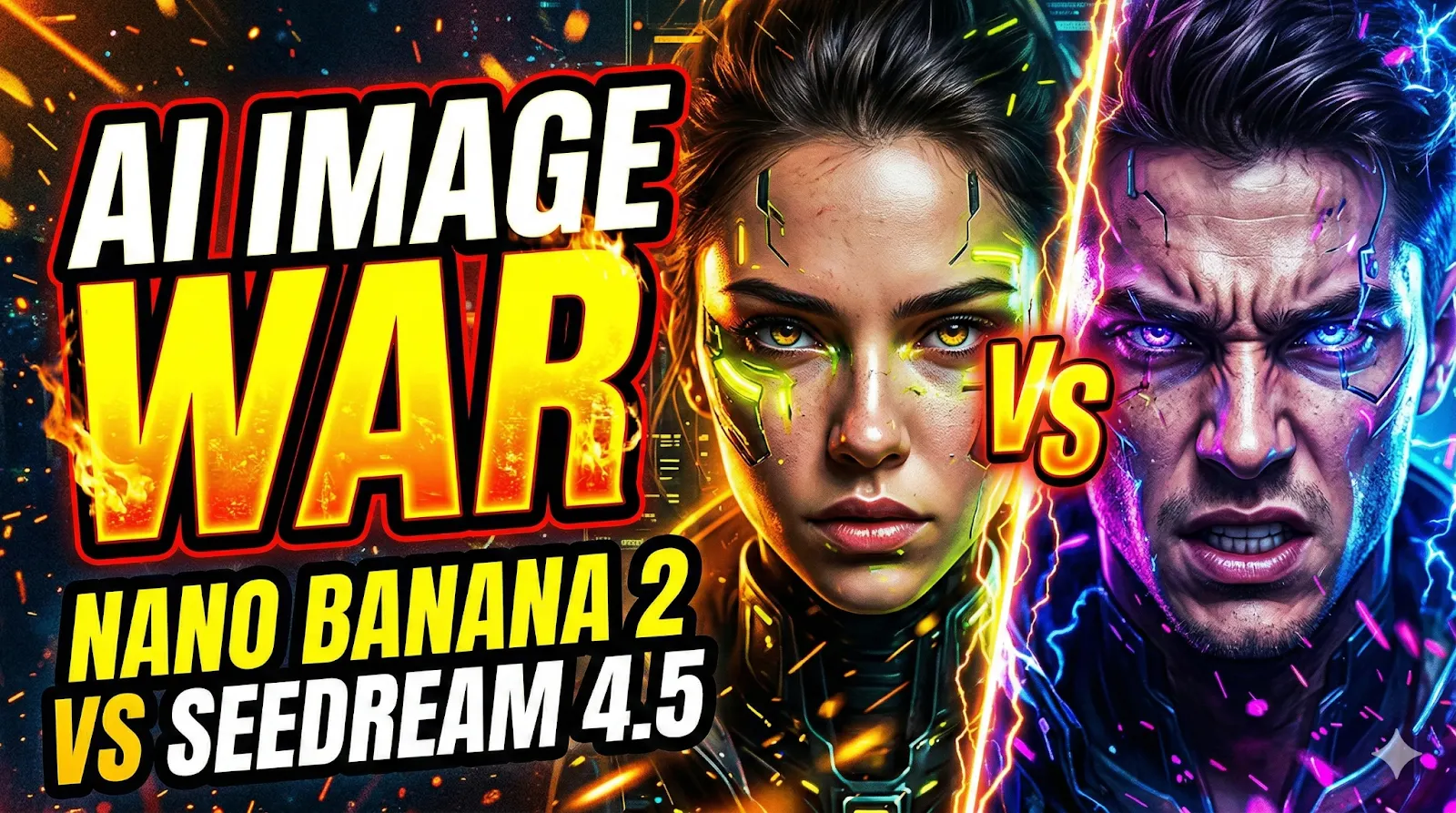
Nano understood thumbnail grammar perfectly. It produced a composition with oversized high-contrast typography on the left, a dramatic split-screen face-off on the right, saturated neon color clash between warm orange and electric blue, and a central lightning divider reinforcing the versus dynamic. The title hierarchy was clean—“AI IMAGE WAR” dominated visually with stroke outlines and glow effects that hold at small mobile screen sizes. Text rendering was accurate, with no spelling distortion, no garbled characters, and consistent kerning throughout. The faces were hyper-detailed and emotionally intense. The visual energy was high. It looked exactly like a thumbnail designed to get clicked.
Seedream:
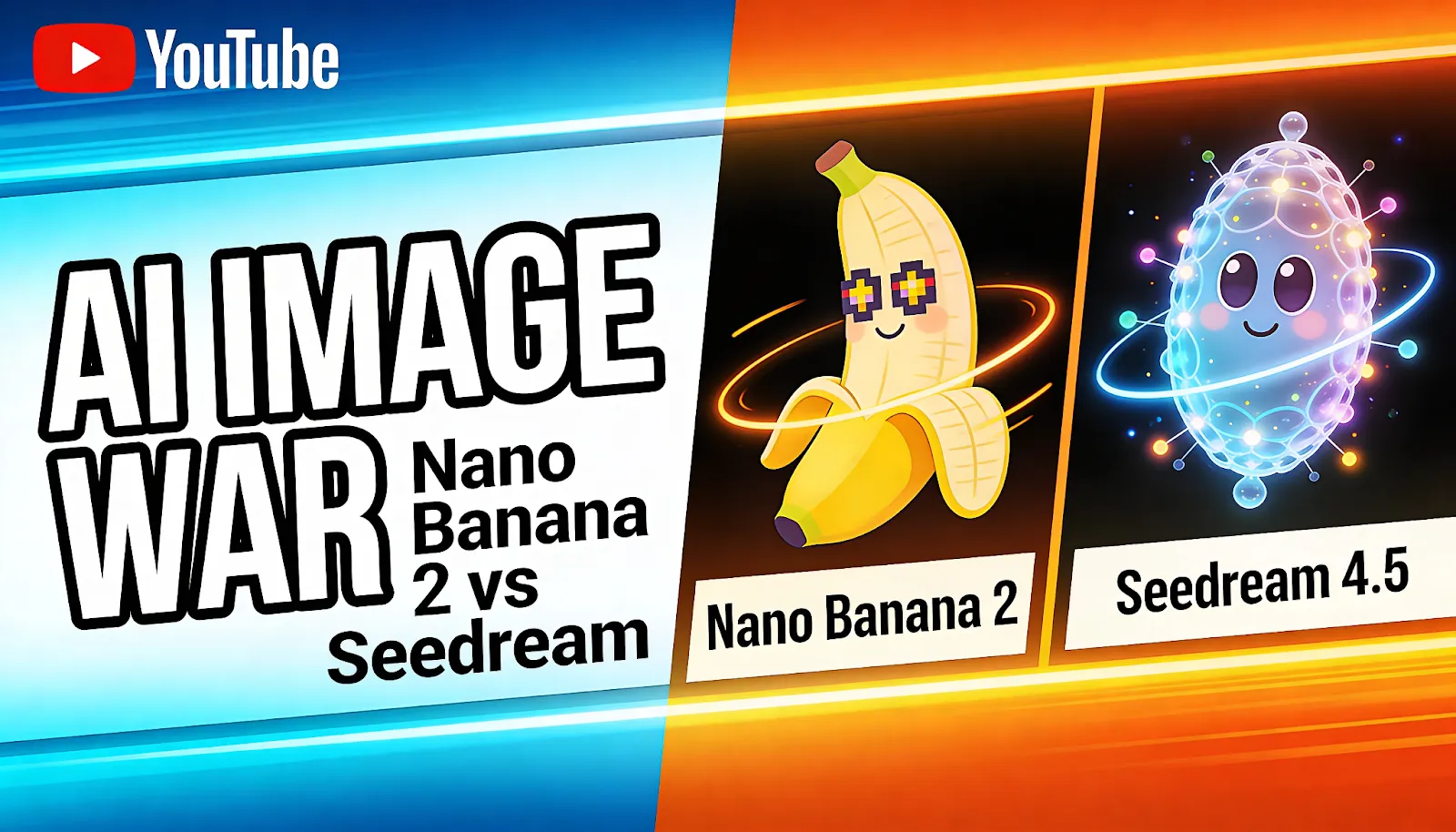
Seedream a different approach. Instead of photorealistic dramatic faces, it generated stylized mascots—a banana character and a glowing neural orb—to represent each model, giving the comparison a more graphic, iconographic feel. The layout was cleaner and well-structured, with the title dominant, the subtitle clearly legible, and each model name boxed for instant scanning. Typography was strong: clean stroke weight, readable at scale, no major artifacts. Where Nano Banana leaned into spectacle and emotional intensity, Seedream produced something less explosive, more differentiated, and scalable as a recurring visual identity. This may be a style choice, but in our subjective opinion, for aggressive viral CTR optimization, Nano Banana 2’s cinematic intensity has the edge. Realistic image generation: Multi-constraint accuracy The final test measured how precisely each model followed a detailed, multi-element prompt without violating or misinterpreting any constraints. The brief: a cinematic portrait of a 32-year-old female architect on a rooftop at sunset, wearing a beige trench coat and round glasses, holding rolled blueprints in her left hand specifically, with the city skyline slightly out of focus in the background, golden hour lighting with a soft rim light, shallow depth of field simulating a 50mm lens, vertical 4:5 aspect ratio, realistic skin texture, and subtle film grain. Every element in that list is a constraint that can fail independently.
Nano:
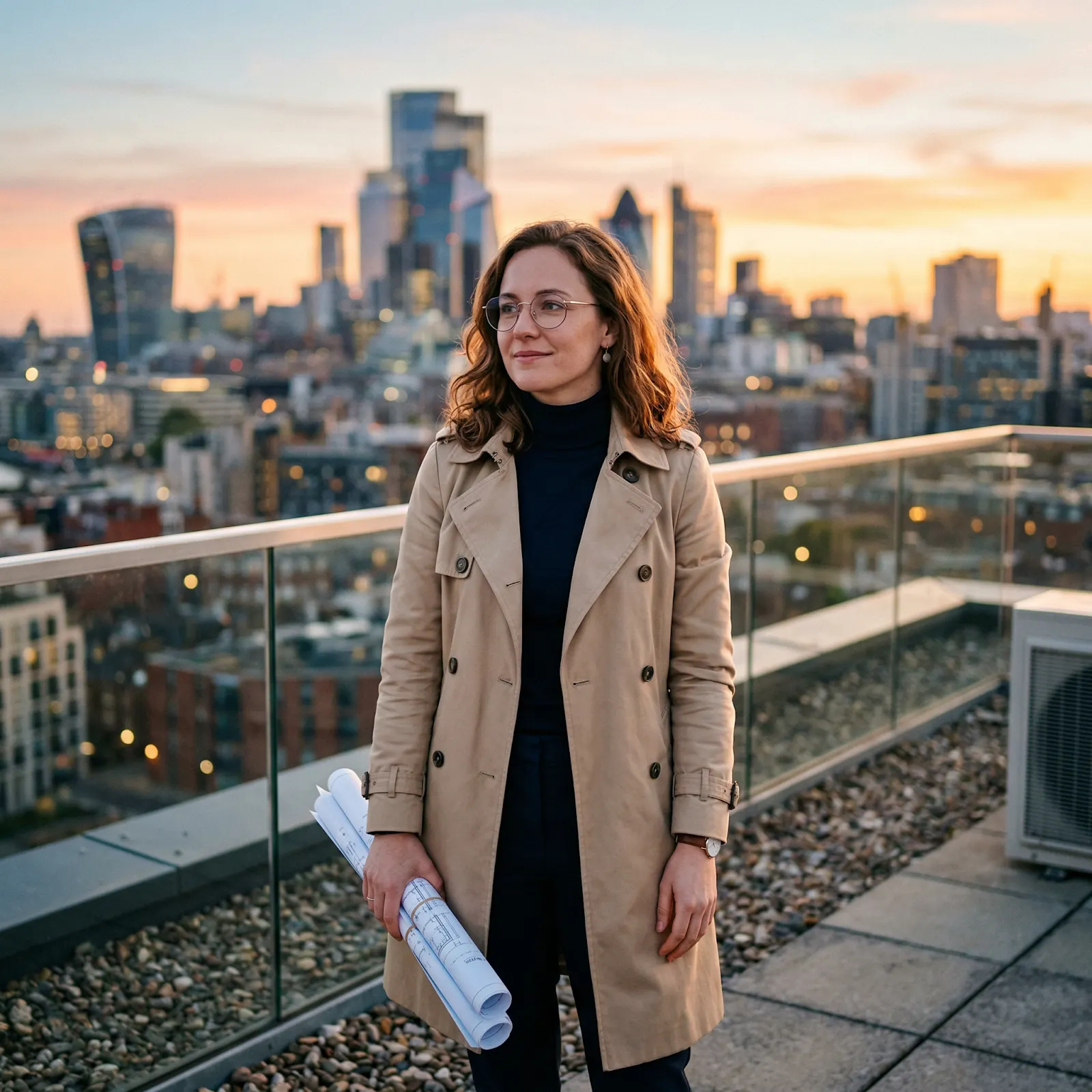
Nano generated a Caucasian woman looking away from the camera—a narrative choice not specified in the prompt, which hinted at a bias toward creative interpretation over strict adherence to constraints. The beige trench coat, round glasses, and rolled blueprints in the left hand were all correctly rendered. The rooftop and blurred skyline were present and spatially convincing. Golden-hour lighting was present, but it ran slightly cool compared to the warm tones the prompt called for. The rim light was understated rather than clearly defined. The depth of field was well executed, but the spatial compression felt closer to a 35mm to 40mm simulation than a true 50mm. Film grain was minimal to the point of being imperceptible. Skin texture was realistic but carried the mild smoothing bias common to beauty-trained diffusion systems. Solid execution overall, with a few quiet substitutions where the model made its own choices. Seedream:

Seedream generated an Asian woman facing the camera directly—a neutral default for a prompt that didn’t specify gaze direction. All specified elements were present and correctly implemented. The golden-hour warmth was more physically present (probably even exaggerated), with a clearly defined rim light separating the subject from the background, matching the prompt’s intent. Depth-of-field execution and focal compression more closely resembled an actual 50mm simulation, with natural subject-to-background proportions. Skin texture was accurate with better micro-contrast retention and fewer smoothing artifacts than Nano Banana’s output. That said, one of the blueprints was incorrectly generated and seemed more like an artifact than a proper element in the generation. Compositionally, Seedream’s result was more centered and technically precise, with fewer interpretive additions, but Nano Banana generated a more realistic image. A consistency bug you may want to consider Across extended API sessions involving a high volume of sequential generations, both models showed degradation that wasn’t present at the start of the workflow. Seedream began producing blurry, indistinct faces on subjects that had been rendered sharply in earlier generations. Nano started losing subject identity altogether, generating characters that bore no consistent relationship to the subjects established at the beginning of the session. Both models seemed to reduce their reasoning depth as the session length increased—as if they were spending less effort on each generation, the more they had already done.
Whether this is a deliberate computational throttle, a load-balancing behavior under heavy API traffic, or something in the architecture isn’t clear from the outside. But it’s consistent enough to plan around in any production pipeline that runs long generation chains. Both models perform best at the start of a session. Both degrade with sustained volume. Ideally, instead of doing consecutive iterations, ask the model for a reasonable number of edits in one single iteration to avoid degradation. But it’s an art. Too many edits in one round lead to poor prompt adherence; too few result in the need for consecutive iterations, which degrade subject consistency. Conclusion: Who wins? Nano wins on text rendering, raw generation speed, ecosystem integration, and generation energy. The text accuracy is its most unambiguous advantage—no garbled characters, no inconsistent fonts, no repeated text. It generates fast. It works across products that billions of people already use. And its world-knowledge integration, where the model searches the web before deciding what to render, produces outputs that feel editorially grounded rather than generically aesthetic. If your workflow lives inside Google’s ecosystem, if text accuracy within images is non-negotiable, or if you need fast iteration without working with real people, Nano is the stronger tool for those specific conditions. Seedream wins on cost, platform design, content flexibility, structural discipline in spatial tasks, and character retention across multi-step editing.
The flat $0.035 pricing makes it the practical default for any pipeline generating images at volume. Dreamina’s purpose-built interface is more coherent for sustained creative sessions than Gemini’s chatbot wrapper. The permissive content policy opens up use cases Google won’t engage with. And for workflows that require maintaining consistent identity across multiple iterations of real subjects—the core demand of campaign work—Seedream held up better in every test we ran.