Bittensor (TAO) is currently priced at $275, with a market cap of $2.6 billion. However, the core subnet Chutes’ subsidy income ratio reaches as high as 22:1 to 40:1. Removing subsidies, the cost exceeds centralized solutions by over 1.6 times. Its valuation multiple of 175–400 times far surpasses industry standards, with the market trading on scarcity narratives rather than real fundamentals. This article is based on Pine Analytics’s piece “The Bear Case for Bittensor (TAO),” edited, translated, and organized by Dongqu.
(Background: Balancer founder announced “dissolving the team but retaining the protocol,” after DeFi hack, TVL remains at $158 million, later taken over by DAO)
(Additional context: What is Terafab? Elon Musk calls for 2% global chip shortage demand; how to build a factory bigger than TSMC?)
TAO is currently about $275, with a market cap of $2.6 billion and a fully diluted valuation of $5.8 billion. The project is backed by Grayscale (application for NYSE ETF listing submitted in December 2025) and publicly endorsed by NVIDIA CEO Jensen Huang. Its token supply narrative is highly attractive: max supply of 21 million, with Bitcoin-style halving mechanism. After the first halving in December 2025, daily issuance drops from 7,200 to 3,600. Within a year, subnet count increases from 32 to 128. Templar’s Covenant-72B training also proves that decentralized compute power can run large language models with baseline competitiveness.
This report does not deny these facts. We explore whether the network’s economic model can generate genuine external revenue supporting its current valuation, and how competitive it is against centralized service providers and self-hosted compute.
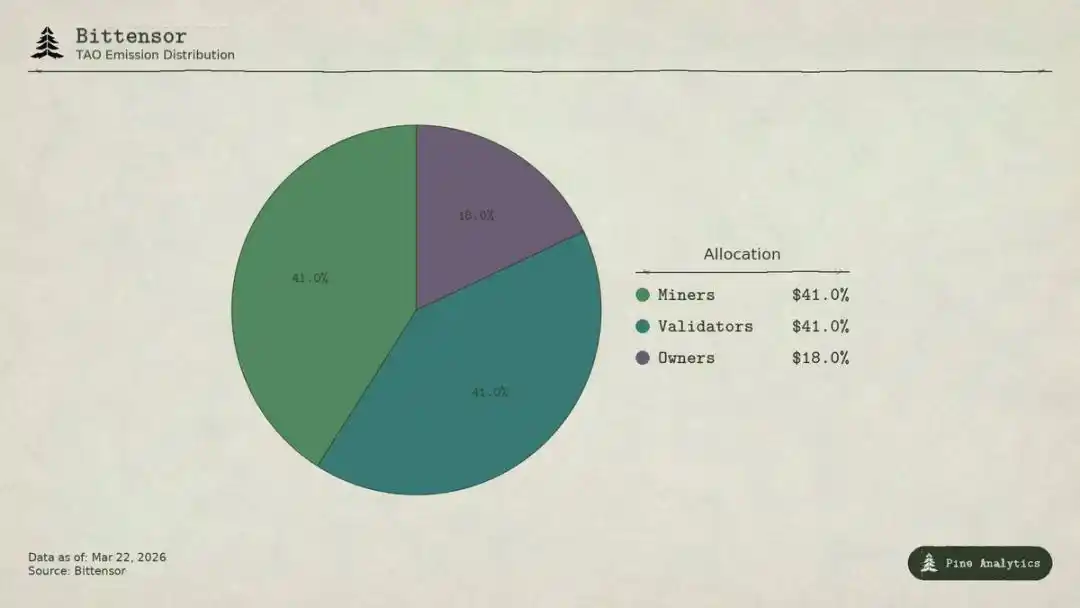
Bittensor (TAO) Token Distribution
Bittensor involves four participant groups:
· Subnet owners build specialized AI markets, earning 18% of TAO issuance rewards;
· Miners perform AI tasks (inference, training, data processing), earning 41%, approximately 1,476 TAO daily, valued at about $148 million annually;
· Validators score miner outputs, earning 41%;
· Stakers lock TAO into subnet liquidity pools in exchange for subnet-specific tokens.
Under the Taoflow model, a subnet’s reward share is determined by net TAO staking inflow; if net inflow is negative, no rewards are issued. The top ten subnets control about 56% of the total issuance.
TAO is a universal network token: used for miner registration, validator staking, subnet token purchases, and service payments. In theory, subnet activity creates structural demand for the underlying token.
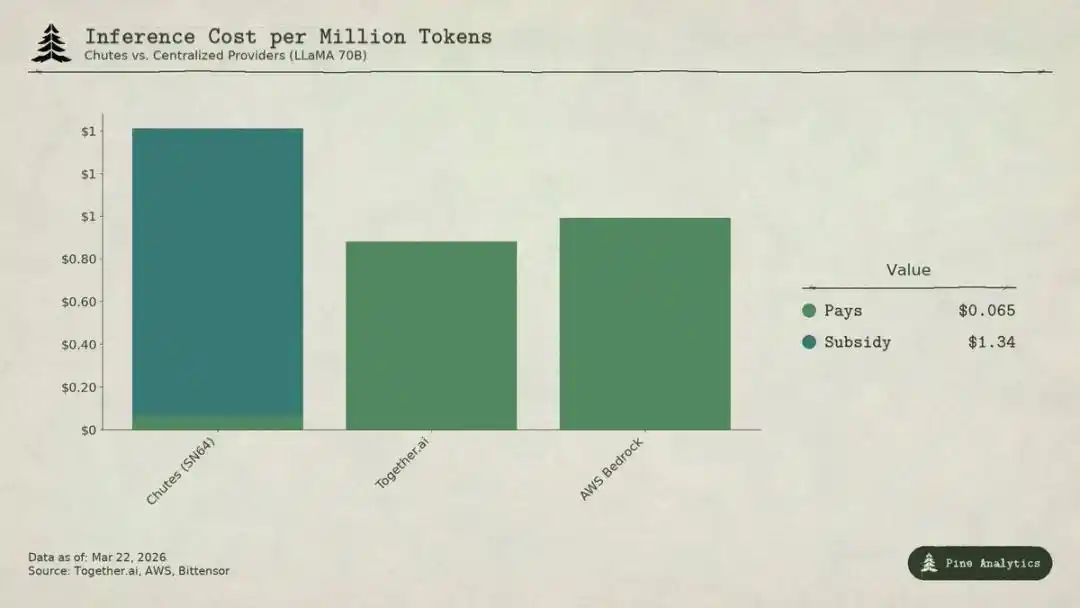
Comparative Analysis of Bittensor Subnet Chutes (SN64) and Centralized Service Providers’ LLaMA 70B Inference Costs
Supply side transparency is high: 3,600 TAO distributed daily via programmed halving, with hardcoded rules, staking rate (~70%), allocation ratios, and on-chain data all visible.
Demand side transparency is absent. No unified dashboard tracks external income per subnet; actual AI service calls (inference, computation, training) occur off-chain and are not recorded on the blockchain. Investors can only infer demand indirectly through staking flows, subnet token prices, and self-reported data. This opacity is structural, not temporary. Blockchain only records token transfers, not API calls.
As of March 2026, the most complete demand picture:
Chutes accounts for 14.4% of total issuance, the highest among all subnets. Developed by Rayon Labs, it offers open-source model serverless inference at prices 85% lower than AWS and 10–50% lower than Together AI. Its usage data is dominant: over 400,000 users (including 100,000 API users), over 5 million requests daily, processing 9.1 trillion tokens, with token generation rising from 6.6 billion to 101 billion in three days. It is also a leading inference provider on OpenRouter, with some models outperforming centralized competitors.
However, this low price is driven by subsidies, not operational efficiency.
Based on a 14.4% share, Chutes earns about 518 TAO daily, roughly $5.2 million annually. Its external annual revenue is only about $1.3–2.4 million (higher estimate self-reported, not independently audited). The subsidy ratio for this subnet is approximately 22:1 to 40:1. For every dollar paid by users, the network must release 22–40 dollars’ worth of TAO via inflation to subsidize.
Excluding subsidies, based on its daily processing volume (~101 billion tokens), the cost is approximately $1.41 per million tokens. Current centralized market prices:
· Together.ai’s LLaMA 3.3 70B Turbo at about $0.88 per million tokens;
· DeepSeek V3 at $0.40–0.80;
· Smaller models as low as $0.18.
This means, without subsidies, Chutes would be priced 1.6–3.5 times higher than centralized solutions. The so-called 85% cost advantage is completely reversed; its low price is essentially paid by TAO holders through inflation, not a structural efficiency of decentralization.
When the next halving occurs (expected late 2026 or 2027), either prices double, miners exit, or the subsidy-revenue gap widens further.
Some compare this to early internet subsidies for customer acquisition, but Uber, DoorDash, AWS built switching costs: proprietary platforms, driver networks, enterprise ecosystems. Bittensor’s subnets have no barriers: open-source models, standardized interfaces, zero-cost switching for users. Once subsidies fade, no lock-in mechanisms can retain users.
Rayon Labs also operates SN56 and SN19, controlling about 23.7% of total issuance, with undisclosed external revenue. A single team nearly controls a quarter of the incentive distribution.
Targon (SN4), operated by Manifold Labs, is the highest-revenue subnet, offering confidential GPU compute services to enterprises, with estimated annual revenue of about $10.4 million, valuation around $48 million, and a market-to-sales ratio of approximately 4.6. It is the most solidly valued within the ecosystem. However, this $10.4 million is based on forecasts cited by multiple reports, not audited figures.
Templar (SN3) completed Covenant-72B training, with a market cap of $98 million, but zero external revenue. API training and enterprise sales are ongoing, with no paid products launched yet.
Over 120 other subnets either lack public revenue or are still in early product stages, mainly surviving on token issuance subsidies.
Total confirmed external demand-side annual revenue is only about $3–15 million. Chutes alone’s annual subsidy (~$52 million) exceeds the entire network’s external revenue upper bound.
Based on a $2.6 billion market cap, the revenue multiple is roughly 175–200x; at a fully diluted valuation of $5.8 billion, nearly 400x. In contrast, centralized AI compute companies’ recent valuations are only 15–25x forward revenue, and high-growth SaaS rarely maintains over 50x long-term. Bittensor’s valuation multiple is 4–10 times industry aggressive targets.
This huge gap between valuation and demand fundamentals indicates that TAO’s market pricing is almost entirely driven by supply-side scarcity (halving, staking lock-up), institutional catalysts (Grayscale ETF, exchange listing expectations), and AI sector sentiment, rather than real economic output. These are valid price drivers, but they are fundamentally separate from the idea of “Bittensor as a sustainable AI service network creating real value.”
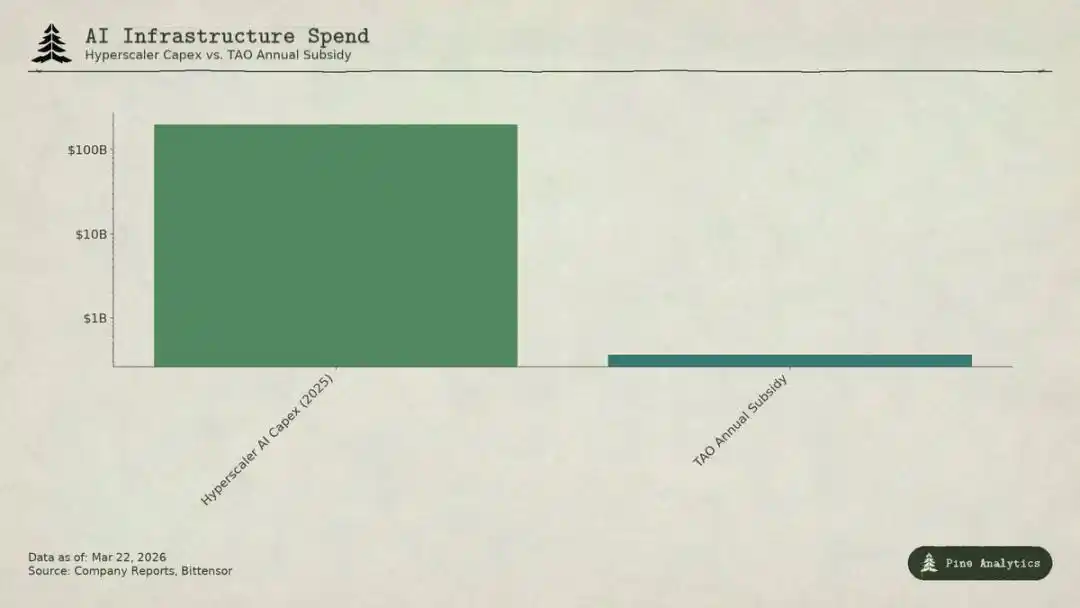
Comparing Large Cloud Provider AI Capital Expenditures and Bittensor (TAO) Annual Subsidy Scale
Subnet faces dual pressures:
· Top: Self-hosted cap limits
All models are open-source, weights public. Running a 70B model on a single H100 costs only $40–50 daily; tools like vLLM, Ollama make local deployment straightforward. NVIDIA’s new chips will further reduce inference costs. For high-volume users, building their own deployment is cheaper.
· Bottom: Cloud giants’ squeeze
Microsoft, Google, Amazon, Meta will spend over $200 billion on AI in 2025, with priority hardware quotas, dedicated data centers, enterprise relationships, and the ability to subsidize AI with other business cash flows. Bittensor’s annual incentive budget (~$360 million) is less than a week’s AI infrastructure investment by Microsoft. Professional service providers also subsidize low-cost open-source models with VC funding.
Subnet pricing is compressed into a narrow range, while incurring unique decentralization costs: token friction, validator node expenses, subnet owner shares, network latency.
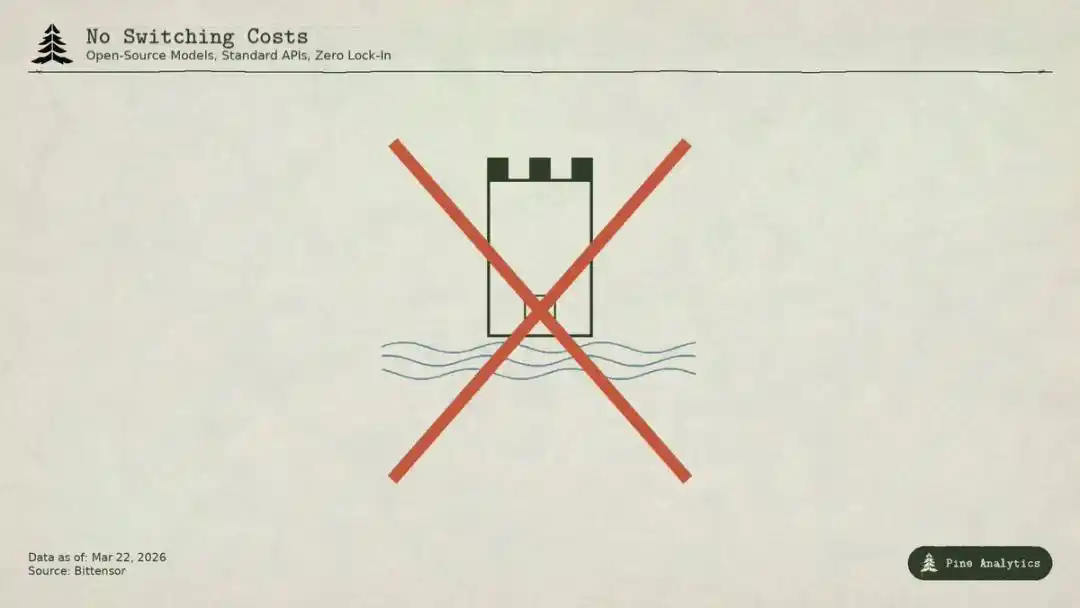
Even if a subnet offers valuable services, the underlying models and methods are inherently open: Covenant-72B uses Apache license, technical papers are public. Competitors can directly replicate without participating in TAO.
Traditional moats (proprietary tech, network effects, switching costs, branding) do not hold:
· Technology is open-source;
· Network effect belongs to TAO, not individual subnets;
· Model weights are identical, switching costs are zero.
Community believes the incentive mechanism is a moat, but it relies on continuous large token issuance, which shrinks with each halving.
At a $2.6 billion market cap, TAO’s price does not reflect demand fundamentals; $3–15 million annual revenue cannot support it under any traditional valuation framework. The market is trading on Bitcoin-like scarcity, Grayscale ETF expectations, AI sector rotations, and long-term options on decentralized AI. These are rational speculative factors, but driven entirely by supply and market sentiment.
If you hold TAO based on scarcity and narrative, you might profit even with weak demand; but if you believe Bittensor will become a truly scalable AI service network, there is no evidence and significant structural barriers. Investors should clearly distinguish their investment logic.