Author: HIBKI, Crypto City
BTQ Testnet Implements BIP 360 Technology
Bitcoin’s quantum defense measures are moving from whitepaper concepts to actual infrastructure.
Canadian blockchain company BTQ Technologies recently announced the complete deployment of Bitcoin Improvement Proposal 360 (BIP 360) in the Bitcoin Quantum Testnet v0.3.0 version.
Although BIP 360 is still in draft stage within the broader Bitcoin ecosystem and has not yet entered formal core developer review, BTQ has proactively turned it into a testable, real-time infrastructure for developers, miners, and researchers to evaluate quantum-resistant transactions in a practical environment.
According to BTQ Technologies, over 50 miners have joined, and more than 100,000 blocks have been mined using the testnet’s proprietary token BTQ. Additionally, an active open-source community has formed, with over 100 cryptographers, developers, and miners participating.
Why is BIP 360 Important?
To understand the significance of BIP 360, we must look back to the Taproot upgrade activated in 2021.
Taproot is a core foundation of Bitcoin’s scalability roadmap, supporting key innovations like the Lightning Network, BitVM, and Ark, and is widely regarded as a critical infrastructure for Bitcoin’s next-generation applications. However, Taproot’s key path spend mechanism has a potential risk: it could expose user public keys on-chain.
In a future with sufficiently powerful quantum computers, exposed public keys could be vulnerable to attacks using Shor’s Algorithm. Theoretically, attackers could reverse-engineer private keys from public keys, forge signatures, and steal funds.
BIP 360 proposes a solution by introducing a new output type called “Pay-to-Merkle-Root” (P2MR). P2MR is a hash tree structure that commits directly to the Merkle root of the script tree, no longer relying on internal keys or tweak operations, effectively cutting off the quantum-vulnerable path while preserving Taproot’s script functionality.
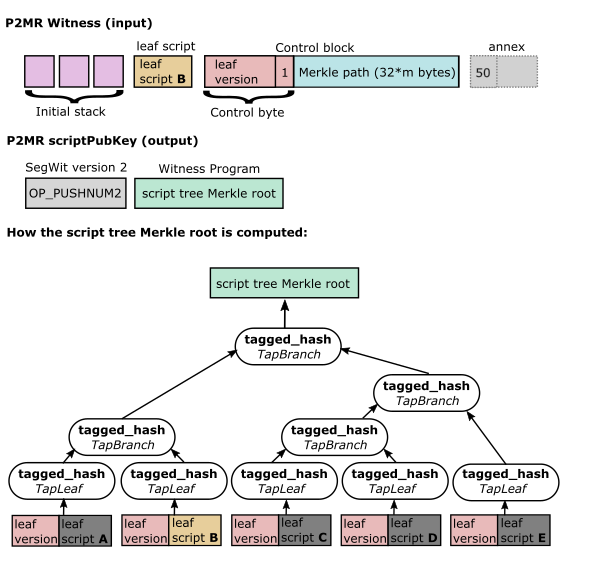
Image source: GitHub | BIP 360 P2MR Technical Explanation
Testnet v0.3.0: From Concept to Practical Infrastructure
According to BTQ’s technical documentation, this implementation of BIP 360 includes full P2MR consensus rules, using bc1z address format (bech32m encoding) for SegWit v2 outputs, and integrates Merkle root commitment verification and block validation mechanisms.
Notably, the testnet has enabled all five Dilithium post-quantum signature operations in the P2MR tapscript environment.
Dilithium is a post-quantum digital signature algorithm standardized by the U.S. National Institute of Standards and Technology (NIST). Its integration indicates that the testnet now possesses real quantum-resistant signature verification capabilities, not just conceptual demonstration.
In terms of tooling support, this release provides a complete command-line interface (CLI) wallet and full RPC support, allowing users to create, fund, sign, broadcast, and confirm P2MR transactions on the testnet, demonstrating end-to-end functionality.
Quantum Threats Are Real but Not Immediate
Currently, industry discussions about quantum threats are polarized: some are optimistic, believing the threat is decades away, while others warn of an impending “Q-Day” doomsday scenario.
Galaxy Digital research head Alex Thorn recently told CoinDesk that, while quantum threats to Bitcoin do exist, they currently only affect certain exposed wallets and do not pose an immediate risk to overall network security. The risk is real and acknowledged, and those best equipped to address it are actively working on solutions.
- Further Reading: Debunking the “Quantum Doomsday” Theory! CoinShares: Only “10,200 Bitcoins” Face Actual Risk
On the Bitcoin network, only funds with public keys exposed on-chain are vulnerable. Common scenarios include: users reusing addresses, some custodial services taking shortcuts, or funds stored in older address formats.
Security research firm Project Eleven estimates that about 7 million Bitcoins fall into this potential exposure category, but under current publicly known quantum computing capabilities, these funds remain secure.
Even with optimistic assumptions, only a very few highly specialized research institutions have the capacity to achieve breakthroughs in quantum computing in the foreseeable future.
How Far Can BIP 360 Go?
While BTQ’s testnet deployment is a milestone, making BIP 360 a true protective layer for Bitcoin still has a long way to go.
BIP 360 remains a draft proposal; whether it will enter the official Bitcoin Improvement Proposal review process and gain broad support from miners and core developers will be key indicators of its potential adoption.
The Bitcoin community has historically been cautious about protocol changes. Taproot itself took years from proposal to activation, and quantum-resistant upgrades involve complex cryptographic migrations, with governance challenges not to be underestimated.
For investors and practitioners, a pragmatic approach is to continue monitoring BIP 360’s development and consensus-building process within the community, rather than making premature judgments based solely on testnet deployment news.
Disclaimer: The information on this page may come from third parties and does not represent the views or opinions of Gate. The content displayed on this page is for reference only and does not constitute any financial, investment, or legal advice. Gate does not guarantee the accuracy or completeness of the information and shall not be liable for any losses arising from the use of this information. Virtual asset investments carry high risks and are subject to significant price volatility. You may lose all of your invested principal. Please fully understand the relevant risks and make prudent decisions based on your own financial situation and risk tolerance. For details, please refer to
Disclaimer.


