
UK, US, and Canada Launch “Operation Atlantic” to Combat $17 Billion Crypto Scams, Targeting Authorization Phishing and Pig Butchering, with Cross-Border Real-Time Fund Interception.
Three countries’ law enforcement agencies jointly launch “Operation Atlantic” to crack down on billion-dollar criminal networks
In response to the increasing prevalence of cross-border cryptocurrency scams, the US Secret Service (USSS), the UK National Crime Agency (NCA), and the Royal Canadian Mounted Police (RCMP) officially announced in March 2026 the launch of a joint law enforcement operation codenamed “Operation Atlantic.”
This operation primarily targets recent scams that have caused heavy losses to investors, such as “Approval Phishing” and the so-called “Pig Butchering” investment scams. Participating agencies include not only the core units mentioned above but also the Ontario Provincial Police (OPP), Ontario Securities Commission (OSC), London Metropolitan Police, UK Financial Conduct Authority (FCA), and the District of Columbia Attorney’s Office.
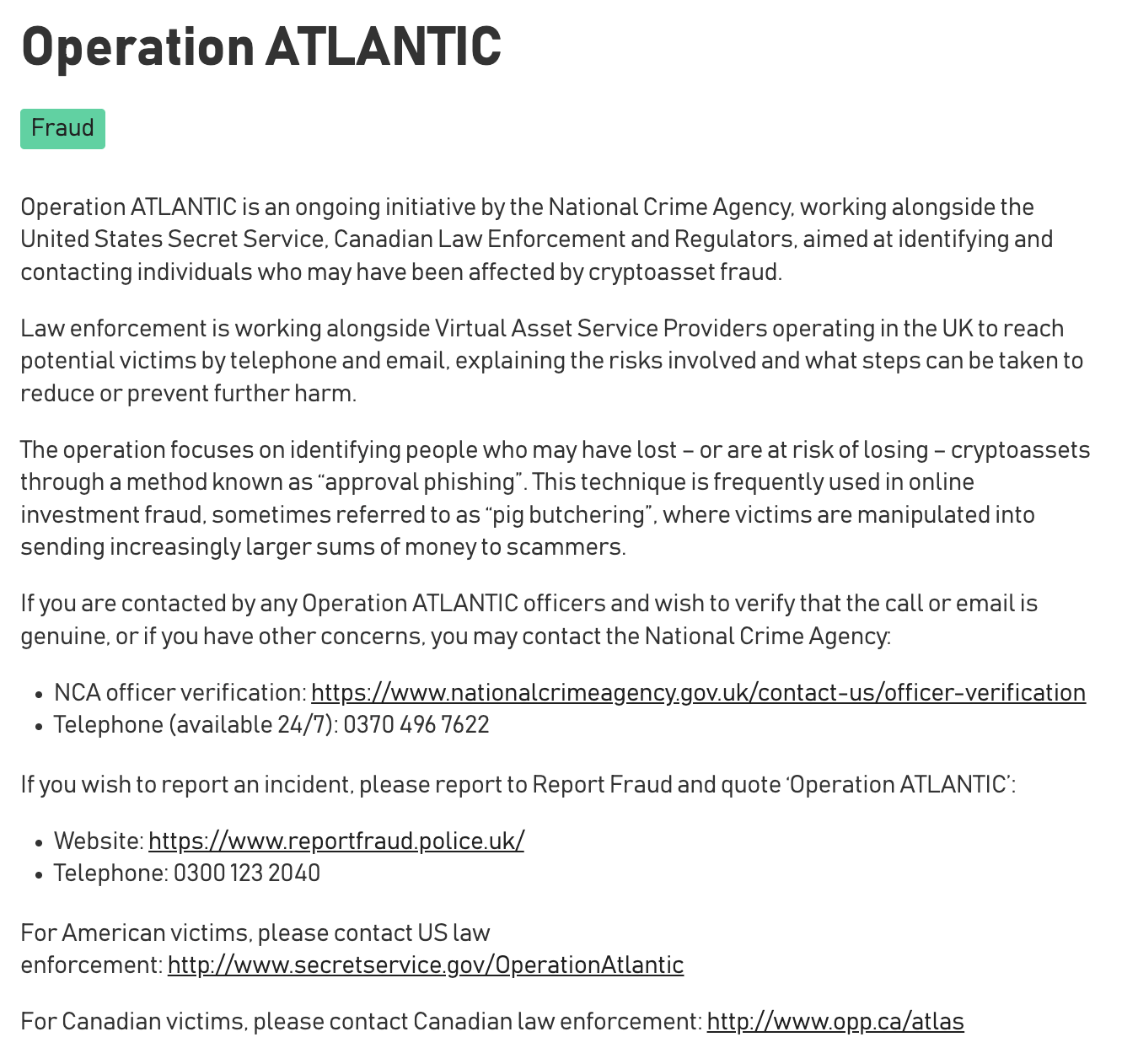
Image source: National Crime Agency International law enforcement agencies of the US, UK, and Canada launch joint operation codenamed “Operation Atlantic”
According to data disclosed by law enforcement, the goal of Operation Atlantic is to identify, intervene, and dismantle these highly organized criminal networks in real time. Blockchain analysis firm Chainalysis’s latest report indicates that cryptocurrency scams generated at least $14 billion in on-chain revenue in 2025. As more illicit wallets are identified, total losses for the year are expected to rise to $17 billion.
Law enforcement agencies from the US, UK, and Canada emphasize that criminals now often operate transnationally, living in Country A, using servers in Country B, and attacking victims in Country C. This cross-border guerrilla tactic makes it difficult for any single nation’s law enforcement to effectively combat these crimes alone. International cooperation, sharing digital investigative tools, and intelligence are essential to intercept funds before they are transferred out.
Breaking down “Approval Phishing” traps, industrialized Pig Butchering threats intensify
The core target of this operation is “Approval Phishing,” a method that bypasses traditional password theft by attacking user authorization mechanisms. Criminals often spend weeks or even months building deep trust with victims via social media or messaging apps, impersonating romantic interests or successful investment mentors.
Once trust is established, scammers induce victims to install malicious apps or click on links. During the process, victims see seemingly legitimate system prompts asking whether they “approve” transactions or verify accounts. When users click “accept,” they are actually signing a malicious contract that grants scammers unlimited permission to withdraw specific tokens from the wallet, leaving victims’ digital assets vulnerable to being drained at any time.
Law enforcement has observed that these scams are becoming increasingly industrialized. Criminal groups are leveraging AI-generated video and audio content to enhance persuasion and have developed “Phishing-as-a-Service” platforms, enabling lower-level criminals without technical skills to participate in profit-sharing.
For example, the “Smishing Triad” (also known as Darcula), uncovered at the end of 2025, sold scam kits and made illegal profits exceeding $1.5 million over three years. Data shows that the largest single theft in 2025 reached $6.5 million, involving mainstream assets like $stETH. Seniors over 60 are the primary targets, bearing the heaviest financial losses.
Building on the successful “Atlas” experience, cross-border law enforcement surpasses geopolitical friction
Operation Atlantic is not created out of thin air; its operational model draws heavily from Canada’s 2024 “Project Atlas.” This initiative achieved milestone results in combating global crypto scams, identifying over 2,000 victim wallet addresses across 14 countries, successfully preventing approximately $70 million in potential scams, and freezing $24 million of stolen digital assets.
Brent Daniels, Deputy Assistant Director of the US Secret Service, stated that Operation Atlantic will continue this real-time collaboration model, using technical interventions to directly cut off criminals’ profit channels.
It is noteworthy that despite current turbulence in the Middle East and the Strait of Hormuz blockade affecting global trade and shipping insurance, the US, UK, and Canada, despite some disagreements on commercial issues, demonstrate high consensus and cooperation in fighting transnational financial crimes.
This partnership extends beyond government agencies; law enforcement also maintains close ties with tech companies, cryptocurrency exchanges, and private sector partners. By sharing databases of malicious domains and abnormal transaction patterns, investigators can issue early warnings to potential victims and even block attacks before assets are lost.
Enhancing Public Defense, Police-Citizen Cooperation to Intercept Funds in Real Time
In the execution of Operation Atlantic, law enforcement invests heavily in “proactive outreach.” Referring to FBI’s past “Operation Level Up,” where 77% of victims were unaware they had fallen into scams or authorized strangers before police notifications, efforts include dedicated hotlines and verification websites. These allow the public to confirm the authenticity of law enforcement alerts immediately, preventing scammers from impersonating police for secondary fraud.
“Crypto City” reminds citizens that the best way to protect assets is to establish proper on-chain security habits.
- Always double-check URLs and specific authorization contracts before approving any wallet transactions, and enable multi-factor authentication (MFA) on exchange accounts.
- Regularly review and revoke unnecessary or expired permissions using tools like Revoke.cash or Etherscan’s contract management features.
Since blockchain transactions are permanent and irreversible, once assets leave control, recovery is lengthy and uncertain. The launch of Operation Atlantic signifies a more proactive phase in global law enforcement’s efforts to safeguard digital assets.
Disclaimer: The information on this page may come from third parties and does not represent the views or opinions of Gate. The content displayed on this page is for reference only and does not constitute any financial, investment, or legal advice. Gate does not guarantee the accuracy or completeness of the information and shall not be liable for any losses arising from the use of this information. Virtual asset investments carry high risks and are subject to significant price volatility. You may lose all of your invested principal. Please fully understand the relevant risks and make prudent decisions based on your own financial situation and risk tolerance. For details, please refer to
Disclaimer.


