Vitalik Buterin recently proposed positioning Ethereum as part of a “sanctuary technology” ecosystem. The FOCIL (Fork-Choice Enforced Inclusion List), encrypted mempool, and ePBS form the “Censorship-Resistant Trinity,” which systematically eliminates transaction censorship risks at the protocol layer. This article is adapted from imToken’s piece “Vitalik’s ‘Sanctuary Technology’ Declaration: How Ethereum Is Writing Censorship Resistance into the Protocol,” edited and translated by Dongqu.
(Background: The International Energy Agency plans to release the “largest-ever” oil reserves—over 180 million barrels—to counter Houthi blockades and suppress oil prices.)
(Additional context: Bitcoin holds at $68,230, Ethereum maintains around $2,000, and BlackRock calls gold: safe-haven demand is far from over.)
Table of Contents
Toggle
- FOCIL: Embedding Censorship Resistance into Fork Choice Rules
- Encrypted Mempool: Making Sandwich Attacks Impossible
- The Ultimate Test for Sanctuary Technologies
What if one day all core Ethereum developers step down, or a government orders the blocking of certain transactions? Would Ethereum still hold up?
These scenarios may sound extreme, but they are increasingly unavoidable considerations in Ethereum protocol design.
In early March, Vitalik Buterin introduced a new framing: the Ethereum community should see itself as part of a “sanctuary technology” ecosystem—free, open-source tools that enable people to live, work, communicate, manage risks, and build assets, while maximizing resilience against external interference.

At first glance, this may seem like an abstract value upgrade. However, compared to Ethereum’s recent protocol evolution, it points to very concrete engineering challenges:
As block production becomes more professionalized, the power to order transactions concentrates, and the public mempool often becomes a battleground for front-running and sandwich attacks. How can Ethereum uphold its fundamental principle of an “open network”—that every user’s transaction should not be arbitrarily blocked by a few nodes?
Vitalik’s stance is candid. He no longer uses grand narratives like “changing the world,” but admits that Ethereum’s real-life improvements for ordinary people remain limited—on-chain financial efficiency has improved, and the ecosystem is more diverse, but much of the progress remains within the crypto bubble.
Therefore, he proposes a new perspective: instead of limiting Ethereum to a financial network, incorporate it into a broader “sanctuary technology” ecosystem. According to his definition, these technologies share several traits: open-source and free, accessible and replicable by anyone; helping people communicate, collaborate, manage risks and assets; and most importantly, capable of operating continuously even under government pressure, corporate bans, or other external interventions.
Vitalik offers a vivid analogy—truly decentralized protocols should be more like “a hammer” rather than a subscription service. Once you buy a hammer, it’s yours; it won’t become unusable if the manufacturer goes bankrupt, nor will it suddenly display a message saying “This feature is unavailable in your region.”
Ultimately, to be a genuine sanctuary tool, this technology cannot depend on any single centralized entity’s existence, nor should users always be passive recipients of service.
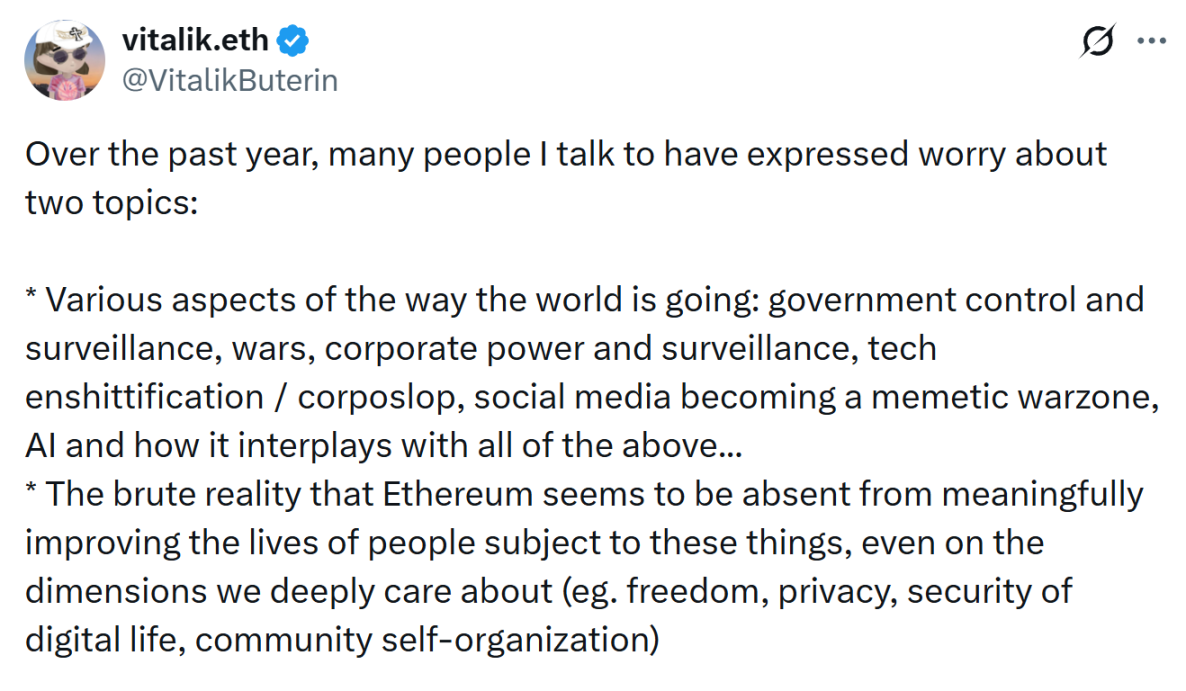
Image source: CoinDesk
This naturally recalls Vitalik’s repeated mention of an ultimate test— the “Walkaway Test.” Its core question is straightforward: if all Ethereum core developers disappeared tomorrow, would the entire protocol still operate normally?
This is not just a slogan but a strict standard—it asks not whether the system is decentralized now, but whether it can withstand the worst-case scenario.
Applied to block production, the answer becomes concrete: for a chain to pass the Walkaway Test, transaction inclusion rights cannot be concentrated in a few hands long-term, and the public transaction flow should not be inherently vulnerable to front-running, sandwich attacks, or censorship.
This is the context behind the prioritization of FOCIL and encrypted mempool solutions in Ethereum’s core agenda.
FOCIL: Embedding Censorship Resistance into Fork Choice Rules
To understand why FOCIL is important, we must first clarify the current dilemma faced by Ethereum’s public mempool.
In recent years, Ethereum block building has become highly specialized. To improve efficiency and MEV extraction, the role of builders has grown, and block production has diverged from the ideal of “each validator building locally.” While this has practical benefits, it also comes with clear costs:
If block building rights tilt toward a few large players, censorship becomes a real risk—not just a theoretical concern. Major builders can selectively exclude certain transactions—for example, transfers from sanctioned Tornado Cash addresses.
In other words, Ethereum’s current challenge is no longer just about high fees or throughput but whether the underlying transaction infrastructure remains trustworthy for ordinary users.
FOCIL (Fork-Choice Enforced Inclusion Lists) directly addresses this censorship issue at the protocol level. Its core idea is simple: by introducing an Inclusion List mechanism, whether a transaction can be included in a block is no longer solely decided by proposers or builders.
Specifically, each slot selects an Inclusion List Committee from validators. Committee members, based on their view of the mempool, form a list of transactions to include and broadcast it; the next slot’s proposer must build a block that complies with this list, and attesters will vote only for blocks that meet these criteria.
In other words, FOCIL does not aim to eliminate builders but uses fork choice rules to strengthen guarantees that valid transactions in the mempool are included—builders can still optimize ordering and MEV, but they lose unilateral power to decide whether a transaction is valid and can enter the block.
Despite ongoing debate, FOCIL has been confirmed as part of the core proposal for the next major upgrade, Hegotá, now in the Specification Freeze Included phase, expected to go live after the Glamsterdam upgrade in late 2026.

Encrypted Mempool: Making Sandwich Attacks Impossible
However, FOCIL does not address another equally important issue: before transactions are included in blocks, are they fully visible to the market? MEV searchers can front-run, sandwich, or reorder transactions based on this information—DeFi transactions are especially vulnerable. Even if transactions are not censored, they can be precisely targeted for extraction before inclusion.
This is the root of sandwich attacks.
Current community solutions focus on two main approaches: one is LUCID (proposed by Ethereum Foundation researchers Anders Elowsson, Julian Ma, and Justin Florentine), and the other is EIP-8105 (Universal Enshrined Encrypted Mempool). The EIP-8105 team recently announced full support for LUCID, and both are working together.
The core idea of encrypted mempool is to keep transactions encrypted before inclusion, preventing searchers from inspecting their content. As researchers state, the combination of ePBS (Execution Layer Proposer-Builder Separation), FOCIL, and encrypted mempool forms the “Holy Trinity of Censorship Resistance,” building systemic defenses across the transaction supply chain.
So far, FOCIL has been confirmed for Hegotá, and the encrypted mempool proposal LUCID is actively vying to be included in the same upgrade.
The Ultimate Test for Sanctuary Technologies
From a broader perspective, FOCIL and encrypted mempool are not just new items on Ethereum’s upgrade roadmap—they send a deeper signal: Ethereum is re-centering “censorship resistance” at the core of protocol design.
While the blockchain industry often touts “decentralization,” users only realize its importance when a transaction is censored, blocked, or disappears from the network. It becomes clear that decentralization is not a default but a result fought for line by line in code.
Notably, Vitalik pointed out as early as February 20 that there is a key synergy between FOCIL and EIP-8141 (based on EIP-7701), which proposes elevating smart accounts (multi-sig, post-quantum signatures, key rotation, gas sponsorship, etc.) to “second-class citizens”—operations from these accounts can be directly packaged as on-chain transactions without additional wrapping.

In response to concerns that FOCIL increases protocol complexity and encrypted mempool might sacrifice efficiency, the deeper question is whether the value of “sanctuary technology” justifies these costs. The answer may lie in the core value of blockchain: not just asset tokenization or transaction speed, but whether it can provide a permissionless, resilient digital escape hatch—especially under high-pressure environments.
Viewed from this angle, the significance of FOCIL and encrypted mempool becomes clear: they aim to harden protocol rules that previously relied on good faith, market self-regulation, and hope that “nothing will go wrong.”
Only when countless users can freely live, work, communicate, manage risks, and build wealth on this “digital safe island” without fear of eviction or censorship by centralized entities—only then does Ethereum truly pass the Walkaway Test.
That, ultimately, is the meaning of sanctuary technology.